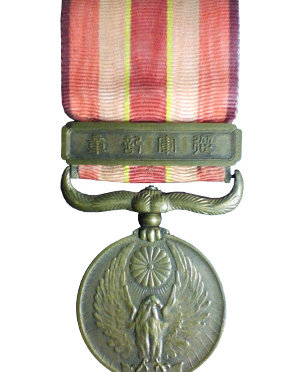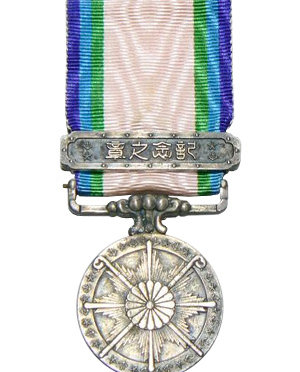
The 1941-45 Great East Asia War Medal

The 1941-45 Great East Asia War Medal (Daitōa sensō jūgun kishō) is a Japanese medal established on June 21, 1944 by Imperial Edict No. 417.

  • Time Period: WW2
  • Institution: 7 December 1944
  • Country: Medals from Japan Japan

The 1941-45 Great East Asia War Medal (or 大東亜戦争従軍記章Daitōa sensō jūgun kishō in Japanese) was a Japanese medal established on June 21, 1944 by Imperial Edict No. 417.

It’s not clear to whom this medal would have been awarded, but it was likely designed to become a common medal
like the China Incident War Medal. After the war ended in defeat, the circa 10,000 struck medals were destroyed by the American occupying forces.

To commemorate the 35th Anniversary of the end of the war, a new series of medals were struck by the Nihon Gouyuu Renmei, which may be translated as Federation of Japan Nationalists. The new medal bears the inscription ‘Great East Asia War, Showa 16 [1941] December 8th to Showa 20 [1945] August 15th.’

The 1941-45 Great East Asia War Medal Design

The medal was designed by the famous sculptor and designer Hinago Jitsuzou (1892-1945). It’s a a tin alloy on jointed suspension bar. The attached bar reads ‘War Medal.’

The obverse has a central Imperial Mum crest imposed on two crossed Japanese swords and, a rayed star and a ring of blossoms on the rim. The reverse a map of East Asia, inscribed with characters meaning ‘Great East Asia War Medal’.

Several post-war replicas made for veterans in the 1960s.
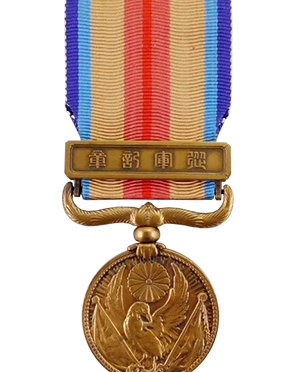
The 1937-45 China Incident War Medal

The China Incident Medal was established in 1939 and awarded for service at any time from the 12th to the 20th years of the Shōwa period.

  • Time Period: WW2
  • Institution: 7 December 1939
  • Country: Medals from Japan Japan

The China Incident Medal (or 支那事変従軍記章Sina jihen jūgun kishō) was established by Imperial Edit No. 496 on July 27, 1939 and awarded for service in China at any time from the 12th through the 20th years of the Shōwa period (1937–1945).

An amendment was promulgated by Imperial Edict No. 418 in 1944, and the decoration was abolished in 1946 by government ordinance No. 177. Although the Japanese government still uses “China Incident” in formal documents, media in Japan often paraphrase it with other expressions like Japan-China Incident (日華事変Nikka jihen) or (日支事変Nisshi jihen). 

This medal is one of the most commonly found Japanese awards. Millions were made for those who served.

The China Incident Medal Design

The medal is struck in bronze and has a swivel grip.

The obverse shows crossed flags, the imperial mum crest, and a crow. The reverse shows mountains, clouds, and waves, as well as the inscription ‘China Incident.’ The ribbon is 37mm wide, watered, of 3 mm blue (the
sea and the Navy), 7.5 mm tan (the soil of China, for the Army), 3.5 mm dark pink (the bloodstained soil of China), and 2 mm bright red (blood and loyalty).

The Inter Allied Victory Medal (Japan)

The Allied Victory Medal was recommended by an inter-allied committee in March 1919. The Japanese Medal was established by Imperial Edict.

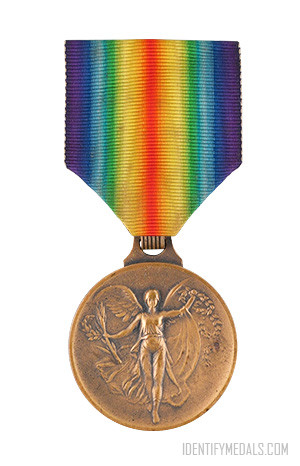
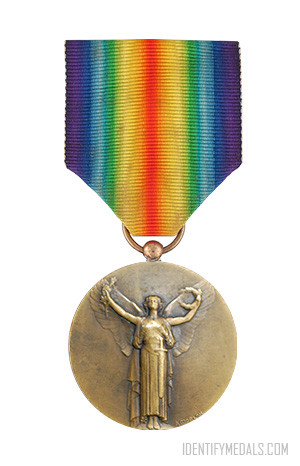
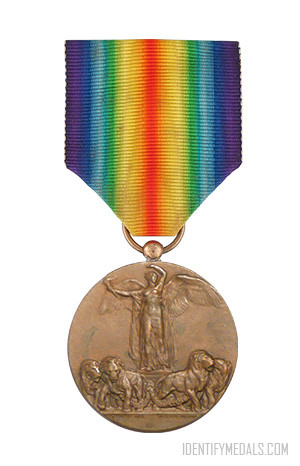
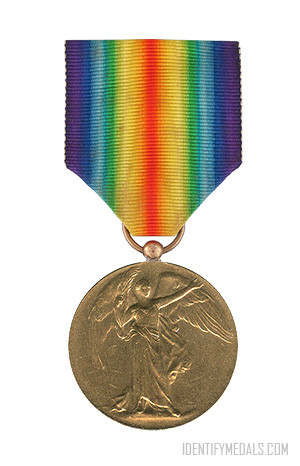
The Allied Victory Medal was recommended by an inter-allied committee in March 1919. Fourteen victorius countries finally awarded the medal after World War I, and each allied nation would design a ‘Victory Medal’ for award to their own nationals. Certain features were to be shared: a winged figure of Victory on the obverse and the same ribbon.

The Japanese Allied Victory Medal was established by Imperial Edict #406 on 17 September 1920.

The Japan Inter Allied Victory Medal Design

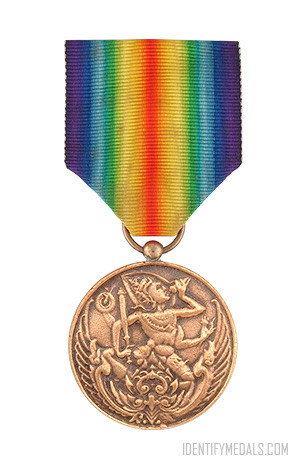
The Victory Medal measures 36 millimetres (1.4 in) in diameter and was designed by William McMillan. The design and ribbon was also adopted by Belgium, Brazil, Cuba, Czechoslovakia, France, Greece, Italy, Japan, Portugal, Romania, Siam, Union of South Africa and the USA. Each allied nation would design a ‘Victory Medal’ for award to their own nationals, all issues having certain common features, including a winged figure of victory on the obverse and the same ribbon.

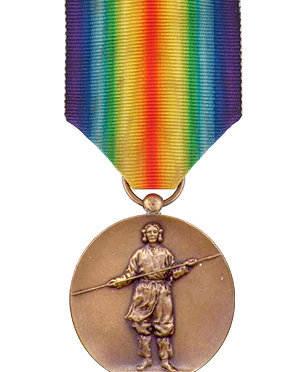
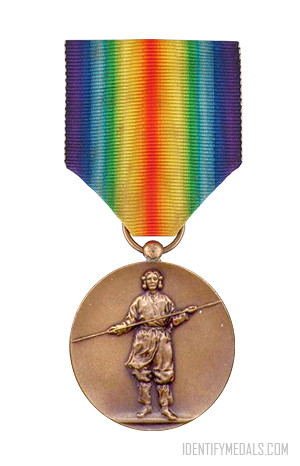
Japan’s obverse design was different from all other versions as it did not depict the goddess Victory. This figure from Roman mythology would have no connection to Japanese culture, so a depiction of Takemikazuchi, the war god in Japanese mythology occupies the obverse of the medal. Takemikazuchi (建御雷/武甕槌) is considered a god of thunder and a sword god.

The reverse shows the words ‘THE GREAT / WAR FOR / CIVILISATION / 1914-1919‘  surrounded by a laurel wreath.

The 39 millimeters (1.5 in) wide watered ribbon has an iridescent color scheme, with the violet moving through to a central red stripe where both schemes meet. It attaches to the medal through a ring suspender. The recipient’s name, rank, service number and unit were impressed on the edge of the medal. The name of the regiment or corps was omitted on medals awarded to Army officers.

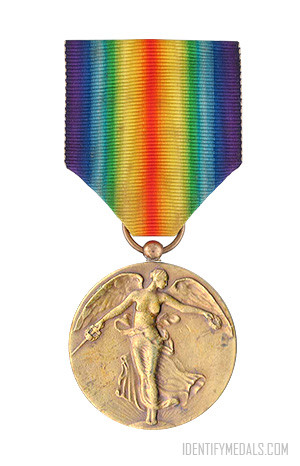
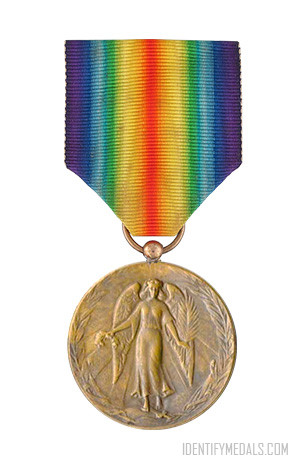
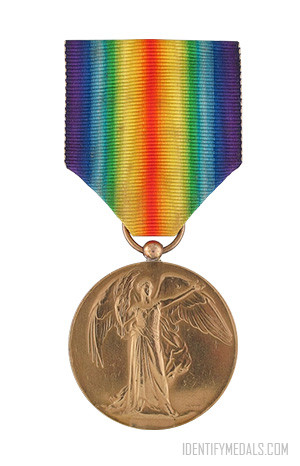
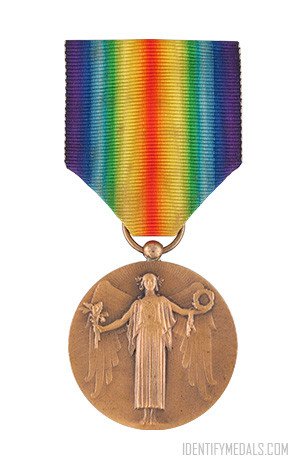
All the Inter-Allied Victory Medal Variations

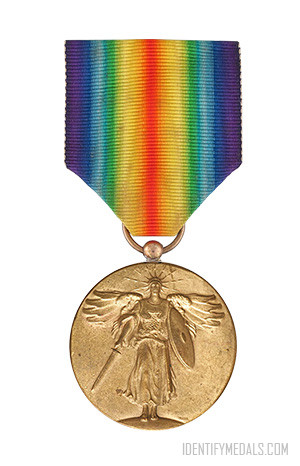
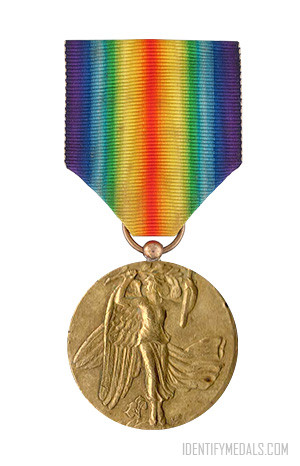
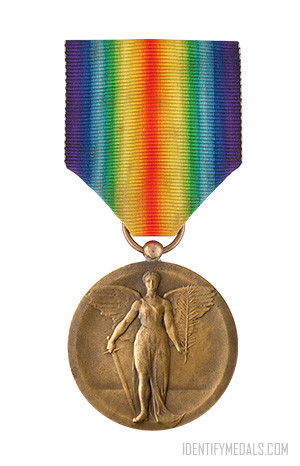
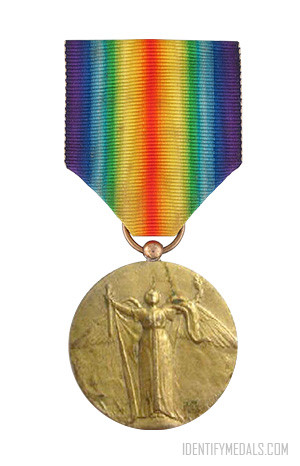
Although each country designed its own version of the Inter-Allied Victory Medal, all of them shared some common elements, such as a winged victory figure on the obverse and a similar ribbon with rainbow colors symbolizing unity among the Allies. Here are the versions for all countries:

Find an Inter-Allied Victory Medal Online

Right Now on eBay 
Clicking a link to eBay may result in a referral commission being paid if a purchase is made.
Loading...

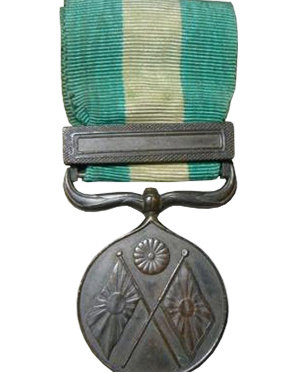
The 1914-20 First World War Medal

The 1914-20 First World War Medal is a Japanese medal established in 1915 to commemorate Japanese participation in World War I.

  • Time Period: WW1
  • Institution: 1915
  • Country: Medals from Japan Japan

The 1914-20 First World War Medal is a Japanese medal established on November 6, 1915 by Imperial Edict No. 203 to commemorate Japanese participation in World War I.

The medal was issued to naval personnel who served in the Japanese fleet in the Mediterranean during the Great War and to the military participating in the Japanese expedition to Siberia from 1918 to 1922 aimed at the Soviet Bolsheviks during the Russian Civil War that followed the October 1917 revolution.

The 1914-20 First World War Medal Design

The award is a blackened bronze circular medal with ornate swivel suspension with bar inscribed ‘ju-gun-ki-sho’ (War Medal).

The obverse bears with crossed Imperial army and navy flags, a chrysanthemum crest above, sprays of pauwlona below. The reverse shows ten characters in three columns ‘tai-sho-san-nen-nai-shi-kyu-nen-sen-eki’ (Taisho 3rd Year to 9th Year War’ – Taisho 3 to 9 = AD1914 to 1920).

The ribbon has a hook and eye fittings. The medal was issued in a fitted wooden case with pale cream felt lining, the lid embossed in gilt characters ‘tai-sho-san-nen-nai-shi-kyu-nen-sen-eki-ju-gun-ki-sho’ (Taisho 3-9 War Military Service Medal).

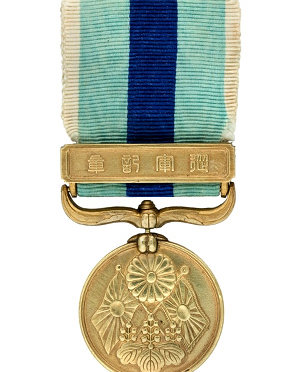
The Russo-Japanese War Medal

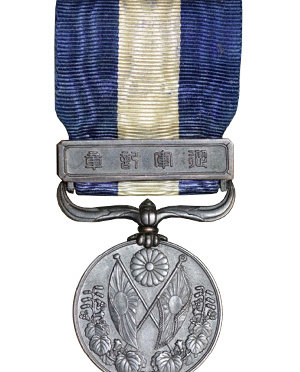
The Russo-Japanese War Medal was established in 1906 in recognition of those who served in the Russo-Japanese War during the Meiji period.

The Russo-Japanese War Medal is a unique Japanese medal, jūgun kishō. It was established on March 31, 1906 by Imperial Edict No. 51 in recognition of those who served in the Russo-Japanese War during the 37th and 38th years of the Meiji period (1904–1905).

The Russo-Japanese War was fought between the Russian Empire and the Empire of Japan over rival imperial ambitions in Manchuria and Korea. The major theatres of operations were the Liaodong Peninsula and Mukden in Southern Manchuria and the seas around Korea, Japan and the Yellow Sea.

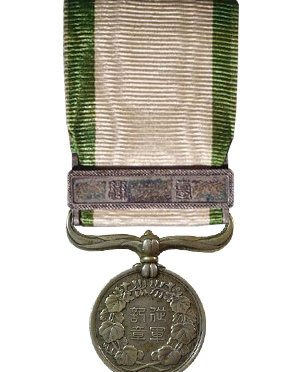
The 1900 Boxer War Medal (Japan)

The 1900 Boxer War Medal was a Japanese medal created by Imperial Edict in 1901 to commemorate those that fought during the Boxer Rebellion.

The 1900 Boxer War Medal was a Japanese medal created by Imperial Edict No. 142 and issued on April 21, 1901. It’s a commemorative medal for those who had participated in the relief of the Beijing legations during the Boxer Rebellion.

The Military Medal of Honor (or 従軍記章 jugun kisho in Japanese) was a military decoration for meritorious service to the Empire of Japan, formerly awarded to all military personnel who participated in battles in a war and effectively abolished during the Allied Occupation of Japan in the post-war years (1945–1951).

The plausible re-institution of a modern equivalent was made unlikely by the adoption of Japan’s post-war Constitution which disavows the right of the state to engage in aggressive war.

The 1894-95 Sino-Japanese War Medal

The 1894-95 Sino-Japanese War Medal was awarded in commemoration of the First Sino–Japanese War, which lasted from 1894 to 1895.

The 1894-95 Sino-Japanese War Medal was awarded in commemoration of the First Sino–Japanese War, which lasted from 1 August 1894 to 17 April 1895.

The war was fought between Qing Dynasty China and Meiji Japan, primarily over control of Korea. After more than six months of continuous successes by the Japanese army and naval forces, as well as the loss of the Chinese port of Weihai, the Qing leadership sued for peace in February 1895.

The Military Medal of Honor (or 従軍記章 jugun kisho in Japanese) was a military decoration for meritorious service to the Empire of Japan, formerly awarded to all military personnel who participated in battles in a war and effectively abolished during the Allied Occupation of Japan in the post-war years (1945–1951).

The plausible re-institution of a modern equivalent was made unlikely by the adoption of Japan’s post-war Constitution which disavows the right of the state to engage in aggressive war.

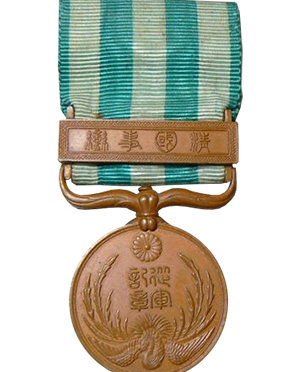
The 1874 Formosa Expedition War Medal

The 1874 Formosa Expedition War Medal was established in 1875 to commemorate the 3000 Japanese warriors who went to Formosa.

The 1874 Formosa Expedition War Medal was established by Daijou-kan Law #54 on April 10, Meiji 8 [1875]. Revised (Law #141) on November 15, 1876.

The Japanese expedition of 1874 to Taiwan Province, also referred to as the Taiwan Expedition of 1874, was in response to the Mudan Incident of 1871. Fifty-four shipwrecked Ryukyuan sailors were killed by Paiwan aborigines in December 1871 in southern Taiwan. In seeking restitution from Qing China, Japan reached an impasse when the Chinese claimed that they were not responsible for the actions of the aborigines in territory that was nominally under Chinese sovereignty.

The Japanese government sent an expedition of 3,600 soldiers led by Saigō Tsugumichi in May 1874. The Japanese won a decisive victory at the Battle of Stone Gate on 22 May 1874. Thirty aborigines were either killed or mortally wounded in the battle, and a great number wounded. Japanese casualties were six killed and thirty wounded.

In November 1874 the Japanese forces withdrew from Taiwan after the Qing government agreed to an indemnity of 500,000 Kuping taels.

The Military Medal of Honor (or 従軍記章 jugun kisho in Japanese) was a military decoration for meritorious service to the Empire of Japan, formerly awarded to all military personnel who participated in battles in a war and effectively abolished during the Allied Occupation of Japan in the post-war years (1945–1951).

The plausible re-institution of a modern equivalent was made unlikely by the adoption of Japan’s post-war Constitution which disavows the right of the state to engage in aggressive war.

The 1874 Formosa Expedition War Medal Design

The obverse of the medal bears branches of Imperial Paulonia Leaves. Inscribed ‘War Medal.’ The reverse is inscribed ‘Meiji 7 [1874] Year of the Dog.’ The latter refers to the Chinese Sexagenary Cycle.

The 1931-34 China Incident War Medal

The China Incident Medal (Sina jihen jugun kisho) medal was created in 1939 and awarded for service in China during the Shōwa period.

The China Incident Medal (Sina jihen jugun kisho) medal was created by Imperial Edit No. 496 on July 27, 1939 and awarded for service in China at any time from the 12th through the 20th years of the Shōwa period — Shōwa 12-20 (1937–1945). The decoration was abolished in 1946 by government ordinance No. 177.

Although the Japanese government still uses “China Incident” in formal documents, media in Japan often paraphrase it with other expressions like Japan-China Incident (日華事変 Nikka jihen) or (日支事変 Nisshi jihen). The word Shina is now construed by China as a derogatory term.

The Military Medal of Honor (or 従軍記章 jugun kisho in Japanese) was a military decoration for meritorious service to the Empire of Japan, formerly awarded to all military personnel who participated in battles in a war and effectively abolished during the Allied Occupation of Japan in the post-war years (1945–1951).

The plausible re-institution of a modern equivalent was made unlikely by the adoption of Japan’s post-war Constitution which disavows the right of the state to engage in aggressive war.