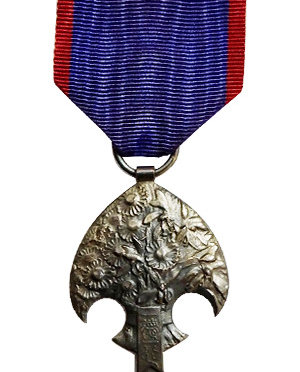
The Manchukuo Emperor State Visit to Japan Medal

The Manchukuo Emperor State Visit to Japan medal was established in 1935 to commemorate the Manchukuo Emperor Pu-Yi’s visit to Japan in 1934.

The Manchukuo Emperor State Visit to Japan medal was established in 1935 to commemorate the Manchukuo Emperor Pu-Yi’s visit to Japan in 1934. The Emperor Pu-Yi (often called the Last Emperor) made two state visits to Japan: The first in 1935 and the second in 1940. The first one was the most celebrated because he presented himself as the Manchukuo Emperor to the Showa Emperor.

Four commemorative postage stamps were issued, while many important people assembled to welcome Pu-Yi to Japan. The Japan Mint created this official medal to commemorate the 1935 visit.

The medal was awarded by the government and not put on sale like some other Japan Mint items.

The Manchukuo Emperor State Visit to Japan Medal Design

The medal is struck in silver and has the shape of a spearhead.

The obverse is decorated with orchids and chrysanthemums, the Imperial flowers of Manchukuo and Japan. There is an inscription in the banner at the bottom that reads ‘One in virtue and spirit.’ The reverse has the inscription’Kang Te 2 [1934] Manchukuo Empire, Emperor’s Visit to Japan Commemorative Medal, April 6th.’

The medal was awarded in a green case with gold lettering on the front.
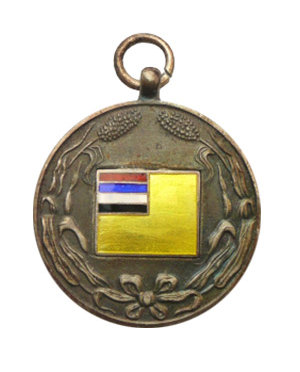
The Commemorative Badge for the Foundation of the Manchukuo Empire

The Commemorative Badge for the Foundation of the Manchukuo Empire is a commemorative item made to celebrate its founding.

  • Time Period: WW2
  • Institution: 1930s?
  • Country: Medals from Japan Japan

The Commemorative Badge for the Foundation of the Manchukuo Empire is one of many commemorative items that were made on the occasion of the founding of the Manchukuo Empire. Similar items were also produced on subsequent anniversaries.

Although these badges had a suspension ring, they were probably never actually worn. Their function was more decorative, with most of them probably bought as a gift for others.

The Commemorative Badge for the Foundation of the Manchukuo Empire Design

The obverse shows two branches around an enameled national flag. These are sorghum branches and buds, a plant used often on Manchukuo items. Although the official imperial crest is the orchid, the sorghum was used as a symbol of the nation, just as the cherry blossom is used as a symbol of Japan.

The reverse shows the inscription ‘Manchukuo Empire, Daidou 2 [1933] March 1st, National Foundation 1-Year Anniversary Commemorative.’

The badge was kept in a paulownia wood box with an inscription reading ‘Manchukuo Empire, National Foundation 1-Year Anniversary Commemorative.’

The Imperial Japanese Army Koga Regiment Badge

Time Period: WW2

Institution: 1930s?
Country: Medals from Japan Japan

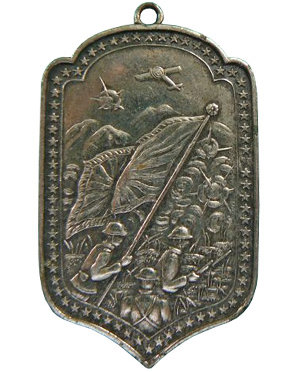
The Imperial Japanese Army Koga Regiment Badge is an example of a small, portable, and inexpensive regiment badge. These awards were usually given to troops by regiment commanders.

The Imperial Japanese Army Koga Regiment Badge Design

These regimental badges usually had the unit name and number inscribed in the obverse, and could also be personalized. However, they rarely had the name of the individual soldier unless they were hand-carved.

The Koga regiment badge has a border covered with Army stars. The obverse shows, it the center, Japanese soldiers battling at the front. One of them is carrying the regiment standard. In the background are clouds of smoke with stylized explosions and some hills. Above is a fighter plane and another explosion. The inscription in the reverse reads ‘Koga Regiment, Blood-Stained Regiment Standard.’

The Japanese Military Wounded Soldier Badge

Time Period: WW2
Institution: From 1938
Country: Medals from Japan Japan

The Japanese Military Wounded Soldier Badge was issued to both army and navy personnel from about 1938. Also translated as the War Wound Badge, this medal was produced in two varieties.

The gilt senshou badge was awarded for a wound sustained in combat. The silver koushou badge was awarded for a wound sustained in the public service (or in a non-combat situation). It was also often given to a soldier when they contracted a disease like malaria or were poisoned, injured in an equipment accident, etc. 

The Japanese Military Wounded Soldier Badge Design

The badge measures approximately 31 mm high. The outer edges on the reverse side read Gunjin Shoui Kishou (Soldier Wound Badge).

The badge was awarded in a red pressed cardboard or wooden box with gold or silver lettering and with an accompanying registration card.

The Patriotic Women’s Association (Aikoku Fujinkai) Distinguished Service Badge

  • Time Period: Pre-WW1
  • Institution: After 1901
  • Country: Medals from Japan Japan

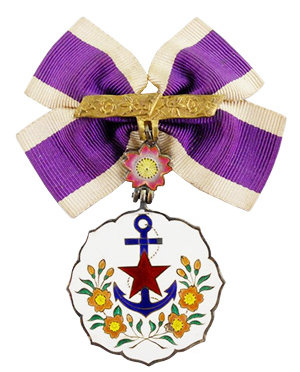
The Patriotic Women’s Association Distinguished Service Badge is a special merit badge awarded by the Patriotic Women’s Association or Aikoku Fujinkai. The Distinguished Service Badge (or Special Merit Badge) was the highest award.

The Patriotic Women’s Association is the oldest of the women’s associations. It was founded on March 2, 1901 by Okumara Ioko and operated under the Ministry of Home Affairs and the Ministry of Health and Welfare.

By 1940, the Association had close to 6,500,000 members in Japan and overseas. Before the outbreak of the Second World War, there were Aikoku Fujinkai branches in Canada, the United States and Brazil, as well as in different territories occupied by the Japanese armed forces. In February 1942, the Asssociation merged with the Greater Japanese Women’s Association for Protection of the Country and the Greater Japan Federation of Women’s Associations into a new association which was called the Greater Japanese Women’s Association.

The Aikoku Fujinkai Distinguished Service Badge Design

The medal is struck in silver and has red, white, blue, orange, green, pink and yellow enamels. It measures 33.5 mm (wide) x 47 mm (high), including its cherry blossom suspension.

The medal is suspended from a silver-gilt bar with pinback and has a bow-tied ribbon with silver-gilt tassels at either end. The badge was awarded in a hard-shelled case made of balsa wood with a black lacquer finish. The box has gilt characters on the lid.

Other badges were as follow:

  • Member Rosette Badge, in yellow, blue and black enamels.
  • Regular Member Badge, in silver with no enamels.
  • Special Member Badge, bronze with yellow enamel.
  • Honor Member Badge, bronze with light blue or white enamel.
  • First Class Exceptional Merit Badge, bronze with colored enamels.
  • Second and Third Class Merit Badges, bronze with a red star.
  • Patron Badge, in reddish bronze with no enamels.

The Army Officer Pilot Badge

[vc_row][vc_column width=”1/4″][vc_single_image image=”5593″ img_size=”full”][/vc_column][vc_column width=”3/4″][vc_column_text]

The Army Officer Pilot Badge

[/vc_column_text][vc_column_text]

Time Period: Interwar Period
Institution: 1923
Country: Medals from Japan Japan

[/vc_column_text][vc_separator css=”.vc_custom_1526473075957{padding-top: 16px !important;padding-bottom: 16px !important;}”][vc_column_text]The Army Officer Pilot Badge is a Japanese badge established in 1923 and in two classes: silver for officers and
bronze for NCOs.

As an incentive to lure infantry, artillery, cavalry, and engineer officers into aviation to become pilots, the Japanese Army instituted its pilot’s badge in time for the graduation of the first pilots.

The award was abolished in 1940, but the NCO class badge was still awarded up until the end of WW2.

The Army Officer Pilot Badge Design

The badge measures 37.5 mm by 51.6 mm and is made of multiple pieces in silver and bronze with a gilt star in the center, illustrating wings on either side framing a series of rays emanating from behind the star, and a two-bladed propeller at the base of the wings. It has a vertical pinback.[/vc_column_text][vc_raw_html css=”.vc_custom_1589024511233{padding-top: 24px !important;padding-bottom: 24px !important;}”]JTNDaW5zJTIwY2xhc3MlM0QlMjJlcG4tcGxhY2VtZW50JTIyJTIwZGF0YS1jb25maWctaWQlM0QlMjI1ZWI2OTU4ZmM2NWQ2MDczY2I1YTg1MGElMjIlM0UlM0MlMkZpbnMlM0U=[/vc_raw_html][/vc_column][/vc_row][vc_row][vc_column][vc_column_text css=”.vc_custom_1555950715853{padding-bottom: 24px !important;}”]

Explore More Japanese Medals

[/vc_column_text][vc_basic_grid post_type=”post” max_items=”18″ style=”pagination” items_per_page=”6″ element_width=”2″ gap=”20″ arrows_design=”vc_arrow-icon-arrow_06_left” arrows_position=”outside” paging_design=”none” item=”masonryGrid_Default” grid_id=”vc_gid:1589024428851-9b2cc382-a678-3″ taxonomies=”85″ el_class=”relatedMedals”][/vc_column][/vc_row][vc_row][vc_column][vc_column_text css=”.vc_custom_1555951766219{padding-bottom: 24px !important;}”]

Explore More Medals from Pre-WW1

[/vc_column_text][vc_basic_grid post_type=”post” max_items=”18″ style=”pagination” items_per_page=”6″ element_width=”2″ gap=”20″ orderby=”rand” arrows_design=”vc_arrow-icon-arrow_06_left” arrows_position=”outside” paging_design=”none” item=”masonryGrid_Default” grid_id=”vc_gid:1589024428853-be68fe47-0021-6″ taxonomies=”8″ el_class=”relatedMedals”][/vc_column][/vc_row]

The Bukochosho Medal

Time Period: WW2

Institution: 7 December 1944
Country: Medals from Japan Japan

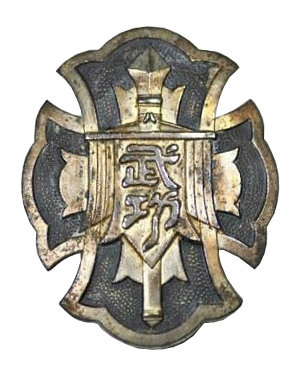
The Rikugun Bukōkishō (陸軍武功徽章 “Badge for Military Merit”), commonly called the Bukōshō, was a military decoration of the Empire of Japan established on 7 December 1944 by Imperial edict.

The medal was awarded by the Imperial Japanese Army (IJA) to living soldiers who had performed with exceptional valor in battle. Airmen, especially fighter pilots defending Japan against enemy bombers, were most likely to win the award. Eighty-nine Bukōshō were awarded during the eight months it was actively awarded.

Emperor Hirohito established the award on 7 December 1944, the third anniversary of the attacks on Hong Kong and Pearl Harbor, which had signaled the start of the broader Pacific War.

The Bukōshō was allowed to be given retroactively to soldiers who had distinguished themselves as far back as 1941 or perhaps 1940. In practice, the award was given disproportionately to fighter pilots flying against the American Boeing B-29 Superfortresses bombing the Japanese homeland.

The Bukochosho Medal Design

The Bukōshō (as it was popularly known) was presented in two classes, called A and B, or First and Second. The Bukōshō was a pin back badge, cast in iron or steel, featuring two shields (in gilt for A-Class, bronzed for B-Class) forming a cross, with a gilt banner at the center bearing the two kanji characters “Bukō” (Military Merit).

The reverse side (again in gilt for A-Class, bronzed for B-Class) bore the six kanji characters in two columns “Rikugun/Bukōchōshō” (Army/Badge for Military Merit). Both classes were the same size: 50 mm (2.0 in) high and 40 mm (1.6 in) wide.