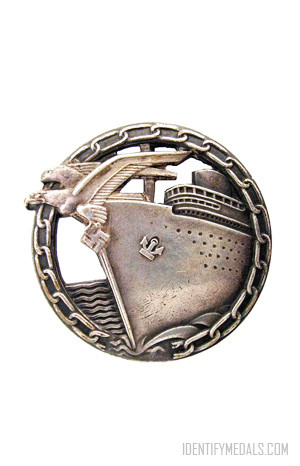
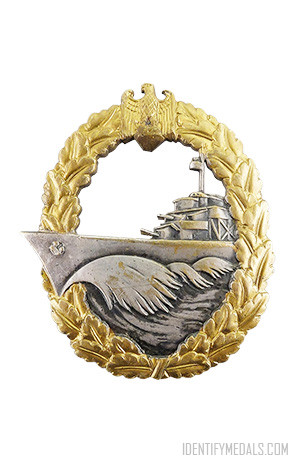
The Naval Front Clasp

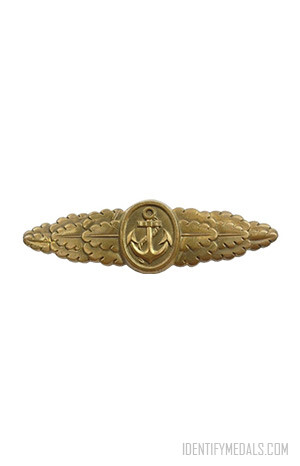
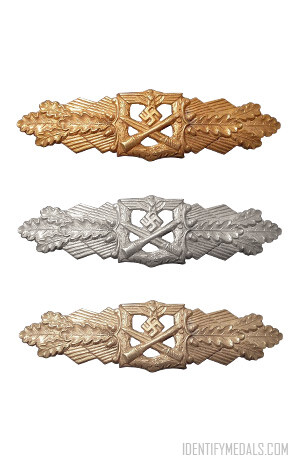
The Naval Front Clasp was a World War II German military decoration awarded to officers and men of the Kriegsmarine during the Third Reich.

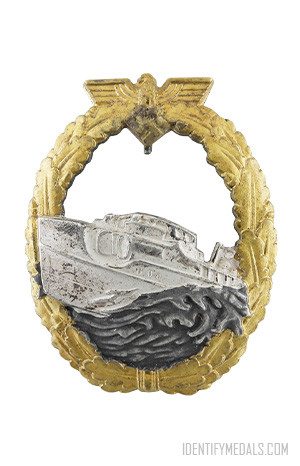
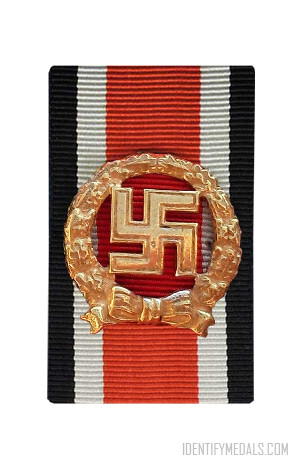
The Naval Front Clasp (or Marine-Frontspange in German) was a German military decoration awarded during World War II.

Established in 1944, the recipients were officers and enlisted personnel of the Kriegsmarine for their prolonged and frontline service across all naval units, except for the submarine service, which had its separate award.

This bronze clasp recognized service or acts of valor that exceeded the requirements of the basic war badge. Instituted on November 19, 1944, by Grand Admiral Karl Dönitz.

The Naval Front Clasp Design

Each wing consisted of six staggered oak leaves, totaling twelve. At the bottom of the central wreath, an anchor adorned the design.

More Naval War Badges

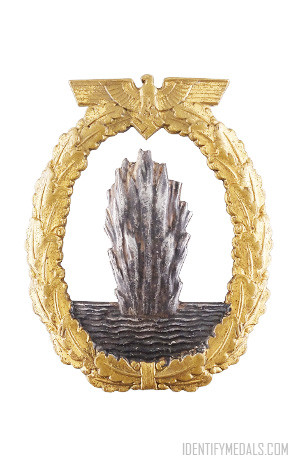
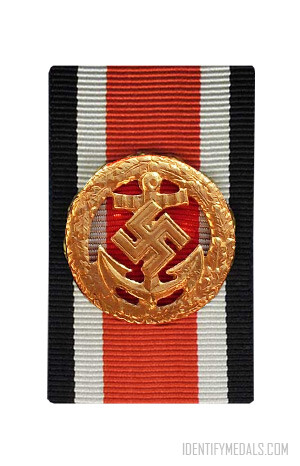
The Naval War Badges (Kriegsmarine) badges were awarded to sailors, officers, and personnel of the Kriegsmarine who demonstrated exceptional skill, bravery, and dedication in naval warfare. Explore the complete collection below:

The U-Boat Front Clasp

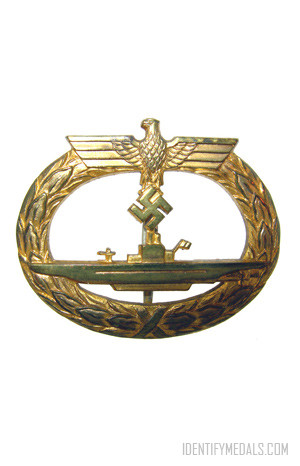
The U-Boat Front Clasp was a World War II German Kriegsmarine military decoration awarded during the Third Reich.

The U-boat Front Clasp (or U-Boot-Frontspange in German) was a German military decoration awarded for continuous service and valor during World War II.

Established on May 15, 1944, the award aimed to align the U-boat force with other branches of the German armed forces, each possessing comparable accolades to honor acts of valor. Merits for receiving the award were not explicitly outlined; rather, decorations were conferred based on recommendations from U-boat commanders, subject to approval by Karl Dönitz.

Often, awards were granted in recognition of the number of completed patrols or displays of bravery in combat. The clasp was worn on the upper left breast.

The award was conferred in two tiers, distinguished by their material.

  • Bronze: This represented the lower grade and was granted based on criteria such as the number of war patrols undertaken, the level of risk inherent in the missions, and individual acts of bravery.
  • Silver: Introduced on November 24, 1944, this class aimed to extend recognition to bronze recipients who continued to demonstrate merit, faced heightened risks, and displayed acts of valor.

The U-Boat Front Clasp Design

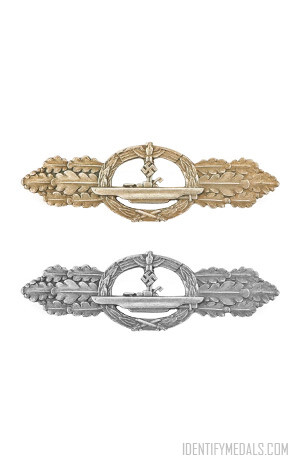
Wilhelm Ernst Peekhaus from Berlin presented the design for the badge, featuring a central laurel wreath adorned with a stylized submarine and wings made of oak leaves.

Each wing consisted of six staggered oak leaves, totaling twelve. At the bottom of the central wreath, two crossed swords adorned the design, while the submarine in the middle echoed the U-Boat War Badge’s design. Integrated into the wreath was an eagle with downturned wings grasping a swastika.

Following the conclusion of the war, German sailors could only wear the medal if it did not bear National Socialist symbols, in accordance with the German Ordensgesetz. An alternative design featuring a complete laurel wreath, devoid of the eagle and swastika, with a submarine emblem centered within, was created for this purpose.

More Naval War Badges

The Naval War Badges (Kriegsmarine) badges were awarded to sailors, officers, and personnel of the Kriegsmarine who demonstrated exceptional skill, bravery, and dedication in naval warfare. Explore the complete collection below:

The Naval Artillery War Badge

The Naval Artillery War Badge was a World War II decoration awarded to the crews of land-based marine artillery and anti-aircraft units.

The Naval Artillery War Badge (or Kriegsabzeichen für die Marineartillerie in German) was a military decoration bestowed upon the personnel serving in land-based marine artillery and anti-aircraft units of the Kriegsmarine during World War II.

Instituted on June 24, 1941, by Grand Admiral Erich Raeder, this badge was presented to individuals and crew members of coastal defense units as well as anti-aircraft units in recognition of their valorous actions. Additionally, it was awarded posthumously to those who lost their lives in action while serving in this unit.

The badge was granted in a singular degree. To earn the award, a crew needed to accumulate eight points, which could be obtained as follows:

  • Two points for independently downing an aircraft.
  • One point for jointly downing an aircraft with the assistance of another crew.
  • Half a point for non-gun crew members who contributed to the downing of aircraft by operating searchlights, fire control systems, sound locators, or serving as radio operators.

The Naval Artillery War Badge Design

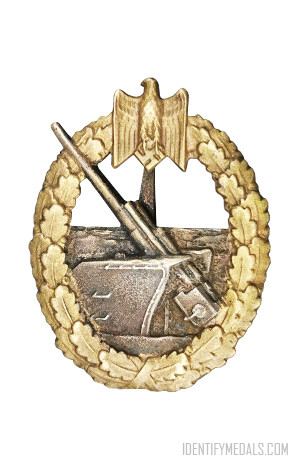
The medal, designed by Otto Placzek of Berlin, comprises an outer laurel wreath adorned with oak leaves, with the German Eagle positioned at the apex, its wings gracefully downturned as it clutches a golden swastika. In the center, a coastal artillery gun is depicted against a backdrop of the sea, rendered in grey.

Early versions of the medal were crafted from bronze, later transitioning to nickel. However, towards the end of the war, inferior quality versions were fashioned from materials such as “pot or monkey metal”. This medal was traditionally worn on the lower section of the left breast pocket of the naval service tunic.

More Naval War Badges

The Naval War Badges (Kriegsmarine) badges were awarded to sailors, officers, and personnel of the Kriegsmarine who demonstrated exceptional skill, bravery, and dedication in naval warfare. Explore the complete collection below:

The Destruction of Low-Flying Aircraft Badge

The Destruction of Low-Flying Aircraft Badge was a German war badge awarded to Waffen SS and Wehrmacht Heer soldiers during World War II.

The Destruction of Low-Flying Aircraft Badge (Tieffliegervernichtungsabzeichenin german) was a German war badge intended for Waffen SS and Wehrmacht Heer soldiers who successfully brought down low-flying aircraft using only handheld weapons during World War II

Instituted in January 1945, there remains some contention regarding whether any were physically awarded during the war (as there is only documentation).

Given the late introduction of this badge, it is improbable that it was awarded in its original form during the war and more likely that any instances of its presentation occurred in the revised 1957 version.

The Destruction of Low-Flying Aircraft Design

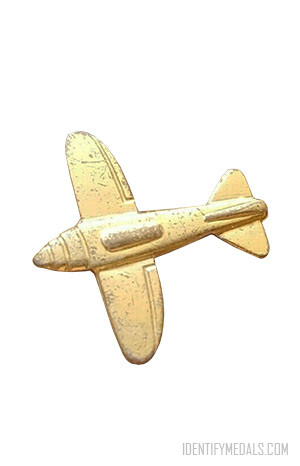
The Destruction of Low-Flying Aircraft Badge featured a metal airplane. It was mounted on a ribbon backing and available in bronze, silver, or gold colors, with corresponding black stripes denoting the grade.

More Army/Waffen-SS War Badges

The Army/Waffen-SS war badges were military decorations awarded by Nazi Germany to members of the Army (Heer) and the Waffen-SS. Explore the complete collection below:

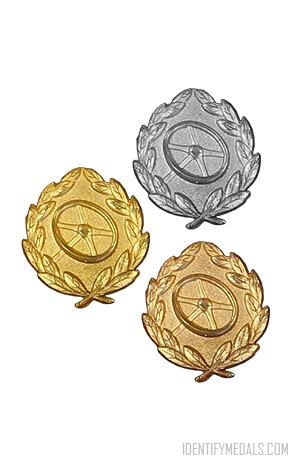
The Driver Proficiency Badge

The Driver Proficiency Badge was a German military badge awarded to drivers of military transport vehicles during World War II.

The Driver Proficiency Badge (Kraftfahrbewährungsabzeichen in German) was a German honor bestowed upon qualified drivers of military transport serving in the Wehrmacht and the Waffen-SS of Nazi Germany World War II.

Established on October 23, 1942, the Driver Proficiency Badge aimed to recognize the skill and dedication of military transport vehicle drivers, encompassing trucks, cars, and motorcycles, who served specific durations in war zones subsequent to December 1, 1940. Eligibility extended to both military personnel and civilian drivers operating under Wehrmacht command, as well as foreign volunteers, excluding members of forces allied with Germany.

Qualification for the badge necessitated service from December 1, 1940, onwards in frontline or rear areas across the Balkan, North African, and Eastern Fronts, with additional areas incorporated as the conflict unfolded. The duration of service requisite for each type of vehicle varied: 90 days for motorbike reconnaissance and dispatch riders, 120 days for supply vehicles supporting the frontline, and 135 days for other categories of military transport.

The silver badge was conferred upon meeting these requirements for a second time, with the gold awarded for a third instance. In instances where drivers encountered exceptionally challenging conditions or achieved notable driving feats, shorter qualifying periods could be considered. Authorization for awards rested with battalion commanders and higher ranks, or for civilians, with the Ministry of the Interior.

However, the badge could be revoked if the recipient demonstrated reckless driving or failed to maintain their vehicle. Notably, it could not be bestowed posthumously.

The Driver Proficiency Design

The badge comprised a laurel wreath, measuring 44 mm in height and 41 mm in width, encasing a representation of a steering wheel. Crafted from iron or zinc alloy, it possessed an appropriate color finish. Mounted on a fabric base, it was affixed to the uniform jacket above the left cuff.

Bundeswehr members who had earned the badge during the war were permitted to wear it on the ribbon bar, represented by a small replica on a field grey ribbon.

Following the prohibition of wearing Nazi-era decorations in 1945, and unlike many awards, the original design of the Driver Proficiency Badge remained unaltered, as it did not incorporate the swastika symbol. 

More Army/Waffen-SS War Badges

The Army/Waffen-SS war badges were military decorations awarded by Nazi Germany to members of the Army (Heer) and the Waffen-SS. Explore the complete collection below:

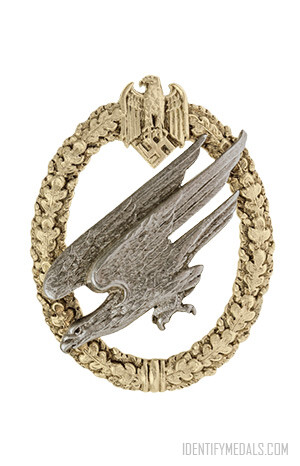
The Parachutist Badge (Army Version)

The Parachutist Badge was awarded to qualified parachutists of the Wehrmacht and the Waffen-SS during the Third Reich in Germany.

The Parachutist Badge (Army Version) (Fallschirmschützen-Abzeichen des Heeres in German) was a prestigious honor bestowed upon qualified parachutists serving in the Wehrmacht and the Waffen-SS of Nazi Germany World War II.

Initially instituted by order of Hermann Göring on November 5, 1936, the badge was primarily awarded to Luftwaffe personnel upon completion of six jumps (The Parachutist Badge – Luftwafe Version). The army version was introduced on September 1, 1937. 

Similar to the Luftwaffe, recipients were obligated to requalify for the badge annually. In 1936, the army initiated its own parachute company, later expanding it to a battalion in 1938.

Waffen-SS personnel serving in the 500, 501, or 502 SS-Parachute Battalions were awarded the Luftwaffe badge upon meeting jump and other test requirements. Following the transfer of army parachute units to the Luftwaffe in 1939, former army soldiers continued to wear the army version of the Parachutist badge. 

The Parachutist Badge (Army Version) Design

Originally, the Luftwaffe version featured a depiction of a diving eagle clutching a swastika within its talons, encircled by a silver wreath. In this version, though, the swastika was positioned at the top of the wreath and topped by a smaller upright eagle.

More Army/Waffen-SS War Badges

The Army/Waffen-SS war badges were military decorations awarded by Nazi Germany to members of the Army (Heer) and the Waffen-SS. Explore the complete collection below:

The Army Mountain Guide Badge

The Army Mountain Guide Badge was a German military badge awarded to experienced Gebirgsjager mountain guides during the Third Reich.

The Army Mountain Guide Badge (Abzeichen für Heeresbergführer in German) was a war badge bestowed upon skilled Gebirgsjäger mountain guides during the era of Nazi Germany and World War II.

The Army Mountain Guide Badge was established in August 1936 and was exclusively worn by Gebirgsjäger troops within the German Wehrmacht who had undergone training as mountain guides and subsequently served in this capacity for a year. However, following the conclusion of World War II in 1945, this badge ceased to be awarded.

The Army Mountain Guide Badge Design

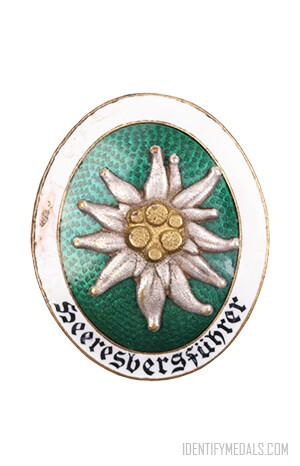
Crafted as an oval tombac-plated iron pin-back badge, it measured 51.8 mm by 42.9 mm. At its center, in the obverse, lay an edelweiss flower rendered in silver with a gilt center, set against a backdrop of green enamel. Surrounding this, a white enamel band displayed the term ‘Heeresbergführer’ in gothic script along its lower portion.

On the reverse side, aside from the pin fastening and often the manufacturer’s name, the badge remained plain.

When worn on the uniform, it was typically positioned on or below the left-hand breast pocket, though occasionally, it was observed on the right side of the jacket.

More Army/Waffen-SS War Badges

The Army/Waffen-SS war badges were military decorations awarded by Nazi Germany to members of the Army (Heer) and the Waffen-SS. Explore the complete collection below:

The Sniper’s Badge

The Sniper’s Badge was a WW2 German military decoration established in 1944 and awarded to snipers of the German Army and the Waffen-SS.

The Sniper’s Badge (Scharfschützenabzeichen in German) was a war badge awarded to Waffen SS and Wehrmacht Heer soldiers during World War II.

It was established on August 20, 1944. Initially, only members serving in the German Army and the Waffen-SS were eligible for this recognition. However, later, by directive of the High Command, it was extended to snipers from other branches of the armed services. 

The Sniper’s badge came in three classes or grades:

  • Third Class (without cord), awarded for achieving 20 enemy kills.
  • Second Class (with a silver cord), granted for 40 enemy kills.
  • First Class (with a gold cord), conferred for achieving 60 enemy kills.

The tally of enemy kills commenced from September 1, 1944. Each enemy kill needed to be corroborated by witnesses and reported to the unit for validation, and close-quarter kills were not included in this count.

The Sniper's Badge Design

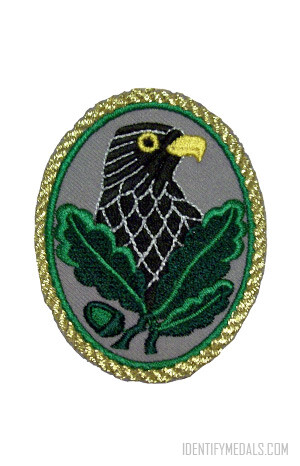
Crafted from greenish-gray cloth and embroidered into an oval shape, the Sniper’s Badge depicted a black eagle’s head facing left, adorned with white plumage, ochre yellow eyes, and a closed beak. Surrounding the eagle’s body were three oak leaves and a left-mounted acorn.

The ribbon’s edges were meticulously sewn, and the badge’s different classes were identified by a circularly stitched cord in either silver (for 2nd class) or gold (for 1st class).

The badge was worn on the right sleeve of the uniform.

Famous Recipients of The Sniper's Badge

Matthäus Hetzenauer and Bruno Sutkus are two notable recipients of the Sniper’s Badge, both achieving the highest rank, signified by the gold cord.

  1. Matthäus Hetzenauer, an Austrian, distinguished himself as one of the most successful snipers of World War II. He served in the 3rd Mountain Division of the Wehrmacht and earned his Sniper’s Badge in the highest class for his exceptional marksmanship skills. Hetzenauer was credited with an impressive tally of confirmed kills, estimated to be around 345 enemy soldiers, primarily on the Eastern Front. His precise shooting and ability to operate effectively in the challenging terrain of the mountains earned him widespread recognition and respect among his comrades.

  2. Bruno Sutkus, a German soldier, also earned the Sniper’s Badge in the gold class for his outstanding achievements as a sniper. Serving in various units of the German Army, including the 24th Panzer Division, Sutkus demonstrated exceptional skill and bravery in combat. He is reported to have accumulated a high number of confirmed kills, though exact figures vary. Sutkus’ proficiency in marksmanship and his contributions to the German war effort earned him the highest accolades, including the prestigious Sniper’s Badge in gold.

More Army/Waffen-SS War Badges

The Army/Waffen-SS war badges were military decorations awarded by Nazi Germany to members of the Army (Heer) and the Waffen-SS. Explore the complete collection below:

The Tank Destruction Badge

The Tank Destruction Badge was a World War II German military decoration given to members of the Wehrmacht who had destroyed an enemy tank.

The Tank Destruction Badge (Sonderabzeichen für das Niederkämpfen von Panzerkampfwagen durch Einzelkämpfer in German) was a war badge awarded to Waffen SS and Wehrmacht Heer soldiers during World War II.

The badge was instituted by Nazi Germany on 9 March 1942 and created to recognize the achievements of soldiers who demonstrated exceptional skill and bravery in destroying enemy tanks. It was awarded to members of the Wehrmacht, Waffen-SS, and other Nazi military units who successfully destroyed enemy tanks through various means, including anti-tank weapons, grenades, mines, and other improvised methods.

To qualify for the Tank Destruction Badge, soldiers had to provide evidence of their tank destruction achievements, usually confirmed by eyewitness accounts, official reports, or other documentation. The badge was then presented as a mark of honor and recognition for their combat prowess and contribution to the war effort.

The Tank Destruction Badge Design

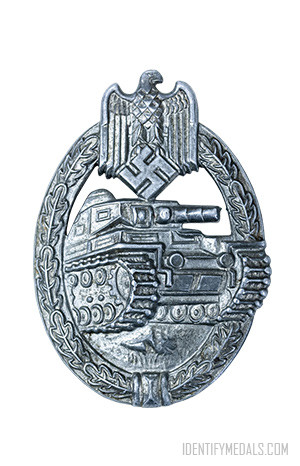
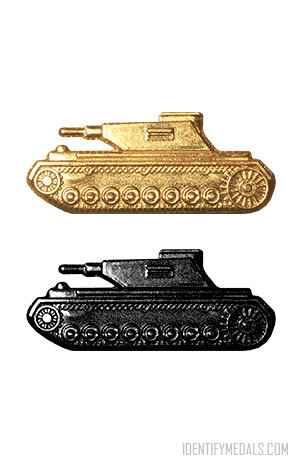
The Tank Destruction Badge showcased a Panzer IV tank, measuring 42 mm by 18 mm, which was darkened and affixed to a silver band measuring 88 mm by 33 mm. Along the top and bottom edges, there were 4 mm black stripes positioned 2 mm away.

The badge was initially pinned to the sleeve and then securely fastened by sewing. It was backed by cloth or cotton material.

There were two main versions of the Tank Destruction Badge: a silver grade and a bronze grade. The silver badge was awarded for the destruction of five or more enemy tanks, while the bronze badge was awarded for the destruction of three or four enemy tanks

More Army/Waffen-SS War Badges

The Army/Waffen-SS war badges were military decorations awarded by Nazi Germany to members of the Army (Heer) and the Waffen-SS. Explore the complete collection below:

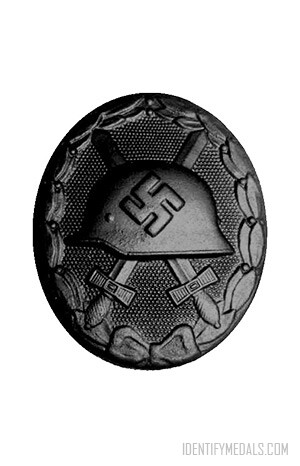
The Wound Badge (1945)

The Wound Badge (Verwundetenabzeichen) was a military decoration awarded to wounded soldiers during the Third Reich and WW2.
The Wound Badge (Verwundetenabzeichen in German) was a military decoration of Nazi Germany that was first introduced during World War I to honor soldiers who were wounded in combat. In World War II, the badge was reintroduced with modifications and continued to be awarded to soldiers who sustained injuries in the line of duty.

The Wound Badge 1945, specifically, was instituted on March 22, 1945, during the final months of World War II. This version of the badge was intended to recognize soldiers who were wounded during the last phases of the war, which were characterized by intense fighting as Allied forces advanced into German territory.

After the defeat of Nazi Germany in 1945, the Wound Badge 1945, like other military decorations of the Third Reich, ceased to be awarded. However, it remains a significant historical artifact, serving as a reminder of the human cost of war and the courage displayed by soldiers in the face of adversity.

The WW2 Wound Badge Design

Like its predecessors from World War I and earlier in World War II, the Wound Badge 1945 came in three grades: black, silver, and gold. The black badge was awarded for one or two wounds, the silver badge for three or four wounds, and the gold badge for five or more wounds, injuries resulting in total disability, loss of a limb, or permanent damage due to combat wounds.

The design of the badge remained consistent with earlier versions, featuring a helmet and crossed swords surrounded by an oak leaf wreath. The color of the badge denoted the level of injury sustained, with the black, silver, and gold grades representing increasingly severe wounds.

Recipients of the Wound Badge 1945 were entitled to wear it on the uniform, typically on the upper left breast pocket of the tunic.

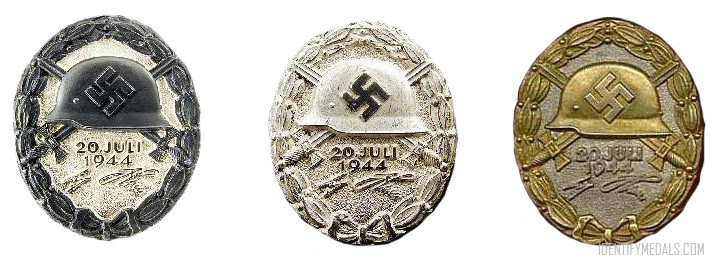
Wound Badge of 20 July 1944

The 20 July 1944 Wound Badge was only issued to those injured during the failed attempt on Adolf Hitler’s life at the Wolf’s Lair headquarters in Rastenburg, East Prussia. Hitler ordered a special wound badge to be awarded to commemorate the event, as he believed “fate had intervened” for him.

The 20 July version of the Badge shown in black, silver and gold

Hitler presented the survivors with the special wound badge as well as a unique award document. The first were in a ceremony on 20 August 1944.

Considered by collectors to be the “Holy Grailof German WWII medals, this Wound Badge is often reproduced. The best counterfeit versions are correct down to the weight and maker’s marks on the back of the award, which make it very difficult to tell the difference between an original or a fake.

Find this Decoration

Right Now on eBay 
Clicking a link to eBay may result in a referral commission being paid if a purchase is made.
Loading...

More Army/Waffen-SS War Badges

The Army/Waffen-SS war badges were military decorations awarded by Nazi Germany to members of the Army (Heer) and the Waffen-SS. Explore the complete collection below: