The Kuban Shield

The Kuban Shield is a World War II military decoration awarded to those who fought at the Kuban bridgehead in the Soviet Union.

The Kuban Shield (or Ärmelschild Kuban in German) is a World War II military decoration of Nazi Germany, awarded to those who fought at the Kuban bridgehead in the Soviet Union from February 1943 until it was abandoned in October 1943.

The criteria for award of the shield to military personnel:

  • Served in the bridgehead for 60 days; or
  • Been wounded while defending the bridgehead; or
  • Had been engaged in a single major operation at the bridgehead.

The Kuban Shield Design

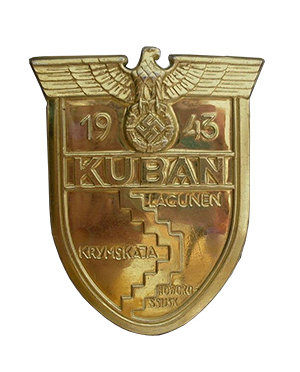
The shield is designed in a similar fashion to the Crimea Shield and was struck in sheet metal or zinc and treated with a bronzed wash.

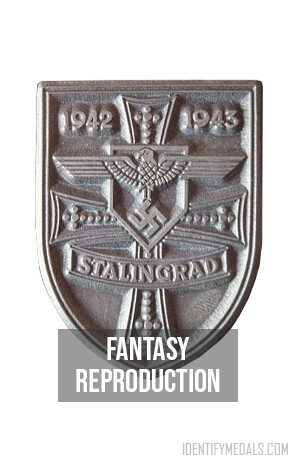
It features a German eagle with outstretched wings clutching a laurel wreath with a swastika. On each side the wreath are the numbers 19 and 43. Directly below the eagle is written KUBAN in block capital letters. Below this name is a stylized map of the Kuban region, with a line representing the defensive line that the men fought to preserve with the location of the bridgeheads – KRYMSKAJALAGUNEN, and NOWOROSSIJSK.

The shield was worn on the upper left sleeve of the tunic. A back plate, which held in place a piece of cloth matching the recipients’ branch of service, was applied to the shield:

  • Green for Heer (army)
  • Blue for Luftwaffe (air force)
  • Black for Panzer units (armoured units)

More Nazi Germany Shields (Ärmelschilde)

These campaign shields were awarded to members of the Wehrmacht (the unified armed forces of Nazi Germany from 1935 to 1945). They were given for participation in specific battles or campaigns and worn on the left upper arm of the uniform jacket.

German WW2 Nazi Awards: The Warsaw Shield

The Warsaw Shield

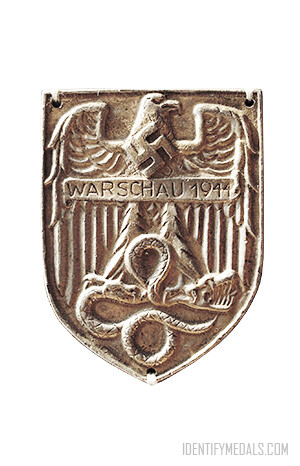
The Warsaw Shield (Ärmelschild Warschau) is a German military decoration for those who took part in the suppression of the Warsaw uprising.
Read More »

The Lappland Shield

The Lappland Shield (Lapplandschild) is a World War II German military decoration awarded to military personnel who fought in Lapland.

The Lappland Shield (or Lapplandschild in German) is a World War II German military decoration awarded to military personnel which had been fighting a two-front campaign against the advancing Finnish and Soviet Red Army forces in Lapland between November 1944 and the war’s end in May 1945.

The badge was awarded to men of General Franz Böhme’s 20th Mountain Army who had “honorably served” for six months in the region or had been wounded during operations therein. It was authorized in February 1945 and was the last officially instituted German campaign shield of the war.

The Lappland shield continued to be awarded after the end of the war in May, 1945 by the unit commander.

The Lappland Shield Design

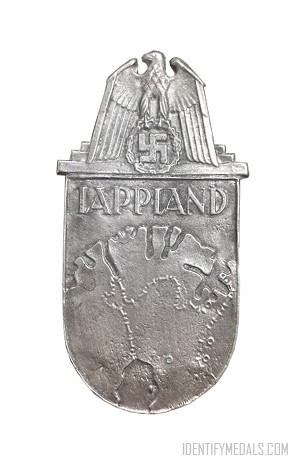
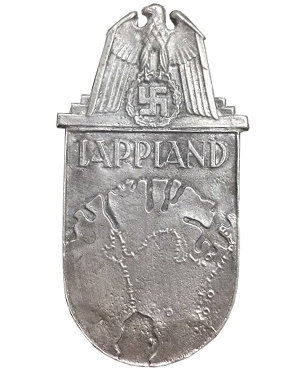
The badge consists of a basic shield with flat top and rounded bottom. It incorporates an eagle at the top but without a swastika. Directly below this, in capital letters, is written “LAPPLAND” and beneath it appears a map of the region.

Four small holes were punched in the shield to allow it to be sewn on the upper left sleeve of the uniform, however, it had no back-plate or uniform cloth section attached.

More Nazi Germany Shields (Ärmelschilde)

These campaign shields were awarded to members of the Wehrmacht (the unified armed forces of Nazi Germany from 1935 to 1945). They were given for participation in specific battles or campaigns and worn on the left upper arm of the uniform jacket.

The Demyansk Shield

Demyansk Shield is a World War II German military decoration awarded to military personnel who fought in the Demyansk pocket.

Demyansk Shield (or Ärmelschild Demjansk in German) is a World War II German military decoration instituted on 25 April 1943 by Adolf Hitler and awarded to military personnel who fought in the Demyansk pocket, achieved through the use of an airbridge.

The pocket of German troops had been encircled and cut off by the Red Army around Demyansk, south of Leningrad, during World War II on the Eastern Front. It was not bestowed after 1 July 1944.

Requirements for army, Waffen-SS and auxiliary units included honorable service in the besieged area for 60 days or wounded in the besieged area. For Luftwaffe personnel — 50 combat or re-supply missions over the besieged area.

The Demyansk Shield Design

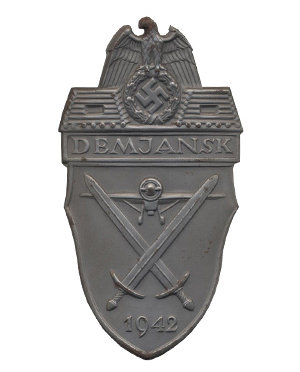
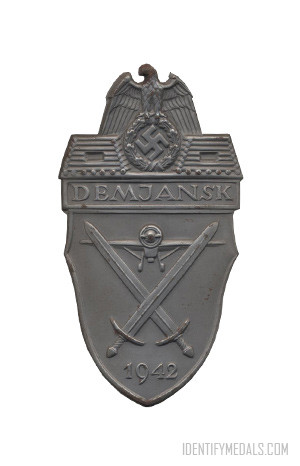
The Demyansk shield features at its apex an eagle with swooped down wings clutching a laurel wreath that surrounds a swastika in the obverse. This is flanked by two pillboxes with gun ports. Below this is capital letters is written DEMJANSK.

The central portion of shield features a head-on single engine aircraft, two crossed swords and at the base, the year 1942. Two minor variations of the aircraft’s propeller exist with either a curved or straight propeller.

The shield was die struck and produced in silver-washed zinc and later in plain zinc. It was affixed to the upper left sleeve of the uniform via a cloth that matched the color of the uniform of the recipient:

  • Light green-grey (field-grey) for Heer (army)
  • Blue for Luftwaffe (air force)
  • Black for Panzer units (armoured units)
  • Field-grey for Waffen-SS

More Nazi Germany Shields (Ärmelschilde)

These campaign shields were awarded to members of the Wehrmacht (the unified armed forces of Nazi Germany from 1935 to 1945). They were given for participation in specific battles or campaigns and worn on the left upper arm of the uniform jacket.

The Crimea Shield - German WW2 Medals, Badges and Awards

The Crimea Shield

The Crimea Shield (Krimschild) is a WW2 German military decoration awarded to military personnel who fought against Soviet Red Army forces.

Read More »
German WW2 Nazi Awards: The Warsaw Shield

The Warsaw Shield

The Warsaw Shield (Ärmelschild Warschau) is a German military decoration for those who took part in the suppression of the Warsaw uprising.
Read More »

The Crimea Shield

The Crimea Shield (Krimschild) is a WW2 German military decoration awarded to military personnel who fought against Soviet Red Army forces.

The Crimea Shield (or Krimschild in German) is a World War II German military decoration instituted on 25 July 1942 and awarded to military personnel who fought against Soviet Red Army forces and captured the Crimea region between 21 September 1941 and 4 July 1942 under the command of Generalfeldmarschall Erich von Manstein.

The Wehrmacht’s Army Group South advanced through the Crimean peninsula between the Autumn of 1941 and Summer of 1942. The hostilities that ended with the German capture of Sevastopol on 4 July 1942.

The Crimea Shield was the most widely distributed of the various German ones, with approximately 250,000 of them being awarded. It could be awarded to all members of the Wehrmacht and to Luftwaffe and other units affiliated to the campaign in the specified dates. The following conditions needed to have been met for the award:

  • Served in the area for at least 90 days; or
  • Been wounded while serving in the area; or
  • Had been engaged in at least one major operation against the enemy.

Romanian troops serving in the Crimea were also eligible for the award.

The Crimea Shield Design

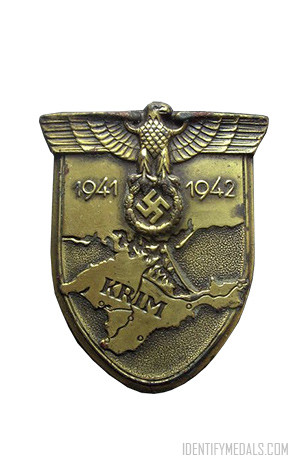
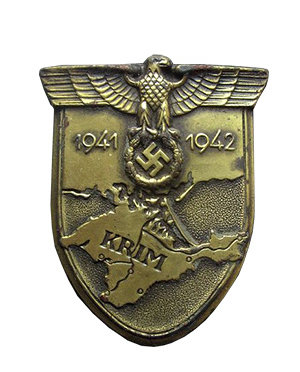
The Crimea shield is headed, on the obverse, by the German eagle clutching a laurel wreath surrounding a swastika. Flanking the eagle are the dates 1941 and 1942, which represent the start and end dates of the campaign. This sits on the backdrop of the Crimean peninsula, where the fighting took place, which has the word KRIM stamped across it.

A special pure-gold version of the Crimea Shield was also produced and first bestowed upon Marshal Ion Antonescu, the military dictator of Romania, at the end of the Siege of Sevastopol on 3 July 1942. It was awarded to him in Bucharest by Erich von Manstein, on Adolf Hitler’s behalf. The second and last Golden Krimschild was awarded to von Manstein himself, on 24 November 1942.

More Nazi Germany Shields (Ärmelschilde)

These campaign shields were awarded to members of the Wehrmacht (the unified armed forces of Nazi Germany from 1935 to 1945). They were given for participation in specific battles or campaigns and worn on the left upper arm of the uniform jacket.

The Cholm Shield

The Cholm Shield (Cholmschild) is a World War II German military decoration awarded to those who fought in the Cholm Pocket.

The Cholm Shield (or Cholmschild in German) is a World War II German military decoration instituted on 1 July 1942 and awarded to those who fought in the Cholm Pocket between 21 January and 5 May 1942.

In January 1942, the Soviet Red Army began a series of counteroffensives against the German Army, while the German occupied city of Cholm. By the end of January the city was surrounded and cut off which led to the creation of the Kholm Pocket. A mixed group of Wehrmacht, Luftwaffe and police personnel led by Generalleutnant Theodor Scherer were supplied by air until they were relieved on 5 May 1942.

To receive the shield, military personnel had to:

  • Have served honourably within the Cholm Pocket between the specified dates; or
  • Have flown and landed at the airfield within the pocket for resupply operations

The Cholm Shield is the rarest of the German combat shields with approximately 5,500 recipients. Bestowing of the award ceased as of 1 April 1943.

The Cholm Shield Design

The design of the commemorative shield was done by Polizei-Rottwachtmeister Schlimmer and sent to Adolf Hitler for approval. Professor Richard Klein made a few minor changes to the design.

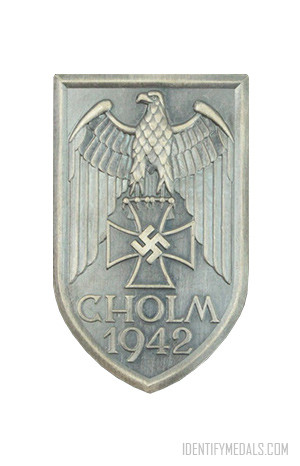
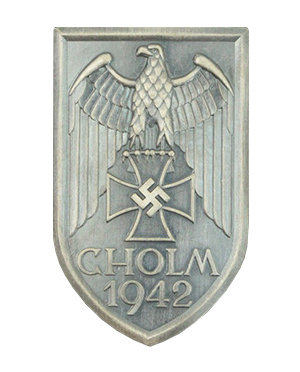
The award features the outline of a shield with a large “open-winged” Wehrmacht-style eagle grasping an Iron Cross with a swastika at its center. Below, in capital letters, is written CHOLM and the date 1942In 1957, the Cholm Shield was denazified (removal of the swastika) to allow recipients to wear the shield on their uniform.

All shields were hollow stamped metal washed in silver. A backing plate was attached to the shield with a number of prongs and affixed to a piece of coloured cloth. The Cholm Shield was worn on the left upper sleeve of the uniform of soldiers and airmen. For civilian clothes a smaller shield roughly 16mm across with a needle fitting could be worn on the left lapel.

More Nazi Germany Shields (Ärmelschilde)

These campaign shields were awarded to members of the Wehrmacht (the unified armed forces of Nazi Germany from 1935 to 1945). They were given for participation in specific battles or campaigns and worn on the left upper arm of the uniform jacket.

The Narvik Shield

The Narvik Shield (Narvikschild) is a WW2 German military decoration awarded to German forces that took part in the battles of Narvik.

The Narvik Shield (or Narvikschild in German) is a World War II German military decoration awarded to all German forces that took part in the battles of Narvik between 9 April and 8 June 1940.

The decoration was instituted on 19 August 1940 by Adolf Hitler. The Oberkommando der Wehrmacht (OKW) published the order the same day.

A total of 8,577 military personnel received the award. It was bestowed by General Eduard Dietl, the commander of Army Group Narvik.

In 1957, the Narvik Shield, along with many other German military decorations of World War II, was reauthorized for wear by qualifying veterans. The new version was without the eagle and swastika symbol of the Third Reich.

The Narvik Shield Design

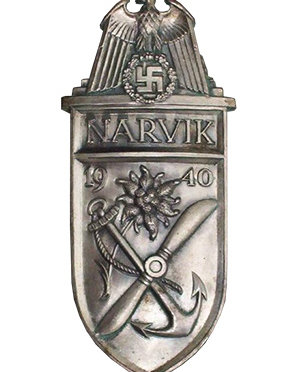
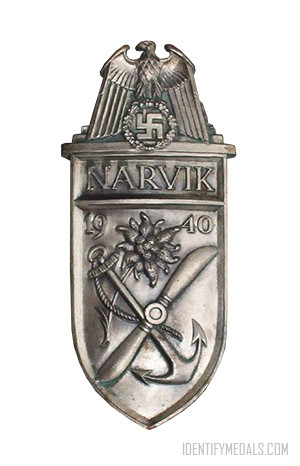
Designed by Professor Dr Richard Klein of Munich, the narrow shield features a pointed bottom and, at its apex, an eagle with down-swept wings clutching a laurel wreath that surrounds a swastika. Below this in capital letters is written NARVIK.

The body of the shield features an edelweiss (representing the Heer mountain troops), an anchor (representing the Kriegsmarine), and propeller (for the Luftwaffe). The anchor and propeller are crossed, with the edelweiss placed at the top of the X. The numbers 19 and 40 appear at the top corners of the main body of the shield.

The shield was hollow backed and stamped from sheet metal which was usually zinc. It was worn on the upper left arm of the uniform. The shield was awarded in two versions; silver-gray versions for army and Luftwaffe and a gilded (golden coloured) version for Kriegsmarine.

More Nazi Germany Shields (Ärmelschilde)

These campaign shields were awarded to members of the Wehrmacht (the unified armed forces of Nazi Germany from 1935 to 1945). They were given for participation in specific battles or campaigns and worn on the left upper arm of the uniform jacket.

The Narvik Shield - German WW2 Medals, Badges and Awards

The Narvik Shield

The Narvik Shield (Narvikschild) is a WW2 German military decoration awarded to German forces that took part in the battles of Narvik.

Read More »

The U-boat War Badge (Nazi Germany)

The U-boat War Badge (or U-Boot-Kriegsabzeichen) was a German war badge that was awarded to U-boat (submarine) crew members in WW2.

The U-boat War Badge (or U-Boot-Kriegsabzeichen in German) was a German war badge that was awarded to U-boat (submarine) crew members during World War I and World War II.

The original U-boat War Badge was originally instituted during WW1 on February 1, 1918, to recognize U-boat crews who had completed three war patrols. On October 13, 1939, the U-boat War Badge was reinstituted and bestowed in two classes:

  • U-Boat War Badge: For the completion of two or more war patrols. Completing two war patrols could be equally dangerous as the U-boat has to endure constant attacks by Allied aircraft and warships. The other occasion when this badge was awarded was having been wounded during a patrol or killed in action.
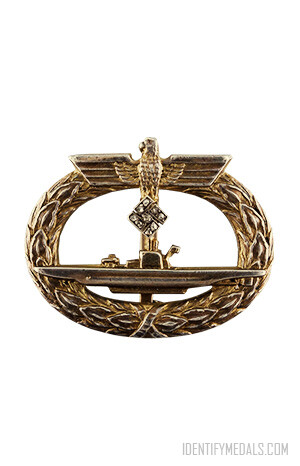
  • U-boat War Badge with Diamonds: It was instituted by Großadmiral Karl Dönitz after he had received from Grand Admiral Erich Raeder a special solid gold version of the U-boat War Badge in which the wreath as well as the swastika were inlaid with diamonds.

This second version of the badge was a special issue award given to U-boat commanders who had received the Knight’s Cross of the Iron Cross with Oak Leaves. Made of gold plate over silver and manufactured by Schwerin u. Sohn and Gebr. Godet & Co., it was the same as the basic pattern but with nine small diamonds inlaid in the swastika. 

This award was more of a personal award by Dönitz, and approximately 30 were awarded, including the original one to Admiral Dönitz.

The U-Boat War Badge Design

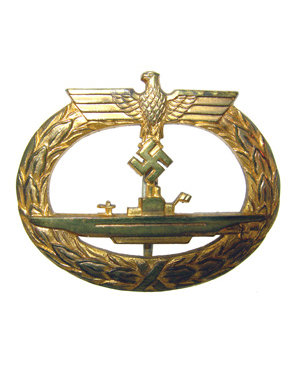
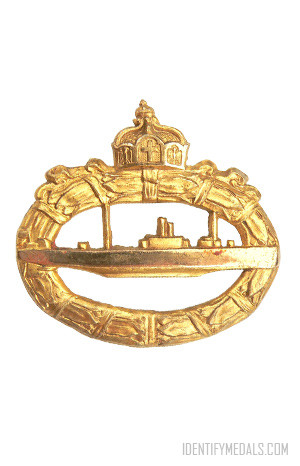
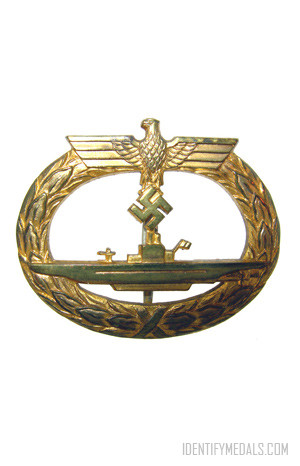
The badge was worn on the lower left side of the uniform and was oval shaped resembling a wreath of laurel leaves. A submarine lay across the center and the German State Crown was inlaid at the top center of the wreath.

The 1939 version was very similar to the original badge with the exception of the imperial crown being replaced with a German Eagle above a swastika, and a more modernized submarine now facing towards the left was used.

The new version was first made of bronze metal, with later ones made of zinc with a “gold wash”.

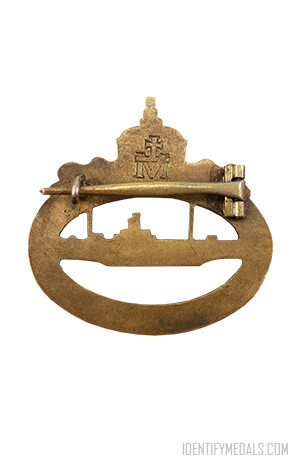
Imperial U-Boat Badge, reverse.
Imperial U-Boat Badge, reverse. The "M" is an original maker mark but the manufacturer is unknown.
The U-boat War Badge - German WW1 Medals & Badges
The WW1 U-boat War Badge - Obverse.
U-Boat Badge with diamonds, reverse.
German WW2 U-Boat Badge with diamonds. 1939 version, obverse.

Find an U-Boat War Badge

Right Now on eBay 
Clicking a link to eBay may result in a referral commission being paid if a purchase is made.
Loading...

More Naval War Badges

The Naval War Badges (Kriegsmarine) badges were awarded to sailors, officers, and personnel of the Kriegsmarine who demonstrated exceptional skill, bravery, and dedication in naval warfare. Explore the complete collection below:

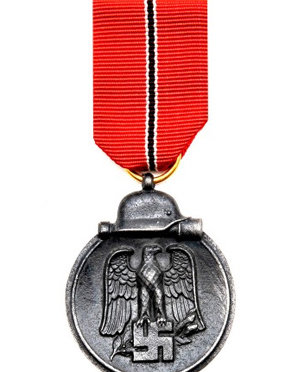
The Eastern Front Medal Winterschlacht im Osten

The Eastern Front Medal was a World War II German military decoration awarded to those who served during the winter campaign.

The Eastern Front Medal (or Medaille „Winterschlacht im Osten 1941/42“) was a World War II German military decoration awarded to both German and Axis personnel. It was awarded to those who served on the German Eastern Front during the winter campaign period of 15 November 1941 to 15 April 1942.

The medal was instituted on 26 May 1942 and was commonly known as the Ostmedaille (East Medal) or Russian Front Medal.

The medal was wryly called the Frozen Meat Medal or the “Order of the Frozen Flesh” (or Gefrierfleischorden in German) by Heer, Luftwaffe and Waffen-SS personnel to whom it was awarded. Armed service personnel qualified for the badge after a minimum of 14 days served in active combat; 30 combat sorties for Luftwaffe members; 60 days of continuous service in a combat zone; being wounded or suffering a “frozen limb”, severe enough to warrant the issue of a Wound Badge.

The medal could be awarded posthumously. It was officially decommissioned by Oberkommando der Wehrmacht on 4 September 1944.

The Eastern Front Medal Design

The medal measures 3.6 cm (1.4 in) in diameter, and is generally made of zinc. The medal was given a gun-metal coloured coating.

The concave obverse side features a national socialist eagle grasping a swastika with laurel behind.

The reverse features the text in capital letters: “WINTERSCHLACHT IM OSTEN 1941/42” (“Winter Battle in the East 1941/42”) featuring a crossed sword and branch below the text. A helmet and stick grenade below the medal loop as well as outer ring were finished in a polished silver effect.

The ribbon featured a central white-black-white (white for snow, black for the fallen soldiers) stripe with red (for blood) either side. The medal and ribbon were presented in a paper packet with the name of the medal on the front and the maker name on the reverse.

Buy an Eastern Front Medal

Note: As an eBay partner, I earn from qualifying purchases. This is all done automatically when you use a link and at no extra cost to you.

Right Now on eBay 
Clicking a link to eBay may result in a referral commission being paid if a purchase is made.
Loading...

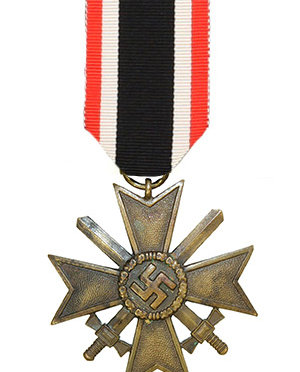
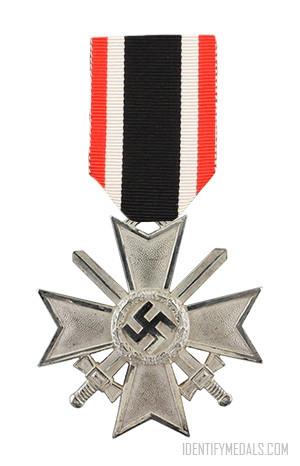
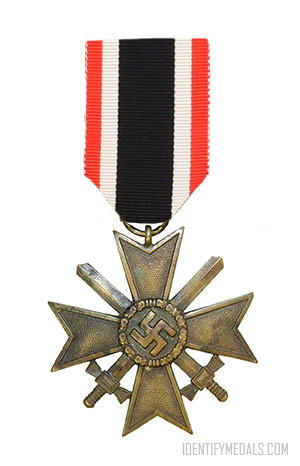
The War Merit Cross (With Swords)

The War Merit Cross was a decoration of Nazi Germany during the Second World War awarded to military personnel and civilians.

The War Merit Cross (or Kriegsverdienstkreuz in German) was a decoration of of Nazi Germany awarded to military personnel and civilians during the Second World War. It was created by Adolf Hitler in October 1939 as a successor to the non-combatant Iron Cross which was used in earlier wars.

The award had four variantswith swords given to soldiers for exceptional service “not in direct connection with combat”, without swords given to civilians for meritorious service in “furtherance of the war effort”, the Knights Cross of the War Merit Cross, and the rare Knight’s Cross of the War Merit Cross in Gold

The War Merit Cross 2nd Class with Swords was presented to Military Personnel for bravery not necessarily in the face of the enemy, and in reality there was a gray area in which individuals received the medal when perhaps the non-combatant grade would have been appropriate.  A total of 6,134,950 were issued.

By the end of the war the War Merit Cross was issued in four degrees and had a related civil decoration. It was reissued in 1957 by the Bundeswehr in a de-Nazified version for veterans.

The War Merit Cross With Swords Design

The medal consists of a bronze plated Maltese Cross. The obverse has pebbled arms, with a central wreathed mobile swastika and crossed swords piercing the centrepiece. The reverse has a block hinge and a banjo-style pinback. The War Merit Cross measures 48.51 mm (w) x 48.48 mm (h) and weighs 17.6 grams.

Materials

War Merit Cross with Swords was constructed from a wide range of materials, from zinc with a bronzed wash to a few very rare bronze pieces. As the war progressed, the quality of the materials decreased, and as a result late war crosses lose their bronze wash with the passing of time, yielding a gray appearance.

Ribbon

The ribbon of the War Merit Cross with Swords was in red-white-black-white-red (the colors being reversed from the ribbon of the World War II version of the Iron Cross). The ribbon for the War Merit Medal was similar, but with a narrow vertical red strip in the center of the black field.

Classes

The War Merit Cross without Swords 1st Class was a pin-backed medal worn on the pocket of the tunic. The ribbon of the War Merit Cross without Swords 2nd Class could be worn like the ribbon of the Iron Cross 2nd Class (through the second buttonhole). Combat soldiers tended to hold the War Merit Cross in low regard, referring to its wearers as being in ‘Iron Cross Training’.

Order of Wear

The War Merit Cross with Swords was a neck decoration and worn the same way as the Knights Cross of the Iron Cross.

Medal Variations

The War Merit Cross came in several variations, each with specific criteria and significance:

  1. War Merit Cross 2nd Class: Awarded with swords for bravery in combat or without swords for meritorious service in a non-combat role. This was worn as a ribbon on the uniform.

  2. War Merit Cross 1st Class: A higher distinction, awarded with or without swords, worn as a pin on the chest.

  3. Knights Cross of the War Merit Cross: The highest grade, also with or without swords, for exceptional service.

Find this Medal Online

Right Now on eBay 
Clicking a link to eBay may result in a referral commission being paid if a purchase is made.
Loading...

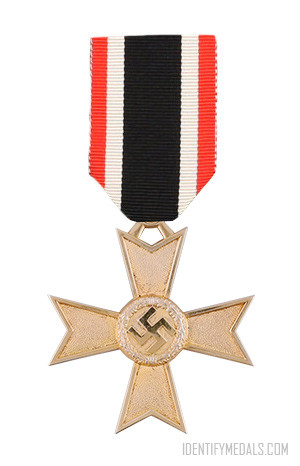
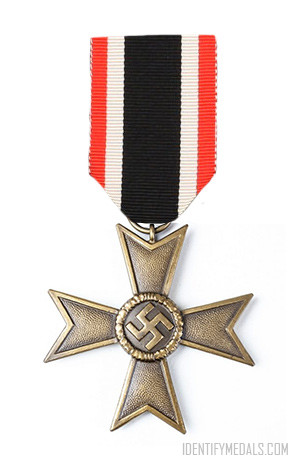
The War Merit Cross (Without Swords)

The War Merit Cross was a decoration of Nazi Germany during the Second World War awarded to military personnel and civilians.

The War Merit Cross (or Kriegsverdienstkreuz in German) was a decoration of Nazi Germany awarded to military personnel and civilians during the Second World War. It was created by Adolf Hitler in October 1939 as a successor to the non-combatant Iron Cross which was used in earlier wars.

The award had four variantswith swords given to soldiers for exceptional service “not in direct connection with combat”, without swords given to civilians for meritorious service in “furtherance of the war effort”, the Knights Cross of the War Merit Cross, and the rare Knight’s Cross of the War Merit Cross in Gold

The War Merit Cross 2nd Class without swords was presented to those whose actions were deemed to be in the furtherance of the war effort but not directly involved in military operations, for example teachers, industrialists, or Military personnel on occupation duty or POW camp guards. A total of 1,591,5673 medals were issued.

By the end of the war the War Merit Cross was issued in four degrees and had a related civil decoration. It was reissued in 1957 by the Bundeswehr in a de-Nazified version for veterans.n

The War Merit Cross Without Swords Design

The medal consists of a bronze plated Maltese Cross. The obverse has pebbled arms, with a central wreathed mobile swastika and crossed swords piercing the centrepiece. The reverse has a block hinge and a banjo-style pinback. The War Merit Cross measures 48.51 mm (w) x 48.48 mm (h) and weighs 17.6 grams.

Materials

The War Merit Cross without Swords was constructed from a wide range of materials, from zinc with a bronzed wash to a few very rare bronze pieces. As the war progressed, the quality of the materials decreased, and as a result late war crosses lose their bronze wash with the passing of time, yielding a gray appearance.

Ribbon

The ribbon of the War Merit Cross without Swords was in red-white-black-white-red (the colors being reversed from the ribbon of the World War II version of the Iron Cross). The ribbon for the War Merit Medal was similar, but with a narrow vertical red strip in the center of the black field.

Classes

The War Merit Cross without Swords 1st Class was a pin-backed medal worn on the pocket of the tunic. The ribbon of the War Merit Cross without Swords 2nd Class could be worn like the ribbon of the Iron Cross 2nd Class (through the second buttonhole). 

Order of Wear

The War Merit Cross without Swords was a neck decoration and worn the same way as the Knights Cross of the Iron Cross.

Medal Variations

Find this Medal Online