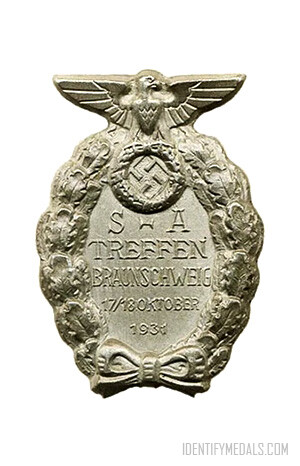
The Brunswick Rally Badge

The Brunswick Rally Badge was established in 1936 and was the third badge to be recognized as a national award by the Nazi Party (NSDAP).

The Brunswick Rally Badge, officially known as the Badge of the SA Rally at Brunswick 1931 (or Das Abzeichen vom SA – Treffen in Braunschweig 1931 in German), was the third badge to be recognized as a national award by the Nazi Party (NSDAP).

Established through regulations issued on November 6, 1936, this special Party Honor Badge commemorated the SA Assembly in Braunschweig, Lower Saxony, held on October 17-18, 1931.

The Rally Event

The Brunswick rally was a significant joint event involving members of the Sturmabteilung (SA) and Schutzstaffel (SS). It aimed to demonstrate the strength and solidarity of these paramilitary groups in a Germany weary from internal strife and political instability.

Held before Adolf Hitler became Chancellor in January 1933, the rally saw a massive participation of 104,000 SA and SS men who marched in a six-hour parade reviewed by Hitler. This event also marked the first inspection of the SA Motor and National Socialist Motor Corps (NSKK) units.

The rally was organized by SA-Gruppe Nord under the leadership of then SA-Gruppenführer Viktor Lutze. During the event, the SA pledged their loyalty to Hitler, who in turn expanded the SA by creating 24 new Standarten (regiment-sized formations). Hitler later rewarded Lutze’s loyalty by appointing him as the commander of the SA in 1934, following the purge of Ernst Röhm during the Night of the Long Knives.

The Brunswick Rally Badge Design

The Brunswick Rally Badge was created to commemorate this large-scale rally and honor its participants. To qualify for purchasing and wearing the badge, one had to have officially attended the rally. The badge was worn on the left breast of the uniform and was made in two patterns.

  • Pattern 1: Measuring 37mm wide by 50mm high, it featured the Party eagle at the top and an oak leaf wreath around the edge, with a bow at the bottom. Inside the wreath was inscribed “S—A Treffen Braunschweig 17./18. Oktober 1931.”
  • Pattern 2: Slightly larger at 37mm wide by 52mm high, it retained the same basic design as the first pattern. Early badges were stamped out of tin and silver in color, while later ones were stamped with a solid back and were grey.

Permission to wear the badge had to be confirmed by a senior SA Party leader or higher, and the authorization to wear it could be revoked by SA-Stabschef Viktor Lutze or his successors.
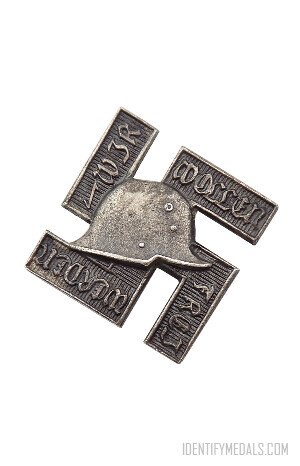
The Frontbann Badge

The Frontbann Badge was introduced in 1932 by the SA Group Berlin-Brandenburg to honor the members of the Frontbann organization.

The Frontbann Badge (or Frontbannabzeichen in German) was introduced in 1932 by the SA Group Berlin-Brandenburg to honor the members of the Frontbann organization.

This badge was awarded to individuals who had joined the Frontbann before December 31, 1927, and who also had been members of the Nazi Party or another right-wing paramilitary group prior to that date. 

In 1933, it was officially recognized as a Nazi Party decoration. However, by the end of 1934, the badge was no longer authorized for wear by members of the NSDAP.

The Frontbann Badge Design

The badge was made of silver, featured a pin-back, and measured 20 mm in diameter.

Its design included a swastika with a German helmet at the center, and the inscription “WIR-WOLLEN-FREI-WERDEN” (“We want to be free”) on the arms of the swastika.

The Nazi Party Long Service Award

The Nazi Party Long Service Award was a distinguished political decoration presented in the form of a badge by the Nazi Party.

The Nazi Party Long Service Award, officially known as Die Dienstauszeichnung der NSDAP in German, was a distinguished political decoration presented in the form of a badge by the Nazi Party.

Instituted on April 2, 1939, by Adolf Hitler, this award recognized long-term service of male and female members of the NSDAP. The decoration was first bestowed on January 30, 1940. 

Due to the Nazi Party’s relatively short existence (1920–1945), the awards were granted before the actual service years were completed. The period from February 1925 to January 1933 was considered the “Kampfzeit” (Time of Struggle), and service during this time was counted double. Continuous service in any Nazi Party organization or formation qualified, with exceptions for up to two years of compulsory military service, military service against the Republican Government in the Spanish Civil War (1936-1939), and German military service post-September 1939.

The Nazi Party Long Service Award Classes

The award featured three classes: ten years (bronze), fifteen years (silver), and twenty-five years (gold).

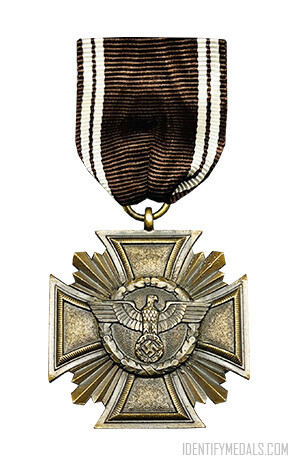
Ten-Year Award: The ten-year service medal (3rd class) was a bronze medal measuring 43mm, suspended from a dark brown ribbon with two narrow white side stripes. The reverse side featured raised lettering.

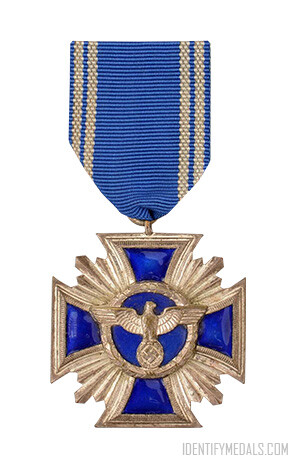
Fifteen-Year Award: The fifteen-year service medal (2nd class) had a similar design but was plated in silver and featured dark blue enamel on the cross arms and the center section. The reverse side inscription was in blue enamel with silver lettering. The ribbon was blue with two narrow silver-gray side stripes.

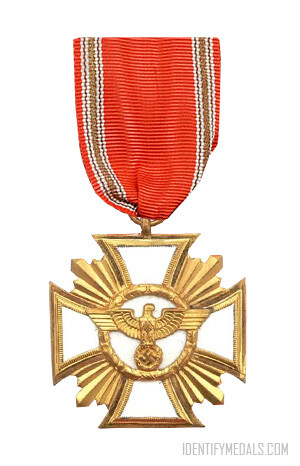
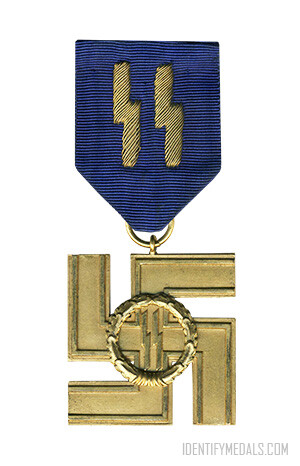
Twenty-Five-Year Award: The twenty-five-year service medal (1st class) was gold-plated with white enamel on the cross arms and center section. The reverse inscription was white enamel with gold lettering. The ribbon was red with white edge stripes and a small gold center stripe. This medal was sometimes awarded posthumously.

Nazi Party Long Service Award - 25 Years.
Nazi Party Long Service Award - 10 Years.
The Nazi Party Long Service Award - Germany Medals, Interwar
The Nazi Party Long Service Award - 15 Years.
Nazi Party Long Service Award - 25 Years.

The Nazi Party Long Service Award Design

Each medal bore the inscription “Treue für Führer und Volk” (Loyalty to Leader and People) on the reverse side. The service award was a four-pointed cross with slightly curved arms, featuring a national eagle and an oak leaf wreath at the center.

When awarded to men, the medals were worn on the left breast pocket medal bar. Women wore the award as a neck order or a brooch medal from a 15mm ribbon. On the small ribbon bar, the ribbon included a small national eagle within a wreath in the class-specific color.

All three classes could be worn simultaneously.

The Blood Order or Blutorden

The Blood Order or Blutorden was a highly prestigious Nazi Party decoration established by Adolf Hitler in March 1934.

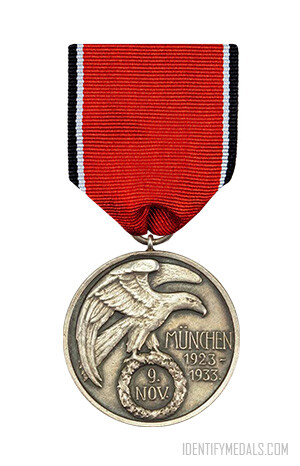
The Blood Order (or Blutorden in German), formally known as the Decoration in Memory of 9 November 1923 (Medaille zur Erinnerung an den 9. November 1923), was a highly prestigious Nazi Party decoration.

Established by Adolf Hitler in March 1934, it commemorated the failed Beer Hall Putsch of November 9, 1923. 

Initially, the Blood Order was awarded to 1,500 putsch participants who were members of the Nazi Party or its formations before January 1932, or cadets from the Munich Infantry School. These first medals, made of 99% pure silver, were carefully numbered except for those given to Hitler and Göring. Recipients wore the ribbon on the right breast in a rosette form, with the medal sometimes pinned below.

In May 1938, eligibility expanded to include those imprisoned or sentenced to death for Nazi activities before 1933, those severely wounded in service of the Party, Austrian Nazi participants in the 1934 July Putsch, and others at Hitler’s discretion. Reinhard Heydrich was the last posthumous recipient.

The Blood Order or Blutorden Rank

Holders who left the Nazi Party had to return the medal. Among the recipients were 16 women, with fewer than 6,000 total awards given, including the original putsch participants and those from the 1938 extensions.

Hitler’s 1936 “Orders and Awards” decree ranked the Blood Order fifth among top NSDAP honors, after the Coburg Badge, Nürnberg Party Badge of 1929, SA Treffen at Brunswick 1931, and the Golden Party Badge, followed by Gau badges and the Golden HJ Badge.

The Blood Order or Blutorden Design

The medal is silver, featuring an eagle clutching an oak wreath with the date “9. Nov” and “München 1923–1933” inscribed on the obverse. The later medals, struck in 80% silver, carried serial numbers above 1500 and lacked the maker’s name, unlike the initial Type I medals. 

The reverse shows the Feldherrnhalle entrance, a swastika with sun rays, and the motto “UND IHR HABT DOCH GESIEGT” (“And after all, you won”).

The NSDAP Golden Party Badge

The NSDAP Golden Party Badge was one of the most prestigious decorations awarded by the party during the Third Reich era in Germany.

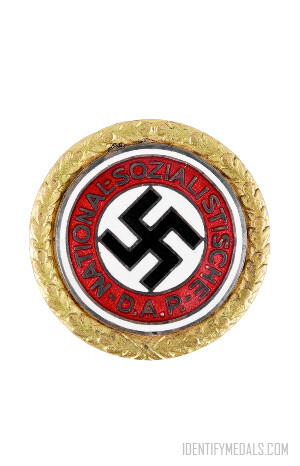
The NSDAP Golden Party Badge, or Gold Party Badge, was one of the most prestigious decorations awarded by the National Socialist German Workers’ Party (NSDAP) during the Third Reich era in Germany. Instituted in 1933, it was primarily intended to honor loyal and long-standing members of the Nazi Party who had made significant contributions to the party’s cause.

The awarding of the Golden Party Badge was a highly prestigious honor, signifying the recipient’s status as a trusted and valued member of the Nazi Party elite. It was often presented in formal ceremonies or special events, further emphasizing its significance within the party hierarchy.

The criteria for receiving the Golden Party Badge were stringent, requiring a minimum of ten years of uninterrupted membership in the NSDAP, along with a record of exceptional service and dedication to the party’s goals. Additionally, candidates needed the personal approval of Adolf Hitler himself.

The NSDAP Golden Party Badge Design

The NSDAP gold badge was crafted in solid gold and features the Nazi Party eagle emblem surrounded by a wreath of oak leaves in the obverse.

The badge was available in two sizes: 30mm for uniform wear and 25mm for civilian attire. On the reverse of each badge is a unique membership number. The value of the badge increases as the serial number on the reverse decreases. Adolf Hitler wore the NSDAP badge number 7.

Two authorized manufacturers produced the badge: Deschler & Sohn and Joseph Fuess, both headquartered in Munich. Recipients wore the NSDAP badge on the left breast of their uniform, symbolizing their allegiance to the Nazi ideology and leadership.

The Coburg Badge

The Coburg Badge (Das Coburger Abzeichen in German) was the first badge recognized as a national award of the Nazi Party or NSDAP.

The Coburg Badge (or Das Coburger Abzeichen in German) was the first badge recognized as a national award of the Nazi Party or NSDAP.

Adolf Hitler ordered the Coburg Badge to be struck on 14 October 1932 to memorialize the event which took place ten years earlier, on Saturday, 14 October 1922. On that day, Hitler led 800 members of the SA from Munich and other Bavarian cities by train to Coburg for a weekend rally. Once there, numerous pitched street battles with leftists and communists occurred. In the end, the final victory belonged to the Nazis. Later, the day was known as the Deutscher Tag in Coburg (German Day in Coburg). Hitler had one his first decisive victory, as it was to become Nazi folklore and led to the expression, in ardent Nazi circles, ‘But were you at Coburg?

The badge was declared an official party and national decoration in a decree signed by Hitler, on 6th November 1936, who had taken a personal interest in the design. Only 436 names were entered on the official party roll of recipients who were entitled to the badge.

On 1 August 1939, Reichsfuhrer-SS Heinrich Himmler decreed that any SS member (whether enlisted or officer) who wore the Coburg Badge was eligible to wear the Totenkopf ring.

The Coburg Badge Medal Design

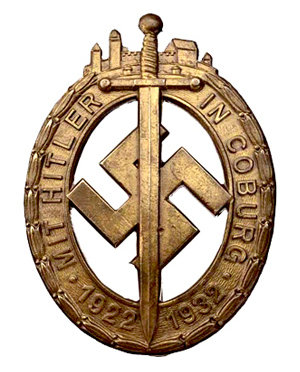
The award consists of an oval, slightly convex badge that was originally produced in massive bronze. It is 40mm wide and 54mm high, with a narrow wreath of laurel leaves around its edge measuring 2 mm across.

The badge features, in the obverse, a sword placed tip downward across the face of a swastika within an oval wreath of three leaves in each bunch and two berries at their tips. There are ten bunches on either side and the top two bunches on either side do not have the laurel berries. At the top of the wreath is Coburg Castle and village. The Castle has two spires on the viewer’s left with a large roofed building and a small adjacent pinnacle on the right. The wreath contains the words, “MIT HITLER IN COBURG 1922-1932″ (with Hitler in Coburg 1922-1932). Inside the wreath is a flat field that measures 4 mm, with a raised 0.5 mm line.  The central oval void has a large swastika measuring 16 mm across and the width of the individual arms is 4 mm. From the top of the badge, superimposed over the castle and swastika is a double-edged sword with straight quillons, twisted grip handle and a pronounced ball pommel.

The reverse is plain with a thin hinge and a pin that has a circular retainer and a ‘C’ type hook at the bottom. There is a second version of the badge which is thinner and has the RZM mark on the reverse.

The SS Long Service Award (4 Years of Service)

The SS Long Service Awards were given in grades of four years, eight years, twelve years, and twenty-five years of true services in the SS.

The SS Long Service Awards (or SS-Dienstauszeichnungen in German) were given in grades of four years, eight years, twelve years, and twenty-five years as an acknowledgment for faithful and true services of SS members in the SS-Verfügungstruppen (SS Dispositional Troops), SS-Totenkopfverbänden (Death’s Head Units) und SS-Junkerschulen (Junker Schools). It was first introduced by Adolf Hitler on 30 January 1938.

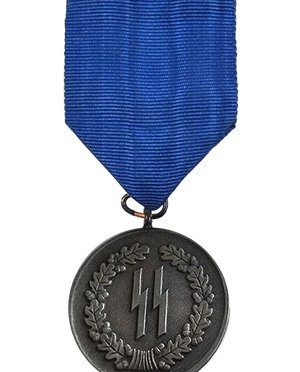
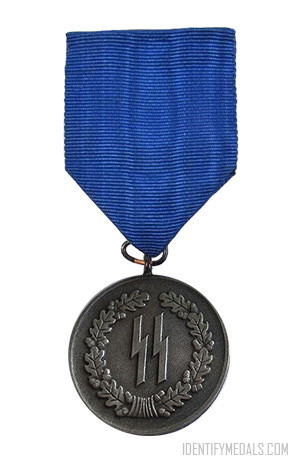
The SS Long Service Award for 4 years of service was the first and lowest class in the hierarchy of the SS long service awards. The 4-year award was specifically given to non-commissioned officers (NCOs) and enlisted men, recognizing their service within the SS.

The SS Long Service Awards Grades or Classes

The grades are awarded to the respective ranks as follows:

  • 1st Class (Gold) for 25 years true service awards to eligible Officers, NCO’s and Men
  • 2nd Class (Silver) for 12 years true service awards to eligible Officers, NCO’s and Men
  • 3th Class (Bronze) for 8 years true service awards to eligible Officers, NCO’s and Men
  • 4th Class (Black) for 4 yrs true service for eligible NCO’s and Men.

The four-year and eight-year awards were the most common awards, and despite the fact that the Nazi movement lasted for little over 25 years, awards of the 25-year version were made well before 25 years of actual service were completed. This was because Kampfzeit (or “Time of Struggle”) counted double. Nevertheless, this was one of the rarer awards given out by Nazi Germany.

The SS Long Service Awards Design

The SS service awards were designed in Munich by Professor Karl Diebitsch, an artist and the Schutzstaffel (SS) officer responsible for designing much of the SS regalia in the Third Reich, including the chained SS officer’s dagger scabbard.

On its reverse side, each award had emblazoned the inscription, in German: FÜR TREUE DIENSTE IN DER SS (“For Loyal Service in the SS”). 

The awards varied in design depending on the length of service of the recipient, and the branches of the Wehrmacht (LuftwaffeHeer and Kriegsmarine) had different insignia. The Nazi Party and German Police also had a similar service award.

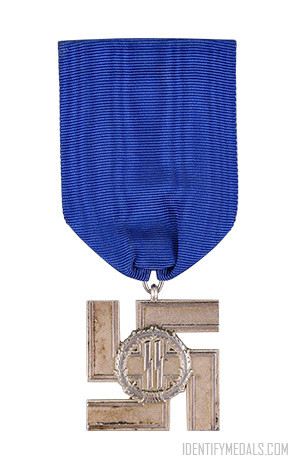
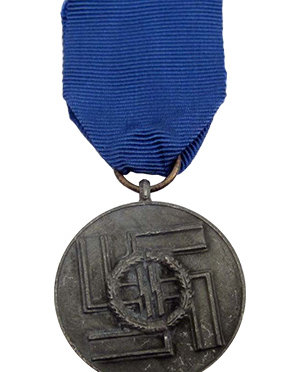
The four and eight-year service awards were in the form of circular medals while the 12 and 25-year service awards were in the form of swastikas.  According to historian Chris Ailsby the awards ceased to be given at the end of 1941.

The four-year service award featured a black finish and was exclusively given to non-commissioned officers (NCOs) and enlisted men. The use of black enamel and the SS runes emphasized the connection to the SS organization. 

The SS Long Service Award (8 Years of Service)

The SS Long Service Award (8 Years) was given as an acknowledgment for faithful and true services of German SS members.

The SS Long Service Awards (or SS-Dienstauszeichnungen in German) were given in grades of four years, eight years, twelve years, and twenty-five years as an acknowledgment for faithful and true services of SS members in the SS-Verfügungstruppen (SS Dispositional Troops), SS-Totenkopfverbänden (Death’s Head Units) und SS-Junkerschulen (Junker Schools). It was first introduced by Adolf Hitler on 30 January 1938.

The four and eight-year service awards were in the form of circular medals while the 12 and 25-year service awards were in the form of swastikas.  According to historian Chris Ailsby the awards ceased to be given at the end of 1941.

The SS Long Service Awards Grades or Classes

The grades are awarded to the respective ranks as follows:

  • 1st Class (Gold) for 25 years true service awards to eligible Officers, NCO’s and Men
  • 2nd Class (Silver) for 12 years true service awards to eligible Officers, NCO’s and Men
  • 3th Class (Bronze) for 8 years true service awards to eligible Officers, NCO’s and Men
  • 4th Class (Black) for 4 yrs true service for eligible NCO’s and Men.

The four-year and eight-year awards were the most common awards, and despite the fact that the Nazi movement lasted for little over 25 years, awards of the 25-year version were made well before 25 years of actual service were completed. This was because Kampfzeit (or “Time of Struggle”) counted double. Nevertheless, this was one of the rarer awards given out by Nazi Germany.

The SS Long Service Awards Design

The SS service awards were designed in Munich by Professor Karl Diebitsch, an artist and the Schutzstaffel (SS) officer responsible for designing much of the SS regalia in the Third Reich, including the chained SS officer’s dagger scabbard.

On its reverse side, each award had emblazoned the inscription, in German: FÜR TREUE DIENSTE IN DER SS (“For Loyal Service in the SS”). 

The awards varied in design depending on the length of service of the recipient, and the branches of the Wehrmacht (LuftwaffeHeer and Kriegsmarine) had different insignia. The Nazi Party and German Police also had a similar service award.

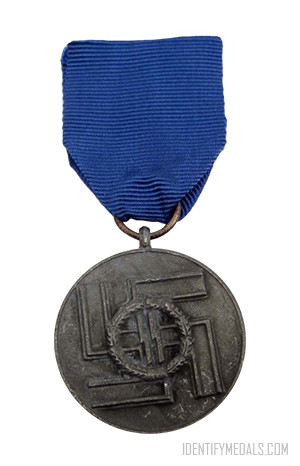
The eight-year service award was finished in bronze and was awarded to all Officers, NCOs and enlisted men. The eight-year service medal was manufactured by the firm Deschler.

The SS Long Service Award (12 Years of Service)

The SS Long Service Awards were given to SS members in grades of four, eight, twelve, and twenty-five years of service.

The SS Long Service Awards (or SS-Dienstauszeichnungen in German) were given in grades of four years, eight years, twelve years, and twenty-five years as an acknowledgment for faithful and true services of SS members in the SS-Verfügungstruppen (SS Dispositional Troops), SS-Totenkopfverbänden (Death’s Head Units) und SS-Junkerschulen (Junker Schools). It was first introduced by Adolf Hitler on 30 January 1938.

The four and eight-year service awards were in the form of circular medals while the 12 and 25-year service awards were in the form of swastikas.  According to historian Chris Ailsby the awards ceased to be given at the end of 1941.

The SS Long Service Awards Grades or Classes

The grades are awarded to the respective ranks as follows:

  • 1st Class (Gold) for 25 years true service awards to eligible Officers, NCO’s and Men
  • 2nd Class (Silver) for 12 years true service awards to eligible Officers, NCO’s and Men
  • 3th Class (Bronze) for 8 years true service awards to eligible Officers, NCO’s and Men
  • 4th Class (Black) for 4 yrs true service for eligible NCO’s and Men.

The four-year and eight-year awards were the most common awards, and despite the fact that the Nazi movement lasted for little over 25 years, awards of the 25-year version were made well before 25 years of actual service were completed. This was because Kampfzeit (or “Time of Struggle”) counted double. Nevertheless, this was one of the rarer awards given out by Nazi Germany.

The SS Long Service Awards Design

The SS service awards were designed in Munich by Professor Karl Diebitsch, an artist and the Schutzstaffel (SS) officer responsible for designing much of the SS regalia in the Third Reich, including the chained SS officer’s dagger scabbard.

On its reverse side, each award had emblazoned the inscription, in German: FÜR TREUE DIENSTE IN DER SS (“For Loyal Service in the SS”). 

The awards varied in design depending on the length of service of the recipient, and the branches of the Wehrmacht (LuftwaffeHeer and Kriegsmarine) had different insignia. The Nazi Party and German Police also had a similar service award.

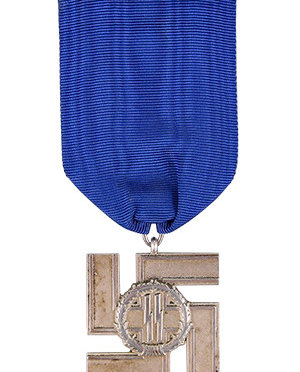
The twelve-year service award was in the shape of the swastika, had a silver finish and was awarded to all Officers, NCOs and enlisted men.