The Wilhelm Orden

The Wilhelm-Orden was instituted on 18 January 1896 by the German Emperor and King of Prussia Willhelm II as a high civilian award.

The Wilhelm-Orden (or “William-Order” in English) was instituted on 18 January 1896 by the German Emperor and King of Prussia Willhelm II as a high civilian award. The order was dedicated to the memory of his grandfather Emperor William I “the Great”.

The order was very exclusive. One of the first to be decorated was Otto von Bismarck.

The Wilhelm Order Design

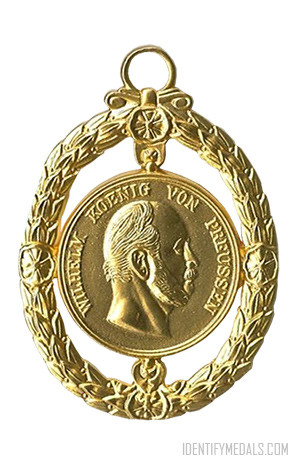
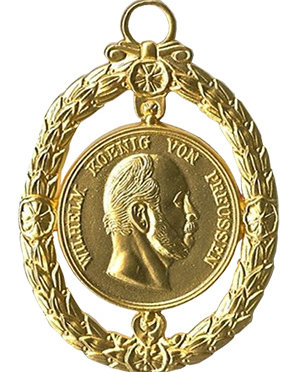
The insignia of the Order consists of a golden medal with the portrait of William I, surrounded by a golden wreath and suspended from a heavy golden collar. It was designed by the jewellers Emil Weigand en Otto Schultz.

The collar weights 222 grams and bears the words “WIRKE IM ANDENKEN AN KAISER WILHELM DEN GROSSEN” (“Work in the memory of Emperor William the Great”).

More Prussian Orders

Throughout Prussian history, these orders played a significant role in the social hierarchy and served as tangible expressions of royal favor and recognition. They continued to be awarded even after the dissolution of the Kingdom of Prussia, remaining as enduring symbols of valor, service, and honor in German society. Here are some more about Prussian Orders:

The Order of Louise

The Order of Louise was founded on 3 August 1814 by Frederick William III of Prussia to honor his late wife, the beloved Queen Louise.

The Order of Louise (or Luisen-Orden in German) was founded on 3 August 1814 by Frederick William III of Prussia to honor his late wife, the beloved Queen Louise. It was intended strictly for women whose service to Prussia was worthy of such high national recognition. Its dame companion members were limited to 100 in number, and were intended to be drawn from all classes.

The Chief of the Order of Louise was the reigning queen. Daughters in the royal family were invested with this order in lieu of the Order of the Black EagleOrder of the Red Eagle Grand Cross, Prussian Crown Order First Class, and Royal House Order of Hohenzollern that were reserved for the sons.

The Order of Louise was renewed with each successive monarch. At its initial creation in 1814, the Order was only available in one class. A second class was added during the reign of Wilhelm I.

The Order of Louise Design

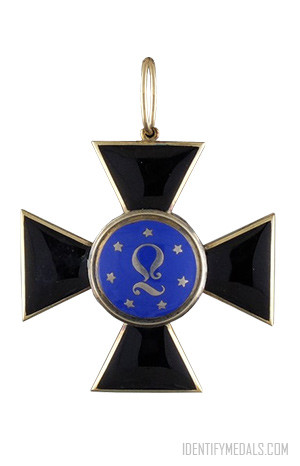
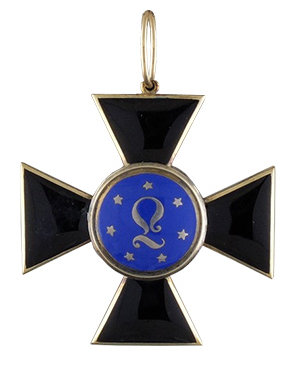
Dames, First Class, wore the black-enameled cross with its blue-enameled, medallion centerpiece, suspended from a predominantly white ribbon, with three black stripes, as tied in a bow. Though the statutes indicate that the badge was to be worn on the left breast, many period portraits show the members wearing the badge on or at the left shoulder of their dresses.

Dames, Second Class, wore a similarly-designed silver cross, minus the black enamel, which was also worn suspended from the white and black bow. The Prussian State Handbook of 1907 indicates further variants and subsets of the Second Class of the order: II.1 with silver crown, II.1 (without crown), and II.2.

More Prussian Orders

Throughout Prussian history, these orders played a significant role in the social hierarchy and served as tangible expressions of royal favor and recognition. They continued to be awarded even after the dissolution of the Kingdom of Prussia, remaining as enduring symbols of valor, service, and honor in German society. Here are some more about Prussian Orders:

The Order of Saint John (Johanniter Order)

The Bailiwick of Brandenburg of the Chivalric Order of Saint John of the Hospital at Jerusalem is the oldest surviving chivalry order.

The Bailiwick of Brandenburg of the Chivalric Order of Saint John of the Hospital at Jerusalem (or Balley Brandenburg des Ritterlichen Ordens Sankt Johannis vom Spital zu Jerusalem in German), also known as the Order of Saint John or the Johanniter Order, is the German Protestant branch of the Knights Hospitaller, the oldest surviving chivalry order.

The order is considered to have been founded in Jerusalem in the year 1099 AD.

It is led by its thirty-seventh Herrenmeister (“Master of the Knights” or Grand Master), Prince Oskar of Prussia. Each of its knights is either a Knight of Justice (Rechtsritter) or a Knight of Honor (Ehrenritter). There are also classes of Honorary Commander (Ehrenkommendator), given to Knights of Justice who have rendered distinguished service to the Order, and Honorary Member (Ehrenmitglieder).

Along with the Roman Catholic Sovereign Military Order of Malta, these four “Alliance Orders” represent the legitimate heirs of the Knights Hospitaller: The London-based Most Venerable Order of the Hospital of Saint John of Jerusalem, the Swedish Johanniterorden i Sverige, and the Dutch Johanniter Orde in Nederland.

The Order of Saint John Design

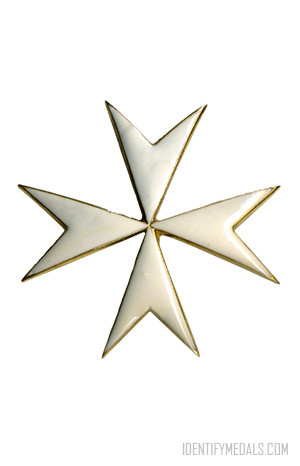
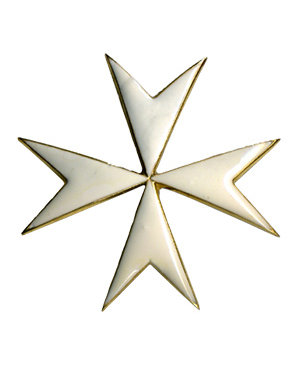
The basic insignia of the Order is a white-enamelled Maltese cross. The crowned Brandenburg eagles between the arms of the crosses date from 1668; they are gold for Knights of Justice, Honorary Commanders, Commanders, and the Herrenmeister. On the crosses of Knights of Honour and Honorary Members, the eagles are enameled black with only the tiny crowns on each eagle’s head left enameled gold.

The cloak of the Order is plain black with a large, white, linen eight-pointed cross on the left breast. 

Excluding the crown, the cross is between 5 cm and 7cm in diameter, depending on the rank. Each cross is worn from a black-moire, 4.5-centimeter-wide ribbon worn about the neck. All members of the Order may also wear a plain, Maltese cross as a star or ‘breast badge’. A white-enameled Maltese cross in either gold or silver may be worn on the left lapel of a knight’s suit coat or sportcoat.

From the late eighteenth century, the Johanniter have had a uniform similar to the Knights of Malta. Though not abolished, this uniform has not been worn since before the Second World War.

More Prussian Orders

Throughout Prussian history, these orders played a significant role in the social hierarchy and served as tangible expressions of royal favor and recognition. They continued to be awarded even after the dissolution of the Kingdom of Prussia, remaining as enduring symbols of valor, service, and honor in German society. Here are some more about Prussian Orders:

Orden of Merit Pour le Mérite

The Pour le Mérite (“For Merit” in French) is an order of merit established in 1740 by King Frederick II of Prussia.

The Pour le Mérite (“For Merit” in French) is an order of merit established in 1740 by King Frederick II of Prussia. The order was awarded as both a military and civil honor and ranked, along with the Order of the Black Eagle, the Order of the Red Eagle and the House Order of Hohenzollern, counting among the highest orders of merit in the Kingdom of Prussia.

The Pour le Mérite was conferred both for military (1740–1918) and civil (1740–1810, after 1842 as a separate class) services, strictly as a recognition of extraordinary personal achievement – rather than a general marker of social status or a courtesy-honour.

The order was secular, and membership endured for the remaining lifetime of the recipient, unless renounced or revoked. The order was named in French because it was the leading international language and the favored language at Frederick’s court. Despite the rising tide of nationalism and increasing hostility between French and Germans during the 19th century, the name remained the same. Ironically, many of its recipients were honored for acts performed in wars against France.

The Pour le Mérite Design

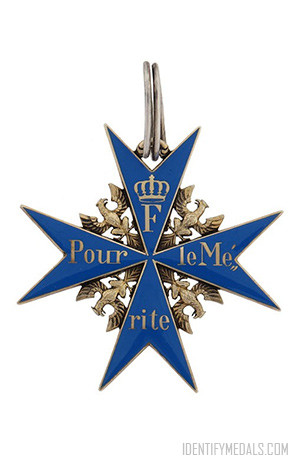
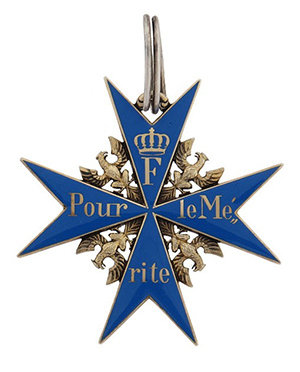
The insignia of the military award is a blue-enameled Maltese Cross with golden eagles between the arms (which is based on the symbol of the Johanniter Order).

The Prussian royal cypher and the words “Pour le Mérite” (“For Merit”) are written in gold letters on the body of the cross.

More Prussian Orders

Throughout Prussian history, these orders played a significant role in the social hierarchy and served as tangible expressions of royal favor and recognition. They continued to be awarded even after the dissolution of the Kingdom of Prussia, remaining as enduring symbols of valor, service, and honor in German society. Here are some more about Prussian Orders:

The House Order of Hohenzollern

The House Order of Hohenzollern is a dynastic order of knighthood of the House of Hohenzollern awarded to officers and civilians.

The House Order of Hohenzollern (or Hausorden von Hohenzollern or Hohenzollernscher Hausorden in German) is a dynastic order of knighthood of the House of Hohenzollern awarded to military commissioned officers and civilians of comparable status.

The House Order of Hohenzollern was instituted on December 5, 1841, by joint decree of Prince Konstantin of Hohenzollern-Hechingen and Prince Karl Anton of Hohenzollern-Sigmaringen. These two principalities in southern Germany were Catholic collateral lines of the House of Hohenzollern, cousins to the Protestant ruling house of Prussia. On August 23, 1851, after the two principalities had been annexed by Prussia, the order was adopted by the Prussian branch of the house.

Associated with the various versions of the order were crosses and medals which could be awarded to lower-ranking soldiers and civilians.

The Royal House Order of Hohenzollern came in the following classes:

  • Grand Commander (Großkomtur)
  • Commander (Komtur)
  • Knight (Ritter)
  • Member (Inhaber) – For soldiers who were not officers, as well as civilians.

The House Order of Hohenzollern Design

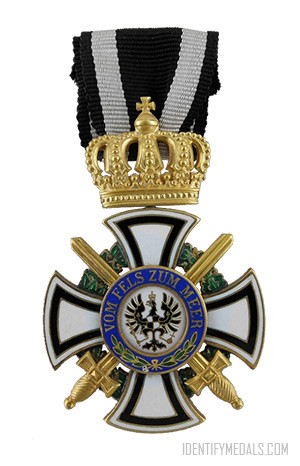
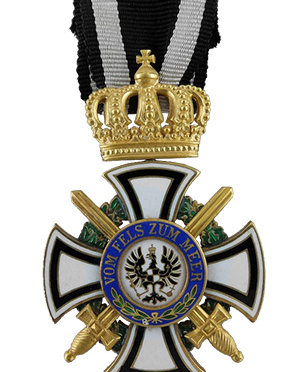
The badge is a cross pattée or “Alisee” cross with convex edges and curved arms. All versions of the badge feature white enamel on the higher classes and a black enameled stripe near the sides of the cross. Between the arms of the cross is a wreath of laurel leaves (left side) and oak leaves (right side).

The cross bears a center medallion with different coats of arms, mottos, dates and ciphers for each of the Royal, Princely and Romanian versions:

  • The white-enameled medallion bears a black Prussian royal eagle with the Hohenzollern house coat of arms on a shield on the eagle’s chest and a gold-rimmed band of blue enamel with the motto in gold letters: vom Fels zum Meer (“From the cliffs to the sea”) and a wreath of laurel below.
  • The white-enameled medallion of the Princely House Order of Hohenzollern bears the Hohenzollern coat of arms (a quartered shield of black and white) under a princely crown.
  • The white-enameled medallion of the Romanian House Order bore a black Romanian eagle with the Hohenzollern coat of arms on a shield on the eagle’s chest.

The ribbon of the order is white with three black stripes (with slight variations among the Royal, Princely and Romanian versions).

More Prussian Orders

Throughout Prussian history, these orders played a significant role in the social hierarchy and served as tangible expressions of royal favor and recognition. They continued to be awarded even after the dissolution of the Kingdom of Prussia, remaining as enduring symbols of valor, service, and honor in German society. Here are some more about Prussian Orders:

The Order of the Crown (Prussia)

The Royal Order of the Crown was a Prussian order of chivalry instituted in 1861 as an honor equal in rank to the Order of the Red Eagle.

The Royal Order of the Crown (or Königlicher Kronen-Orden in German) was a Prussian order of chivalry instituted in 1861 as an honour equal in rank to the Order of the Red Eagle (officially both orders were equal, but most officials preferred to be appointed in the older Order of the Red Eagle).

Membership could only be conferred upon commissioned officers (or civilians of equivalent status), but there was a medal associated with the order which could be earned by non-commissioned officers and enlisted men.

The Order had six classes:

  • Grand Cross – wore the Grand Cross badge on a sash on the right shoulder, plus the star on the left chest;
  • 1st Class – wore the badge on a sash on the right shoulder, plus the star on the left chest;
  • 2nd Class – wore the badge on a necklet, plus the star on the left chest;
  • 3rd Class – wore the badge on a ribbon on the left chest;
  • 4th Class – wore the badge on a ribbon on the left chest;
  • Medal – wore the medal on a ribbon on the left chest.

The Order of the Crown Design

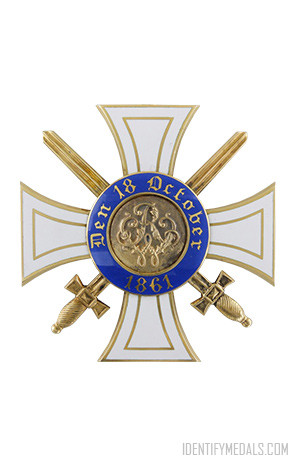
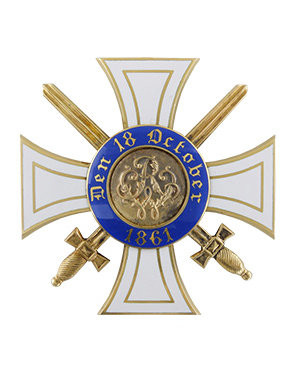
The insignia of the order could be awarded in dozens of variations. For example with superimposed Cross of Geneva (Red Cross – normally given to doctors for meritorious service), with swords and with oak leaves. The badge for the 1st to 4th classes is a gilt cross pattée with white enamel (except for the 4th Class, which was plain).

The obverse gilt central disc bears the crown of Prussia surrounded by a blue enamel ring bearing the motto of the German Empire “Gott Mit Uns” (“God With Us”).

The reverse gilt disc has the Prussian royal monogram, surrounded by a blue enamel ring with the date 18 October 1861.

The star of the Order is (for Grand Cross) a gilt eight-pointed star, (for 1st Class) a silver eight-pointed star, or (for 2nd Class) a silver four-pointed star, all with straight rays.

The ribbon of the Order is blue.

More Prussian Orders

Throughout Prussian history, these orders played a significant role in the social hierarchy and served as tangible expressions of royal favor and recognition. They continued to be awarded even after the dissolution of the Kingdom of Prussia, remaining as enduring symbols of valor, service, and honor in German society. Here are some more about Prussian Orders:

The Order of the Red Eagle

The Order of the Red Eagle (Roter Adlerorden) was an order of chivalry of the Kingdom of Prussia awarded to military personnel and civilians.

The Order of the Red Eagle (or Roter Adlerorden in German) is an order of chivalry of the Kingdom of Prussia awarded to both military personnel and civilians to recognize valor in combat, excellence in military leadership, long and faithful service to the kingdom, or other achievements.

The predecessor to the Order of the Red Eagle was founded on November 17, 1705, by the Margrave Georg Wilhelm of Brandenburg-Bayreuth as the Ordre de la Sincerité. It was revived in 1712 and again in 1734 in Brandenburg-Ansbach, where it first received the name of “Order of the Brandenburg Red Eagle”. The Kingdom of Prussia absorbed both Brandenburg-Bayreuth and Brandenburg-Ansbach in January 1792, and on June 12, 1792, King Frederick William II again revived the order as a Prussian royal order.

The Order of the Red Eagle could only be awarded to commissioned officers or civilians of approximately equivalent status. However, there was a medal of the order, which could be awarded to non-commissioned officers and enlisted men, lower ranking civil servants and other civilians.

The Order of the Red Eagle Design

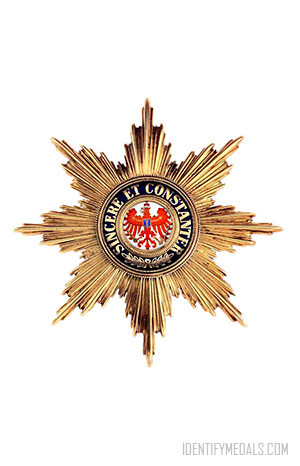
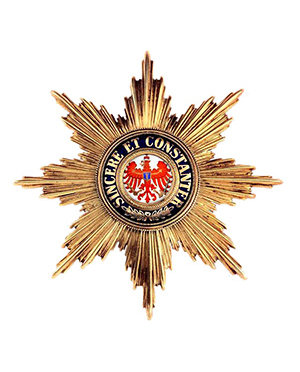
The badge is a gold (gilt after 1916) Maltese Cross enameled in white, with red enameled eagles between the arms of the cross. The central disc, in gold, bears the Royal monogram surrounded by a blue enameled ring bearing the motto of the Order, Sincere et Constanter.

The badge for the 1st to 3rd classes is a gold (gilt after 1916) cross pattée, enameled in white; that for the 4th class was similar but with smooth, plain silver arms. The enlisted man’s medal was of a relatively simple, round design, topped with the Prussian crown.

After September 16, 1848, awards of all classes (except the medal) bestowed for military merit had two golden swords crossed through the central medallion.

The traditional ribbon of the order was white with two orange stripes at the edges, but combat awards were frequently conferred with a black and white ribbon similar to that of the Iron Cross.

Find This Medal

Right Now on eBay 
Clicking a link to eBay may result in a referral commission being paid if a purchase is made.
Loading...

More Prussian Orders

Throughout Prussian history, these orders played a significant role in the social hierarchy and served as tangible expressions of royal favor and recognition. They continued to be awarded even after the dissolution of the Kingdom of Prussia, remaining as enduring symbols of valor, service, and honor in German society. Here are some more about Prussian Orders:

The Order of Merit of the Prussian Crown

The Order of Merit of the Prussian Crown is an award of civil and military merit established on the bicentennial of the Kingdom of Prussia.

The Order of Merit of the Prussian Crown (or Verdienstorden der Preußischen Krone in German) is an award of civil and military merit established on the occasion of the bicentennial of the establishment of the Kingdom of Prussia 18 January 1901 by King Wilhelm II.

The order was presented in one class and consisted of a badge and a breast star. For military merit the award was presented with crossed swords. Once, it was presented with diamonds (to Maximilian von Seinsheim, from the Bavarian Court on 15 December 1913).

The medal was awarded only 57 times. General von Gossler was the only person who received the awards in both departments.

The Order of Merit of the Prussian Crown Design

The order consists of a badge (which is worn on a sash from right shoulder to the left hip), and a star worn on the left chest.

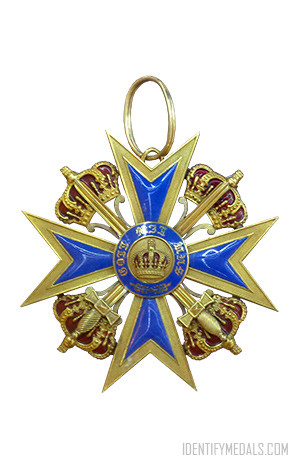
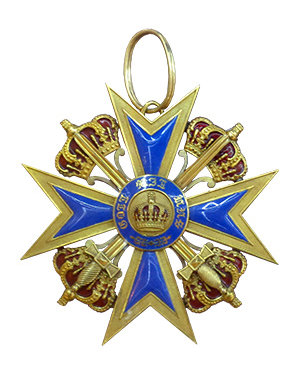
The badge is a blue-enamelled, eighteen-karat, yellow-gold Maltese cross with a granular border. In each of the compartments between the four arms of the cross is a red-enamelled crown surmounting the royal monogram (“W II”, for Wilhelm II).

The central disc on the obverse of the badge shows a golden crown with red enamel, surrounded by a blue-enamelled circular band bearing the gold-lettered motto, “Gott Mit Uns” (“God with Us”).

The disc on the reverse bears the intertwined initials “IR W II” (for “Imperator Rex Wilhelm II”: “Emperor King William II”), encircled by the date “18 January 1901”.

The star is a golden eight-pointed star with straight rays, displaying the central disc from the obverse of the badge. The sash of the order is blue, edged with orange stripes.

More Prussian Orders

Throughout Prussian history, these orders played a significant role in the social hierarchy and served as tangible expressions of royal favor and recognition. They continued to be awarded even after the dissolution of the Kingdom of Prussia, remaining as enduring symbols of valor, service, and honor in German society. Here are some more about Prussian Orders:

The Order of the Black Eagle

The Order of the Black Eagle was the highest order of chivalry in the Kingdom of Prussia. It was founded in 1701 by Elector Friedrich III.
The Order of the Black Eagle (or Hoher Orden vom Schwarzen Adler in German) was the highest order of chivalry in the Kingdom of Prussia. The order was founded on 17 January 1701 by Elector Friedrich III of Brandenburg (soon after Friedrich I, King in Prussia).

In his Dutch exile after World War I, deposed Emperor Wilhelm II continued to award the order to his family (he made his second wife, Princess Hermine Reuss of Greiz, a Lady in the Order of the Black Eagle.

Membership in the Order of the Black Eagle was limited to a small number of knights, and was divided into two classes: On the one hand, members of reigning houses, and on the other capitular knights (before 1847 membership was limited to nobles). Capitular knights were generally high-ranking government officials or military officers.

The Order of the Black Eagle had only one class, but could also be awarded at the king’s prerogative “with the Chain” (“mit der Kette“) or without (“ohne Kette“).

From its founding in 1701 to 1918, the Order of the Black Eagle was awarded 407 times, with 57 of these installations occurring during the reign of Friedrich I (1701–1713).

The Order of the Black Eagle Design

The badge is a gold Maltese cross, enameled in blue, with gold-crowned black eagles between the arms of the cross. The gold center medallion bears the royal monogram of Friedrich I (“FR”, for Fredericus Rex).

The badge was worn from either a broad ribbon or a collar. The ribbon was an orange moiré sash worn from the left shoulder to the right hip, with the badge resting on the hip. The sash color was chosen in honor of Louise Henriette of Nassau, daughter of the prince of Orange and first wife of the great elector.

The collar or chain (Kette) was worn around the neck and resting upon the shoulders, with the badge suspended from the front center.

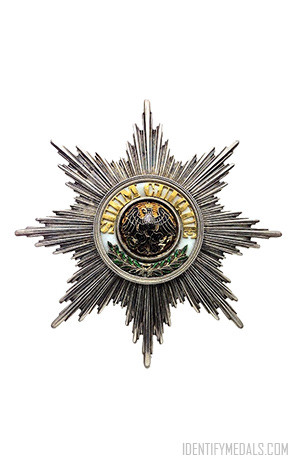
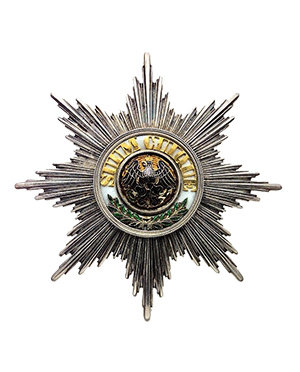
The star of the Order is a silver eight-pointed star, with straight or faceted rays depending on the jeweler’s design. The center medallion displays a black eagle gripping a wreath of laurels in its left claws and a scepter in its right on a golden background, surrounded by a white enamelled ring bearing a wreath of laurels and the motto of the Order.

At certain ceremonies, the knights wore red velvet capes with blue linings. Embroidered on the left shoulder of each cape was a large star of the Order.

More Prussian Orders

Throughout Prussian history, these orders played a significant role in the social hierarchy and served as tangible expressions of royal favor and recognition. They continued to be awarded even after the dissolution of the Kingdom of Prussia, remaining as enduring symbols of valor, service, and honor in German society. Here are some more about Prussian Orders: