- Time Period: Pre-WW1
- Institution: 20 May 1871
- Country: Germany (Kingdom of Prussia)
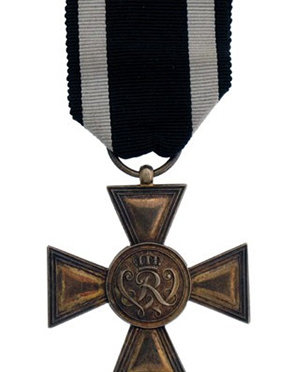
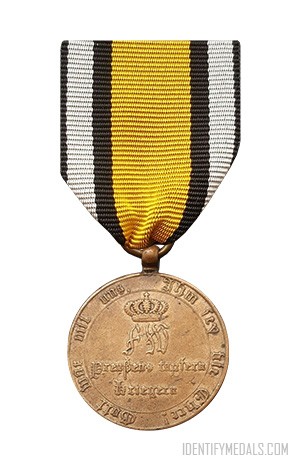
The War Commemorative Medal of 1813/15 (or Kriegsdenkmünze für 1813/15 in German) was a Prussian war commemorative medal established on 24 December 1813 by King Friedrich Wilhelm III of Prussia to honour members of the Prussian Army who fought in the Wars of Liberation against Napoleonic France during 1813–1815.
It recognised those who served throughout the conflict, which included campaigns that eventually led to the defeat of Napoleon and the decisive Battle of Waterloo.
A later related piece, the Erinnerungs‑Kriegs‑Denkmünze, was instituted on 17 March 1863 by King Wilhelm I on the 50th anniversary of the original campaigns. This anniversary issue featured portraits of Friedrich Wilhelm III and inscriptions marking the years 1813–1815, and was intended as a keepsake for legitimate holders of the original medal and their families.
The War Commemorative Medal Design
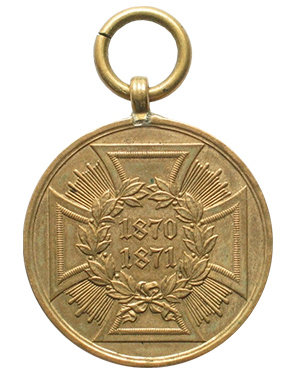
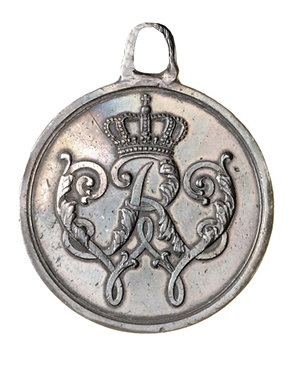
The medal is about 29 mm in diameter and features a cross on the obverse with rays between its arms and a wreath of laurel and oak leaves encircling the year or years of service (such as 1813, 1814, or 1815). The reverse bears the crowned monogram “F. W.” for Friedrich Wilhelm and the inscription Preußens tapferen Kriegern, Gott war mit uns, Ihm sey die Ehre (“To Prussia’s brave warriors, God was with us, to Him be the glory”).
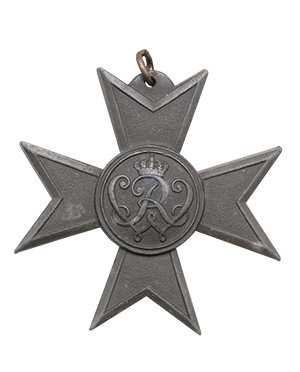
There were two versions of the medal: a combatant version struck in bronze made from captured artillery, often with the edge inscription Aus erobertem Geschütz (“From captured cannon”), and a non‑combatant version cast in iron and oval in shape, which was awarded to those who did not see active combat or who supported the war effort. The iron variant became informally known as the “Eiserne Pflaume” (“Iron Plum”) due to its shape.
Both versions were worn on the left breast suspended from distinctive ribbons: combatants on an orange ribbon edged in black and white, and non‑combatants on a white ribbon edged in black, orange, and white.
The Different Waterloo Medals
The Waterloo medal was issued by the British Government to all soldiers present during action. Seven nations of the Seventh Coalition struck differently designed medals for soldiers who took part in the campaign. These are:

The Waterloo Medal
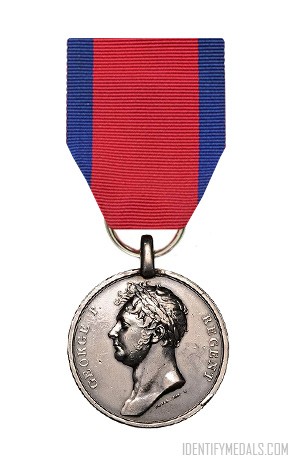
The Waterloo Medal is a British military medal established in 1816-17 and struck for all those who participated in the Waterloo campaign.
The Brunswick Waterloo Medal
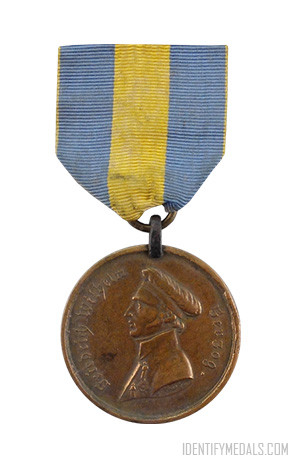
The Brunswick Waterloo Medal was a campaign medal awarded to those who participated in the Battles of Quatre Bras and Waterloo.
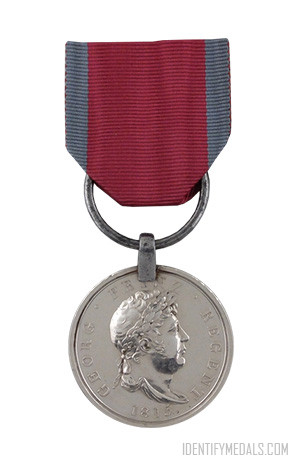
The Hanoverian Waterloo Medal
The Hanoverian Waterloo Medal was issued to all members of the Hanoverian army who fought in the battles of Quatre Bras and Waterloo.
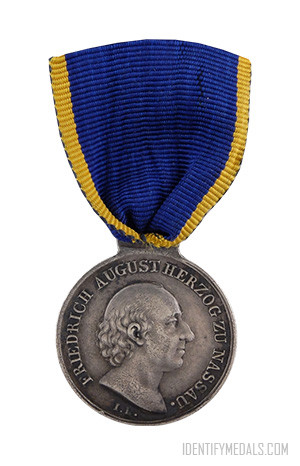
The Nassau Waterloo Medal
The Waterloo Medal is a campaign of the Duchy of Nassau established by Frederick Augustus, Duke of Nassau on 23 December 1815.
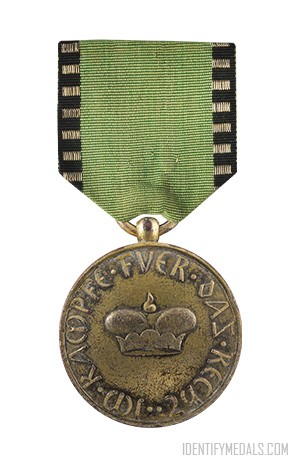
The Saxe-Gotha Altenburg Waterloo Medal
The Saxe-Gotha Altenburg Waterloo Medal, instituted in 1816, was awarded for participation n the Napoleonic Wars against France.
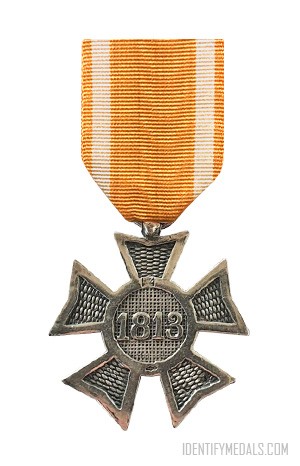
The Silver Memorial Cross 1813–1815
The Silver Memorial Cross 1813–1815 was a Dutch campaign medal created by King William III of the Netherlands in 1865.