The SS Zivilabzeichen Badge

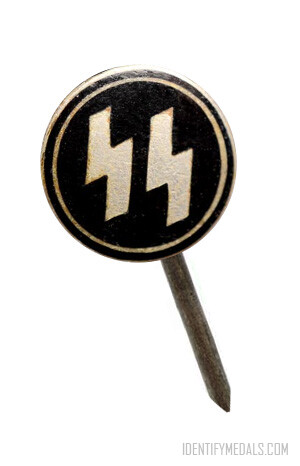
The SS Zivilabzeichen Badge, also known as the SS Civil Badge, was a lapel pin issued to SS members between 1933 and 1938.

The SS Zivilabzeichen, also known as the SS Civil Badge, was a lapel pin issued to SS members between 1933 and 1938. This badge, displaying the SS runes, was worn on civilian clothing to signify membership in the SS.

The badge was predominantly awarded to veteran SS members within the Sicherheitspolizei, though there was no strict criteria for its issuance. Members simply had to apply to the SS-Hauptamt to receive it.

Known Badge Numbers

  • Adolf Hitler: Honorary SS number “1”. His badge was kept in his Munich apartment and later taken by 1st Lieutenant Philip Ben Lieber in 1945. This badge, along with other items owned by Hitler, was sold through Mohawk Arms to collectors Stephen Wolfe and Neil Hardin, and eventually acquired by collector Craig Gottlieb in 2013.
  • Heinrich Himmler: Badge number 2.
  • Adolf Eichmann: Badge number 6,375.
  • Gustav Lombard: Badge number 72,723.
  • Karl Freiherr Michel von Tüßling: Badge number 106,983.
  • Ernst Kaltenbrunner: Badge number 160,180.
  • Hermann Senkowsky: Badge number 169,582.
The SS Membership Runes for Order Police

The SS Membership Runes for Order Police was a badge worn by members of the Ordnungspolizei who were also full members of the SS.

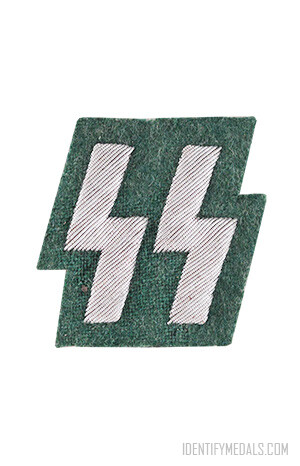
The SS Membership Runes for Order Police was a badge worn by members of the Ordnungspolizei (Orpo) who were also full members of the Schutzstaffel (SS). This badge featured two white Sig Runes, the symbol of the SS, and was centered on the lower left-hand pocket of the jacket.

This badge marked the initial step towards merging the Order Police with the SS, a process supported by Kurt Daluege and Heinrich Himmler. The integration advanced further in 1942, when all Orpo Police Generals were granted equivalent SS ranks and began wearing modified SS-Police rank insignia.

The SS Membership Runes for Order Police Design

The badge was centered on the lower left-hand jacket pocket. It prominently featured two white Sig Runes, which are the iconic symbol of the SS, signifying the wearer’s dual membership in both the Order Police and the SS.

The two white Sig Runes were centrally placed, symbolizing the SS. The runes are in a stylized font typical of Nazi iconography.

The background of the badge is a dark green color, creating a strong contrast with the white runes and ensuring the symbol is easily recognizable from a distance.

The SS Chevron for Former Police and Military

The SS Chevron for Former Police and Military was a service badge awarded to members of the Nazi Party Schutzstaffel (SS) for service.

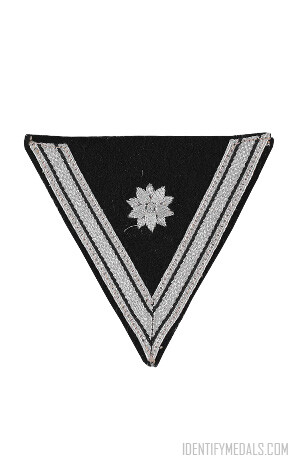
The SS Chevron for Former Police and Military (or SS-Ehrenwinkel mit Stern für ehemalige Polizei- und Wehrmachtsangehörige in German) was a service badge awarded to members of the Nazi Party Schutzstaffel (SS) who had previously served in law enforcement, the Reichswehr, or Der Stahlhelm, Bund der Frontsoldaten (“The Steel Helmet, League of Front-Line Soldiers”).

Notable recipients included Arthur Nebe, recognized for his service as a detective with the Berlin Police Department, and Franz Josef Huber, who had served as a police inspector with the Munich Police Department.

The SS Chevron for Former Police and Military Design

This badge signified prior professional service and was visually similar to the Honor Chevron for the Old Guard, distinguished by a darkened center and a silver service pip.

The average price for an authentic SS Chevron for Former Police and Military typically ranges from $300 to $600 USD, depending on its condition and provenance.

The Police Long Service Award (Nazi Germany)

The Police Long Service Award was a commendation given to active members of the German police during the Nazi era.

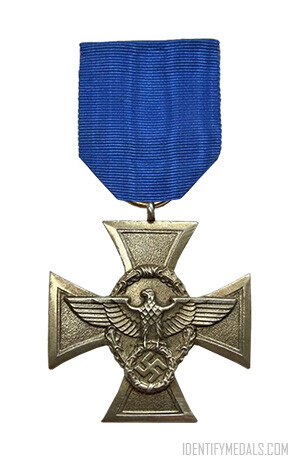
The Police Long Service Award (or Polizei-Dienstauszeichnung in German) was a commendation given to active members of the German police during the Nazi era. Designed by Professor Richard Klein, the awards varied slightly depending on the length of service.

On January 30, 1938, Adolf Hitler instituted the Police Long Service Award to recognize police personnel based on their years of service. The awards were issued in three grades for eight, eighteen, and twenty-five years of service. 

Eligibility required active membership in the police force or administrative service, with military service time also counting towards the total service duration.

The Police Long Service Award Design

Each medal featured the police insignia—a national eagle emblem surrounded by a wreath—on the obverse, with the inscription “Für treue Dienste in der Polizei” (“For faithful service in the Police”) on the reverse.

Eight-Year Award:

    • Design: Silver, round medal, 38 mm in diameter.
    • Ribbon: Cornflower blue, 35 mm wide.
    • Obverse: Police insignia.
    • Reverse: Number 8 with the inscription “Für treue Dienste in der Polizei.”

Eighteen-Year Award:

    • Design: Silver-gray four-pointed cross (Ordenskreuz), 43 mm in size.
    • Ribbon: Cornflower blue with a woven police insignia, varying in width (37 mm or 51 mm).
    • Obverse: Police insignia.
    • Reverse: Inscription “Für treue Dienste in der Polizei.”

Twenty-Five-Year Award:

    • Design: Gold four-pointed cross (Ordenskreuz), similar to the eighteen-year award but in gold.
    • Presentation Case: Green simulated leather with the number 18 or 25 embossed on the top. Inside, the case had a white satin lid and a velvet lower portion.

On August 12, 1944, a higher grade was authorized for forty years of service, designed as a gold metal bar with the number 40 and oak leaves, to be affixed to the ribbon of the twenty-five-year award. However, there is no record of this being awarded before the end of World War II.

The SS Long Service Award (25 Years of Service)

The SS Long Service Awards were given to SS members in grades of four, eight, twelve, and twenty-five years of service.

The SS Long Service Awards (or SS-Dienstauszeichnungen in German) were given in grades of four years, eight years, twelve years, and twenty-five years as an acknowledgment for faithful and true services of SS members in the SS-Verfügungstruppen (SS Dispositional Troops), SS-Totenkopfverbänden (Death’s Head Units) und SS-Junkerschulen (Junker Schools). It was first introduced by Adolf Hitler on 30 January 1938.

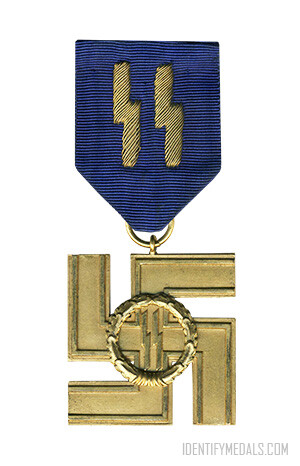
The SS Long Service Award for 25 years of service was the highest class of the SS long service awards, specifically designed to honor members of the SS who had dedicated a quarter-century to the organization.

The SS Long Service Awards Grades or Classes

The grades are awarded to the respective ranks as follows:

  • 1st Class (Gold) for 25 years true service awards to eligible Officers, NCO’s and Men
  • 2nd Class (Silver) for 12 years true service awards to eligible Officers, NCO’s and Men
  • 3th Class (Bronze) for 8 years true service awards to eligible Officers, NCO’s and Men
  • 4th Class (Black) for 4 yrs true service for eligible NCO’s and Men.

The SS Long Service Award for 25 years of service was awarded to officers, non-commissioned officers (NCOs), and enlisted men, recognizing their prolonged commitment and loyalty to the SS and the Nazi Party over a significant part of their careers.

The four-year and eight-year awards were the most common awards, and despite the fact that the Nazi movement lasted for little over 25 years, awards of the 25-year version were made well before 25 years of actual service were completed. This was because Kampfzeit (or “Time of Struggle”) counted double. Nevertheless, this was one of the rarer awards given out by Nazi Germany.

The SS Long Service Awards Design

The SS service awards were designed in Munich by Professor Karl Diebitsch, an artist and the Schutzstaffel (SS) officer responsible for designing much of the SS regalia in the Third Reich, including the chained SS officer’s dagger scabbard.

On its reverse side, each award had emblazoned the inscription, in German: FÜR TREUE DIENSTE IN DER SS (“For Loyal Service in the SS”). 

The awards varied in design depending on the length of service of the recipient, and the branches of the Wehrmacht (LuftwaffeHeer and Kriegsmarine) had different insignia. The Nazi Party and German Police also had a similar service award.

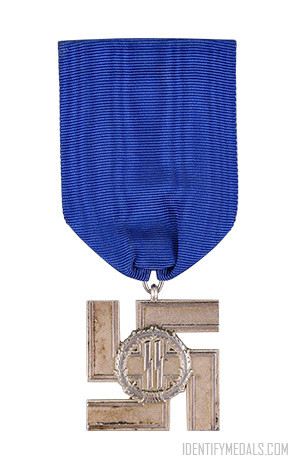
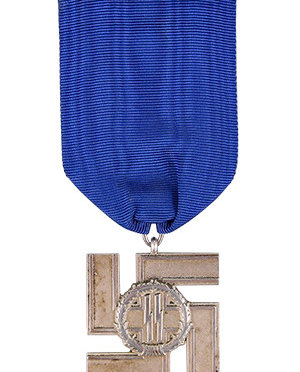
The twenty-five-year service award was designed in the shape of a swastika, featuring a gold finish. It was bestowed upon all officers, non-commissioned officers (NCOs), and enlisted men in recognition of their long-term service.

The SS Long Service Award (4 Years of Service)

The SS Long Service Awards were given in grades of four years, eight years, twelve years, and twenty-five years of true services in the SS.

The SS Long Service Awards (or SS-Dienstauszeichnungen in German) were given in grades of four years, eight years, twelve years, and twenty-five years as an acknowledgment for faithful and true services of SS members in the SS-Verfügungstruppen (SS Dispositional Troops), SS-Totenkopfverbänden (Death’s Head Units) und SS-Junkerschulen (Junker Schools). It was first introduced by Adolf Hitler on 30 January 1938.

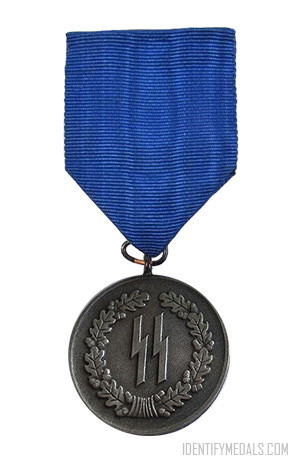
The SS Long Service Award for 4 years of service was the first and lowest class in the hierarchy of the SS long service awards. The 4-year award was specifically given to non-commissioned officers (NCOs) and enlisted men, recognizing their service within the SS.

The SS Long Service Awards Grades or Classes

The grades are awarded to the respective ranks as follows:

  • 1st Class (Gold) for 25 years true service awards to eligible Officers, NCO’s and Men
  • 2nd Class (Silver) for 12 years true service awards to eligible Officers, NCO’s and Men
  • 3th Class (Bronze) for 8 years true service awards to eligible Officers, NCO’s and Men
  • 4th Class (Black) for 4 yrs true service for eligible NCO’s and Men.

The four-year and eight-year awards were the most common awards, and despite the fact that the Nazi movement lasted for little over 25 years, awards of the 25-year version were made well before 25 years of actual service were completed. This was because Kampfzeit (or “Time of Struggle”) counted double. Nevertheless, this was one of the rarer awards given out by Nazi Germany.

The SS Long Service Awards Design

The SS service awards were designed in Munich by Professor Karl Diebitsch, an artist and the Schutzstaffel (SS) officer responsible for designing much of the SS regalia in the Third Reich, including the chained SS officer’s dagger scabbard.

On its reverse side, each award had emblazoned the inscription, in German: FÜR TREUE DIENSTE IN DER SS (“For Loyal Service in the SS”). 

The awards varied in design depending on the length of service of the recipient, and the branches of the Wehrmacht (LuftwaffeHeer and Kriegsmarine) had different insignia. The Nazi Party and German Police also had a similar service award.

The four and eight-year service awards were in the form of circular medals while the 12 and 25-year service awards were in the form of swastikas.  According to historian Chris Ailsby the awards ceased to be given at the end of 1941.

The four-year service award featured a black finish and was exclusively given to non-commissioned officers (NCOs) and enlisted men. The use of black enamel and the SS runes emphasized the connection to the SS organization. 

The SS Long Service Award (8 Years of Service)

The SS Long Service Award (8 Years) was given as an acknowledgment for faithful and true services of German SS members.

The SS Long Service Awards (or SS-Dienstauszeichnungen in German) were given in grades of four years, eight years, twelve years, and twenty-five years as an acknowledgment for faithful and true services of SS members in the SS-Verfügungstruppen (SS Dispositional Troops), SS-Totenkopfverbänden (Death’s Head Units) und SS-Junkerschulen (Junker Schools). It was first introduced by Adolf Hitler on 30 January 1938.

The four and eight-year service awards were in the form of circular medals while the 12 and 25-year service awards were in the form of swastikas.  According to historian Chris Ailsby the awards ceased to be given at the end of 1941.

The SS Long Service Awards Grades or Classes

The grades are awarded to the respective ranks as follows:

  • 1st Class (Gold) for 25 years true service awards to eligible Officers, NCO’s and Men
  • 2nd Class (Silver) for 12 years true service awards to eligible Officers, NCO’s and Men
  • 3th Class (Bronze) for 8 years true service awards to eligible Officers, NCO’s and Men
  • 4th Class (Black) for 4 yrs true service for eligible NCO’s and Men.

The four-year and eight-year awards were the most common awards, and despite the fact that the Nazi movement lasted for little over 25 years, awards of the 25-year version were made well before 25 years of actual service were completed. This was because Kampfzeit (or “Time of Struggle”) counted double. Nevertheless, this was one of the rarer awards given out by Nazi Germany.

The SS Long Service Awards Design

The SS service awards were designed in Munich by Professor Karl Diebitsch, an artist and the Schutzstaffel (SS) officer responsible for designing much of the SS regalia in the Third Reich, including the chained SS officer’s dagger scabbard.

On its reverse side, each award had emblazoned the inscription, in German: FÜR TREUE DIENSTE IN DER SS (“For Loyal Service in the SS”). 

The awards varied in design depending on the length of service of the recipient, and the branches of the Wehrmacht (LuftwaffeHeer and Kriegsmarine) had different insignia. The Nazi Party and German Police also had a similar service award.

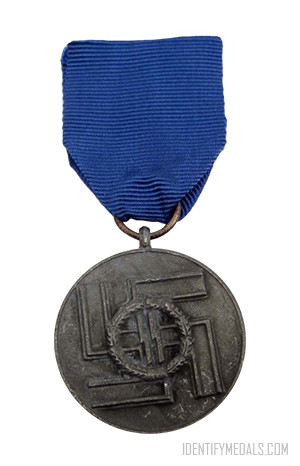
The eight-year service award was finished in bronze and was awarded to all Officers, NCOs and enlisted men. The eight-year service medal was manufactured by the firm Deschler.

The SS Long Service Award (12 Years of Service)

The SS Long Service Awards were given to SS members in grades of four, eight, twelve, and twenty-five years of service.

The SS Long Service Awards (or SS-Dienstauszeichnungen in German) were given in grades of four years, eight years, twelve years, and twenty-five years as an acknowledgment for faithful and true services of SS members in the SS-Verfügungstruppen (SS Dispositional Troops), SS-Totenkopfverbänden (Death’s Head Units) und SS-Junkerschulen (Junker Schools). It was first introduced by Adolf Hitler on 30 January 1938.

The four and eight-year service awards were in the form of circular medals while the 12 and 25-year service awards were in the form of swastikas.  According to historian Chris Ailsby the awards ceased to be given at the end of 1941.

The SS Long Service Awards Grades or Classes

The grades are awarded to the respective ranks as follows:

  • 1st Class (Gold) for 25 years true service awards to eligible Officers, NCO’s and Men
  • 2nd Class (Silver) for 12 years true service awards to eligible Officers, NCO’s and Men
  • 3th Class (Bronze) for 8 years true service awards to eligible Officers, NCO’s and Men
  • 4th Class (Black) for 4 yrs true service for eligible NCO’s and Men.

The four-year and eight-year awards were the most common awards, and despite the fact that the Nazi movement lasted for little over 25 years, awards of the 25-year version were made well before 25 years of actual service were completed. This was because Kampfzeit (or “Time of Struggle”) counted double. Nevertheless, this was one of the rarer awards given out by Nazi Germany.

The SS Long Service Awards Design

The SS service awards were designed in Munich by Professor Karl Diebitsch, an artist and the Schutzstaffel (SS) officer responsible for designing much of the SS regalia in the Third Reich, including the chained SS officer’s dagger scabbard.

On its reverse side, each award had emblazoned the inscription, in German: FÜR TREUE DIENSTE IN DER SS (“For Loyal Service in the SS”). 

The awards varied in design depending on the length of service of the recipient, and the branches of the Wehrmacht (LuftwaffeHeer and Kriegsmarine) had different insignia. The Nazi Party and German Police also had a similar service award.

The twelve-year service award was in the shape of the swastika, had a silver finish and was awarded to all Officers, NCOs and enlisted men.