The Army Mountain Guide Badge

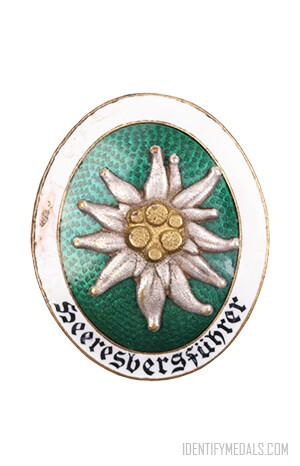
The Army Mountain Guide Badge was a German military badge awarded to experienced Gebirgsjager mountain guides during the Third Reich.

The Army Mountain Guide Badge (Abzeichen für Heeresbergführer in German) was a war badge bestowed upon skilled Gebirgsjäger mountain guides during the era of Nazi Germany and World War II.

The Army Mountain Guide Badge was established in August 1936 and was exclusively worn by Gebirgsjäger troops within the German Wehrmacht who had undergone training as mountain guides and subsequently served in this capacity for a year. However, following the conclusion of World War II in 1945, this badge ceased to be awarded.

The Army Mountain Guide Badge Design

Crafted as an oval tombac-plated iron pin-back badge, it measured 51.8 mm by 42.9 mm. At its center, in the obverse, lay an edelweiss flower rendered in silver with a gilt center, set against a backdrop of green enamel. Surrounding this, a white enamel band displayed the term ‘Heeresbergführer’ in gothic script along its lower portion.

On the reverse side, aside from the pin fastening and often the manufacturer’s name, the badge remained plain.

When worn on the uniform, it was typically positioned on or below the left-hand breast pocket, though occasionally, it was observed on the right side of the jacket.

More Army/Waffen-SS War Badges

The Army/Waffen-SS war badges were military decorations awarded by Nazi Germany to members of the Army (Heer) and the Waffen-SS. Explore the complete collection below:

The Sniper’s Badge

The Sniper’s Badge was a WW2 German military decoration established in 1944 and awarded to snipers of the German Army and the Waffen-SS.

The Sniper’s Badge (Scharfschützenabzeichen in German) was a war badge awarded to Waffen SS and Wehrmacht Heer soldiers during World War II.

It was established on August 20, 1944. Initially, only members serving in the German Army and the Waffen-SS were eligible for this recognition. However, later, by directive of the High Command, it was extended to snipers from other branches of the armed services. 

The Sniper’s badge came in three classes or grades:

  • Third Class (without cord), awarded for achieving 20 enemy kills.
  • Second Class (with a silver cord), granted for 40 enemy kills.
  • First Class (with a gold cord), conferred for achieving 60 enemy kills.

The tally of enemy kills commenced from September 1, 1944. Each enemy kill needed to be corroborated by witnesses and reported to the unit for validation, and close-quarter kills were not included in this count.

The Sniper's Badge Design

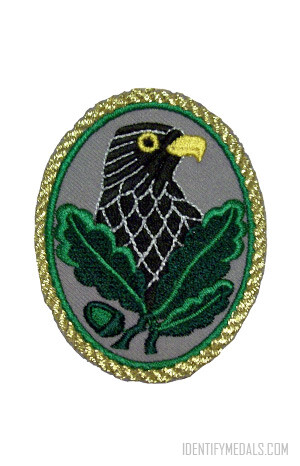
Crafted from greenish-gray cloth and embroidered into an oval shape, the Sniper’s Badge depicted a black eagle’s head facing left, adorned with white plumage, ochre yellow eyes, and a closed beak. Surrounding the eagle’s body were three oak leaves and a left-mounted acorn.

The ribbon’s edges were meticulously sewn, and the badge’s different classes were identified by a circularly stitched cord in either silver (for 2nd class) or gold (for 1st class).

The badge was worn on the right sleeve of the uniform.

Famous Recipients of The Sniper's Badge

Matthäus Hetzenauer and Bruno Sutkus are two notable recipients of the Sniper’s Badge, both achieving the highest rank, signified by the gold cord.

  1. Matthäus Hetzenauer, an Austrian, distinguished himself as one of the most successful snipers of World War II. He served in the 3rd Mountain Division of the Wehrmacht and earned his Sniper’s Badge in the highest class for his exceptional marksmanship skills. Hetzenauer was credited with an impressive tally of confirmed kills, estimated to be around 345 enemy soldiers, primarily on the Eastern Front. His precise shooting and ability to operate effectively in the challenging terrain of the mountains earned him widespread recognition and respect among his comrades.

  2. Bruno Sutkus, a German soldier, also earned the Sniper’s Badge in the gold class for his outstanding achievements as a sniper. Serving in various units of the German Army, including the 24th Panzer Division, Sutkus demonstrated exceptional skill and bravery in combat. He is reported to have accumulated a high number of confirmed kills, though exact figures vary. Sutkus’ proficiency in marksmanship and his contributions to the German war effort earned him the highest accolades, including the prestigious Sniper’s Badge in gold.

More Army/Waffen-SS War Badges

The Army/Waffen-SS war badges were military decorations awarded by Nazi Germany to members of the Army (Heer) and the Waffen-SS. Explore the complete collection below:

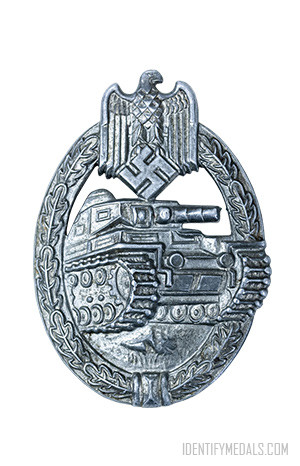
The Tank Destruction Badge

The Tank Destruction Badge was a World War II German military decoration given to members of the Wehrmacht who had destroyed an enemy tank.

The Tank Destruction Badge (Sonderabzeichen für das Niederkämpfen von Panzerkampfwagen durch Einzelkämpfer in German) was a war badge awarded to Waffen SS and Wehrmacht Heer soldiers during World War II.

The badge was instituted by Nazi Germany on 9 March 1942 and created to recognize the achievements of soldiers who demonstrated exceptional skill and bravery in destroying enemy tanks. It was awarded to members of the Wehrmacht, Waffen-SS, and other Nazi military units who successfully destroyed enemy tanks through various means, including anti-tank weapons, grenades, mines, and other improvised methods.

To qualify for the Tank Destruction Badge, soldiers had to provide evidence of their tank destruction achievements, usually confirmed by eyewitness accounts, official reports, or other documentation. The badge was then presented as a mark of honor and recognition for their combat prowess and contribution to the war effort.

The Tank Destruction Badge Design

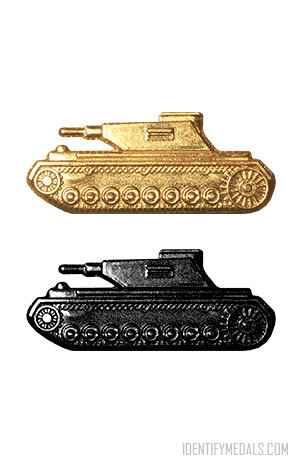
The Tank Destruction Badge showcased a Panzer IV tank, measuring 42 mm by 18 mm, which was darkened and affixed to a silver band measuring 88 mm by 33 mm. Along the top and bottom edges, there were 4 mm black stripes positioned 2 mm away.

The badge was initially pinned to the sleeve and then securely fastened by sewing. It was backed by cloth or cotton material.

There were two main versions of the Tank Destruction Badge: a silver grade and a bronze grade. The silver badge was awarded for the destruction of five or more enemy tanks, while the bronze badge was awarded for the destruction of three or four enemy tanks

More Army/Waffen-SS War Badges

The Army/Waffen-SS war badges were military decorations awarded by Nazi Germany to members of the Army (Heer) and the Waffen-SS. Explore the complete collection below:

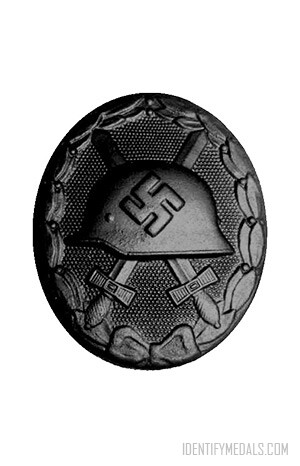
The Wound Badge (1945)

The Wound Badge (Verwundetenabzeichen) was a military decoration awarded to wounded soldiers during the Third Reich and WW2.
The Wound Badge (Verwundetenabzeichen in German) was a military decoration of Nazi Germany that was first introduced during World War I to honor soldiers who were wounded in combat. In World War II, the badge was reintroduced with modifications and continued to be awarded to soldiers who sustained injuries in the line of duty.

The Wound Badge 1945, specifically, was instituted on March 22, 1945, during the final months of World War II. This version of the badge was intended to recognize soldiers who were wounded during the last phases of the war, which were characterized by intense fighting as Allied forces advanced into German territory.

After the defeat of Nazi Germany in 1945, the Wound Badge 1945, like other military decorations of the Third Reich, ceased to be awarded. However, it remains a significant historical artifact, serving as a reminder of the human cost of war and the courage displayed by soldiers in the face of adversity.

The WW2 Wound Badge Design

Like its predecessors from World War I and earlier in World War II, the Wound Badge 1945 came in three grades: black, silver, and gold. The black badge was awarded for one or two wounds, the silver badge for three or four wounds, and the gold badge for five or more wounds, injuries resulting in total disability, loss of a limb, or permanent damage due to combat wounds.

The design of the badge remained consistent with earlier versions, featuring a helmet and crossed swords surrounded by an oak leaf wreath. The color of the badge denoted the level of injury sustained, with the black, silver, and gold grades representing increasingly severe wounds.

Recipients of the Wound Badge 1945 were entitled to wear it on the uniform, typically on the upper left breast pocket of the tunic.

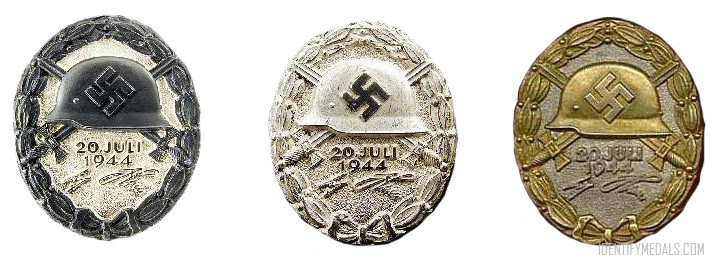
Wound Badge of 20 July 1944

The 20 July 1944 Wound Badge was only issued to those injured during the failed attempt on Adolf Hitler’s life at the Wolf’s Lair headquarters in Rastenburg, East Prussia. Hitler ordered a special wound badge to be awarded to commemorate the event, as he believed “fate had intervened” for him.

The 20 July version of the Badge shown in black, silver and gold

Hitler presented the survivors with the special wound badge as well as a unique award document. The first were in a ceremony on 20 August 1944.

Considered by collectors to be the “Holy Grailof German WWII medals, this Wound Badge is often reproduced. The best counterfeit versions are correct down to the weight and maker’s marks on the back of the award, which make it very difficult to tell the difference between an original or a fake.

Find this Decoration

Right Now on eBay 
Clicking a link to eBay may result in a referral commission being paid if a purchase is made.
Loading...

More Army/Waffen-SS War Badges

The Army/Waffen-SS war badges were military decorations awarded by Nazi Germany to members of the Army (Heer) and the Waffen-SS. Explore the complete collection below:

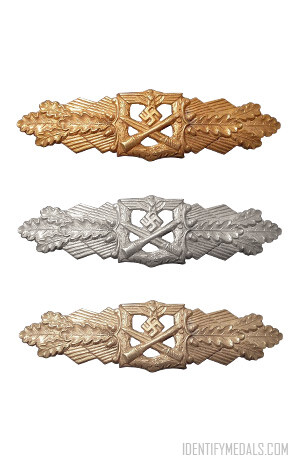
The Close Combat Clasp

The Close Combat Clasp (Nahkampfspange) was instituted on 25 November 1942, during WW2, for participation in hand-to-hand fighting.
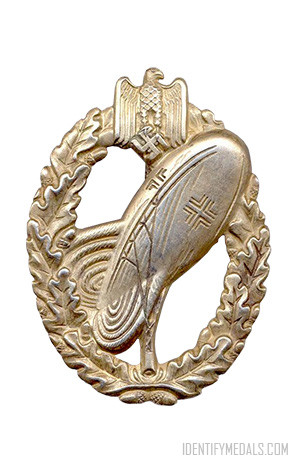
The Close Combat Clasp (Nahkampfspange in German) was a war badge awarded to Waffen SS and Wehrmacht Heer soldiers during World War II. Established on November 25, 1942, the Close Combat Clasp was awarded to German soldiers who displayed exceptional bravery and skill in close combat situations, treet fighting, or other situations where the use of firearms was impractical or ineffective. This included combat actions within buildings, trenches, or other confined spaces where the enemy was engaged at close range.

To be eligible for the Close Combat Clasp, soldiers had to meet certain requirements, including demonstrating individual bravery and skill in close combat situations. These engagements were often intense and dangerous, requiring quick thinking, physical strength, and the ability to adapt to rapidly changing circumstances.

The Close Combat Clasp was one of many military decorations instituted by the Nazi regime during World War II to honor acts of bravery and valor among its soldiers. Despite its association with a regime responsible for some of the greatest atrocities in human history, the award itself remains a significant historical artifact.

The Close Combat Clasp Design

The clasp was made of bronze, silver, or gold, with varying criteria determining which level of award a soldier received. For instance:

  • The bronze clasp was awarded for 15 days of close combat.
  • The silver clasp for 25 days of close combat.
  • The gold clasp for 50 days or more of close combat engagements.

The award was typically worn on the upper left pocket and above the ribbon bar. Individuals would only wear one (the highest level they had received).

More Army/Waffen-SS War Badges

The Army/Waffen-SS war badges were military decorations awarded by Nazi Germany to members of the Army (Heer) and the Waffen-SS. Explore the complete collection below:

The Sea Battle Badge of the Luftwaffe

The Sea Battle Badge was a German award instituted in 1944 and given to crews of Luftwaffe supply ships, air/sea rescue launches, and vessels.

The Sea Battle Badge was a German award instituted in 1944 and given to crews of Luftwaffe supply ships, air/sea rescue launches, and other special vessels (working on the surface). It’s worth mentioning that Germany had no aircraft carriers or a navy air branch. 

The eligibility criteria were quite broad: Any military or civilian Luftwaffe personnel as eligible – as long as they were not also awarded another badge. There were a number of days at sea required, however:

  • Leaders and crew of supply ships: 60 days in the North or East sea, between 5 and 20 degrees longitude and south of the 60th degree of latitude or 20 days in the Mediterranean, including the Aegean and the Black Sea.
  • Leaders and crew of air and sea rescue boats: 20 days with a minimum of one rescue attempt or a three-hour sea duration each day, or 10 days with a successful rescue.

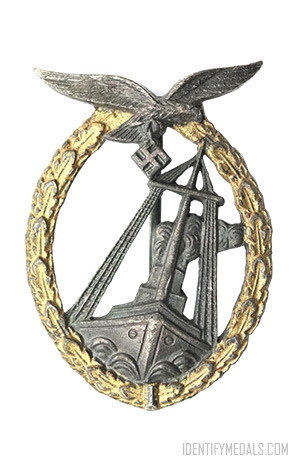
The badge has the Luftwaffe eagle and a swastika with a 30-degree-tilted sea vessel in the center, all surrounded by a gilt wreath made of oak leaves. 

More Luftwaffe War Badges

Awarded to members of the German Luftwaffe for their achievements and contributions to air warfare, the Luftwaffe War Badges symbolized excellence, courage, and skill in aerial combat and support roles. Explore the complete collection below:

The Glider Badge of the Luftwaffe

The Glider Badge of the Luftwaffe was a German award instituted in 1940 and awarded to pilots who had done the glider training course.

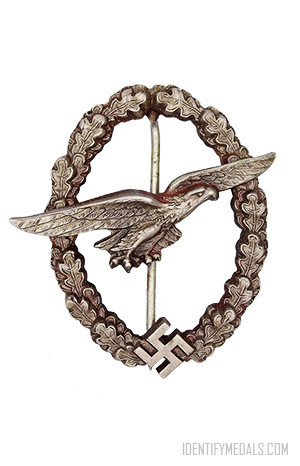
The Glider Badge of the Luftwaffe was a German award instituted in 1940 and awarded to pilots who had done the glider training course. 

The badge consists of an eagle in flight, with wings spread and spanning the full width of the insignia, and a swastika on top of a circular wreath made of silver oak leaves (unlike other Luftwaffe badges, it’s only oak ones). The Glider Badge was usually made of aluminum, nickel-silver, zinc, or tombak. There was also a cloth version of it. 

More Luftwaffe War Badges

Awarded to members of the German Luftwaffe for their achievements and contributions to air warfare, the Luftwaffe War Badges symbolized excellence, courage, and skill in aerial combat and support roles. Explore the complete collection below:

The Radio Operator Badge of the Luftwaffe

The Radio Operator Badge of the Luftwaffe was a German award given to radio and gunner qualified personnel with training or operations.

The Radio Operator Badge of the Luftwaffe was a German award given to radio operators, gunners, and mechanics (qualified personnel) that had succeeded in the training course (two months at least) and had at least five operational flights. These criteria was shortened if the recipient had been wounded in action.

This badge was later replaced by the Gunner and Flight Engineer Badge of the Luftwaffe. 

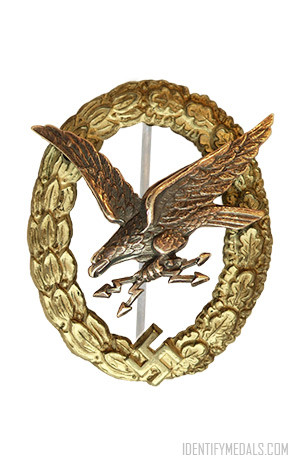
The badge is shaped like an oval and shows an eagle carrying two crossed lightning bolts in its claws. There is also a swastika and a wreath made of oak and laurel leaves. The Radio Operator badges were usually made of different metals such as tombak, silver-nickel, pot metal, and zinc. There was also a cloth version authorized later that has silver wire embroidery. 

More Luftwaffe War Badges

Awarded to members of the German Luftwaffe for their achievements and contributions to air warfare, the Luftwaffe War Badges symbolized excellence, courage, and skill in aerial combat and support roles. Explore the complete collection below:

The Air Gunner and Flight Engineer Badge of the Luftwaffe

The Air Gunner and Flight Engineer Badge was a German award given to Luftwaffe flight engineers, air gunners, and aircrew meteorologists.

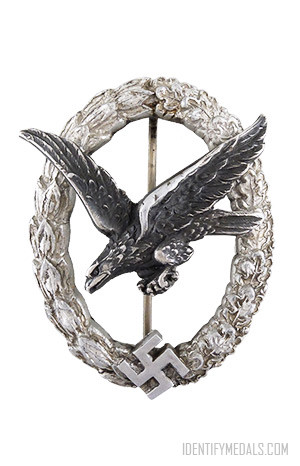
The Air Gunner and Flight Engineer Badge was a German award given to (and worn by) Luftwaffe flight engineers, air gunners, and aircrew meteorologists. The requirement was to complete two months of training or to have participated in five operational flights. 

The badge could be awarded at an earlier stage if the recipient had suffered wounds during an operational flight. 

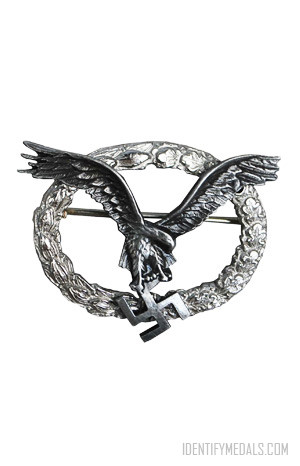
The badge shows an eagle in flight. At the bottom is a swastika. The design is surmounted by a wreath of laurel leaves and oak leaves (the wreath is made of silver). 

The first Air Gunner badges were made in tombak, although there are also examples in kreigsmetal and zinc. The eagle was sometimes made of aluminum and the wreath zinc. 

More Luftwaffe War Badges

Awarded to members of the German Luftwaffe for their achievements and contributions to air warfare, the Luftwaffe War Badges symbolized excellence, courage, and skill in aerial combat and support roles. Explore the complete collection below:

The Observer Badge of the Luftwaffe

The Observer Badge of the Luftwaffe was a German award for qualifying service established in 1935 and instituted in 1936.
The Observer Badge of the Luftwaffe was a German award for qualifying service established in 1935 (provisions) and instituted in 1936. It was one of the first set of badges for which Reichsmarchall Göring gave specifications. 
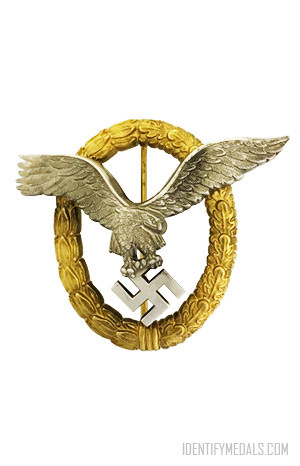
The badge was awarded after completing two months of qualifying service and five operational flights as an observer, or if the recipient was wounded while posted as an observer (before completing the 5 flights). 

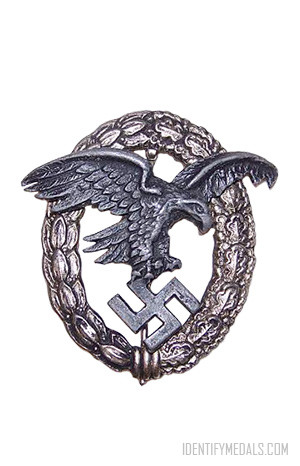
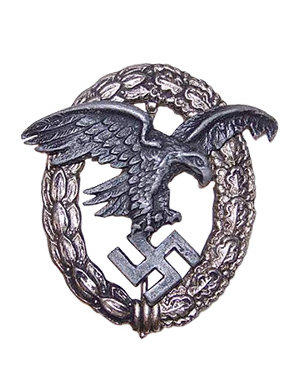
It’s not known how many Observer badges were awarded. The shape is oval and slightly convex. An eagle is over-imposed on a wreath of laurel leaves (on the right) and oak leaves (on the left). The material used for the Observer badge were tombac, aluminum, and zinc. Measures can vary slightly according to the manufacturer.

More Luftwaffe War Badges

Awarded to members of the German Luftwaffe for their achievements and contributions to air warfare, the Luftwaffe War Badges symbolized excellence, courage, and skill in aerial combat and support roles. Explore the complete collection below: