The Tank Combat Badge of the Luftwaffe

The Tank Combat Badge of the Luftwaffe is a Third Reich / Nazi Germany Luftwaffe War Badge awarded during the Second World War.

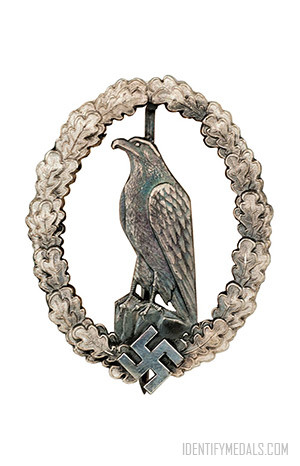
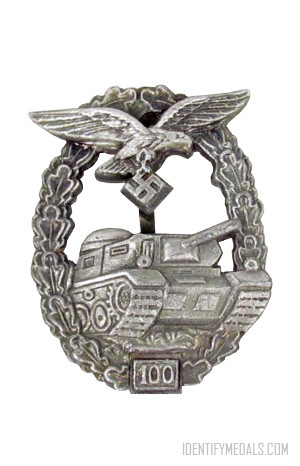
The Tank Combat Badge of the Luftwaffe (Or Luftwaffe Panzer Badge, Panzerkampfabzeichen der Luftwaffe German) was a World War II German military decoration instituted on 3 November 1944 by Reichsmarshall Goring to honor the panzer troops of the Luftwaffe field divisions (until then, qualified Luftwaffe personnel were awarded the Heer Panzer Badge).

The badge had two designs:

  • All Silver: Awarded to tank commanders, gunners, drivers, radiomen, repair crews and their medical personnel.
  • Silver with Black Wreath: Awarded to Panzer grenadiers, armored reconnaissance units, and the medical personnel attached to them.

Both badge styles were awarded for three combat engagements on three different days.

The Tank Combat Badge of the Luftwaffe Design

The badge is an oval wreath composed of eight oak leaves on the left and seven oak leaves on the right. The first design was entirely silver and the second had a black wreath.

The badge was presented in a paper packet with the name of the award printed on the outside. 

More Luftwaffe War Badges

Awarded to members of the German Luftwaffe for their achievements and contributions to air warfare, the Luftwaffe War Badges symbolized excellence, courage, and skill in aerial combat and support roles. Explore the complete collection below:

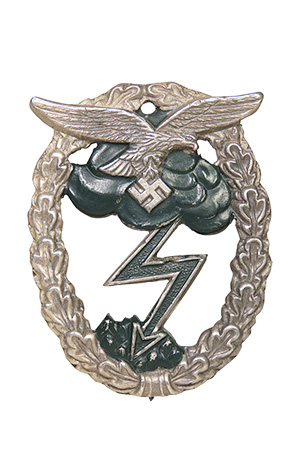
The Ground Assault Badge of the Luftwaffe

The Ground Assault Badge of the Luftwaffe is a Third Reich / Nazi Germany Luftwaffe War Badge awarded during the Second World War.

The Ground Assault Badge of the Luftwaffe (Erdkampfabzeichen der Luftwaffein German) was a World War II German military decoration instituted on 31 March 1942 by commander-in-chief Hermann Göring and awarded for achievement in ground combat. 

The criteria was the participation in three separate combat operations on separate days. Luftwaffe soldiers who had already been awarded medals or orders of the Heer such as General Assault Badge or the Infantry Assault Badge, were required to exchange their badges for the Ground Assault Badge of the Luftwaffe.

The badge was awarded in four classes based on the number of combat operations:

  • 2nd grade (II. Stufe) for 25 eligible operations,
  • 3rd grade (III. Stufe) for 50 eligible operations,
  • 4th grade (IV. Stufe) for 75 eligible operations,
  • 5th grade (V. Stufe) for 100 eligible operations.

The Ground Assault Badge of the Luftwaffe Design

Designed by Professor Sigmund von Weech, the badge consists of a Luftwaffe eagle, clawing a Swastika, flying above a storm cloud, from which a lightning bolt strikes rough ground.

More Luftwaffe War Badges

Awarded to members of the German Luftwaffe for their achievements and contributions to air warfare, the Luftwaffe War Badges symbolized excellence, courage, and skill in aerial combat and support roles. Explore the complete collection below:

The Anti-Aircraft Flak Battle Badge

The Anti-Aircraft Flak Battle Badge is a Third Reich / Nazi Germany Luftwaffe War Badge awarded during the Second World War.

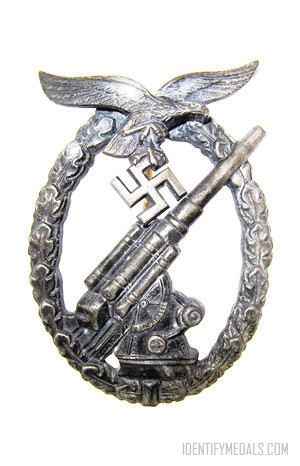
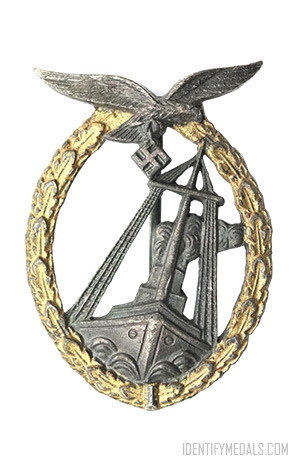
The Anti-Aircraft Flak Battle Badge (Flak-Kampfabzeichen der Luftwaffein German) was a World War II German military decoration instituted on 10 January 1941 by the Commander in Chief of the Luftwaffe Hermann Göring to commemorate soldiers or servicemen of the Flak Artillery who distinguished themselves in action against enemy aerial or ground attacks. 

The Anti-Aircraft Flak Battle Badge Design

The badge was worn on the lower part of the left breast pocket of the service tunic, underneath the 1st class Iron Cross if awarded.

More Luftwaffe War Badges

Awarded to members of the German Luftwaffe for their achievements and contributions to air warfare, the Luftwaffe War Badges symbolized excellence, courage, and skill in aerial combat and support roles. Explore the complete collection below:

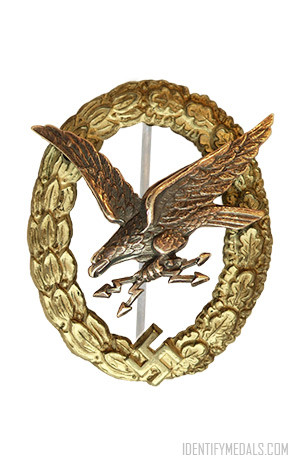
The Luftwaffe Parachutist Badge

The Luftwaffe Parachutist Badge is a Third Reich / Nazi Germany Luftwaffe War Badge awarded during the Second World War.

The Luftwaffe Parachutist Badge (Fallschirmschützenabzeichen in German) was a World War II German military decoration instituted on 5 November 1936 and awarded to qualified parachutists of the Wehrmacht and the Waffen-SS.

The badge was first established by order of Hermann Göring and originally given to Luftwaffe personnel after completion of the required number of six jumps. A recipient had to re-qualify for the badge each year.

An army version was introduced on 1 September 1937, in which the swastika was relocated to the top of the wreath and surmounted by a smaller upright eagle. 

The Luftwaffe Parachutist Badge Design

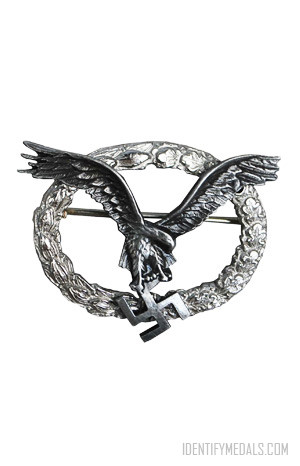
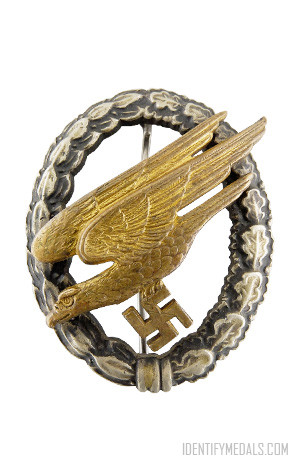
The Luftwaffe Parachutist Badge depicts a diving eagle with a swastika in its claws surrounded by a silver wreath. The original construction was made of gold-finished bronze for the eagle and oxidized silver plate for the laurel leaves.

In 1937, the construction of the badge was changed to aluminum and in late 1942 to a metal alloy. A cloth version of the badge was also authorized in 1937, to be worn on a flight jacket.

More Luftwaffe War Badges

Awarded to members of the German Luftwaffe for their achievements and contributions to air warfare, the Luftwaffe War Badges symbolized excellence, courage, and skill in aerial combat and support roles. Explore the complete collection below:

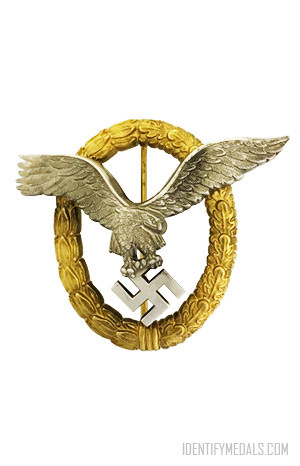
The Pilot / Observer Badge of the Luftwaffe

The Pilot/Observer Badge (or Flugzeugführer- und Beobachterabzeichen in German) was a WW2 German decoration instituted by Hermann Göring.
The Pilot/Observer Badge (or Flugzeugführer- und Beobachterabzeichen in German) was a World War II German military decoration instituted on 26 March 1936 by the Commander in Chief of the Luftwaffe Hermann Göring and awarded to Luftwaffe service personnel who had already been awarded the Pilot’s Badge and Observer Badge.

It was  It was worn on the lower part of the left breast pocket of the service tunic, underneath the Iron Cross 1st Class if awarded. It was to replace the older 1933 Aircrew Badge.

The Pilot/Observer Badge Design

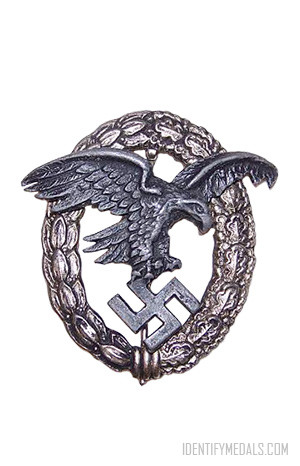
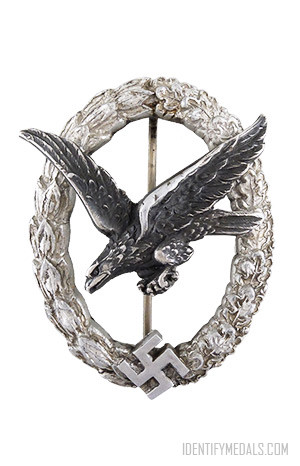
The badge was originally manufactured in bronze, and later zinc. The badge can be distinguished from the Pilot’s Badge by the gold wreath; the Pilot’s Badge had a silver wreath.

There was also a cloth version of the badge which used embroidered bullion for the officer’s version and cotton for the NCO’s version. The presentation case was dark blue, with a blue satin top liner and a blue velvet bottom liner on the inside.

There is an exclusive variant of the Pilot/Observer Badge in Gold with Diamonds (or Gemeinsame Flugzeugführer- und Beobachterabzeichen in Gold mit Brillanten in German). It was bestowed by Göring to honour exceptional achievement and on rare occasions as an honorary award. The first recipients were General Walther Wever, Chief of the Luftwaffe General Staff and General der Flieger Erhard Milch, State Secretary of the Reichsluftfahrtministerium on 11 November 1935.

More Luftwaffe War Badges

Awarded to members of the German Luftwaffe for their achievements and contributions to air warfare, the Luftwaffe War Badges symbolized excellence, courage, and skill in aerial combat and support roles. Explore the complete collection below: