The Honor Roll Clasp of the Kriegsmarine

The Honor Roll Clasp of the Kriegsmarine was a German decoration first issued in July 1941 after the German invasion of the Soviet Union.

The Honor Roll Clasp (or Ehrenblattspange in German) was a World War II German military decoration issued in July 1941 after the German invasion of the Soviet Union.

The Honor Roll existed in three different versions: One for the Army (Heer), one for the Air Force (Luftwaffe), and one for the Navy (Kriegsmarine) – all of which also have de-nazified versions.

To be eligible for the clasp, across all three services, a recipient must have:

  • Previously received the Iron Cross in both the first and second classes;
  • Demonstrated further distinction in combat subsequent to being awarded the Iron Cross in both classes; and
  • Been listed in the Honor Roll of the German Army.

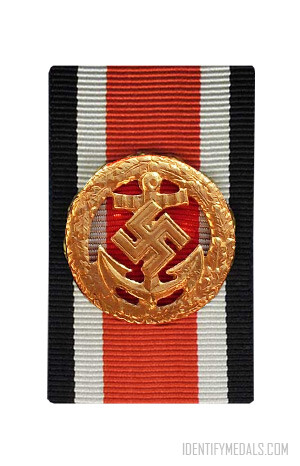
The Honor Roll Clasp of the Kriegsmarine (Ehrentafel der Deutschen Kriegsmarine) was established in February 1943 and received a wearable decoration (seen in the picture) in May 1944.

The Honor Roll Clasp of the Kriegsmarine Design

The clasp was crafted from gilt metal and features a wreath measuring 24.5 mm in diameter, composed of six clusters of oak leaves on either side. At its widest point, the wreath measures 5 mm in width, narrowing to a point at the apex where two oak leaves met tip-to-tip. The badge’s height from base to tip is 26 mm. The reverse of all clasps has four pins for attachment.

The Honor Roll Clasp of the Kriegsmarine shows a swastika superimposed on an anchor.

More Naval War Badges

The Naval War Badges (Kriegsmarine) badges were awarded to sailors, officers, and personnel of the Kriegsmarine who demonstrated exceptional skill, bravery, and dedication in naval warfare. Explore the complete collection below:

The Naval Front Clasp

The Naval Front Clasp was a World War II German military decoration awarded to officers and men of the Kriegsmarine during the Third Reich.

The Naval Front Clasp (or Marine-Frontspange in German) was a German military decoration awarded during World War II.

Established in 1944, the recipients were officers and enlisted personnel of the Kriegsmarine for their prolonged and frontline service across all naval units, except for the submarine service, which had its separate award.

This bronze clasp recognized service or acts of valor that exceeded the requirements of the basic war badge. Instituted on November 19, 1944, by Grand Admiral Karl Dönitz.

The Naval Front Clasp Design

Each wing consisted of six staggered oak leaves, totaling twelve. At the bottom of the central wreath, an anchor adorned the design.

More Naval War Badges

The Naval War Badges (Kriegsmarine) badges were awarded to sailors, officers, and personnel of the Kriegsmarine who demonstrated exceptional skill, bravery, and dedication in naval warfare. Explore the complete collection below:

The U-Boat Front Clasp

The U-Boat Front Clasp was a World War II German Kriegsmarine military decoration awarded during the Third Reich.

The U-boat Front Clasp (or U-Boot-Frontspange in German) was a German military decoration awarded for continuous service and valor during World War II.

Established on May 15, 1944, the award aimed to align the U-boat force with other branches of the German armed forces, each possessing comparable accolades to honor acts of valor. Merits for receiving the award were not explicitly outlined; rather, decorations were conferred based on recommendations from U-boat commanders, subject to approval by Karl Dönitz.

Often, awards were granted in recognition of the number of completed patrols or displays of bravery in combat. The clasp was worn on the upper left breast.

The award was conferred in two tiers, distinguished by their material.

  • Bronze: This represented the lower grade and was granted based on criteria such as the number of war patrols undertaken, the level of risk inherent in the missions, and individual acts of bravery.
  • Silver: Introduced on November 24, 1944, this class aimed to extend recognition to bronze recipients who continued to demonstrate merit, faced heightened risks, and displayed acts of valor.

The U-Boat Front Clasp Design

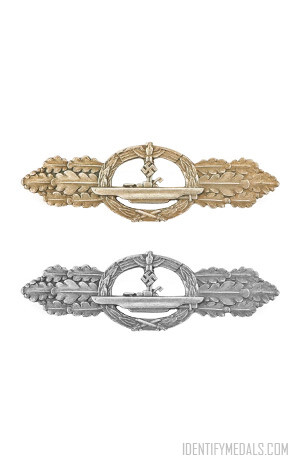
Wilhelm Ernst Peekhaus from Berlin presented the design for the badge, featuring a central laurel wreath adorned with a stylized submarine and wings made of oak leaves.

Each wing consisted of six staggered oak leaves, totaling twelve. At the bottom of the central wreath, two crossed swords adorned the design, while the submarine in the middle echoed the U-Boat War Badge’s design. Integrated into the wreath was an eagle with downturned wings grasping a swastika.

Following the conclusion of the war, German sailors could only wear the medal if it did not bear National Socialist symbols, in accordance with the German Ordensgesetz. An alternative design featuring a complete laurel wreath, devoid of the eagle and swastika, with a submarine emblem centered within, was created for this purpose.

More Naval War Badges

The Naval War Badges (Kriegsmarine) badges were awarded to sailors, officers, and personnel of the Kriegsmarine who demonstrated exceptional skill, bravery, and dedication in naval warfare. Explore the complete collection below:

The Naval Artillery War Badge

The Naval Artillery War Badge was a World War II decoration awarded to the crews of land-based marine artillery and anti-aircraft units.

The Naval Artillery War Badge (or Kriegsabzeichen für die Marineartillerie in German) was a military decoration bestowed upon the personnel serving in land-based marine artillery and anti-aircraft units of the Kriegsmarine during World War II.

Instituted on June 24, 1941, by Grand Admiral Erich Raeder, this badge was presented to individuals and crew members of coastal defense units as well as anti-aircraft units in recognition of their valorous actions. Additionally, it was awarded posthumously to those who lost their lives in action while serving in this unit.

The badge was granted in a singular degree. To earn the award, a crew needed to accumulate eight points, which could be obtained as follows:

  • Two points for independently downing an aircraft.
  • One point for jointly downing an aircraft with the assistance of another crew.
  • Half a point for non-gun crew members who contributed to the downing of aircraft by operating searchlights, fire control systems, sound locators, or serving as radio operators.

The Naval Artillery War Badge Design

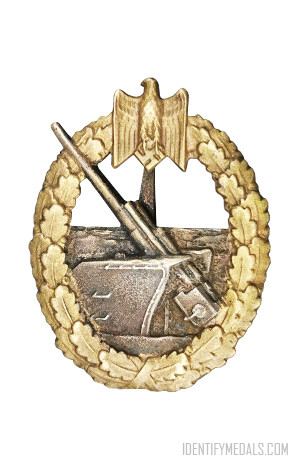
The medal, designed by Otto Placzek of Berlin, comprises an outer laurel wreath adorned with oak leaves, with the German Eagle positioned at the apex, its wings gracefully downturned as it clutches a golden swastika. In the center, a coastal artillery gun is depicted against a backdrop of the sea, rendered in grey.

Early versions of the medal were crafted from bronze, later transitioning to nickel. However, towards the end of the war, inferior quality versions were fashioned from materials such as “pot or monkey metal”. This medal was traditionally worn on the lower section of the left breast pocket of the naval service tunic.

More Naval War Badges

The Naval War Badges (Kriegsmarine) badges were awarded to sailors, officers, and personnel of the Kriegsmarine who demonstrated exceptional skill, bravery, and dedication in naval warfare. Explore the complete collection below:

The Auxiliary Cruiser Badge

The Auxiliary Cruiser Badge is a Military Service Badge (Naval War / Kriegsmarine) from the Third Reich, Germany, Second World War.
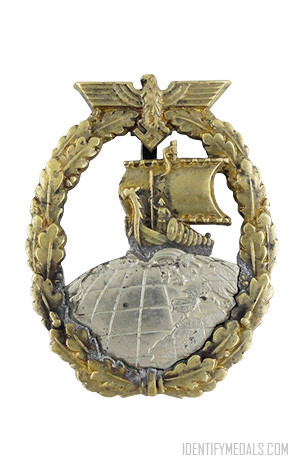
The Auxiliary Cruiser Badge (Kriegsabzeichen für Hilfskreuzer in German) is a war badge awarded to Kriegsmarine soldiers during World War II. It was instituted on 24 April 1941 and given to officers and men of the Kriegsmarine for service on Auxiliary Cruisers or the supply ships that supported them for a successful large voyage.

The Auxiliary Cruiser Badge Design

The badge bears a Viking ship above the northern hemisphere globe, surrounded by oak leaves.

More Naval War Badges

The Naval War Badges (Kriegsmarine) badges were awarded to sailors, officers, and personnel of the Kriegsmarine who demonstrated exceptional skill, bravery, and dedication in naval warfare. Explore the complete collection below:

The Fast Attack Craft War Badge

The Fast Attack Craft War Badge is a Military Service Badge (Army/Waffen-SS) from the Third Reich, Germany, Second World War.

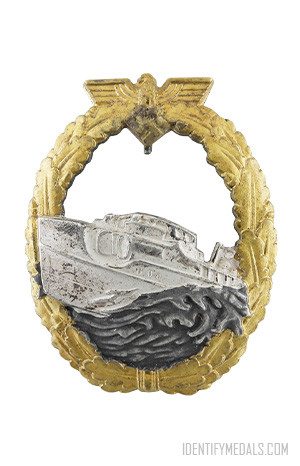
The Fast Attack Craft War Badge (or Das Schnellbootkriegsabzeichen in German) is a war badge instituted on 30 May 1941 and awarded to Kriegsmarine members for service on fast attack craft or torpedo boats.

The requirements for receiving this award included an outstandingly successful sortie, wounds in action, 12 sorties against enemy vessels or installations, or outstanding leadership.

The Badge was made in two versions; the first instituted on May 30, 1941 and the second in January 1943.

The Fast Attack Craft War Badge Design

The badge was worn on the lower part of the left breast pocket of the naval service tunic, underneath the 1st class Iron Cross or equivalent grade award.

Both badge designs were created by Wilhelm Ernst Peekhaus of Berlin. There is also a third exclusive version with nine diamonds replacing the solid bars of the swastika at the top, although only eight of them are known to have been awarded.

More Naval War Badges

The Naval War Badges (Kriegsmarine) badges were awarded to sailors, officers, and personnel of the Kriegsmarine who demonstrated exceptional skill, bravery, and dedication in naval warfare. Explore the complete collection below:

The Blockade Runner Badge

The Blockade Runner Badge is a Military Service Badge (Naval War / Kriegsmarine) from the Third Reich, Germany, Second World War.
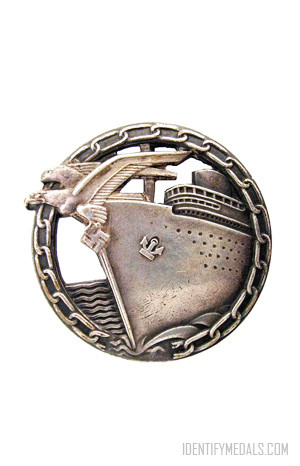
The Blockade Runner Badge (also known as the Badge for Blockade Runners or Abzeichen für Blockadebrecher in German) is a war badge awarded to Kriegsmarine soldiers during World War II.

It was instituted on 1 April 1941 for service on warships or merchant vessels (also allied) that attempted to break through the British sea blockade of Germany. A smaller half-size version was awarded for use by civilians and members of the merchant marine.

The Blockade Runner Badge Design

The design of the Blockade Runner Badge is a warship or merchant vessel surrounded by an circular chain.

More Naval War Badges

The Naval War Badges (Kriegsmarine) badges were awarded to sailors, officers, and personnel of the Kriegsmarine who demonstrated exceptional skill, bravery, and dedication in naval warfare. Explore the complete collection below:

The Minesweeper War Badge

The Minesweeper War Badge is a Military Service Badge (Naval War / Kriegsmarine) from the Third Reich, Germany, Second World War.
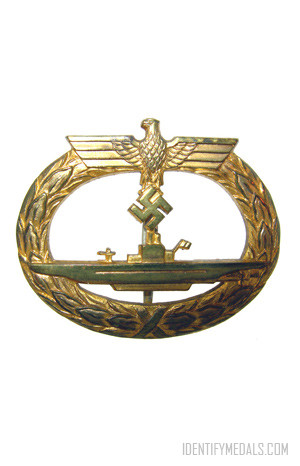
The Minesweeper War Badge (Also known as Minesweepers, Sub-Chasers and Escort-Vessel War Badge, Kriegsabzeichen für Minensuch-, U-Boot-Jagd- und Sicherungsverbände in German) is a war badge awarded to Kriegsmarine soldiers during World War II. It was instituted on 31 August 1940 and given to members for service on Minesweepers boats.

In order to qualify for the award, a person had to be recommended from the ship’s captain if the candidate had completed 3 operational sorties, had been wounded during an operational sortie, had shown exemplary conduct in the execution of his duties over a 6-month period, had completed a specially dangerous mission in a mined area, had served on escort duty for 25 days or more, had participated in a specific mission that had been successfully completed, or if the ship was sunk due to enemy action.

The Minesweeper War Badge Design

The badge was worn on the lower part of the left breast pocket of the naval service tunic, underneath the 1st class Iron Cross or equivalent grade award.

More Naval War Badges

The Naval War Badges (Kriegsmarine) badges were awarded to sailors, officers, and personnel of the Kriegsmarine who demonstrated exceptional skill, bravery, and dedication in naval warfare. Explore the complete collection below:

The Destroyer War Badge

The Destroyer War Badge is a Military Service Badge (Naval War / Kriegsmarine) from the Third Reich, Germany, Second World War.
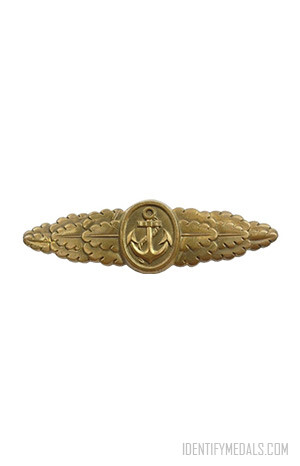
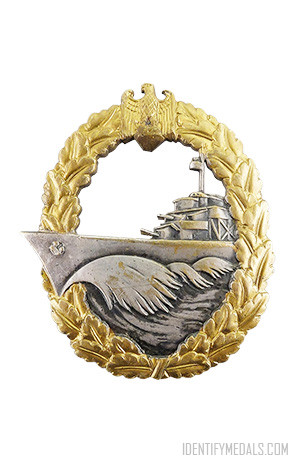
The Destroyer War Badge (Zerstörerkriegsabzeichen in German) is a war badge awarded to Kriegsmarine soldiers during World War II. It was instituted on 4 June 1940 by admiral Erich Raeder and awarded to officers and crew for the service on Kriegsmarine destroyers.

Before October 10, 1940, requirements included participation in the battles of Narvik. After the date, the requirements were wound, participation in three enemy engagements or at least in 12 non-enemy sorties, ship sinking in action, outstanding performance or other heroic deeds. The Badge was also awarded to the crews of Kriegsmarine torpedo boats and fast attack craft until the institution of the Fast Attack Craft War Badge.

Around 6000 Destroyer War Badges were awarded during WW2. A few of them were manufactured using also diamonds but it’s believed these awards were to be presented to only the most successful destroyer captains after the war was over.

The Destroyer War Badge Design

The badge was worn on the lower part of the left breast pocket of the naval service tunic. It was placed underneath the 1st class Iron Cross or equivalent grade award.

A cloth version of the Badge was issued for wear on the dark blue uniform.

More Naval War Badges

The Naval War Badges (Kriegsmarine) badges were awarded to sailors, officers, and personnel of the Kriegsmarine who demonstrated exceptional skill, bravery, and dedication in naval warfare. Explore the complete collection below:

The High Seas Fleet Badge

The High Seas Fleet Badge is a Military Service Badge (Naval War / Kriegsmarine) from the Third Reich, Germany, Second World War.
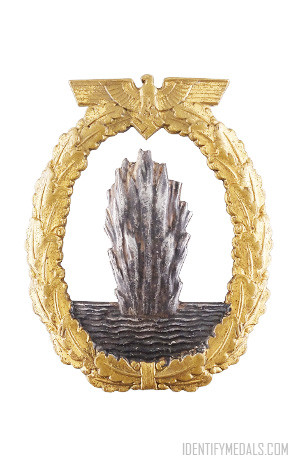
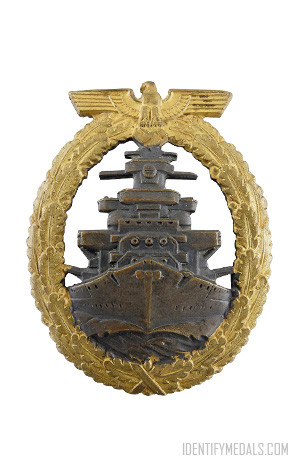
The High Seas Fleet Badge (Das Flottenkriegsabzeichen in German) is a war badge awarded to Kriegsmarine soldiers during World War II. It was instituted in April 1941 and given for service to the crews of the High Seas Fleet – mainly of battleships and cruisers but also the ships that supported them operationally and for which there was no other award available.

In order to qualify for the badge, a person had to show active duty on 1 or more 12 week cruises, wounds or sinking in action, as well as proof of distinction and good conduct. The award could be given retroactively for actions against the British fleet. The number of required weeks could be reduced if the person met one of these conditions:

  • The recipient was wounded or killed during the voyage.
  • For outstanding achievements in an engagement.
  • If the cruise was successful.
  • If an individual’s ship was sunk in action.
  • For participation in “Rawalpindi” and “Jan Mayen”.
  • For all crew members of the Scharnhorst and Gneisenau in view of the operational effectiveness of the ships.
  • To every sailor who was present on the Tirpitz when it was bombed and sunk by the British R.A.F. on November 12, 1944.

The High Seas Fleet Badge Design

The design of the badge is set over a battleship and surrounded by an oval of oak leaves. 

More Naval War Badges

The Naval War Badges (Kriegsmarine) badges were awarded to sailors, officers, and personnel of the Kriegsmarine who demonstrated exceptional skill, bravery, and dedication in naval warfare. Explore the complete collection below: