- Time Period: Post-WW2
- Institution: 8 November 1950
- Country: United States
The Korean Service Medal (KSM) is a United States military service medal created during the Korean War to recognise American Armed Forces members who served in the Korean theatre between 27 June 1950 and 27 July 1954. It was established by Executive Order 10179 signed by President Harry S. Truman on 8 November 1950, with retroactive effect back to the start of the conflict.
The medal was awarded to service members who either served in Korea or its surrounding waters and airspace, or those who directly supported United Nations military operations during the Korean War. Eligibility generally required a period of service in the designated area or participation with a unit on permanent or temporary duty during the war.
Although active combat in Korea ended with the armistice in July 1953, the Korean Service Medal continued to be issued until mid-1954 because of ongoing occupation duties and the potential for renewed hostilities. It was not awarded for service after that date; later periods of service in Korea have been recognised by other medals such as the Korea Defense Service Medal.
The Korean Service Medal Design
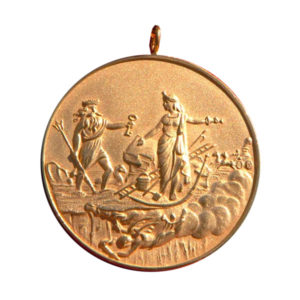
The KSM is a bronze medallion about 1¼ inches in diameter. The obverse shows a Korean gateway encircled by the words “KOREAN SERVICE”, and the reverse bears the Korean taegeuk symbol from the South Korean flag with “UNITED STATES OF AMERICA” and a wreath of oak and laurel.
The ribbon uses blue and white colours inspired by the United Nations flag, reflecting the UN’s role in the conflict.
To denote participation in specific phases of the campaign, service stars were worn on the ribbon, one for each of the officially recognised campaigns within the Korean War period. In some cases, additional devices such as an arrowhead were authorised to show involvement in assault landings.