The Commemorative Medal for Foreign Operations or Missions

The Commemorative Medal for Foreign Operations or Missions (Médaille Commémorative pour Missions ou Opérations à l’Étranger / Herinneringsmedaille voor Buitenlandse Opdrachten of Operaties) is a military decoration of Belgium established on 13 April 1993 and awarded to military and civilian members of the Belgian Armed Forces who participated in operations or missions outside of the territory of Belgium.

The medal is awarded to those who participated in good standing, in humanitarian, peacekeeping, peace enforcement or international security operations or missions outside the territory of Belgium for a minimum duration of one month. The list of the operations for which the medal is awarded is included in a separate Ministerial Decree, which is amended on a regular basis. If a person participated in more than one such operation, they receive the medal for each of these operations, the number of awards being represented by the number displayed on the ribbon.

The Commemorative Medal for Foreign Operations or Missions Design

The medal is circular and is struck from bronze.

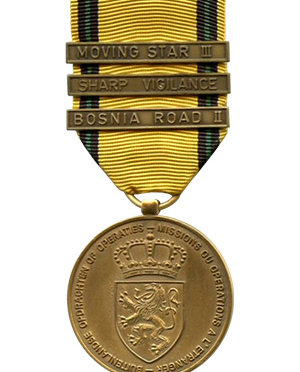
The obverse of the medal bears the Escutcheon-only version of the Coat of arms of Belgium under the royal crown and surrounded by the text “Missions ou opérations à l’étranger – Buitenlandse opdrachten of operaties”. The reverse bears a laurel crown along the outer circumference. The blank area within the wreath may be used to engrave the recipients’ name and date of the award.

The ribbon is golden with three thin longitudinal stripes of black, green, and black near the outer edges. The ribbon is adorned with an Arabic numeral that denotes the number of operations or missions the recipient has participated in.
The Medal for Services Rendered

The Medal for Services Rendered (Médaille pour Services Rendus / Medaille voor Bewezen Diensten) is a Belgian military service medal that was proposed to be created on 18 April 1988 by ministerial decree.

It was intended to be awarded to members of the army, navy, air force and medical services of the Belgian Armed Forces for service rendered in particularly difficult circumstances over an extended time period. However, the creation of the medal was presented to the Council of State under the form of a ministerial decree and the Council ruled that the creation of such an award should be done by the King, thus via a Royal Decree.

Because a Royal Decree was never made, the medal was never officially created and has not or cannot be awarded.

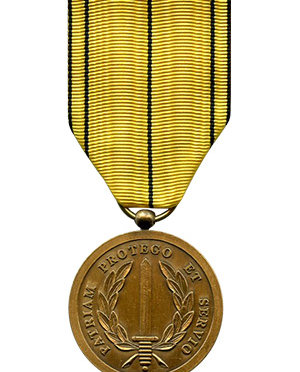
The Medal for Services Rendered Design

The medal measures 36mm in diameter and is circular and struck in bronze.

The obverse bears a relief vertical broadsword pointing up superimposed over the base of a laurel wreath. Inscribed in relief along the medal circumference is, in Latin, “PATRIAM PROTEGO ET SERVIO” (“I PROTECT AND SERVE MY COUNTRY“). The reverse is smooth and plain.

The ribbon is 37 mm wide yellow silk moiré with five longitudinal black stripes. The black stripes are positioned as follows: one in the center, one on each edge, the last two are 4 mm from the edges. The width of the stripes varies according to the ribbon type. The type 1 ribbon has 2 mm edge stripes, 1 mm inner stripes and a 3 mm central stripe, the type 2 ribbon has five equal 1 mm stripes.

The medal hangs by a ring through a suspension loop.

The Commemorative Medal for Armed Humanitarian Operation

The Commemorative Medal for Armed Humanitarian Operations (Médaille commémorative pour opérations humanitaires armées / Herinneringsmedaille voor Gewapende Humanitaire Operaties) is a military decoration of Belgium established on 11 September 1987 and awarded to military and civilian members of the Belgian Armed Forces who participated in armed humanitarian operations.

The list of the operations for which the medal is awarded is included in the Royal Decree creating the medal, it is amended on a regular basis. If a person participated in more than one such operation, he or she will be awarded the same medal for each of these operations, each award represented by an additional clasp on the ribbon.

In the period 2009-2013, the Commemorative Medal for Armed Humanitarian Operations was awarded 119 times.

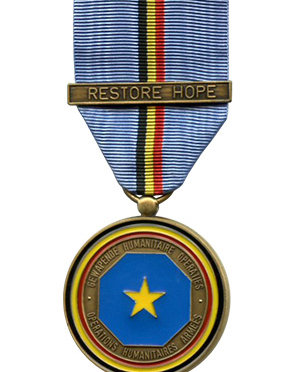
The Commemorative Medal for Armed Humanitarian Operation Design

The medal is circular and struck in bronze. The obverse bears at its center a blue enameled octagon with a yellow five-pointed star in the center. Along the outer circumference of the medal are thin enameled lines of black, yellow, and red surrounding the relief inscription “ARMED HUMANITARIAN OPERATIONS” (OPÉRATIONS HUMANITAIRES ARMÉES / GEWAPENDE HUMANITAIRE OPERATIES). The obverse is plain.

The ribbon is azure blue, with three thin longitudinal bars in the national colors of Belgium (black, yellow and red). Small bronze clasps bear the names of the operations in which the recipient participated.

The Cross of Honor for Military Service Abroad

The Cross of Honour for Military Service Abroad (Croix d’Honneur pour Service Militaire à l’Étranger / Erekruis voor Militaire Dienst in het Buitenland) is a Belgian military decoration established on 16 June 1997 and originally awarded to Belgian servicemen who served for a long period of time in the Federal Republic of Germany, Zaire (now Congo), Rwanda or Burundi.

The medal was awarded in three classes, based on the duration of service in the relevant territory:

  • First Class is awarded for 15 years of service;
  • Second Class for 10 years of service;
  • Third Class for 5 years of service.

Depending on the region where the services were performed, one year of actual service may count for more than one year for the purpose of awarding the Cross of Honor.

The Cross of Honor for Military Service Abroad Design

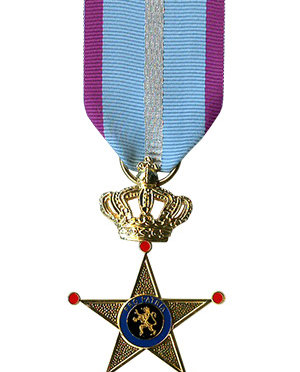
The medal is a gold star with a red pearl at each tip, suspended to the ribbon by a royal crown and a ring.

The obverse bears a central medallion with a golden lion on a black enameled background surrounded by a ring of blue enamel with the motto in gold letters Pro Patria. The reverse bears a crown of laurels surrounding two crossed swords.

The ribbon is azure blue with a purple vertical border on each side and in the center a vertical stripe the color of which depends on the class: gold for first-class, silver for second class, and red for third class.

The Foreign Operational Theaters Commemorative Medal

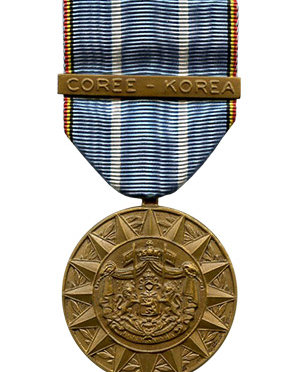
The Foreign Operational Theaters Commemorative Medal (Médaille Commémorative des Théatres d’Opérations Extérieurs / Herinneringsmedaille voor Buitenlandse Operaties) was promulgated by Royal Decree of 26 September 1951 and signed by King Baudouin. The medal could be awarded posthumously.

The medal was awarded to Belgian citizens and entitled foreigners who served with Belgian Units in the Korean theatre of operations, for one day or more, between 18 December 1950 and 29 July 1953.

There are several clasps and emblems, worn to show each of the theatres involved.

  • COREE-KOREA – all volunteers of the Bataillon Belge who qualified for the medal are entitled to this clasp.
  • IMJIN – for soldiers of the first Belgian contingent (1951-2) who participated in the fighting in April 1951.
  • HAKTANG-NI – for soldiers of the first contingent (1951-2) who participated in the fighting in October 1951.
  • CHATKOL for soldiers of the second contingent (1952-3) who participated in the fighting along the bank of the Imjin River in April 1953.

The Foreign Operational Theaters Commemorative Medal Design

The medal measures 5mm in diameter and is circular and struck in bronze.

The obverse bears the emblem with the lion of Belgium in relief. A single red enameled cross is worn by those wounded in action and granted an injury chevron, and a 5 pointed silver star by servicemen returning to duty in Korea after being wounded in action.

The Medal of Belgian Gratitude 1940-1945

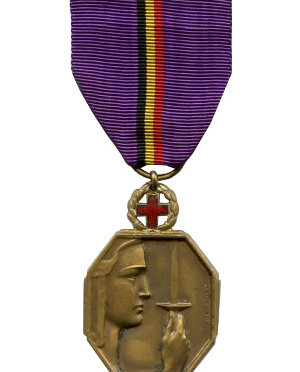
The Medal of Belgian Gratitude 1940-1945 (Médaille de la Reconnaissance Belge 1940–1945 / Erkentelijkheidsmedaille 1940–1945) is a Belgian medal instituted on 1 August 1945 by the Prince-Regent Karel, in three classes: gold, silver and bronze.

The medal was awarded to civilians, Belgian or foreign alike, who during the war had shown their patriotism in the humanitarian field by acts of courage. A good example of an award to non-Belgians is the gold medal to the Dutch village of Vught, given in recognition of the inhabitant’s attitude towards the Belgian prisoners held in the German concentration camp there.

The Medal of Belgian Gratitude 1940-1945 Design

The medal measures 34 mm in diameter and is octagonal and struck in silver.

The obverse depicts a veiled woman (representing Belgium) facing to the right, with a rapier in her right hand, raised in salute. The reverse bears the inscription “PATRIA GRATA 1940 1945” with a decorative pattern on either side of the inscription. Above the medal is a laurel wreath.

The ribbon has central stripes of black, yellow, and pink flanked by purple.

Red Cross members who qualified were awarded a medal with a red enamel cross in the open laurel wreath of the medal’s suspension.

The Commemorative Medal of the War 1940-1945

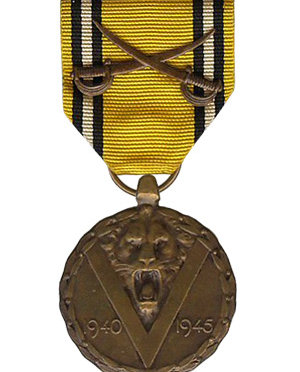
The Commemorative Medal of the 1940–45 War (Médaille Commémorative de la Guerre 1940–45 / De Herinneringsmedaille van de Oorlog 1940–1945) is a military decoration of Belgium established on 16 February 1945 by royal decree of the Prince Regent to recognize Belgian servicemen and women who served during the Second World War.

The medal was also awarded to members of the Belgian Resistance and members of Belgium’s Merchant Navy on the side of the Allies. Later decrees allowed for its award to foreign recipients of the Belgian Croix de Guerre.

The Commemorative Medal of the War 1940-1945 Design

The medal measures 38mm in diameter and is circular and struck in bronze.

The obverse bears a large V for Victory sign with a relief roaring lion in the V, at the lower left was the relief year “1940”, at the lower right the relief year “1945”. A 3mm wide laurel wreath encircled the entire medal on both the obverse and reverse. On the reverse, within a 5mm wide raised circle, the relief inscriptions “MEDAILLE COMMEMORATIVE” within the upper half and “HERINNERINGSMEDAILLE” in the lower half. In the center of the circle, two 3mm high raised horizontal bars positioned 8mm apart bear the relief inscriptions “DE LA GUERRE” / “VAN DER OORLOG“, at the center, between the two horizontal bars, the relief years “1940–1945”.

The ribbon is 37mm wide yellow silk moiré with 8mm wide edge stripes composed of 2mm wide stripes of yellow, black, white and black, the yellow being closest to the edges. The medal is suspended by a ring through a lateral suspension loop.

The Medal of the Recruiting Centers 1940

The Medal of the Recruiting Centers 1940 (Médaille des Centres de Recrutement 1940 / Medaille van de Recruteringscentra van het Belgisch Leger 1940) is a decoration of the Kingdom of Belgium created by royal decree on

 granted to any man between the ages of sixteen and thirty-five who responded to the order, given in  by the Government, to join the recruiting centers of the Belgian army in France from  and whose period of absence from their home must count at least 10 days and have taken place before .

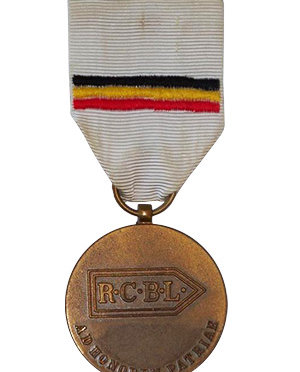
The medal exists in three versions according to the linguistic affiliation of the beneficiary: With the inscription in relief “CRAB” for French speakers, “RCBL” for Dutch speakers and “RZBH” for German speakers.

The Medal of the Recruiting Centers 1940 Design

The medal measures 37 millimeters in diameter and is struck in patinated bronze.

The obverse bears the inscription “CRAB” and “AD HONOREM PATRIAE” in relief and the reverse the year “1940” in relief. The medal is suspended by a ring passing laterally in a suspension barrel at the top of the medal, to a white silk ribbon with a width of 38 mm, in its center horizontally 3 bands of 2 mm, red, yellow and black symbolizing the Belgian flag.

The Medal for Resistance against Nazism in the Annexed Territories

The Medal for Resistance against Nazism in the Annexed Territories (Médaille du Résistant contre le Nazisme dans les Territoires Annexées / Medaille voor Weerstand tegen het Nazisme in de Geannexeerde Gebieden) was established very late, on April 16, 1985.

It was intended for the inhabitants of the German region in Belgium (annexed after the 1st World War) who had actively resisted Nazism during the Second World War: political prisoners, prisoners of war, members of the resistance, saboteurs, and members of the underground press, those who, between May 10, 1940 and January 1, 1943, had – for patriotic reasons – left the region or been expelled from it, those who had forced to enter service with the German army or the labor force in Germany and who had deserted their post before June 6, 1944, etc.

The Medal for Resistance against Nazism in the Annexed Territories Design

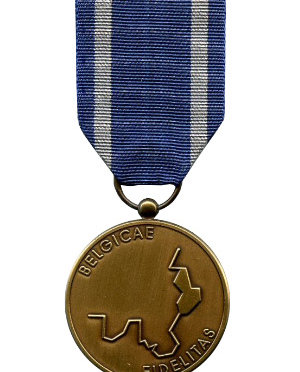
The medal is circular and struck in bronze. The obverse bears the inscription “BELGICAE FIDELITAS” and the reverse “1940-1945”.

There are three different ribbons to indicate the category to which the decorated person belonged: to the deserters of the German service the medal with the blue ribbon with yellow bands, with those which had left the region or were expelled with the ribbon with red bands, with the others that with the ribbon white stripes was awarded.

The Escapees’ Cross 1940-1945

The Escapees’ Cross 1940–1945 (Croix des Évadés 1940–1945 / Kruis der Ontsnapten 1940–1945) is a Belgian war service medal established by the Belgian government in exile in London on 25 February 1944.

The medal was awarded to all Belgian citizens who, during the Second World War escaped from occupied Belgium (or from another occupied land or Germany) and that, following it, had proven their patriotism by joining and serving with a resistance group. It was also awarded for being imprisoned for a minimum of three months following an act of patriotism, or for having traveled clandestinely to participate in a Belgian action aimed at promoting the war against the enemy. 

The medal’s statute was later amended to include those who had escaped also from non-occupied territories and made their way to the United Kingdom in order to continue fighting the enemy (such as those that left the beaches of Dunkirk, non-occupied France or French North Africa).

The Escapees’ Cross 1940-1945 Design

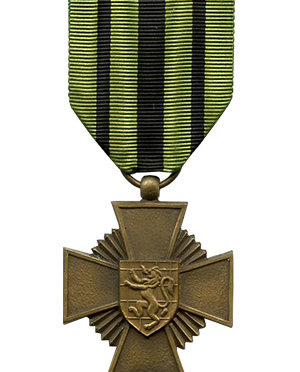
The medal is a cross pattée measuring 39mm wide, with four 7mm long rays radiating outwards between its arms.

The obverse bears a 14mm wide by 18mm high shield bearing a lion rampant superimposed over prison bars. The medal is a single face, and the reverse is bare.

The ribbon is 37mm wide green silk moiré, with a longitudinal 6mm wide central black stripe and narrow 3mm black stripes 6mm from the ribbon edges. The award was suspended by a ring through a suspension loop.