The Order of St. Patrick

The Order of St. Patrick is a dormant British order of chivalry created in 1783 to reward the Irish during the American War of Independence.

The Order of St. Patrick (or The Most Illustrious Order of Saint Patrick) is a dormant British order of chivalry created in 1783 by George III to reward the loyalty of Irish peers during the American War of Independence. The knights of Saint Patrick lasted until 1922, when most of Ireland gained independence as the Irish Free State.

The patron of the Order is St Patrick, and its motto is “Quis separabit?” or “Who will separate [us]?” in Latin, an allusion to the Vulgate translation of Romans 8:35, “Who shall separate us from the love of Christ?

No knight of St Patrick has been created since 1936, and the last surviving knight, Prince Henry, Duke of Gloucester, died in 1974. The Queen, however, remains the Sovereign of the Order. Its equivalent in England is The Most Noble Order of the Garter, dating to the middle fourteenth century, and in Scotland it’s The Most Ancient and Most Noble Order of the Thistle, in its modern form to 1687.

The Order of St. Patrick Design

The star of the Order is an eight-pointed figure, with the four cardinal points longer than the intermediate points. Each point is a cluster of rays. In the center is the same motto, year, and the saltire cross of St Patrick in red enamel. The star was worn pinned to the left breast. The chain is made of gold and composed of six harps and six roses, the last alternating with white and red petals. The badge is pinned to the riband at the left hip. Made of gold, it depicts a shamrock bearing three crowns, on top of a cross of St Patrick and surrounded by a blue circle bearing the motto as well as the date of the Order’s foundation in Roman numerals (“MDCCLXXXIII“). The broad riband is a celestial blue sash worn across the body, from the right shoulder to the left hip.

For important occasions, such as Coronations, Knights of St Patrick wore elaborate vestments consisting of: The mantle, a celestial blue robe lined with white silk and a blue hood, the hat of the Order, changed from white satin to black velvet by George IV, plumed with three falls of feathers, one red, one white and one blue, and the collar, made of gold and consisting of Tudor roses and harps attached with knots and a central harp, from which the badge of the Order is suspended, surmounted by a crown.

Unlike the other two great orders, the sash is worn in the manner of the lesser orders, over the right shoulder.


The Order of the Thistle

The Order of the Thistle is an order of chivalry revived by King James VII of Scotland (James II) in 1687 and re-established in 1703.

The Order of the Thistle (or The Most Ancient and Most Noble Order of the Thistle) is an order of chivalry revived in 1687 by King James VII of Scotland (James II of England and Ireland). It’s believed the original Order dates back to 787 AD and alludes to .barefoot enemy soldiers who cried out when they trode on thistles, alerting the Scots of an imminent attack. The Order was re-established again by Queen Anne in December 1703.

It consists of the Sovereign and sixteen Knights and Ladies, as well as “extra” knights among which are members of the British Royal Family and foreign monarchs.

The Sovereign alone grants membership of the Order. The Order of the Thistle, which pertains to Scotland, is the second most senior in precedence in the United Kingdom. Its equivalent in England is The Most Noble Order of the Garter, dating to the middle fourteenth century. At death, the official insignia is returned to the Central Chancery.

The Order of the Thistle Design

The Order’s primary emblem is the thistle, the national flower of Scotland. Its motto is Nemo me impune lacessit (or “No one provokes me with impunity” in Latin).

The star of the Order is a silver St Andrew’s saltire, with clusters of rays between the arms thereof. In the center is depicted a green circle bearing the motto of the Order in gold; within the circle, there is depicted a thistle on a goldfield. The star is worn pinned to the left breast. The badge of the Order depicts St Andrew in the same form as the badge-appendant, surrounded by an oval collar bearing the Order’s motto, and surmounted by a gold cord fitted with a ring for suspension. There are examples of it in plain gold, or with enameling and set with jewels. 

For the Order’s great occasions, as well for coronations, the Knights and Ladies wear an elaborate costume consisting of: The mantle, a green robe worn over suits or military uniforms and lined with white taffeta, tied with green and gold tassels. The hat, made of black velvet and plumed with white feathers with a black egret’s or heron’s top in the middle, the collar, made of gold and depicting thistles and sprigs of rue, and the St Andrew, or badge-appendant, worn suspended from the collar.

The ribbon is plain dark green.

Find This Medal

Right Now on eBay 
Clicking a link to eBay may result in a referral commission being paid if a purchase is made.
Loading...

The Italian Independence Medal

The Italian Independence Medal was instituted in 1865 to reward the participants of the wars against Austria and the Sicilies.

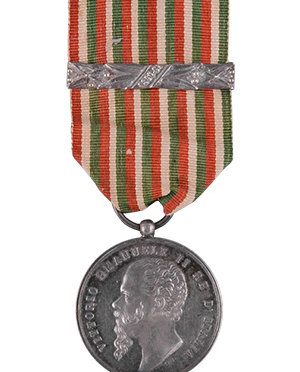
The Italian Independence Medal (or Medaglia per le guerre di Indipendenza e l’Unita d’italia) was instituted on March 4, 1865 by Royal Decree No. 2174 of King Vittorio Emmanuele II to reward the participants of the wars against Austria and the Kingdom of the 2 Sicilies.

This medal replaced all other previously granted awards, except the Crimea, St. Helena, Napoleonic campaigns of 1859 and the Expedition of Thousands medals.

The Italian Independence Medal Design

The medal is struck in silver and measures 32 millimeters in diameter.

The ribbon has green, red and white stripes.

The Italian African Campaign Medal

The Italian African Campaign Medal was awarded for campaigns and battles to colonize part of North Africa in the late 19th century.

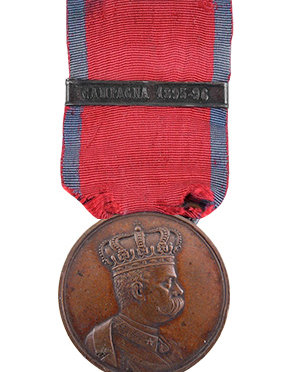
The Italian African Campaign Medal for the 1895-96 Campaign is an Italian Pre-WW1 medal awarded for the various Italian campaigns and battles to colonize part of North Africa in the late nineteenth century.

The medal was established on 3 November 1894.

The Italian African Campaign Medal Design

The medal is struck in bronze and has a diameter of 32 millimeters. It was awarded with a silver clasp reading the name of the corresponding campaign (for example, “Campagna 1895-96“).

The obverse bears the crowned bust of Umberto I facing right, crowned, and in military uniform. The reverse bears the inscription ‘CAMPAGNE D’AFRICA‘ within a laurel wreath.

The ribbon is 39 millimeters wide and red, with 6 mm blue edges. The medal is fitted with a fixed bar loop suspender and the two rectangular campaign bars slide over the ribbon.

The Italian Red Cross Medal of Merit

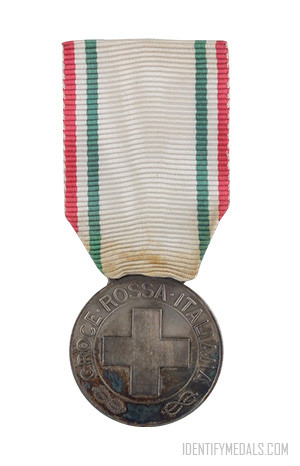
The Italian Red Cross Medal of Merit (Al merito della Croce Rossa) is an Italian award established in 1913 and awarded in three grades.

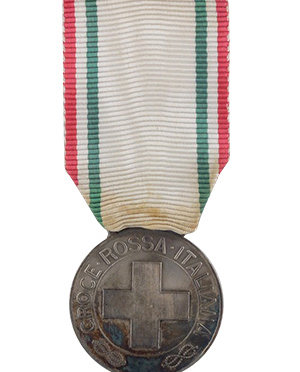
The Italian Red Cross Medal of Merit (or Medaglia al merito della Croce Rossa Italiana) is an Italian award established in 1913.

The medal was awarded in both peacetime and wartime. In peacetime, for particular merits or personal actions and for social commitment and organizational capacity. In wartime for those who have particularly distinguished themselves or worked for the Association in peace and humanitarian support operations in support of populations affected by armed conflict.

The medal was awarded in the following grades:

  • Gold Medal of Merit, awarded for services rendered in wartime in the area of ​​operations,
  • Silver Medal of Merit, awarded for services rendered in times of war in the area of ​​operations, and
  • Bronze medal of merit, awarded for services rendered in wartime in the area of ​​operations.
  • Diploma of Merit, awarded for services rendered in times of war in the area of ​​operations.

The Italian Red Cross Medal of Merit Design

The medal has a diameter of 34 millimeters and weighs about 16,67 grams. It was issued with a red case, with red fitted leatherette exterior.

The ribbon is white with narrow red, white, and green edges.

Find Red Cross Medals Online

More Red Cross Medals

The Centenary of National Independence Commemorative Medal

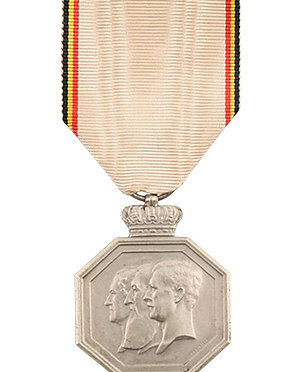
The Centenary of National Independence Commemorative Medal 1830-1930 (Médaille Commémorative du Centenaire de l’Indépendance Nationale 1830-1930 / Herinneringsmedaille van 100 Jaars de Onafhankelijkheid 1830-1930) is a Belgian commemorative medal established on 20 July 1930 by royal decree to commemorate the 100th anniversary of Belgian independence.

It was awarded to serving members of the Belgian Armed Forces and to veterans of the service as well as to civil servants who served honorably for twenty years or more prior to 1 January 1931.

The Centenary of National Independence Commemorative Medal Design

The medal is octagonal, measures 32mm wide by 30mm high and is struck in silvered bronze. It’s surmounted by a crown giving it a total height of 41mm.

The obverse bears the left-facing profiles of kings Leopold I, Leopold II and Albert I of Belgium. The reverse bears the relief years “1830” and “1930” on two rows slightly offset from center superimposed over oak and laurel leaves.

The ribbon is white 38mm wide silk moiré with the national colors of Belgium as 3mm wide edge stripes (1mm black, 1mm yellow and 1mm red). The medal is suspended by a ring through a suspension loop.

The Four Days of the Yser Commemorative Medal

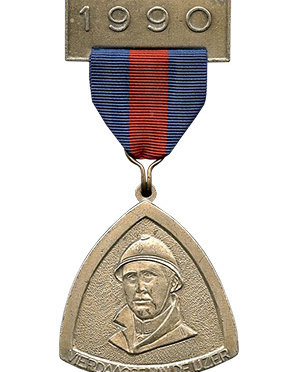
The Four Days of the Yser Commemorative Medal (Médaille commémorative des “Quatre jours de l’Yser” / Herinneringsmedaille van de “Vierdaagse van de IJzer”) was established in 1967.

The Four Days of the Yser is a four-day international march organized since 1967 by the Order of the Horse Fishermen of Oostduinkerke, in order to honor the tradition of shrimping on horseback on the one hand and to emphasize the scenic attractions of the Westhoek, the western part of the Belgian coast.

Since 1972 it is organized by the Belgian Armed Forces to strengthen the bond between the Belgian Armed Forces and society, to commemorate the casualties of both World Wars, particularly those who fell on the battlefields of the Westhoek during the First World War, and to introduce the hikers to the historical and touristic values of the Westhoek.

The march was initially four times thirty-two kilometers long, but now currently has 8,16,24 and 32 km routes including detours for disabled access and pushchairs.

The Four Days of the Yser Commemorative Medal Design

The medal is round or triangular (the shape of the medal can change every five years), and struck in silver or bronze.

The obverse bears the imprint of a World War I Belgian soldier.

The ribbon is dark blue with a large vertical scarlet stripe. Small metal bars are added to the ribbon when the bearer has completed the march more than one time.

The European March of Remembrance and Friendship Commemorative Medal

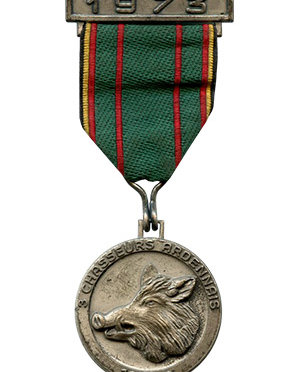
The European March of Remembrance and Friendship Commemorative Medal (Médaille commémorative de la “Marche Européenne du Souvenir et de l’Amitié” / Herinneringsmedaille van de “Europese Mars van de Herdenking en de Vriendschap”) was established in 1967 to commemorate the European March of Remembrance and Friendship, a four-day international march originally organized in 1967 by the 3rd Battalion of the Ardennes Chasseur Regiment in remembrance of the operations performed by the unit at the beginning of World War II in the Ardennes region.

The march is now organized on a yearly basis and also focusses on honoring the towns in the region regularly changing its course to do so. The march is divided into four legs of thirty-two kilometers each in the Ardennes region of Belgium as well as the Grand Duchy of Luxemburg.

The European March of Remembrance and Friendship Commemorative Medal Design

The medal is circular and struck in silver.

The obverse bears the relief left profile of a wild boar’s head surrounded by a 3mm wide ring along the entire medal’s circumference and bearing the relief inscription “3 CHASSEURS ARDENNAIS” in the upper half and “125 km” at the bottom. The reverse bears the relief inscription on four lines “MARCHE” “DU SOUVENIR” “ET DE L’AMITIE” “ARLON-VIELSALM“.

The ribbon is dark green with the national colors of Belgium in three narrow 1mm edge stripes and two narrow 1mm wide red stripes centered 1 cm apart on the green field. The medal hangs from a ribbon secured by a hook through a suspension loop at its top.

The Meritorious Service Medal

The Meritorious service medal for personnel of the Belgian Defence Forces and Foreign Armed Forces (Médaille du Mérite en faveur des membres du personnel de la défense et d’armées étrangères / Medaille van Verdienste ten gunste van de personeelsleden van defensie en van vreemde legers) is a military decoration of Belgium established on 23 February 2005.

The medal is awarded to members of the Belgian Armed Forces and civilians working for the Belgian Defence who show exemplary meritorious behavior in the completion of their duties or who have accomplished an exemplary meritorious act. It may also be awarded to foreign military and civilian members of a foreign Armed Force who have provided exceptional support to the Belgian Defence. The medal is awarded by the King based on a proposal from the Secretary of Defence, the Chief of Defence or an officer with the authority of Corps Commander or above, for award to a person who:

  • is more productive than most of their colleagues;
  • tries to achieve perfection in their daily work;
  • has on their own initiative achieved something to the benefit of the Belgian Armed Forces;
  • has not had any previous penal or disciplinary sanctions;
  • behaves in an exemplary manner; and
  • takes into account human and social issues in their work.

The Meritorious Service Medal Design

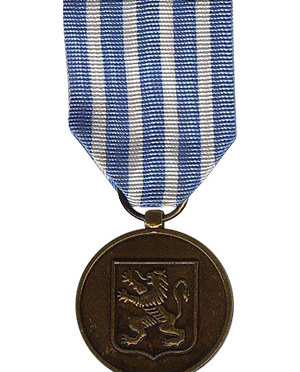
The medal is circular and struck from bronze.

The obverse bears the Escutcheon-only version of the Coat of arms of Belgium. The plain reverse usually bears the engraved name of the recipient and date of the award.

The ribbon is light blue with four vertical white stripes. The original Medal for Military Merit had the same design and hung from the same ribbon as the new one, only the statute differs. The medal is suspended to the ribbon by a ring though the suspension loop.

The Commemorative Medal for Operations in Defense of the Territory

The Commemorative Medal for Missions or Operations regarding the operational defense of the territory (Médaille commémorative pour les missions ou opérations relatives à la défense opérationnelle du territoire / Herinneringsmedaille voor de opdrachten of operaties met betrekking tot de operationele verdediging van het grondgebied) is a military decoration of Belgium established on 28 March 2018 and is awarded to military and civilian members of the Belgian Armed Forces who participated in operations related to the defense of the Belgian territory or who provided specialized support to such operations for a minimum duration of 30 days.

In order to be eligible for the award, personnel must have shown exemplary behavior during the operation.

The Commemorative Medal for Operations in Defense of the Territory Design

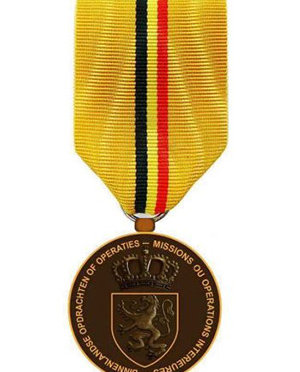
The medal is circular and struck from bronze.

The obverse of the medal bears the Escutcheon-only version of the Coat of arms of Belgium under the royal crown and surrounded by the text “MISSIONS OU OPERATIONS INTERIEURES BINNENLANDSE OPDRACHTEN OF OPERATIES”. The reverse bears a laurel crown along the outer circumference. The blank area within the wreath may be used to engrave the recipients’ name and date of the award.

The ribbon is golden with three thin longitudinal stripes of black, yellow and red in the middle and adorned with an Arabic numeral that denotes the number of operations or missions the recipient has participated in.