The Long Service Decoration (Bourbon-Parma Lucca)

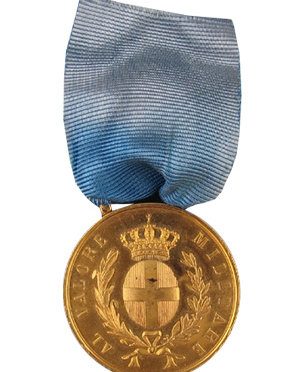
The Long Service Decoration (Bourbon-Parma Lucca) is a medal instituted in 1833 and awarded to NCO’s and Enlisted Men for ten years’ service.

The Long Service Decoration (or Decorazioni di servizio per gli ufficiali e sottufficiali in Italian, also Medaglia di Anzianitá) is a medal instituted in 1833 and awarded to NCO’s and Enlisted Men who had served at least ten (round medal) or thirty years (cross).

The medal was created during the period of the House of Bourbon-Parma, a cadet branch of the Spanish royal family. Their members once ruled as Duke of Parma and Piacenza, Guastalla, and Lucca.

The Long Service Decoration Design

The medal is round, struck in bronze gilt and measures 33 mm (wide) x 37.7 mm (hight) inclusive of its laterally-pierced ball suspension.

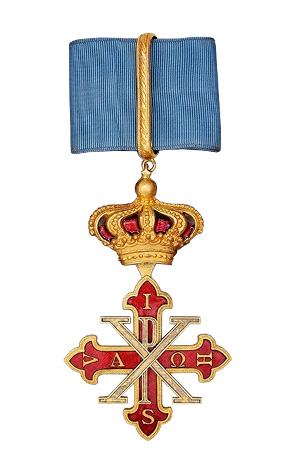
The Constantinian Order of St. George (Parma)

The Constantinian Order of St. George, or Order of St. Angelus / Order of the Golden Chevaliers is a dynastic order of knighthood.

The Sacred Military Constantinian Order of Saint George, also known as the Imperial Constantinian Order of Saint George and the Order of the Constantinian Angelic Knights of Saint George, is a dynastic order of knighthood of the House of Bourbon-Two Sicilies.

The order is allegedly founded in its original form by Constantine the Great and restored under later Byzantine emperors. However, the actual origin of the order can be traced to the 16th century, when it was founded by an Albanian family by the name Angelo Flavio Comneno. Chivalric orders were completely unknown in the Byzantine world, so it’s believed the story of the links between the Comneno family and their claim to be connected to the Byzantine Komnenos and Angelos dynasties was invented much later.

The Order is best recognized for its Parma iteration. Duke Francesco Farnese of Parma made several amendments to the Order statutes in 1705. These changes were  recognized by Pope Clement XI in 1706 and finalized as a dynastic Order of the Duchy of Parma by a Papul Bull in 1718. In 1731, the Order became a dynastic Order of the Kingdom of the Two Sicilies. When Marie Louise ascended to the throne of the Duchy of Parma, Piacenza and Guastalla she restored it as a dynastic Order of the Duchy of Parma, resulting in the creation of two Order branches.

The motto of the Order is “In hoc signo vinces,” or “In this sign you will conquer.

The Constantinian Order of Saint George Design

There are several insignia for this order. The medal is a bronze, silver, or gold cross with a collar, sash or ribbon. 

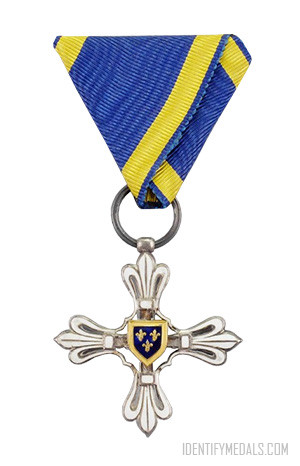
The Civil Merit Order Of St. Louis (Parma)

The Civil Merit Order Of St. Louis is an order of the Duchy of Parma (today Italy). The Order was established in c. 1860.

The Civil Merit Order Of St. Louis is an order of the Duchy of Parma (today Italy) awarded for extraordinary merit within civil services. It has five grades and the Grand Master of the Order was always the Duke of Parma

The Order of St. Louis was initially founded in the Duchy of Lucca in 1836 by Charles Louise (also known as Charles II). His son, Charles III Duke of Parma, revived the Order at Parma, on August 11, 1849, as an award of merit. Membership to the Order was primarily restricted to noble Catholics. When a non-noble became the recipient of the Grand Cross or Commander grades they were bestowed with hereditary nobility.

The Order of St. Louis Design

The insignia for this order is a silver 4 multifaceted armed star, measuring 45 mm (w) x 46.8 mm, with a central gold crest on both the obverse and the reverse. The medal also has finely detailed red, blue, white enameled centers. The suspension is a French style ring with right facing eagles head.

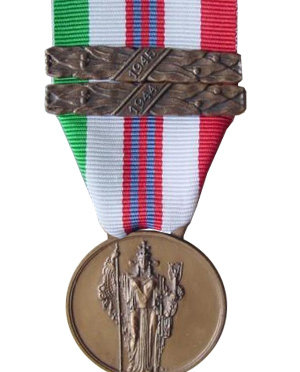
The Medal for the War of Liberation

The Medal for the War of Liberation is an Italian medal established in 1945 and awarded for minimum 3 months service after September 1943.

The Medal for the War of Liberation was instituted on 21 April 1945 and awarded to personnel of the Italian armed forces, frontier guards, Red Cross, and certain categories of civilians, for a minimum 3 months service after 9 September 1943, excluding service in the “Social Italian Republic”.

The medal was awarded to Italian forces who served in operations against the German occupational army in Italy, post the capitulation and collapse of the Mussolini Fascist regime.

The award was first instituted as a ribbon and from 6 May 1959 as a medal.

The Medal for the War of Liberation Design

The ribbon can carry bars for each year of service: 1943, 1944, 1945, and possibly 1946. The latter year would refer to services in defusing bombs, mine clearance, etc. but seems never to have been effectively awarded or manufactured.

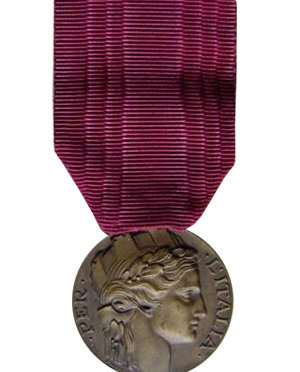
The Medal for Volunteers of the War 1940-45

The Medal for Volunteers of the War 1940-45 was instituted on 21 April 1948 and awarded to those that volunteered for the Second World War.

The Medal for Volunteers of the War 1940-45 (or Volontario di Guerra 1940-45 in Italian) was instituted on 21 April 1948.

This medal, with a different ribbon and referred to as The Merit Medal for Crossing Enemy Lines after 8 September 1943, was also awarded to those that crossed enemy lines into Allied liberated territory before 8 September 1943 and put themselves at the disposal of the Italian National Government.

The Medal for Volunteers of the War 1940-45 Design

The official medal’s reverse has the inscription “VOLONTARIO DI GVERRA MCMXL-MCMXLV“. A type with the years in Arabic figures has also been reported to exist.

This medal can be found on different ribbons. The original decree stipulates the claret ribbon as for the WW1 Volunteer’s Medal but two other ribbons are known to exist (although they are considered unofficial). Both are purple, one with a center of four green and three red stripes, the other with three green and two red stripes in the middle. They both incorporate the War Commemorative Medal’s color scheme.

The National Security Voluntary Militia’s Long Service Cross

The National Security Voluntary Militia’s Long Service Cross was established in 1933 and awarded for 10 ys of good services in the militia.

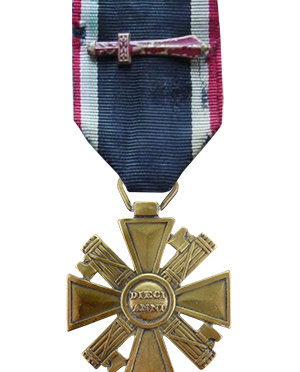
The National Security Voluntary Militia’s Long Service Cross (or Milizia Volontaria per la Sicurezza Nazionale in Italian) is a medal established in Italy on 23 January 1933 by royal decree and awarded for 10 years of good services within the militia.

In 1943, it became necessary to also create a decoration for 20 years service. Due to the critical wartime situation, the decision was made to not strike a new cross with a 20 year reverse but instead to institute a ribbon device. This device, a Roman swords colored red, was instituted on 28 January 1943.

The National Security Voluntary Militia's Long Service Cross Design

The medal is a cross-pathée with fasces between the arms. It’s struck in bronze and measures 38 mm wide by 42.3 mm high. The suspension is a laterally-pierced ball.

The obverse shows the initials ‘MVSN’ for the Milizia Volontaria per la Sicurezza Nazionale (National Security Volunteer Militia), popularly referred to at the ‘Blackshirts’.

The reverse has the inscription “DIECI / ANNI” (Ten Years).

The Gold Medal of Military Valor

Institution: 21 May 1793
Country: Italy

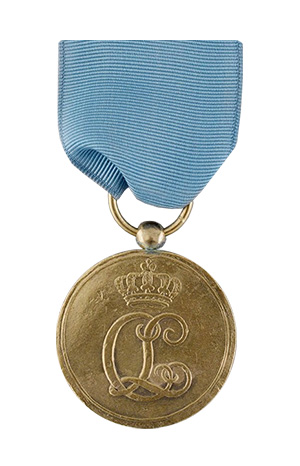
The Gold Medal of Military Valour (or Medaglia d’oro al valor militare in Italian) is a medal established on 21 May 1793 by King Victor Amadeus III of Sardinia for deeds of outstanding gallantry in war by junior officers and soldiers.

On 14 August 1815, Victor Emmanuel I of Sardinia replaced it with the Military Order of Savoy. On 26 March 1833, Charles Albert of Sardinia revived it and added to it the Silver and Bronze medals.

With the proclamation of the Republic on 2 June 1946, the coat of arms of the House of Savoy was replaced with the emblem of the Italian Republic. 

For actions performed by individuals during World War I, the Gold Medal was awarded some 368 times, as well as 37 times to military units, and once to the Unknown Soldier. Only four of the individual awards went to foreigners, one of these being Czar Nicholas II of Russia. The other three were for acts of gallantry in which the recipient was killed in action or died from his injuries (the Frenchmen John O’Byrne and Roland Morillot, and the American Coleman deWitt). 

During World War II the medal was awarded to soldiers of the Royal Italian Army; after these forces were reorganized following the Armistice with Italy in 1943, it was awarded to members of the Allies-supporting Italian Co-Belligerent forces. The Axis-affiliated Italian Social Republic created another design of the medal, with a Gladius replacing the arms of Savoy, for members of the Esercito Nazionale Repubblicano from 1943 to 1945. This version of the award was not given recognition by the postwar Italian government.

The Gold Medal for Military Valor is still awarded by the Italian state, and it, along with Silver and Bronze medals for Military Valor as well as the War Cross of Military Valor (which can only be awarded in time of war) was established by the Royal Decree of 4 November 1932.

The Gold Medal of Military Valor Design

The obverse of the medal displays the coat of arms of Savoy with laurel branches, the royal crown, and the words “For Military Valor“. On the reverse are two laurel branches enclosing the name of the decorated soldier, and the place and date of the action.

The World War I Gold Medal Commemorative

The World War I Gold Medal Commemorative Medal was instituted by the President of the Republic of Italy on the 50th Anniversary of Victory.

The World War I Gold Medal Commemorative Medal (or Medaglia-ricordo in oro della I Guerra Mondiale in Italian) was an award instituted by the President of the Republic of Italy on the 50th Anniversary of Victory.

The medal was awarded in 1968 to all veterans of World War I (or of previous conflicts) who served in arms for at least 6 months before 2.8.1920.

The World War I Gold Medal Commemorative Design

The medal is small, round, and struck in solid gold. It weighs 5 grams and has a mirror finish.

The obverse bears a small star and an “Adrian” helmet over a laurel and oak wreath. On the reverse is the inscription “50° ANNIVERSARIO DELLA VITTORIA 1918 1968” (“50th Anniversary of the Victory – 1918 1968).

The ribbon is a reduced-size one, with twelve narrow vertical stripes in green-white-red repeated four times.

The Commemorative East Balkan Expeditionary Corps Cross

The Orient Balkan Cross was an unofficial medal awarded to the expeditionary corps that fought in the Balkans from 1914 to 1919.

The Orient Balkan Cross (or Croce Commemorativa del Corpo di Spedizione dell’Oriente Balcanico in Italian) was an unofficial medal awarded to the expeditionary corps that had taken part in war operations in the Balkans (Albania and Macedonia) from 1914 to 1919, during the First World War.

The medal was advertised on nr. 8 of the Domenica del Corriere on 23 March 1924, with an announcement that specified that the first specimens would be offered in homage to the king, to generals Diaz and Cadorna and to all general officers who had had a command in Albania and Macedonia. The cross was put up for sale, equipped with a special ribbon, for the benefit of the “National Union of Veterans East Balkan”, Turin, via S. Tomaso, 6.

The Commemorative East Balkan Expeditionary Corps Cross Design

The medal was designed by the painter Adolfo Caly, and advertised in the popular magazine “Domenica del Corriere” and coined by the Fassino firm of Turin. The shape is a Greek cross and it was struck in gilded bronze. The ends of the arms are crenelated and intersected by a ribbon with eyelets and corners.

The obverse has a central medallion with golden beads and a representation of a mosque with a minaret in and orange enameled background. The arms of the cross have blue enamel and black and white borders around the cross arms.

The reverse has no enamels and bears the inscription “ORIENTE BALCANICO / 1914 = 1919 / ALBANIA = MACEDONIA”. Some versions have a trademark on the lower arm.

The ribbon has a black central stripe measuring one-third of the overall width, flanked on both sides by five narrow stripes in red-orange-blue-orange-red.

The Italian Army Commemorative Crosses 1915-1018

The Italian Army Crosses 1915-1018 were a series of crosses awarded to specific members of the Army for their participation in WW1.

The Italian Army Crosses 1915-1018 were awarded after the war to members of specific Italian Armies for their participation in the Great War. The crosses were instituted in 1924 and awarded to various Italian units.

While awarded by the army, recipients often had to purchase the medal itself. Some variations in the crosses exist, but the basic designs remained fairly consistent. The different cross designs were created by different makers and feature various designs.

The Italian Army Crosses 1915-1018 Design

The medals are shaped like a cross and measure approximately 33 mm wide by 44.5 mm high. They were struck in silver or bronze gilt. Some were decorated with enamels.