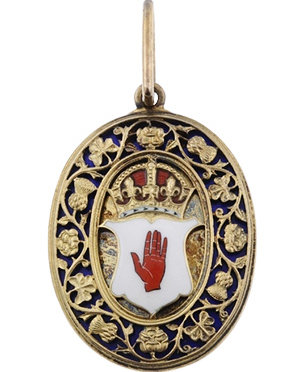
The Baronet’s Badge

The Baronet’s Badge was established in 1629 by Letter Patent by James I to recognize baronets whose knighthood became hereditary. 

Time Period: Pre-WW1
Year of Institution: 1629
Country: Great Britain

The Baronet’s Badge was established in 1629 by Letter Patent by James I to recognize baronets whose knighthood became hereditary.

In 1625, Charles I conferred on the holders of lands in Nova Scotia the title and dignity of Baronets of Nova Scotia with the title of Sir, and decreed that they should wear around their necks “an orange tawny ribbon whereon shall be pendent an escutcheon“.

English and Scottish Baronetcies ceased to be created after the Union with England in 1707, when they were replaced by baronetcies of Great Britain.

The Baronet’s Badge Design

The badge is struck in gold or silver-gilt upright oval with a plain ring suspension and measures 55 millimeters in height and either 41 or 44 millimeters in width. Originally skeletal, with a shield bearing the lion rampant of Scotland and decorated with pearls and enamels. It was surmounted by a Scottish crown and surrounded by a blue border with the inscription “FAX MENTIS HONESTAE GLORIA”.

From 1929 on, the badges have a solid ground and a central shield with the red hand of Ulster surmounted by a crown and a border of gold and blue enamel. The border is decorated with roses (England), shamrocks (Ireland), roses and thistles combined (Great Britain) or roses, shamrocks, and thistles combined (United Kingdom). The name of the recipient is usually engraved on the reverse.

The ribbon is either 30 millimeters wide orange watered silk (for Nova Scotia), or 44 millimeters orange bordered with narrow blue edges (for other Baronets).
The Order of the Companions of Honor

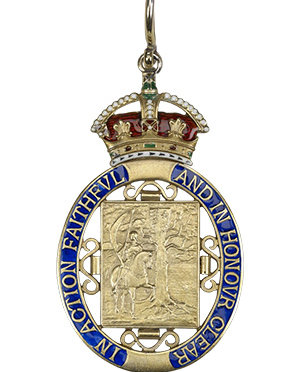
The Order of the Companions of Honor is an order of the Commonwealth founded in 1917 by King George V as a reward for achievements.

The Order of the Companions of Honor is an order of the Commonwealth realms founded on 4 June 1917 by King George V as a reward for outstanding achievements. The Chapel Royal at Hampton Court is now the Chapel of the Order.

The order was initially designed to be bestowed upon a select group of individuals for whom this unique distinction was deemed the most fitting form of recognition, separate from any acceptance of titles or merit classifications. The decoration is now described as “awarded for having a major contribution to the arts, science, medicine, or government lasting over a long period of time“, the first recipients were all decorated for “services in connection with the war“.

The inaugural recipients of this order were honored for their services related to the war, and their names were published in The London Gazette.

The Order's Award Criteria

Today, the Order of the Companions of Honor is awarded to those who have made a significant contribution to the arts, science, medicine, or government over an extended period.

It’s “conferred upon a limited number of persons for whom this special distinction seems to be the most appropriate form of recognition, constituting an honor disassociated either from the acceptance of title or the classification of merit.” 

The order consists of the Sovereign and a maximum 65 members. Appointments to the order are typically made based on recommendations from the prime ministers of the Commonwealth realms. Foreigners or Commonwealth citizens from outside the Commonwealth realms may be added as honorary members.

The Order of the Companions of Honor Design

The badge of the Order is struck in silver in the form of an oval medallion measuring 48 millimeters high and 29 millimeters wide. It’s surmounted by an imperial crown with a rectangular panel within, depicting on it an oak tree, a shield with the Royal Arms of the United Kingdom hanging from one branch, and, on the left, a mounted knight in armor. 

The insignia’s blue border bears, in the obverse and in gold letters the motto IN ACTION FAITHFUL AND IN HONOUR CLEARAlexander Pope‘s description in his Epistle to Mr Addison of James Craggs. The oval is surmounted by an imperial crown.

Men wear the badge on a neck ribbon (red with golden border threads) and women on a bow at the left shoulder. The ribbon measures 38 millimeters and is carmine with borders of gold thread.

The British Empire Medal

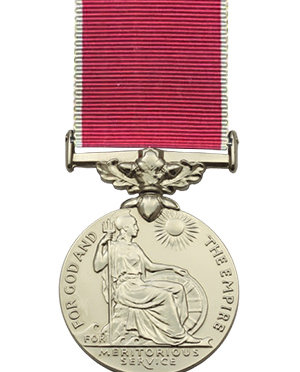
The British Empire Medal is a British medal awarded for meritorious civil or military service worthy of recognition by the Crown.

The British Empire Medal (formally known as British Empire Medal for Meritorious Service) is a British medal awarded for meritorious civil or military service worthy of recognition by the Crown. It was created in 1922 to replace the original medal, which had been established in 1917 as part of the Order of the British Empire.

Recipients are entitled to use the post-nominal letters “BEM“. The honor is divided into civil and military medals and, while recipients are not technically counted as members of the Order, these medals are nevertheless affiliated with it.

Between 1922 and 1940, the BEM was usually awarded to people below management or professional level such as to non-commissioned officers of the armed forces, officers below superintendent rank in the police, and personnel below divisional officer level in the fire services. From 1940, the BEM was awarded for acts of gallantry that did not reach the standard of the George Medal.

The British Empire Medal Design

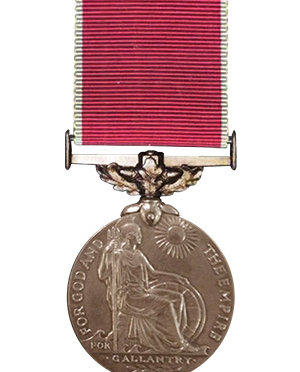
The medal is struck in silver and measures 36 millimeters in diameter, although some specimens measure up to 37.5 millimeters. The words MERITORIOUS SERVICE are inscribed in the exergue. The medal is suspended from a straight bar ornamented with oak leaves. An emblem of crossed silver oak leaves was introduced in December 1957 to denote a gallantry award.

Like the ribbons used for other classes of the Order of the British Empire, the ribbon of the British Empire Medal is rose-pink with pearl-grey edges, with the addition of a pearl-grey central stripe for the military division.

The Empire Gallantry Medal

The Empire Gallantry Medal (or EGM), was a British medal awarded for acts of the gallantry introduced it on 29 December 1922.

The Medal of the Most Excellent Order of the British Empire for Gallantry, or Empire Gallantry Medal (EGM), was a British medal awarded for acts of the gallantry introduced it on 29 December 1922, when the original Medal of the Order of the British Empire was split into two.

The Medal of the Order of the British Empire for Gallantry (EGM) awarded for acts of gallantry. Shortly after the commencement of the Blitz, King George VI created the George Cross to recognize gallantry by men and women in all walks of civilian life. It was to rank immediately after the Victoria Cross.

Recipients were entitled to use the post-nominal letters “EGM” and were divided into military and civil divisions. The Empire Gallantry Medal was revoked by Royal Warrant on 24 September 1940.

The Empire Gallantry Medal Design

The phrase “For God and the Empire” was inscribed around the upper side of the obverse. The first type of reverse had six lions, with the Royal Cypher centered. The 2nd type of reverse had four lions, two on either side of the Royal Cypher.

The original ribbon was plain purple, with the addition of a thin vertical red stripe for military awards. A silver laurel branch was added diagonally to the ribbon for both types of the award in 1933. The ribbon changed to rose pink with pearl-grey edges in July 1937, with an additional pearl grey vertical stripe for military awards, and stayed in this version until its revocation.

The medal and ribbon were designed first by Langford Jones.

The Royal Victorian Order

The Royal Victorian Order is a dynastic order of knighthood established in 1896 by Queen Victoria for distinguished service to the monarch.

The Royal Victorian Order is a dynastic order of knighthood established in 1896 by Queen Victoria to recognize distinguished personal service to the monarch of the Commonwealth realms, members of the monarch’s family, or to any viceroy or senior representative of the monarch. There is no limit on the number of individuals honored at any grade, and admission remains at the sole discretion of the monarch.

The reigning monarch is at the apex of the Royal Victorian Order as its Sovereign, followed by the Grand Master. The Order has five grades and one medal with three levels representing different levels of service. All those honored may use the prescribed styles of the order. The order’s motto is Victoria, and its official day is 20 June and its chapel is the Savoy Chapel in London.

The grades are as follows:

  • Knight / Dame Grand Cross.
  • Knight / Dame Commander.
  • Commander.
  • Lieutenant.
  • Member.

The Royal Victorian Order Design

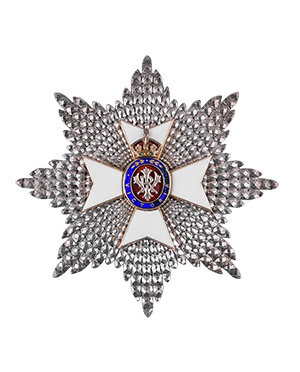
The badge of the Order is a Maltese cross with a central medallion depicting on a red background the Royal Cypher of Queen Victoria, surrounded by a blue ring bearing the motto of the order—VICTORIA—and surmounted by a Tudor crown and worn on a sash depending on the grade. For Knights and Dames Grand Cross, Commanders, and Lieutenants, the Maltese cross is rendered in white enamel with gold edging, while that for Knights and Dames Commander and Members is in silver. The size of the badge also varies by rank, that for the higher classes being larger.

The medal bears the effigy and name of the reigning sovereign at the time of its awarding, as well as the phrase DEI • GRATIA • REGINA (or REX) • F.D. (by the grace of God, Queen (or King), Defender of the Faith), and on the reverse is the Royal Cypher upon an ornamental shield within a laurel wreath.

The ribbon is blue with red-white-red stripe edging, and at formal events, or collar days, Knights and Dames Grand Cross wear the Royal Victorian Order’s livery collar, consisting of an alternating string of octagonal gold pieces.

The Imperial Order of the Crown of India

The Imperial Order of the Crown of India is an order established by Queen Victoria in 1878 when she became Empress of India.

The Imperial Order of the Crown of India is an order in the British honors system open only to women and established by Queen Victoria in 1878 when she became Empress of India. The members of the Order could use the post-nominal letters “CI“, but did not acquire any special precedence or status due to it.

No additional appointments have been made since the Partition of India in 1947. The Order was limited to British princesses, wives or female relatives of Indian princes and the wife or female relatives of any person who held the office of:

  • Viceroy of India,
  • Governor of Madras,
  • Governor of Bombay,
  • Governor of Bengal,
  • Commander-in-Chief India,
  • Secretary of State for India,
  • Governor-General of India.

Queen Elizabeth II is the last surviving former member (now Sovereign) of the Order. Princess Alice, Duchess of Gloucester was the last ordinary member at the time of her death in 2004.

The Imperial Order of the Crown of India Design

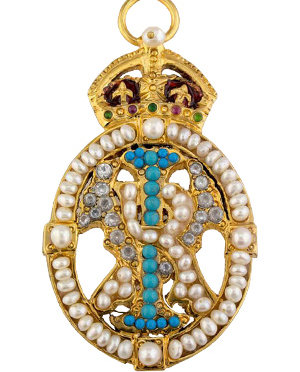
The badge of the Order includes Queen Victoria’s Imperial Cypher, VRI (“Victoria Regina Imperatrix”). The letters were set in diamonds, pearls, and turquoises and were together surrounded by a border of pearls, surrounded by an oval frame and surmounted by a figure of the Imperial Crown.

The badge was worn attached to a light blue silk bow, with narrow white stripes towards the edges, on the left shoulder.

The Royal Order of Victoria and Albert

The Royal Order of Victoria and Albert was a British Royal Family Order instituted in1862 by Queen Victoria and granted to female members.

The Royal Order of Victoria and Albert was a British Royal Family Order instituted on 10 February 1862 by Queen Victoria and only granted to female members of the British Royal Family and female courtiers. It was personally awarded by the Queen.

The honor conferred no rank or title upon the recipient, but recipients were entitled to use the post-nominal letters “VA”.

The order had four classes:

  • First Class
  • Second Class
  • Third Class
  • Fourth Class

No award was made after the death of Queen Victoria and the last holder of the Order, Princess Alice, Countess of Athlone (and the last surviving grandchild of the Queen), died in 1981.

The Royal Order of Victoria and Albert Design

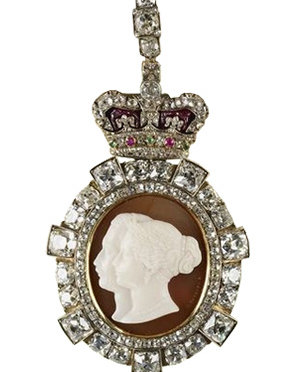
For the first three classes, the badge consisted of an upright oval onyx cameo of Queen Victoria and Albert, The Prince Consort, differing in the width and jewelling of the border as the classes descend, whilst the fourth substitutes a jeweled cipher. The badges of the First and Second Classes are set in diamonds and surmounted by an imperial crown. The badge of the Second Class is similar but smaller. The badge for the Third Class is set in pearls and that for the Fourth Class takes the form of a monogram “V&A” set with pearls.

All four were surmounted by a crown, which was attached to a bow of white silk moiré ribbon 38 millimeters in diameter. The bow was worn on the left shoulder.

The Order of the Star of India

The Most Exalted Order of the Star of India is an order of chivalry founded by Queen Victoria to honor Indian Princes who served in India. 

The Most Exalted Order of the Star of India is an order of chivalry founded by Queen Victoria in 1861 to honor Indian Princes and Chiefs, as well as British officers and administrators who served in India. Former viceroys and other high officials, as well as those who served in the Department of the Secretary of State for India at least thirty years were eligible for appointment. Rulers of Indian Princely States were also eligible.

The order is the fifth most senior British order of chivalry, following the Order of the GarterOrder of the ThistleOrder of St Patrick, and the Order of the Bath. With the death in 2009 of the last surviving knight, the Maharaja of Alwar, the order became dormant (but still exists). The British Sovereign was, and still is, Sovereign of the Order.

The Order included members of three classes:

  • Knight Grand Commander (GCSI)
  • Knight Commander (KCSI)
  • Companion (CSI)

The Order of the Star of India Design

The mantle was made of light blue satin lined with white silk and was worn only by Knights Grand Commanders. The collar was made of gold and was composed of alternating figures of lotuses, red and white roses, and palm branches, with an imperial crown in the center. It was worn only by Knights Grand Commanders over their military uniform, formal day dress, or evening wear.

The star featured a sunburst, with twenty-six large rays alternating with twenty-six small rays and worn only by Knights Grand Commanders and Knights Commanders. It was in gold and circular for Knights Grand Commanders, and in silver and eight-pointed for Knights Commanders. In the center of the sunburst was a light blue ring bearing the motto of the Order. Within the ribbon was a five-pointed star, decorated with diamonds for Knights Grand Commanders.

The badge was worn on a white-edged light blue riband, or sash, passing from the right shoulder to the left hip by Knights Grand Commanders, and by Knights Commanders and Companions from a white-edged light blue ribbon around the neck. It included an oval, containing the effigy of the Sovereign, surrounded by a light blue ring bearing the motto of the Order. The oval was suspended from a five-pointed star, which may be decorated with diamonds depending on the class.

The Order of St Michael and St George

The Order of Saint Michael and Saint George is an order of chivalry founded in 1818 in honor of military saints St. Michael and St. George.

The Most Distinguished Order of Saint Michael and Saint George is a British order of chivalry founded on 28 April 1818 in honor of two military saints, St. Michael the Archangel, and St. George, patron saint of England. The Order was established by George, Prince Regent (later King George IV) as acting as regent for his father, King George III.

The Order was originally awarded to those holding commands or high position in the Mediterranean territories acquired in the Napoleonic Wars. It was later extended to holders of similar office or position in other territories of the British Empire. Today, it’s awarded (or rather, people are appointed to it) to men and women who hold high office or who render extraordinary or important non-military service in a foreign country and can also be conferred for important or loyal service in relation to foreign and Commonwealth affairs.

The Order includes three classes:

  • Knight Grand Cross or Dame Grand Cross (GCMG)
  • Knight Commander (KCMG) or Dame Commander (DCMG)
  • Companion (CMG)

The Order of St Michael and St George Design

The mantle is made of Saxon blue satin lined with crimson silk and bound with two large tassels. It’s worn only by Knights and Dames Grand Cross. The collar is made of gold, with alternating crowned lions, Maltese Crosses, and the ciphers “SM” and “SG”. In the center are two winged lions, each holding a book and seven arrows. The collar is worn only by Knights and Dames Grand Cross.

The star is worn pinned to the left breast only by Knights and Dames Grand Cross and Knights and Dames Commanders. The Knight and Dame Grand Cross’ star includes seven-armed, silver-rayed ‘Maltese Asterisk’, with a gold ray in between each pair of arms. The Knight and Dame Commander’s star is a slightly smaller eight-pointed silver figure formed by two Maltese Crosses and no gold rays. In all cases, the star bears a red cross of St George with a dark blue ring bearing the motto of the Order and a representation of St Michael trampling on Satan.

The badge is used by all members of the Order and is suspended on a blue-crimson-blue ribbon. It’s a seven-armed, white-enameled ‘Maltese Asterisk’. Its obverse shows St Michael trampling on Satan, while its reverse shows St George on horseback killing a dragon, both within a dark blue ring bearing the motto of the Order.

The Royal Guelphic Order

The Royal Guelphic Order (or the Hanoverian Guelphic Order), is a Hanoverian order of chivalry instituted on 28 April 1815 by King George IV. 

The Royal Guelphic Order (or the Hanoverian Guelphic Order), is a Hanoverian order of chivalry instituted on 28 April 1815 by King George IV. It takes its name from the House of Guelph, of which the Hanoverians were a branch.

Because Hanover and the United Kingdom shared a monarch until 1837, the order was frequently bestowed upon British subjects, usually to officers in the British Navy and Army. However, it was still classed as a foreign order, with British members of the order not entitled to style themselves as “Sir”. When Hanover was annexed by the Kingdom of Prussia in 1866, the order continued as a house order of the Royal House of Hanover.

The Order includes two divisions: Civil and Military. From 1815 to 1841, the classes were:

  • Knight Grand Cross (GCH)
  • Knight Commander (KCH)
  • Knight (KH).

After 1841, the classes became:

  • Grand Cross
  • Commander 1st Class
  • Commander 2nd Class
  • Knight
  • Cross of Merit.

The Royal Guelphic Order Design

The collar chain is made in gold, with alternating lions and crowns linked by scrolled royal ciphers. The collar badge is an eight-pointed Maltese cross with balls on each point and a lion in each angle. The obverse bears, in the center, a white horse of Hanover on a red enamel background, surrounded by a blue enameled circle reading “NEC ASPERA TERRENT” (or “Difficulties do not terrify” in Latin). The reverse has the monogram GR in gold letters, surmounted by the British crown and surrounded by a gold circle with the date of institution inscribed: MDCCCXV. The Military Division is indicated by crossed swords on both the badge and star.

The star has rays grouped into eight points and shares the same design in the center as the badge. The ribbon measures 44 millimeters and is made of light blue watered silk.