The King’s Medal for Service in the Cause of Freedom

The King’s Medal for Service in the Cause of Freedom was awarded to foreign civilian nationals who had given meritorious service to the Allied cause.

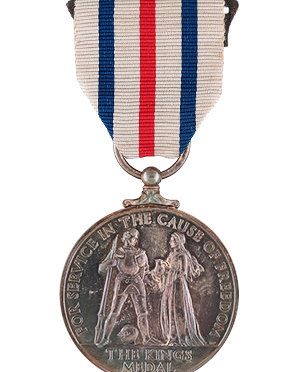
The King’s Medal for Service in the Cause of Freedom is a British medal instituted on 23 August 1945 by King George VI and awarded to foreign civilian nationals, mainly of allied countries, who had given meritorious service to further the interests of the British Commonwealth or the Allied cause during World War II.

Among those activities recognized by the decoration are fundraising for British war relief, scientific research that aided the war effort, and organizing ambulance services. Those who helped British military personnel to escape the enemy, return from occupied areas or for other dangerous work for the British or Allied cause during the war were eligible for the King’s Medal for Courage in the Cause of Freedom.

The medal was awarded 2,539 times.

The King’s Medal for Service in the Cause of Freedom Design

The medal is struck in silver and measures 36 millimeters (1.4 in) in diameter.

The obverse shows the left facing crowned effigy of King George VI with the inscription ‘GEORGIVS VI D:G:BR:OMN:REX ET INDIAE IMP‘.

The reverse bears a medieval warrior in armor carrying a broken lance, being offered sustenance by a woman. The upper circumference is inscribed ‘FOR SERVICE IN THE CAUSE OF FREEDOM‘, with ‘THE KINGS MEDAL‘ below.

The ribbon measures 32 millimeters (1.3 in) wide and is white with a central red stripe, flanked by blue stripes. The medal has a ring suspension and was awarded unnamed.
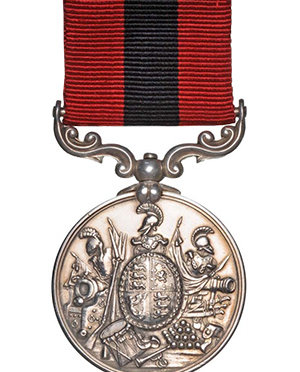
The Allied Subjects’ Medal

The Allied Subjects’ Medal is a decoration awarded to citizens of allied countries who gave assistance to British and Commonwealth soldiers.

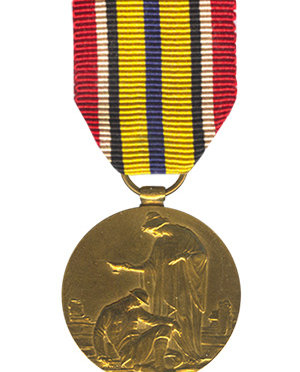
The Allied Subjects’ Medal is a British decoration instituted in 1920 and distributed by the Foreign Office to citizens of allied and neutral countries who gave assistance to British and Commonwealth soldiers – especially escaped prisoners of war, behind enemy lines between 1914–1918. Most medals were awarded to Belgian and French citizens, although Danish, Dutch and other nationals also received it.

Because of delays caused by discussions within Government on the precise form and design of the award meant that it was only manufactured and distributed in 1922.

In France and Belgium, it was generally referred to as Médaille de la Reconnaissance britannique or Médaille de la Reconnaissance anglaise, after the Médaille de la Reconnaissance française.

In total, 134 silver and 574 in bronze medals were awarded, nearly half to women. In addition, 28 further foreign nationals who had rendered notable assistance received honorary appointments to the Order of the British Empire, while about one thousand others received letters of thanks for their services.

The Allied Subjects’ Medal Design

The medal was struck in silver and bronze, and measures 36 millimeters (1.4 in) in diameter. Both medals have the same design.

The obverse shows the left facing bareheaded effigy of King George V with the inscription “GEORGIVS V BRITT: OMN: REX ET IND: IMP:“. The reverse bears a female allegory of Humanity offering a cup to a British soldier resting on the ground, with ruined buildings in the background.

The ribbon is 25 millimeters (1.0 in) wide, and incorporates the French and Belgian national colors: It’s red with a light blue center, flanked by stripes of yellow black and white.

The medal was awarded unnamed.

The medal has a ring suspension.

The Distinguished Conduct Medal

The Distinguished Conduct Medal, or DCM, was established in 1854 and is the oldest British award for gallantry in the field by other ranks.

The Distinguished Conduct Medal, or DCM, was established in 1854, during the Crimean War, by Queen Victoria. It’s the oldest British award for gallantry in the field by other ranks (personnel who are not commissioned officers) of the British Army. The medal was also awarded to personnel of other Commonwealth Dominions and Colonies.

The Distinguished Conduct Medal ranked below the Victoria Cross, until its discontinuation in 1993 when it was replaced by the Conspicuous Gallantry Cross. Prior to its institution, there had been no official medal awarded by the British Crown in recognition of individual acts of gallantry in the Army. The Distinguished Conduct Medal was awarded with a gratuity, that varied in amount depending on rank, and given on the recipient’s discharge from the Army.

In May 1894, Queen Victoria authorized Colonial governments to adopt various military medals for awards to their local military forces. The Colony of Natal and the Cape Colony introduced this system in 1894, and the Transvaal Colony followed in 1902, while Australia, Canada and New Zealand also adopted the medal. However, only the Natal and Canada versions were finally awarded.

All awards of the Distinguished Conduct Medal were notified in the London Gazette and, during the First World War, citations were generally also included.

A bar was introduced in 1881 to be awarded in recognition of each subsequent act of distinguished conduct for which the medal would have been awarded.

The Distinguished Conduct Medal Design

The medal is struck in silver and is a disk measuring 36 millimeters (1.4 inches) in diameter and 3 millimeters (0.12 inches) thick.

The original obverse shows a Trophy of Arms, designed by Benedetto Pistrucci, which incorporates a central shield bearing the Royal Coat of Arms without any inscription. From 1902, after the accession of King Edward VII, the effigy of the reigning monarch replaced the trophy of arms, with the respective titles of the monarch inscribed around the perimeter. There were eight variants of the obverse:

  • King Edward VII – “EDWARDVS VII REX IMPERATOR”.
  • King George V, bareheaded – “GEORGIVS V BRITT: OMN: REX ET IND: IMP:”.
  • King George V, crowned – “GEORGIVS•V•D•G•BRITT•OMN•REX•ET•INDIÆ•IMP•”.
  • King George VI – Two versions: “GEORGIVS VI D:G:BR OMN REX ET INDIAE IMP:” and “GEORGIVS VI DEI GRA: BRITT: OMN: REX FID: DEF:”.
  • Queen Elizabeth II – Two versions,: “ELIZABETH II D:G:BR:OMN: REGINA F:D:” and “ELIZABETH II DEI GRATIA REGINA F.D”.

The reverse is smooth, with a raised rim and the inscription “FOR DISTINGUISHED CONDUCT IN THE FIELD” in four lines, underlined by a laurel wreath between two spear blades.

The suspender is an ornamented scroll. The ribbon is 32 millimeters wide and dark crimson, with a 10 millimeters wide navy blue band in the center. All medals awarded bear the recipient’s number, rank, name and unit on the rim.

The Albert Medal for Lifesaving

The Albert Medal for Lifesaving is a British medal established by a Royal Warrant on 7th March 1866 and awarded to recognize the saving of life. It has since been replaced by the George Cross.

The medal was named in memory of Prince Albert and originally was awarded to recognize saving life at sea. It was discontinued in 1971 with the last two awards promulgated in the London Gazette of 31 March 1970. The first recipient was Samuel Popplestone, a tenant farmer who on 23 March 1866 helped to rescue four men after the cargo ship Spirit of the Ocean lost its battle with force eleven gales and was torn apart as it was swept onto the notorious Start Point rocks in Devon.

A Royal Warrant in 1867 created two classes of Albert Medal. The titles of the medals changed in 1917, the gold “Albert Medal, first-class” becoming the “Albert Medal in gold” and the bronze “Albert Medal, second class” being known as just the “Albert Medal”.

The decoration was discontinued in 1971 and all living recipients were invited to exchange the award for the George Cross. From the total of 64 eligible to exchange, 49 took up the option.

The Albert Medal for Lifesaving Design

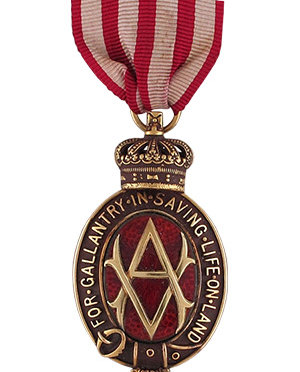
The medal was made of gold (although early examples are gold and bronze), and consists of an oval enclosing the entwined initials V and A. The sea medals have, in addition, an anchor. The oval is enclosed by a bronze garter with the words FOR GALLANTRY IN SAVING LIFE, with AT SEA or AT LAND as appropriate, and is enameled in red or crimson respectively. The medal is surmounted by a crown pierced by a ring for suspension.

The original medal had a blue ribbon 58” (16 mm) wide with two white stripes. A further Royal Warrant in 1867 created two classes of Albert Medal, and the ribbon of the first-class changed to 1 ​38” (35 mm) wide with four white stripes.

The Kaisar-I-Hind Medal

The Kaisar-i-Hind Medal for Public Service was awarded by the Emperor or Empress of India from 1900 to 1947 for significant contributions.

The Kaisar-i-Hind Medal (or Kaisar-i-Hind Medal for Public Service in India, قیصرِ ہند‎ qaisar-e-hind in Urdu, कैसर-इ-हिन्द in Hindi) was established in May 1900 (instituted by Queen Victoria on 10 April 1900) and awarded by the Emperor/Empress of India between 1900 and 1947 to “any person without distinction of race, occupation, position, or sex who shall have distinguished himself (or herself) by important and useful service in the advancement of the public interest in India.

The word kaisar, meaning “emperor” is a derivative of the Roman imperial title Caesar. The title Kaisar-i-Hind was coined in 1876 by the orientalist G.W. Leitner in a deliberate attempt to dissociate British imperial rule from that of preceding dynasties.

The last ruler to bear it was George VI. While never officially rescinded, the Kaisar-i-Hind ceased to be awarded following the passage of the Indian Independence Act 1947.

The Kaisar-I-Hind Medal Grades or Classes

The medal had three grades:

  • Gold
  • Silver
  • Bronze

The Gold Medal for Public Service in India was awarded directly by the monarch on the recommendation of the Secretary of State for India. Silver and Bronze medals were awarded by the Viceroy.

The Kaisar-I-Hind Medal Design

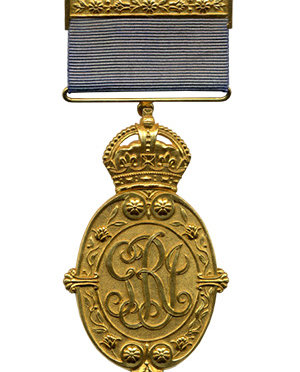
The medal measures 61 mm high and 34 mm wide. It consists of an oval-shaped badge or decoration in gold, silver or bronze with the Royal Cipher and Monarchy on the obverse, and the words “Kaisar-i-Hind for Public Service in India” on a scroll across the center against a floral background on the reverse. The badge is surmounted by the imperial crown.

The decoration was to be worn suspended from the left breast by a dark blue ribbon. The medal has no post-nominal initials.

The Order of British India

The Order of British India is an order of merit established in 1837 by the East India Company and incorporated into the British Honors System in 1859. It’s awarded for “long, faithful and honorable service“.

The Order was awarded by the Viceroy of India to selected serving officers of between 20 and 30 years of service. It was initially intended as a means of providing recognition for serving Indian officers in the East India Company’s military forces, as the so-called “Native Officers” faced slow promotion under a system that was based on advancement through seniority.

The 1st Class of the Order, limited to a further 100 people, conferred the title of sirdar bahadoor (heroic leader) and an increase in salary of two rupees a day. Appointments to the 2nd Class, entitled the recipient to the title of bahadoor (hero) and a more modest wage increase. Holders of both classes could use the post-nominal letters OBI.

In September 1939 eligibility was extended to include native officers serving in the Indian States Forces, Frontier Corps and Military Police, and further extended in January 1944 to include native officers and Indian Warrant Officers in the Royal Indian Navy and the Hong Kong and Singapore Royal Artillery, as well as foreign officers.

The order became obsolete in 1947, after the partition of British India into the Dominion of India and the Dominion of Pakistan.

The Order of British India Design

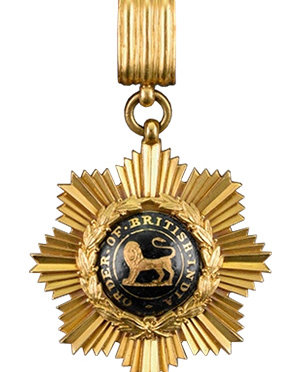
The badge for the First Class consisted of a gold star 1.7 inches (43 mm) in diameter composed of rays of gold. In its center are the words ORDER OF BRITISH INDIA encircling a lion on a background of light blue enamel, surrounded by a laurel wreath and surmounted by a Crown. The enamel behind the wording was dark blue until 1939, when it was changed to the same light blue as appears behind the lion.

The badge for the Second class comprised a slightly smaller gold star 1.5 inches (38 mm) in diameter of similar design to the first class, but without the crown and with the center enamel in dark blue enamel. 

The ribbon was originally sky-blue but changed to dark red in 1838 after it was found that the hair oil favored by Indian soldiers stained the ribbon. From September 1939 the first class ribbon had two thin light blue strips added towards the center of the dark red ribbon, while the second class had one light blue stripe added to the center of the ribbon.

The Distinguished Flying Cross and Medal (UK)

The Distinguished Flying Cross (DFC) was established in June 1918 for officers and warrant officers of the RAF for acts of valor and courage.

The Distinguished Flying Cross (or DFC) was established in June 1918, shortly after the formation of the Royal Air Force (RAF), for officers and warrant officers of the RAF for “an act or acts of valor, courage, or devotion to duty whilst flying in active operations against the enemy“.

The DFC now serves as the third-level award for all ranks of the British Armed Forces for exemplary gallantry in active operations against the enemy in the air, not to the standard required to receive the Victoria Cross or the Conspicuous Gallantry Cross. All awards of the DFC are announced in the London Gazette.

In March 1941 eligibility for the DFC was extended to Naval Officers of the Fleet Air Arm, and in November 1942 to Army officers, including Royal Artillery officers serving on attachment to the RAF as pilots-cum-artillery observers. Posthumous awards were permitted from 1979. The DFC had also been awarded by Commonwealth countries but by the 1990s most had established their own honors systems and no longer recommended British honors.

Recipients are entitled to use the post-nominal letters “DFC”.

The Distinguished Flying Cross and Medal Design

The Cross

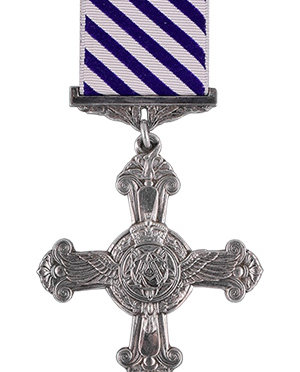
The decoration is a cross flory, 2.125 inches (54.0 mm) wide and was designed by Edward Carter Preston. The horizontal and bottom bars are terminated with bumps, the upper bar with a rose.

Its obverse features airplane propellers, superimposed on the vertical arms of the cross, and wings on the horizontal arms. In the center is a laurel wreath around the RAF monogram, surmounted by a heraldic Imperial Crown. The reverse is plain, except for a central roundel bearing the reigning monarch’s cipher and the date ‘1918’. 

The ribbon is 1.25-inch (32 mm) wide. Originally white with deep purple broad horizontal stripes, it was changed in 1919 to the current white with purple broad diagonal stripes. The ribbon bar is silver, with the Royal Air Force eagle in its center. The suspender is straight and decorated with laurel wreaths.

Originally unnamed, the WW2 crosses usually have the year of issue engraved on the reverse of the lower limb.

The Medal

The Distinguished Flying Medal is an oval struck in silver and measures 42 mm tall and 34 mm wide.

The obverse features the sovereign’s effigy, while the reverse shows Athena Nike seated on an aeroplane, with a hawk rising from her hand. The medal was originally undated, but the date 1918 was added to the reverse with the advent of George VI obverse.

The medal is suspended by a pair of wings from a straight bar. The ribbon was originally purple and white with horizontal stripes, but since July 1919 it changed to thirteen diagonal stripes alternating white and purple.

Find This Medal

Right Now on eBay 
Clicking a link to eBay may result in a referral commission being paid if a purchase is made.
Loading...

The Imperial Service Order and Medal

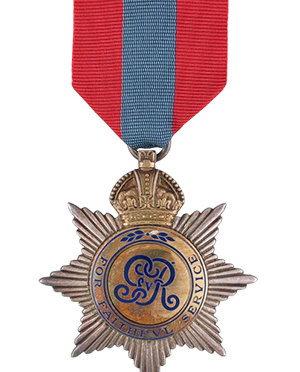
The Imperial Service Order is a decoration of Great Britain established by King Edward VII in August 1902 and awarded on retirement to the administration and clerical staff of the Civil Service throughout the British Empire for long and meritorious service.

A person must have served for 25 years at home, 20 years and 6 months in India and 16 years in the tropics to become eligible. In exceptional cases, awards were made for “eminently meritorious service” irrespective of the qualifying period.

There is one class: Companion. Both men and women are eligible, as women were admitted in 1908. and recipients of this order are entitled to use the post-nominal letters ‘ISO’. No awards have been made since 1995.

The Imperial Service Medal was instituted at the same time as the ISO but was intended for junior grades of the Civil Service.

The Imperial Service Order Design

The medal is struck in silver with gold overlay and measures 61 mm high and 55 mm wide.

The insignia of the order for men is an eight-pointed silver star, with the top ray obscured by a crown; the golden central medallion bore the cipher of the reigning monarch surrounded by the legend ‘For Faithful Service‘. The medal is suspended on a ribbon of crimson with a blue central stripe. The insignia for women is the same medallion as for men, surrounded by a silver laurel wreath and topped by a crown, suspended on a bow of crimson with a blue central stripe. The medal is struck in silver and bronze, circular and measures 32 mm. In 1920 it was transformed from a silver plaque into a circular medal with the sovereign’s effigy on the obverse, and a reverse depicting a naked man resting from his labors. The exergue reads “FOR FAITHFUL SERVICE”.

The ribbon measures 38 mm wide and has three equal sections of crimson, blue and crimson.

The George VI issue comes in two types: The early ones with GRI cypher, and the later with CVIR.

The New Zealand Cross

The New Zealand Cross is a Great Britain decoration introduced on 10th March 1869 by an Order in Council, Wellington, during the New Zealand Wars, which were fought between natives of New Zealand, the Māori, and forces raised by European settlers known as Pākehā assisted by British troops. The decoration was conferred for bravery.

Because of the mistaken impression that colonial troops were not eligible for the Victoria Cross unless under command of British troops, the Governor of New Zealand, Sir George Bowen, instituted the New Zealand Cross as the highest New Zealand award. Queen Victoria eventually ratified his action.

Only 23 New Zealand Crosses were awarded, the last being authorized in 1910.

The New Zealand Cross Design

The decoration has the form of a silver (with gold apliqué) cross pattée with a six-pointed gold star on each limb. It measures 52 mm high and 38 mm wide.

The obverse bears the words ‘NEW ZEALAND’ in the center, gilded in gold and encircled by a laurel wreath. The reverse has two concentric circles with the name of the recipient engraved between the circles, and the date of the action engraved within the inner circle. For the first 20 medals cast in 1871, the reverse of the suspender clasp contains the cartouche of the goldsmith Messrs Phillips Brothers and Son of Cockspur Street, London. This cartouche was omitted from a further five medals cast in 1886.

The ribbon is crimson and passes through a silver seriffed “V” suspender clasp with small gold laurel leaves. The cross is surmounted by a Tudor Crown.

The Knight Bachelor’s Badge

The title of Knight Bachelor (KB) as introduced by King Henry III to recognize a battelier, and the KB badge authorized by George V.

The title of Knight Bachelor (KB) as introduced by King Henry III to recognize a battelier (someone who fought in battle). The badge was authorized by George V in response to a request from the Imperial Society of Knights Bachelors who wished to have a distinctive badge denoting their rank.

Knights Bachelor are the most ancient sort of British knight, but Knights Bachelor rank below knights of chivalric orders. There is no female counterpart to Knight Bachelor.

The Knight Bachelor’s Badge Design

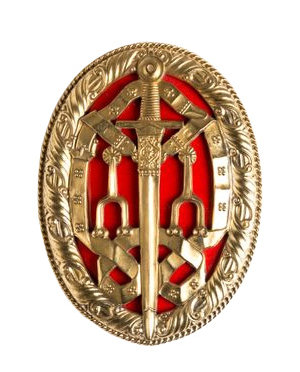
The badge is a silver-gilt and enamel upright oval medallion enclosed by a scroll and bearing a cross-hilted sword, belted and sheathed with the pommel upwards. It’s surrounded by two spurs, rowels upwards, and a sword-belt.

Some pre-war breast badges are struck in metal. The badge measures a maximum of 76.50 millimeters high and 56.50 millimeters wide, but it was reduced in 1933 to 63.25 mm and in 1973 to 54 mm.

The ribbon measures 38 millimeters and is scarlet with broad yellow borders.