The Most Venerable Order of the Hospital of St. John of Jerusalem

The Most Venerable Order of the Hospital of St. John of Jerusalem is a working order of charitably minded men and women established in 1888.

The Most Venerable Order of the Hospital of St. John of Jerusalem, and also known as the Order of St John or St John International, is a British royal order of chivalry constituted in 1888 by Queen Victoria and dedicated to St John the Baptist, an itinerant preacher in the early 1st century AD.

The order can be tracked back to the Knights Hospitaller in the Middle Ages. The Knights Hospitalle were a medieval and early modern Catholic military order, later known as the Order of Malta. A faction moved to Britain in the early 1830s and became associated with the founding in 1882 of the St John Ophthalmic Hospital near the old city of Jerusalem and the St John Ambulance Brigade in 1887.

The Order of St John is also known for the health organizations it has founded, such as St John Ambulance and St John Eye Hospital Group. 

The Order of the Hospital of St. John of Jerusalem Design

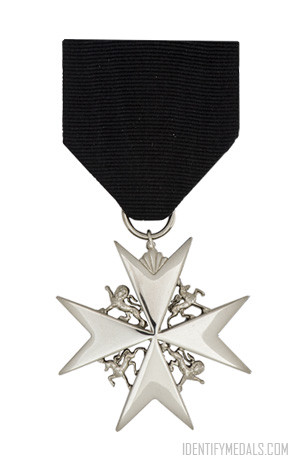
The insignia of the Order is a Maltese cross, or eight-pointed cross in white enamel set in silver-colored metal. The cross is embellished in each of its main angles with lions and unicorns, with a lion in the top left and bottom right angles. 

The insignia of a Bailiff or Dame Grand Cross consists of a breast star and a sash badge. The insignia of a Knight or Dame of Justice or of Grace is a breast star and a neck badge. The insignia of a Commander is a neck badge, the Officer insignia is silver and enameled white, and he insignia of a Member is also worn on the left breast but is bright silver without enamel.

The badges have a ring attached to the top through which the ribbon passes. The ribbon for all grades is black watered.
The Military Medal (MM)

The Military Medal (or MM) was a military decoration established in 1916 and awarded for bravery in battle to personnel of the British Army.

The Military Medal (or MM) was a military decoration established in 1916 and awarded for bravery in battle on land. The award is given to personnel of the British Army and other arms of the armed forces, and to personnel of other Commonwealth countries, below commissioned rank.

The award had retrospective application to 1914, and was awarded to other ranks for “acts of gallantry and devotion to duty under fire“. It was discontinued in 1993 when it was replaced by the Military Cross, which was extended to all ranks, while other Commonwealth nations instituted their own award systems in the post-war period.

When the medal was first introduced, it was unpopular among regular soldiers wrote MM and DCM recipient Frank Richards who stated “the Military Medal, which without a shadow of a doubt had been introduced to save awarding too many DCMs. The old regular soldiers thought very little of the new decoration“.

Since 1918 recipients of the Military Medal have been entitled to the post-nominal letters “MM”.

The Military Medal Design Design

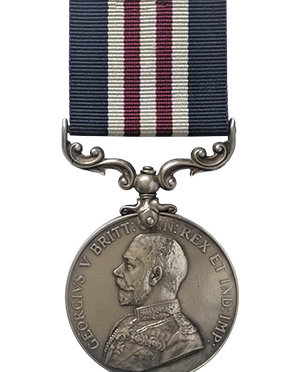
The medal is circular, struck in silver and measures 1.4 inches (36 mm) in diameter.

The obverse bears the effigy of the reigning monarch and an appropriate inscription. The reverse shows the inscription “FOR BRAVERY IN THE FIELD” in four lines, surrounded by a laurel wreath, and surmounted by the Royal Cypher and Imperial Crown.

The ribbon is dark blue, 1.25 inches wide with five equal center stripes of white, red, white, red, and white, each 0.125 inches wide. The suspender is of an ornate scroll type and the name and service details of the recipient were impressed on the rim of the medal, although honorary awards to foreign recipients were issued unnamed. Silver, laurelled bars were authorized for subsequent awards, with a silver rosette worn on the ribbon bar to indicate the award of each bar.

The Distinguished Service Cross (UK)

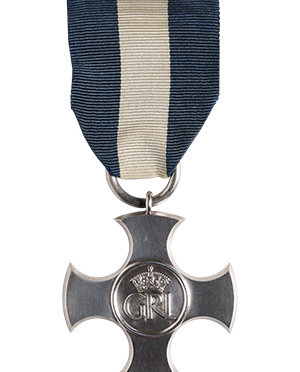
The Distinguished Service Cross (DSC) is a military decoration awarded to officers for acts of gallantry during active operations at sea.

  • Time Period: Pre-WW1
  • Year of Institution: 15 June 1901 (as Conspicuous Service Cross, renamed 1914)
  • Country: Great Britain

The Distinguished Service Cross (or DSC) is a third level military decoration awarded to officers in recognition of an act or acts of exemplary gallantry during active operations against the enemy at sea. Ranks included officers of the British Armed Forces, Royal Fleet Auxiliary and British Merchant Navy, and formerly also of other Commonwealth countries.

The award was created in 1901 as the Conspicuous Service Cross and awarded to warrant and subordinate officers, including midshipmen, ineligible for the Distinguished Service Order. In October 1914, the award was renamed the Distinguished Service Cross and eligibility was extended to all naval officers (commissioned and warrant) below the rank of lieutenant commander. In August 1916, bars were introduced to reward further acts of gallantry meriting the Cross.

In December 1939 eligibility was extended to Naval Officers of the rank of Commander and Lieutenant-Commander, in April 1940 to equivalent ranks in the Royal Air Force serving with the Fleet, and in November 1942 to those in the Army aboard defensively equipped merchant ships.

Recipients are entitled to the post-nominal “DSC”. Since 1979, the Distinguished Service Cross can be awarded posthumously.

The Distinguished Service Cross Design

The medal is a plain silver cross with rounded ends with a width of 43 millimeters (1.7 in).

The obverse has a circular center containing the Royal Cypher of the reigning monarch at the time of award surmounted by a crown. The reverse is plain apart from the hallmark, and the ribbon is attached via a hall-marked silver ring. From 1940, the year of issue was engraved on the lower limb of the cross, and since 1984 it has been awarded named to the recipient.

The ribbon has three equal stripes of dark blue, white, and dark blue. The ribbon bar denoties a further award is plain silver, with convex ends and a central crown.

The Distinguished Conduct Medal

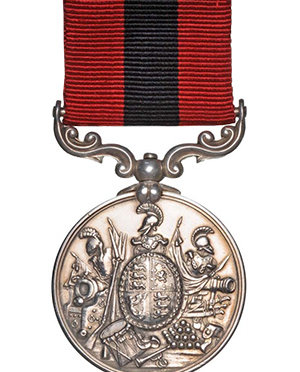
The Distinguished Conduct Medal, or DCM, was established in 1854 and is the oldest British award for gallantry in the field by other ranks.

The Distinguished Conduct Medal, or DCM, was established in 1854, during the Crimean War, by Queen Victoria. It’s the oldest British award for gallantry in the field by other ranks (personnel who are not commissioned officers) of the British Army. The medal was also awarded to personnel of other Commonwealth Dominions and Colonies.

The Distinguished Conduct Medal ranked below the Victoria Cross, until its discontinuation in 1993 when it was replaced by the Conspicuous Gallantry Cross. Prior to its institution, there had been no official medal awarded by the British Crown in recognition of individual acts of gallantry in the Army. The Distinguished Conduct Medal was awarded with a gratuity, that varied in amount depending on rank, and given on the recipient’s discharge from the Army.

In May 1894, Queen Victoria authorized Colonial governments to adopt various military medals for awards to their local military forces. The Colony of Natal and the Cape Colony introduced this system in 1894, and the Transvaal Colony followed in 1902, while Australia, Canada and New Zealand also adopted the medal. However, only the Natal and Canada versions were finally awarded.

All awards of the Distinguished Conduct Medal were notified in the London Gazette and, during the First World War, citations were generally also included.

A bar was introduced in 1881 to be awarded in recognition of each subsequent act of distinguished conduct for which the medal would have been awarded.

The Distinguished Conduct Medal Design

The medal is struck in silver and is a disk measuring 36 millimeters (1.4 inches) in diameter and 3 millimeters (0.12 inches) thick.

The original obverse shows a Trophy of Arms, designed by Benedetto Pistrucci, which incorporates a central shield bearing the Royal Coat of Arms without any inscription. From 1902, after the accession of King Edward VII, the effigy of the reigning monarch replaced the trophy of arms, with the respective titles of the monarch inscribed around the perimeter. There were eight variants of the obverse:

  • King Edward VII – “EDWARDVS VII REX IMPERATOR”.
  • King George V, bareheaded – “GEORGIVS V BRITT: OMN: REX ET IND: IMP:”.
  • King George V, crowned – “GEORGIVS•V•D•G•BRITT•OMN•REX•ET•INDIÆ•IMP•”.
  • King George VI – Two versions: “GEORGIVS VI D:G:BR OMN REX ET INDIAE IMP:” and “GEORGIVS VI DEI GRA: BRITT: OMN: REX FID: DEF:”.
  • Queen Elizabeth II – Two versions,: “ELIZABETH II D:G:BR:OMN: REGINA F:D:” and “ELIZABETH II DEI GRATIA REGINA F.D”.

The reverse is smooth, with a raised rim and the inscription “FOR DISTINGUISHED CONDUCT IN THE FIELD” in four lines, underlined by a laurel wreath between two spear blades.

The suspender is an ornamented scroll. The ribbon is 32 millimeters wide and dark crimson, with a 10 millimeters wide navy blue band in the center. All medals awarded bear the recipient’s number, rank, name and unit on the rim.

The Distinguished Flying Cross and Medal (UK)

The Distinguished Flying Cross (DFC) was established in June 1918 for officers and warrant officers of the RAF for acts of valor and courage.

The Distinguished Flying Cross (or DFC) was established in June 1918, shortly after the formation of the Royal Air Force (RAF), for officers and warrant officers of the RAF for “an act or acts of valor, courage, or devotion to duty whilst flying in active operations against the enemy“.

The DFC now serves as the third-level award for all ranks of the British Armed Forces for exemplary gallantry in active operations against the enemy in the air, not to the standard required to receive the Victoria Cross or the Conspicuous Gallantry Cross. All awards of the DFC are announced in the London Gazette.

In March 1941 eligibility for the DFC was extended to Naval Officers of the Fleet Air Arm, and in November 1942 to Army officers, including Royal Artillery officers serving on attachment to the RAF as pilots-cum-artillery observers. Posthumous awards were permitted from 1979. The DFC had also been awarded by Commonwealth countries but by the 1990s most had established their own honors systems and no longer recommended British honors.

Recipients are entitled to use the post-nominal letters “DFC”.

The Distinguished Flying Cross and Medal Design

The Cross

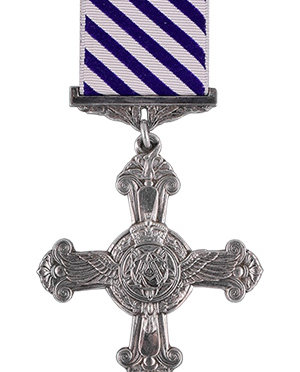
The decoration is a cross flory, 2.125 inches (54.0 mm) wide and was designed by Edward Carter Preston. The horizontal and bottom bars are terminated with bumps, the upper bar with a rose.

Its obverse features airplane propellers, superimposed on the vertical arms of the cross, and wings on the horizontal arms. In the center is a laurel wreath around the RAF monogram, surmounted by a heraldic Imperial Crown. The reverse is plain, except for a central roundel bearing the reigning monarch’s cipher and the date ‘1918’. 

The ribbon is 1.25-inch (32 mm) wide. Originally white with deep purple broad horizontal stripes, it was changed in 1919 to the current white with purple broad diagonal stripes. The ribbon bar is silver, with the Royal Air Force eagle in its center. The suspender is straight and decorated with laurel wreaths.

Originally unnamed, the WW2 crosses usually have the year of issue engraved on the reverse of the lower limb.

The Medal

The Distinguished Flying Medal is an oval struck in silver and measures 42 mm tall and 34 mm wide.

The obverse features the sovereign’s effigy, while the reverse shows Athena Nike seated on an aeroplane, with a hawk rising from her hand. The medal was originally undated, but the date 1918 was added to the reverse with the advent of George VI obverse.

The medal is suspended by a pair of wings from a straight bar. The ribbon was originally purple and white with horizontal stripes, but since July 1919 it changed to thirteen diagonal stripes alternating white and purple.

Find This Medal

Right Now on eBay 
Clicking a link to eBay may result in a referral commission being paid if a purchase is made.
Loading...

The Royal Victorian Order

The Royal Victorian Order is a dynastic order of knighthood established in 1896 by Queen Victoria for distinguished service to the monarch.

The Royal Victorian Order is a dynastic order of knighthood established in 1896 by Queen Victoria to recognize distinguished personal service to the monarch of the Commonwealth realms, members of the monarch’s family, or to any viceroy or senior representative of the monarch. There is no limit on the number of individuals honored at any grade, and admission remains at the sole discretion of the monarch.

The reigning monarch is at the apex of the Royal Victorian Order as its Sovereign, followed by the Grand Master. The Order has five grades and one medal with three levels representing different levels of service. All those honored may use the prescribed styles of the order. The order’s motto is Victoria, and its official day is 20 June and its chapel is the Savoy Chapel in London.

The grades are as follows:

  • Knight / Dame Grand Cross.
  • Knight / Dame Commander.
  • Commander.
  • Lieutenant.
  • Member.

The Royal Victorian Order Design

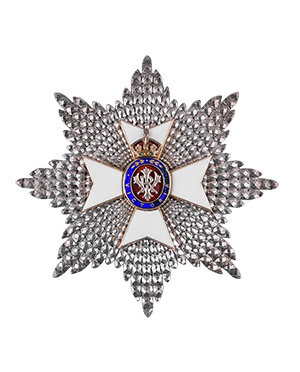
The badge of the Order is a Maltese cross with a central medallion depicting on a red background the Royal Cypher of Queen Victoria, surrounded by a blue ring bearing the motto of the order—VICTORIA—and surmounted by a Tudor crown and worn on a sash depending on the grade. For Knights and Dames Grand Cross, Commanders, and Lieutenants, the Maltese cross is rendered in white enamel with gold edging, while that for Knights and Dames Commander and Members is in silver. The size of the badge also varies by rank, that for the higher classes being larger.

The medal bears the effigy and name of the reigning sovereign at the time of its awarding, as well as the phrase DEI • GRATIA • REGINA (or REX) • F.D. (by the grace of God, Queen (or King), Defender of the Faith), and on the reverse is the Royal Cypher upon an ornamental shield within a laurel wreath.

The ribbon is blue with red-white-red stripe edging, and at formal events, or collar days, Knights and Dames Grand Cross wear the Royal Victorian Order’s livery collar, consisting of an alternating string of octagonal gold pieces.

The Medal for the Liberation of Kuwait (Canada)

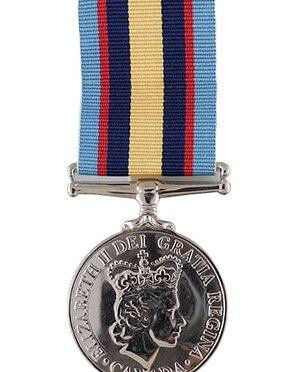
The Gulf and Kuwait Medal as a Canadian medal created in 1990 to recognize the Canadian Forces who had directly participated in the Gulf War.

The Gulf and Kuwait Medal (or Médaille du Golfe et du Koweït in French) was a Canadian campaign medal created in 1990 by the monarch-in-Council to recognize members of the Canadian Forces who had directly participated in the Gulf War, either in the hostilities themselves or during the troop build-up prior to the invasion of Iraq.

The medal is, within the Canadian system of honors, the third highest of the war and operational service medals. Queen Elizabeth II, on the advice of her Cabinet under Prime Minister Brian Mulroney, created the medal to recognize members of the Canadian Forces. To qualify for the medal, individuals had to have served for 30 consecutive days between 2 August 1990 and 27 June 1991 in the region of the Persian Gulf, and those who for a minimum of one day engaged in direct combat with the enemy during the offensive that lasted from 16 January to 3 March 1991 were entitled to receive the additional medal bar.

In total, 4,436 medals were issued, along with 3,184 bars.

The Medal for the Liberation of Kuwait (Canada) Design

The medal was designed by Bruce W. Beatty. It measures 36 millimeters (1.4 in) diameter and is a rhodium plated tombac disc.

The obverse bears the Latin words ELIZABETH II DEI GRATIA REGINA (Elizabeth II, by the Grace of God, Queen) and CANADA surrounding an effigy of Queen Elizabeth II, symbolizing her roles as both fount of honor and Commander-in-Chief of the Canadian Forces. On the reverse is a laurel wreath with a maple leaf at its base encircling the words: GULF AND KUWAIT • 1990-1991 • LE GOLFE ET KUWAIT.

This medallion is worn at the left chest, suspended on a 31.8mm wide ribbon colored with vertical stripes in light blue, scarlet and dark blue, symmetrically flanking a sand colored central stripe. Originally, the Gulf and Kuwait medal was to have coincidentally had the same ribbon as the British Gulf Medal.

Should an individual already possessing a Gulf and Kuwait Medal be awarded the medal cupro-nickel and bearing a maple leaf bar for combat service, for wear on the ribbon from which the original medal is suspended.

The Air Force Cross and Medal (United Kingdom)

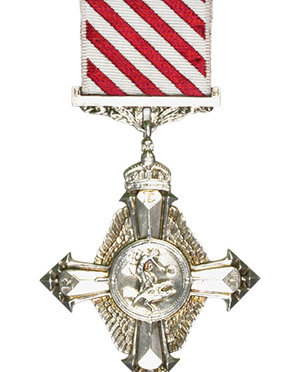
The Air Force Cross is a British military decoration awarded to officers for “acts of exemplary gallantry while flying against the enemy”

Time Period: WW1 The Great War
Year of Institution: 3 June 1918
Country: Great Britain

The Air Force Cross (or AFC) is a military decoration awarded to officers for “an act or acts of exemplary gallantry while flying, though not in active operations against the enemy“. Since 1993 it’s also given to other ranks, of the United Kingdom Armed Forces, and formerly also to officers of the other Commonwealth countries.

The award was established on 3 June 1918, shortly after the formation of the Royal Air Force (RAF). It was originally awarded to RAF commissioned officers and Warrant Officers, but was later expanded to include Royal Navy and army aviation officers. Recipients of the Air Force Cross are entitled to use the post-nominal letters “AFC”.

Between 1919 and 1932 the AFC was also awarded to civilians, on the same basis as for RAF personnel. The AFC had also been awarded by Commonwealth countries but by 1990’s most, including Canada, Australia, and New Zealand, had established their own honors systems and no longer recommended British honors.

The Air Force Cross and Medal Design

The Cross

The Air Force Cross is a silver cross measuring 60 millimeters (2.4 in) in height and 54 millimeters (2.1 in) in width, representing aircraft propeller blades, with wings between the arms. It was design by Edward Carter Preston.

The obverse depicts Hermes, riding on the wings of a hawk holding a laurel wreath. At the top of the upper arm is the royal crown, while the other three arms bear the royal cipher of the reigning monarch at the time of issue. The reverse is plain, except for a central roundel bearing the reigning monarch’s cipher and the date ‘1918’. Originally awarded unnamed, from 1939 the year of issue was engraved on the reverse lower limb of cross, and since 1984 it has been awarded named to the recipient.

The suspender is straight and decorated with laurel wreaths. The ribbon bar denoting a further award is silver, with the Royal Air Force eagle in its centre. Bars awarded during World War II have the year of award engraved on the reverse. The 32 mm (1.25 inch) ribbon was originally white with red broad horizontal stripes, but changed in July 1919 to the current white with red broad diagonal stripes at a 45-degree angle.

The Medal

The Air Force Medal is an oval struck in silver and measures 42 mm tall and 32 mm wide. It has a laurel border and features, on the obverse, the sovereign’s effigy. The reverse Hermes mounted on a hawk bestowing a laurel wreath.

The medal is suspended by a pair of wings from a straight bar. The ribbon, originally with horizontal narrow stripes or white and crimson, changed in 1919 to diagonal ones of the same colors.

The Royal Red Cross

The Royal Red Cross is a military decoration established by Queen Victoria and awarded for exceptional services in military nursing.

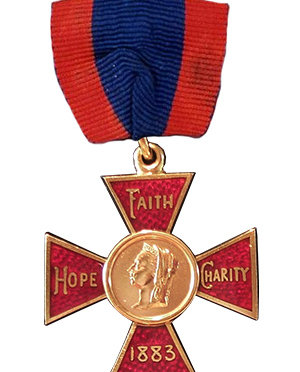
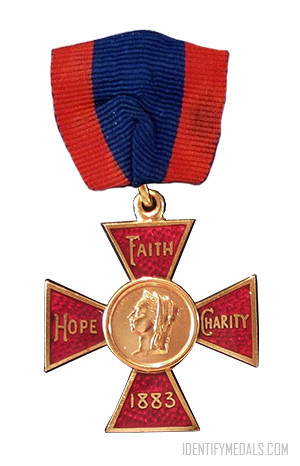
The Royal Red Cross is a military decoration awarded in the United Kingdom and Commonwealth for exceptional services in military nursing. It was established on 27 April 1883 by Queen Victoria.

The Royal Red Cross has a single class of Member and it was first awarded to the founder of modern nursing, Florence Nightingale. A second and lower class, Associate, was added during World War I in 1917.

The award is awarded to a fully trained nurse of an officially recognized nursing service, military or civilian, who has shown exceptional devotion and competence in the performance of nursing duties, over a continuous and long period, or who has performed an exceptional act of bravery and devotion at her or his post of duty.

The decoration was conferred exclusively to women until 1976.  Recipients of the Royal Red Cross are entitled to use the post-nominal letters “RRC” or “ARRC” for Members and Associates respectively.

The Royal Red Cross Medal Design

The badge for RRC is shaped like a golden cross. It measures 1.375 inches (or 3.49 cm) wide.

The obverse is enameled red, with a circular medallion (now bearing an effigy of the reigning monarch) at its centre. The words “Faith“, “Hope” and “Charity” are inscribed on the upper limbs of the cross, and the year “1883” in the lower limb.

The reverse is plain except a circular medallion bearing the Royal Cypher of the reigning monarch.

The ribbon for both grades is dark blue with crimson edge stripes. To recognise further exceptional devotion and competency in the performance of nursing duties or exceptional act of bravery and devotion at her or his post of duty, a bar may be awarded to a recipient of the RRC. The bar is linked to the cross and is made of red enamel. A rosette is worn on the ribbon in undress to denote a bar to the RRC.

Find Red Cross Medals Online

More Red Cross Medals

The Korea Medal

The Korea Medal (or Médaille de Corée in French), also known as the Queen’s Korea Medal, was a campaign medal created in 1951 to recognize troops from Australia, Canada, New Zealand, and the United Kingdom who had given 28 days service offshore during the Korean War, or at least one day’s service in an air sortie over Korea.

The Korean War was the first event in which United Nations (UN) armed forces took on a combat role in a multinational effort to stop the North Korean takeover of the Republic of Korea. It involved the participation of 20 UN member states, the Republic of Korea and Italy.

Except for Canada, the medal was identical in all countries where it was awarded, and holds a different place in each country’s order of precedence for honors.

The Korean War Medal Design

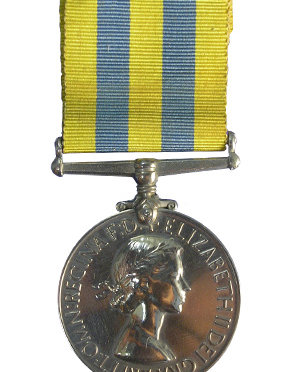
Designed by Edward Carter Preston, a Liverpool artist, sculptor and medallist, the Korea Medal measures 36 millimetres (1.4 in) and is a disc. All medals were made of cupro-nickel, except for the Canadian version that was made of silver.

On the Korean War medal obverse is an effigy of Queen Elizabeth II, surrounded by an inscription that symbolizes her roles as both fount of honour and Commander-in-Chief of her various forces. At the time of the medal’s creation, King George VI was monarch. However, he died on 6 February 1952 and so the image of his daughter was placed on the obverse of the medal, uncrowned.

There are three versions of the inscription surrounding the Queen’s head:

  • ELIZABETH II DEI GRA. BRITT. OMN. REGINA F.D. (Elizabeth II, by the Grace of God Queen of all the Britons, Defender of the Faith).
  • ELIZABETH II DEI GRATIA REGINA F.D. (Elizabeth II, by the Grace of God Queen, Defender of the Faith), later awards omitting BRITT. OMN..
  • ELIZABETH II DEI GRATIA REGINA CANADA (Elizabeth II, by the Grace of God Queen of Canada), awarded to Canadian participants.

On the reverse is a depiction of Hercules wrestling the Hydra—a symbolic representation of communism—with the word KOREA below.

The recipient’s name, rank and regimental number is impressed on the medal’s rim.