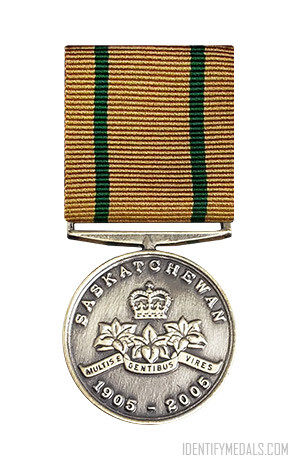
The Commemorative Medal for the Centennial of Saskatchewan

A commemorative medal struck to celebrate the first 100 years since the province’s entrance into Canadian Confederation.

The Commemorative Medal for the Centennial of Saskatchewan, also known as the Saskatchewan Centennial Medal, was created to celebrate Saskatchewan‘s 100th anniversary of joining the Canadian Confederation.

This medal honors individuals who have made significant contributions to society and recognizes outstanding achievements, including leadership, volunteerism, community involvement, and exceptional personal achievements. Only individuals (not groups) were eligible, and posthumous nominations were not accepted.

Certain individuals received the medal automatically by virtue of their positions, such as provincial and federal elected officials, judges, aboriginal leaders, and community and municipal leaders. Additional recipients were selected based on recommendations from governmental and non-governmental organizations and Members of the Legislative Assembly.

About 4,200 medals were produced.

The Saskatchewan Centennial Medal Design

The medal features, on the obverse, the provincial motto beneath a wreath of western red lilies, topped by the St. Edward’s Crown. The inscription “Saskatchewan 1905–2005” encircles the edge.

On the reverse side, the provincial shield of arms is displayed.

The medal is attached to a gold-colored ribbon with two narrow green diagonal stripes.
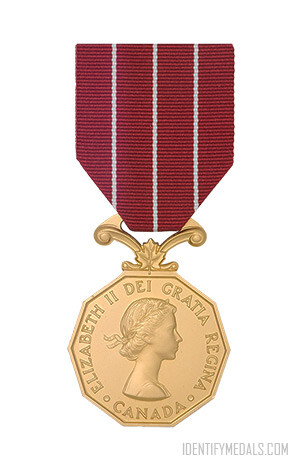
The Canadian Forces’ Decoration

The Canadian Forces’ Decoration is awarded to members of the Canadian Armed Forces who have completed twelve years of military service.

The Canadian Forces’ Decoration (post-nominal letters “CD”) is a Canadian award granted to members of the Canadian Armed Forces who have completed twelve years of military service (under specific conditions).

The decoration is awarded to officers and non-commissioned members of the Regular and Reserve forces, including honorary appointees within the Canadian Armed Forces, excluding time on the Supplementary Reserve List. It can be granted to individuals who already hold long service, good conduct, or efficiency awards, as long as the full qualifying periods for each are completed and service for one award does not count towards another.

Service in the regular and reserve or auxiliary forces of the Commonwealth nations is eligible if the final five years are with the Canadian Armed Forces, and no other similar medal has been awarded for that service.

The first governor general to receive the CD was Viscount Alexander of Tunis in 1951. Initially, the medal was awarded to all members of the Royal Family who served in the Canadian Forces, regardless of whether they had completed twelve years of service; however, this practice has not been automatic since 1953.

The Canadian Forces’ Decoration Design

The medal is ten-sided, representing the ten provinces, and measures 36 millimeters across. The King George VI version is made of .800 fine silver and gilded, featuring an uncrowned bust of the King facing left with the inscription “Georgivs VI D: G: Britt: omn: Rex Fid: Def” around the edge.

The Queen Elizabeth II version, made of tombac (a copper-zinc alloy) and later introduced in a gilded copper variant in 2008, has an uncrowned bust of the Queen facing right with “Elizabeth II Dei gratia Regina” around the edge and “Canada” at the bottom.

The reverse of both medals features a naval crown, three maple leaves, and an eagle representing the navy, army, and air force, respectively, with the word “service” on a scroll at the base and a fleur-de-lis on each side of the crown. The King George VI medal includes the royal cypher in the center, which is omitted from the Queen Elizabeth II medal. The King George VI medal has the recipient’s name and rank engraved on the reverse of the solid bar, while the Queen Elizabeth II medal has them engraved around the edge, with early versions stamped rather than engraved.

A clasp, or bar, is awarded for every 10 years of additional service. The clasp is tombac, 1⁄4 inch (6.4 mm) high, with the Canadian coat of arms in the center, crowned and gold in color. On the undress ribbon, this is indicated by a rosette.

The Queen Elizabeth II Coronation Medal

The medal, established in 1953, was given as a personal memento from the Queen to members of the Royal Family and selected officers of state.

The Queen Elizabeth II Coronation Medal is a commemorative medal established on 2 June 1953 and instituted to celebrate the coronation of Queen Elizabeth II.

This medal was given as a personal memento from the Queen to members of the Royal Family and selected officers of state, including members of the Royal Household, government officials, mayors, public servants, local government officials, and members of the navy, army, air force, and police in Britain, as well as her colonies and Dominions. It was also awarded to members of the Mount Everest expedition, two of whom reached the summit four days before the coronation. The medal was struck at the Royal Mint and distributed immediately after the coronation.

For Coronation and Jubilee medals, up until 1977, the practice was for the authorities in the United Kingdom to decide on the total number to be produced and then allocate a proportion to each of the Commonwealth countries, Crown dependencies, and other possessions of the Crown. The government of each territory had the discretion to decide who would receive a medal and for what reasons.

In total, 129,051 medals were awarded, including:

  • 11,561 to Australians.
  • 12,500 to Canadians.

The Queen Elizabeth II Coronation Medal Design

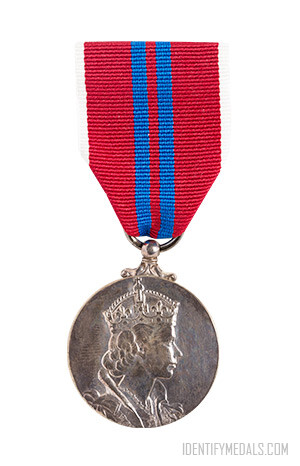
The Queen Elizabeth II Coronation Medal is a silver disk measuring 1.25 inches in diameter. The obverse features a crowned effigy of Queen Elizabeth II, facing right, adorned in a high-collared ermine cloak and wearing a Tudor Crown along with the Collar of the Garter and Badge of the Bath. It lacks a raised rim and any inscriptions.

The reverse displays the Royal Cypher “EiiR” topped by a large crown, with the inscription “QUEEN ELIZABETH II CROWNED 2nd JUNE 1953” around the edge. The medal was designed by Cecil Thomas.

The dark red ribbon is 1.25 inches (32 mm) wide, featuring 2 mm wide white edges and two narrow dark blue stripes in the center, each 2 mm wide and 1.6 mm apart.

Medal of Bravery (Canada)

The Medal of Bravery (Médaille de la Bravoure in French) is a decoration given to Canadian citizens (civilians or members of the forces) for acts of bravery in hazardous circumstances. The medal is within the Canadian system of honors and is the third-highest award for bravery. It was created in 1972 and can be presented to both living and deceased individuals. Recipients the ability to use the post-nominal letters MB.

The Medal of Bravery Design

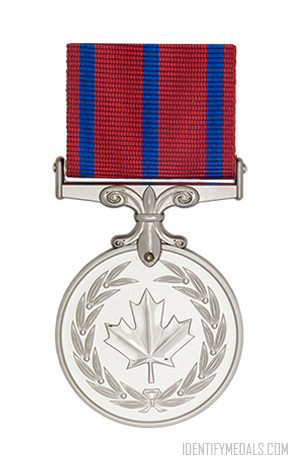
The Medal of Bravery is a silver medal measuring 31.8 millimetres (1.25 in) in diameter.

The obverse of the medal bears a maple leaf surrounded by a laurel wreath. On the reverse is the Royal Cypher of the reigning monarch, a St. Edward’s Crown, and the inscription BRAVERY • BRAVOURE. The name and rank of the recipient is engraved on the medal’s edge.

The insignia is worn on the left chest, on a 31.8mm wide red with three vertical blue stripes ribbon.

For men, the medal hungs from a bar, and for women, on a ribbon bow.

Individuals already possessing a Medal of Bravery can be awarded the decoration again (for subsequent acts of bravery), in which case a silver medal bar bearing a maple leaf is added on the original ribbon. 

The WW1 Royal Tank Corps Cap Badge

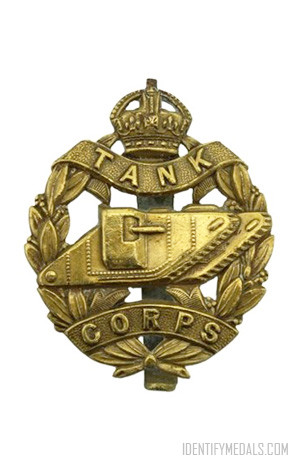
The Royal Tank Corps Cap Badge is a First World War brass King’s crown cap badge for members of the Tank Corps.

The Royal Tank Corps Cap Badge is a First World War brass King’s crown cap badge for members of the Tank Corps.

The Royal Tank Regiment (RTR) is a division of the British Army specializing in armored warfare. Previously referred to as the Tank Corps and the Royal Tank Corps, it operates under the Royal Armoured Corps. On July 5, 2012, plans were announced to merge the operational regiments—1st Royal Tank Regiment (1RTR) and 2nd Royal Tank Regiment (2RTR)—into a unified regiment named The Royal Tank Regiment, effective 2014.

Tanks made their debut at the Battle of Flers-Courcelette in September 1916, part of the larger Battle of the Somme in World War I. During this period, the six tank companies were organized under the Heavy Section of the Machine Gun Corps (MGC).

The Royal Tank Corps Cap Badge Design

The cap badge measures 48 millimeters by 40 millimeters and is stuck in brass. The obverse features a Mark I tank and the words “Tank” and “Corps”. The reverse has a slider.

The Order of Yukon

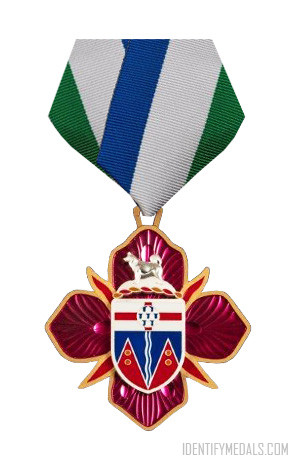
The Order of Yukon (Ordre du Yukon in French), instituted on 1 January 2020, is a civilian honor for merit in the Canadian territory of Yukon. It is the highest honor which can be bestowed by the Government of Yukon. 

The Order is intended to honor current and former residents of the territory for significant contributions to the advancement of Yukon society. The Order of Yukon was first proposed in 2016, following public consultation and created by the passage of the Order of Yukon Act in 2018. 

Inductees are entitled to use the postnominal letters OY.

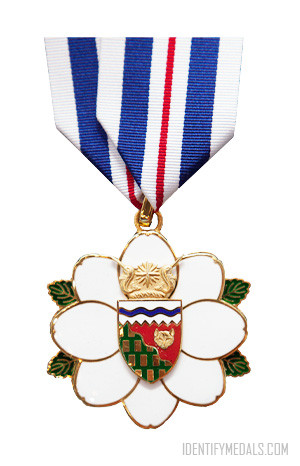
The Order of the Northwest Territories

The Order of the Northwest Territories (Ordre des Territoires du Nord-Ouest in French), instituted on 7 October 2015, is a civil honor for merit in the Canadian territory of the Northwest Territories. 

The Order It is intended to honor current and former residents of the territory who have served with the great distinction and excelling in any field of endeavor for the benefit the people of the Northwest Territories and others. The order may be awarded to no more than three persons annually.

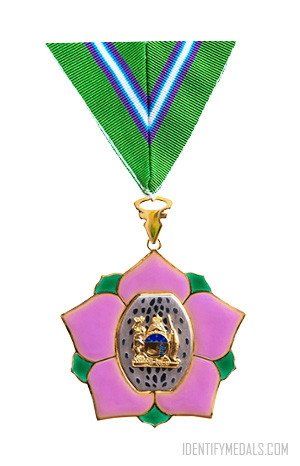
The Order of Nunavut

The Order of Nunavut (Ordre du Nunavut in French, ᓄᓇᕗᒻᒥ ᐃᓕᓴᖅᓯᔾᔪᑦ ᐅᔭᒥᒃ / Nangariyauyunut Nunavunmi in Inuktitut), instituted in 2010, is a civilian honor for merit in the Canadian territory of Nunavut.

The Order was created by the passage of the Order of Nunavut Act and is intended to honor current and former residents of the territory (or the territory which became Nunavut) for outstanding contribution to the cultural, social, or economic well-being of Nunavut. A maximum of three individuals may be inducted by the Commissioner of Nunavut each year. 

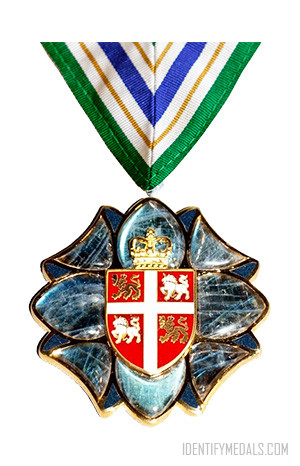
The Order of Newfoundland and Labrador

The Order of Newfoundland and Labrador (Ordre du Terre-Neuve-et-Labrador in French), instituted in 2001, is a civilian honor for merit in the Canadian province of Newfoundland and Labrador. It is the highest honor amongst all others conferred by the Newfoundland and Labrador Crown.

The Order of Newfoundland and Labrador is intended to honor any current or former longtime resident of Newfoundland and Labrador who has demonstrated a high level of individual excellence and achievement in any field, having “demonstrated excellence and achievement in any field of endeavor benefiting in an outstanding manner Newfoundland and Labrador and its residents.

The Order of Newfoundland and Labrador Design

New Members are presented with an insignia. The badge consists of a gold medallion in the form of a stylized sarracenia purpurea (or purple pitcher plant)—the official provincial flower.

The obverse is made in marbleized green enamel with gold edging, and bearing at its center the escutcheon of the arms of Newfoundland and Labrador, all surmounted by a St. Edward’s Crown symbolizing the Canadian monarch’s role as the fount of honor.

The ribbon is patterned with vertical stripes in blue, white, and two shades of green; men wear the medallion suspended from this ribbon at the collar, while women carry theirs on a ribbon bow at the left chest. 

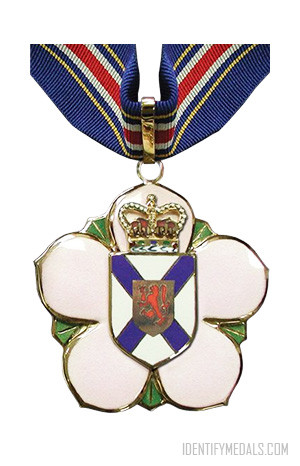
The Order of Nova Scotia

The Order of Nova Scotia (Ordre de la Nouvelle-Écosse in French), instituted on 2 August 2001, is a civilian honor for merit in the Canadian province of Nova Scotia. The Order the highest honor amongst all others conferred by the Nova Scotia Crown.

The Order of Nova Scotia is intended to honor any current or former longtime resident of Nova Scotia who has demonstrated a high level of individual excellence and achievement in any field, having “distinguished themselves in many fields of endeavor and having brought honor and prestige to themselves and to Nova Scotia.” Canadian citizenship is a requirement, and those who are elected or appointed members of a governmental body are ineligible as long as they hold office.

The Order of Nova Scotia Design

New Members are presented with an insignia. The badge consists of a gold medallion in the form of a stylized epigaea repens (or mayflower)—the official provincial flower.

The obverse is made in white enamel with gold edging, and bearing at its center the escutcheon of the arms of Nova Scotia, surmounted by a St. Edward’s Crown symbolizing the Canadian monarch’s role as the fount of honor.

The ribbon is patterned with vertical stripes in red, blue, gold, and white; men wear the medallion suspended from this ribbon at the collar, while women carry theirs on a ribbon bow at the left chest.