The Pilot’s Badge (Prussia)

The Pilot’s Badge is a badge from the Kingdom of Prussia instituted in 1913 by the King of Prussia and Emperor Wilhelm II.

The Pilot’s Badge (or Flugzeugführerabzeichen in German) is a badge from the Kingdom of Prussia instituted on 27 January 1913 by the King of Prussia and the Emperor of the German Empire Wilhelm II in conjunction with his birthday.

At some point during the war, and because stamped metal badges become scarce, it’s believed only certificates were issued and aircrew were required to purchase their own badges. While issued badges are thinly stamped and silvered (or silver-washed, an economical alternative) metal, privately purchased examples can be found in hollow two-piece construction or single massive silver stampings.

The Pilot's Badge Award Criteria

The badge was awarded to officers, NCOs and enlisted men upon successful graduation from the flying schools and passing two practical flight examinations. 

One of the examinations consisted of unassisted takeoff and landing. The other was a long-distance or a cross-country flight. The badges were presented by local air station commanders.

What Was Training Like for a Prussian Pilot?

Training to become a Prussian pilot during World War I was both rigorous and dangerous, reflecting the early, experimental days of military aviation. The training process involved multiple stages, beginning with ground school where recruits learned the basics of flight, navigation, and military conduct. This was followed by preliminary flight school, which included about 40-50 flight hours. Cadets had to perform a variety of maneuvers such as sideslips, loops, and simulated uncontrolled falls before graduating​ (Hartzell Propeller)​​ (MyLearning)​.

Some popular aircraft used during the time included:

  1. Fokker Eindecker (E-Series): The Fokker E.I, E.II, E.III, and E.IV were some of the first aircraft used for aerial combat. These were monoplane designs equipped with synchronized machine guns that could fire through the propeller arc, giving the Germans an initial air superiority.

  2. Albatros B Series: An early reconnaissance biplane, the Albatros B.I was unarmed and used primarily for observation and artillery spotting.

  3. Albatros D-Series (D.I to D.Va): The Albatros D.I and its subsequent models (D.II, D.III, D.V, D.Va) became the backbone of the German fighter force. Known for their speed and firepower, these aircraft were used extensively from 1916 onward.

  4. Halberstadt D.II: Another early fighter aircraft, the Halberstadt D.II was used to complement the Fokker Eindecker until more advanced aircraft became available.

  5. Fokker Dr.I: The Fokker Dr.I triplane, made famous by Manfred von Richthofen (the Red Baron), was renowned for its maneuverability. However, it was also prone to structural failures.

  6. Fokker D.VII: Considered one of the best fighter aircraft of the war, the Fokker D.VII was introduced in early 1918. It had excellent handling, firepower, and structural integrity, making it highly effective in combat.

  7. Pfalz D.III: The Pfalz D.III and its improved version, the D.IIIa, were used by many Jastas (fighter squadrons). They were known for their durability and decent performance but were generally considered inferior to the Albatros and Fokker designs.

  8. Aviatik C.I: A versatile two-seater used for reconnaissance and light bombing missions, the Aviatik C.I was one of the many C-type aircraft that served various roles.
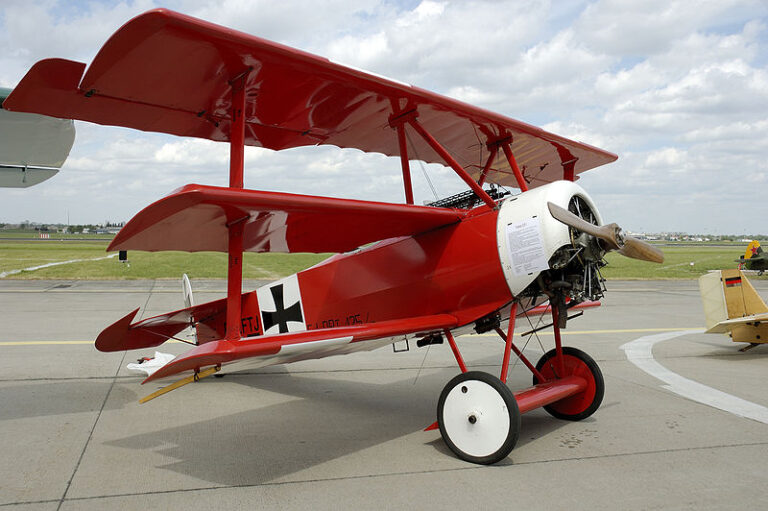
The Red Baron, or Manfred von Richthofen, was a legendary German fighter pilot and fighter ace during World War I.
Replica of Richthofen's Fokker Dr.I triplane, at the Berlin Air Show in 2006". Aircraft & Warplanes

The Pilot's Badge Design

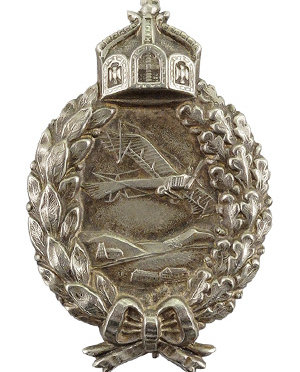
The badge measures 46.00 mm (width) by 70.60 mm (height), weighs 13.5 grams and is struck in silvered brass. In all of the Imperial German Army flight qualification badges, the outside perimeter is surrounded by a wreath. The left side has laurel leaves symbolizing victory, while the right side has oak leaves signifying strength and hardiness. The bow joining them together at the bottom signifies the joining of these two qualities.

The top of the badge mounts either a Preußen (Prussian) crown or a Bayern (Bavaria) crown. These badges were manufactured by C.E. Juncker (Berlin), Meybauer or Pollath and worn on or below the left breast pocket lower than the Prussian Iron Cross 1st Class.

The obverse bears a standard pilot’s badge motive within a wreath, with laurel leaves towards the left side of the wreath, and oak leaves towards the right side of the wreath, separated by a bow on the bottom of the wreath, ordained by the Prussian crown at the top.

The reverse is hallowed and has a vertical needle pinback with a barrel hinge and a round wire catch.
The Civilian Disobedience Medal

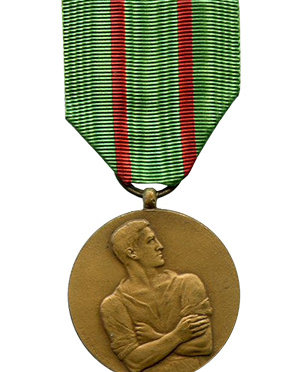
The Civilian Disobedience Medal (Médaille du Réfractaire / Werkweigeraarsmedaille) is a war service medal of the Kingdom of Belgium established on 12 February 1951 by royal decree and awarded to Belgian citizens refusing to support the German war effort during the Second World War.

The Civilian Disobedience Medal Design

The medal measures 37mm in diameter, and is circular and struck in bronze.

The obverse bears the relief torso of a civilian male with his arms crossed and his face turned away to the right in defiance. The reverse bears the relief inscription on two lines in Latin “FORSAN VICTI NUNQUAM SERVI” roughly translating into “MAYBE DEFEATED BUT NEVER SLAVES“. The years “1940-1945” are inscribed along the reverse’s upper circumference.

The ribbon measures 38mm wide and is silk moiré green, with two 3mm wide longitudinal stripes located 1cm from the edges, the stripes came in three different colors depending on the reason for bestowal:

  • yellow stripes indicated a refusal to serve in the German armed forces;
  • white stripes indicated a refusal to work for the Germans;
  • red stripes indicated a refusal to return to Germany by a forced laborer following leave at home in Belgium.

The medal is suspended by a ring through a suspension loop.

The Civilian Resistance Medal

The Civilian Resistance Medal was established in 1951 and awarded to all members of the Belgian civilian resistance during World War II.

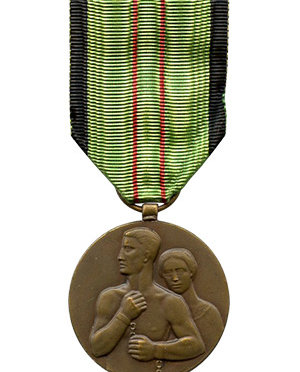
The Civilian Resistance Medal (Médaille du résistant civil / Burgerlijke Weerstandsmedaille) is a war service medal of the Kingdom of Belgium established on 21 March 1951 by royal decree and awarded to all members of the Belgian civilian resistance during the Second World War who were recognized as such by the law of 24 September 1946.

The Civilian Resistance Medal Design

The medal measures 39mm in diameter and is circular and struck in bronze. The obverse bears the relief image of the torso of a man breaking free of chains around his wrists, a woman stands behind him and slightly to his left. The reverse bears the relief inscription in Latin “RESTITERUNT” meaning “THEY RESISTED” with the years “1940” above and “1945” below. The reverse has a slightly raised border.

The ribbon masures 37 mm wide and is light green silk moiré, with two central 1 mm wide red stripes 5 mm apart and 4 mm black edge stripes. The colors of the ribbon are symbolic, the black denoting the dark days of the German occupation and/or the clandestine nature of the resistance, the green stands for the hope of liberation and the red for the spilled blood of the resistance members. The medal is suspended by a ring through a suspension loop.

The Medal of the Armed Resistance 1940-1945

The Resistance Medal 1940–1945 (Médaille de la Résistance 1940–1945 / Medaille van de Weerstand 1940–1945) is a Belgian war medal established on 16 February 1946 by royal decree of the Regent and awarded to all members of the Belgian armed resistance during the Second World War.

The medal was also awarded to members of the intelligence service who operated in occupied territories and participated in combat actions aimed at the liberation of Belgium.

The Medal of the Armed Resistance 1940-1945 Design

The medal measures 39mm in diameter and is circular and struck in bronze.

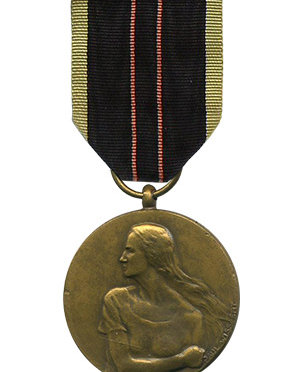
The obverse bears the upper body of a young woman facing left in defiance with her right fist clenched. The reverse bears the relief inscription in Latin on three lines “1940 RESISTERE 1945” superimposed over a laurel wreath.

The ribbon measures 37 mm wide and is black silk moiré, with two central 1 mm wide red stripes 5 mm apart and 4 mm light green edge stripes. The colors of the ribbon are symbolic, the black denoting the dark days of the German occupation and/or the clandestine nature of the resistance, the green stood the hope of liberation and the red for the spilled blood of the resistance members. The medal is suspended by a ring through a suspension loop.

The Commemorative Medal of the Ethiopian Campaign

The Commemorative Medal of the Ethiopian Campaign (Médaille Commémorative de la Campagne d’Ethiopie / Herinneringsmedaille van de Ethiopische Veldtocht) was established by royal decree in January 1947 and awarded for participation in the campaign in Abyssinia for at least one year between 6 March and 3 July 1941.

On 11 March 1941, Belgian forces, together with elements of the British King’s African Rifles attacked Asosa, defeating the occupying Italians before moving on to Gambela and Saio. The Belgian forces besides defending the Belgian Colonies of Congo or Ruanda/Urundi served also in Madagascar, Ethiopia, Nigeria, Libya, Egypt, Sudan and Palestine.

This medal is very rare, as the Belgian forces that participated in the campaign were less than 3000 men. There were possibly fewer than 500 medals actually awarded.

The Commemorative Medal of the Ethiopian Campaign Design

The medal was designed by the sculptor Arthur Dupagne. Struck patinated bronze, of trapezoidal form, it measures 45mm high by 31mm wide and has two curved sides.

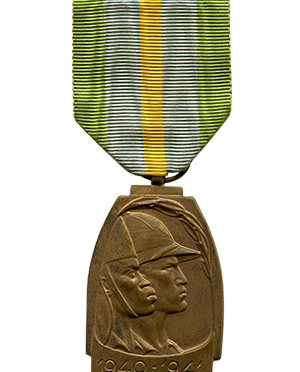
The obverse depicts the overlapping right-facing profiles of the head of a European and an African soldier with the date “1940-1941” at the base. The reverse bears the names of the three major actions of the campaign: SAIO, GAMBELA, and ASOSA, with a star above and below.

The ribbon is light blue with green edges and a yellow central stripe.

The claspNigeria” was awarded to the expeditionary force of 13.000 men of the Force Public (Gendarmery and Military force of Belgian Congo consisted of native Congolese troops under the command of Belgian officers and NCOs) who served under British command from 1942 to 1943 in Nigeria – 9.000 of these troops served in Egypt and Palestine and received also the “Middle East” clasp.

The 1940-1945 Colonial War Effort Medal

The 1940–1945 Colonial War Effort Medal (Médaille de l’Effort de Guerre Colonial 1940-1945 / Medaille voor de Koloniale Oorlogsinspanning 1940-1945) is a Belgian war service medal established on 30 January 1947 by royal decree of the Regent and awarded to government civil servants, magistrates, volunteer members of the female auxiliary service, missionaries, civilian agents of the different departments and civilians who served honorably for at least one year in the Belgian Congo or Ruanda-Urundi colonies of the Kingdom of Belgium in Africa between 10 May 1940 and 7 May 1945.

Those eligible for the award of both the 1940–1945 Colonial War Effort Medal and the 1940–1945 African War Medal could only receive one of the two, usually the one earned for the longest service.

The 1940-1945 Colonial War Effort Medal Design

The medal measures 31mm wide by 52mm high, and is struck bronze. It’s rectangular with sloping upper corners.

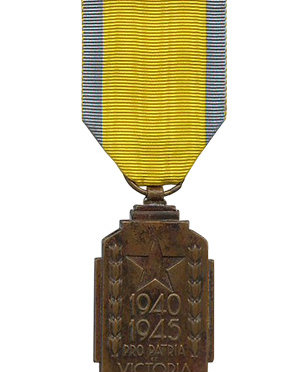
The obverse bears, at its upper center, an embossed five-pointed star above the relief inscription on five rows “1940” “1945” “PRO PATRIA” “ET” “VICTORIA” between vertical laurel leaves. The reverse is plain.

The ribbon is 37mm wide yellow silk moiré with 5mm wide light blue edge stripes. The medal is suspended by a ring through a lateral suspension hole.

The 1940-1945 African War Medal

The 1940–1945 African War Medal (Médaille de la Guerre Africaine 1940-1945 / Afrikaanse Oorlogsmedaille 1940-1945) is a Belgian war service medal established on 30 January 1947 by royal decree of the Regent and awarded to officers and soldiers for at least one year’s service in the Force Publique between 10 May 1940 and 7 May 1945.

Those eligible for the award of both the 1940–1945 Colonial War Effort Medal and the 1940–1945 African War Medal could only receive one of the two, usually the one earned for the longest service.

The service was not limited to the Belgian colonies of the Congo and Ruanda-Urundi. The following four clasps were issued for wear on the ribbon inscribed in French:

  • NIGERIE (for six months service in Nigeria)
  • MOYEN-ORIENT (for six months service in the Middle East)
  • MADAGASCAR (for six months service in Madagascar)
  • BIRMANIE (for six months service in Burma)

The 1940-1945 African War Medal Design

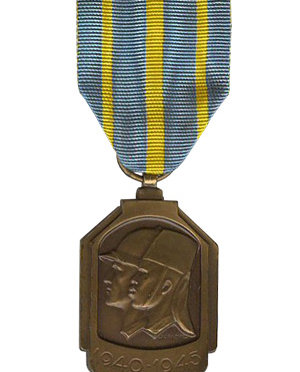
The medal measures 52mm high (including the suspension) by 33mm wide and is rectangular and struck from bronze. It has sloped upper shoulders and rounded lower corners.

The obverse bears the relief images of the left profiles of a native African soldier wearing a fez and of a pith-helmeted Belgian soldier, both within a recessed central area. Under the recess, the embossed years “1940 – 1945”. The reverse is plain.

The Volunteer’s Medal 1940-1945

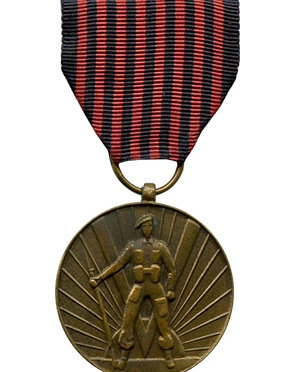
The Volunteer’s Medal 1940–1945 (Médaille du Volontaire 1940–1945 / Medaille van de Oorlogsvrijwilliger 1940–1945) is a Belgian war medal established on 16 February 1945 by royal decree of the Regent and awarded to Belgian and foreign civilians who voluntarily enlisted in the Belgian Armed Forces during the Second World War.

The medal could also be awarded to volunteers serving in the Belgian units of the Royal Air Force, Royal Navy or British merchant navy.

The Volunteer’s Medal 1940-1945 Design

The medal measures 38 mm in diameter and is circular and struck in bronze.

The obverse bears the relief image of a soldier standing at ease holding a rifle with a bayonet, with the soldier is superimposed over a large capital letter V in front of a rising sun. The reverse bears the relief image of the Flemish lion rampant below the inscription in Latin “VOLONTARIIS“, and the inscription of the dates “1940” and “1945“.

The medal was suspended by a ring through the suspension loop from a 38 mm wide silk moiré ribbon composed of fifteen 2 mm wide alternating red and blue stripes and two 4 mm wide blue edge stripes.

The 1940-1945 Military Combatant’s Medal

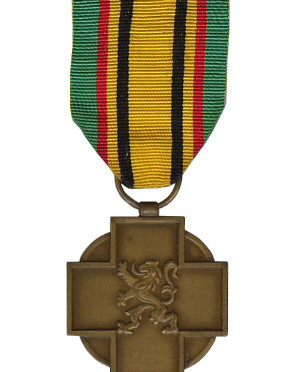
The 1940–1945 Military Combatant’s Medal (Médaille du Combattant Militaire de la Guerre 1940–1945 / Medaille van de Militaire Strijder 1940–1945) is a Belgian war medal established on 19 December 1967 by royal decree and awarded to all members of the Belgian Armed Forces who fought from England during the Second World War.

The 1940-1945 Military Combatant’s Medal Design

The medal measures 38mm wide is Greek cross struck in bronze, with semi-circular protrusions filling the gaps between the arms up to 3mm from the cross arms’ ends.

The obverse bears the relief image of a lion rampant at the center of the cross. The reverse bears a vertical broadsword bisecting the years “1940” and “1945” inscribed in relief.

The ribbon is 36mm wide silk moiré with the colors divided as follows from the left to the right edge: 6mm green, 2mm red, 3mm yellow, 2mm black, 1 cm yellow, 2mm black, 3mm yellow, 2mm red, 6mm green. The medal is suspended by a ring through a suspension loop.

The Maritime Medal 1940-1945

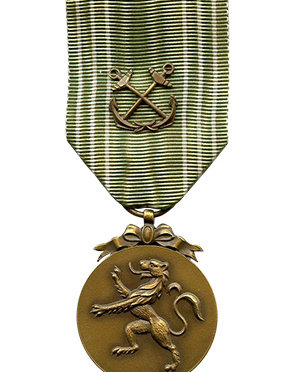
The Maritime Medal 1940–1945 (Médaille Maritime 1940–1945 / Maritieme Medaille 1940–1945) is a Belgian bravery award of World War II, established on 17 July 1941 by Royal Decree and awarded to members of the Belgian Navy, merchant navy or fishing fleet (later also all naval personnel for service of two years onboard an allied warship and those shipwrecked twice due to combat action) for acts of heroism in the saving of ships or lives during action against the enemy.

The Maritime Medal 1940-1945 Design

The medal measures 38mm in diameter and is circular and struck in bronze. Its obverse bears the relief image of a lion rampant. The reverse bears the royal cipher of King Leopold III

The ribbon is 38mm wide ocean green silk moiré. There are six 1mm wide white stripes, three at left and three at right separated by 3mm each starting 3mm from the ribbon’s edges. The medal is suspended by a ring through the suspension loop. Miniature crossed bronze sea anchors are affixed to the ribbon, sizes vary greatly depending on the maker.