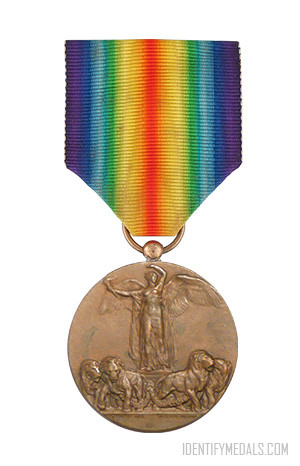
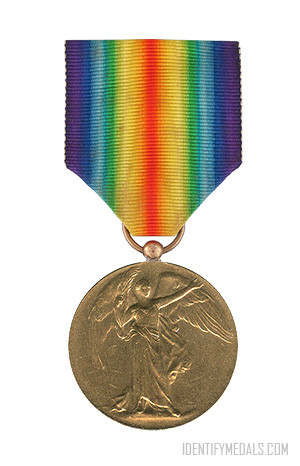

The Inter Allied Victory Medal (United States)

The American Victory Medal was designed by James Earle Fraser and awarded to military personnel for service between 1917 and 1918.

The Allied Victory Medal was recommended by an inter-allied committee in March 1919. Fourteen victorius countries finally awarded the medal after World War I, and each allied nation would design a ‘Victory Medal’ for award to their own nationals. Certain features were to be shared: a winged figure of Victory on the obverse and the same ribbon.

The American Victory Medal was awarded to military personnel for service between April 6, 1917, and November 11, 1918 with the American Expeditionary Forces in European Russia (November 12, 1918 to August 5, 1919) or the American Expeditionary Forces Siberia (November 23, 1918 to April 1, 1920).

Although originally intended to be established by an act of Congress, the bill authorizing the medal never passed and it had to be established by the military departments through general orders. The War Department published orders in April 1919, and the Navy on June 1919.

The Victory Medal was authorized with a large variety of devices to denote specific accomplishments, such as the Citation Star, Navy Commendation Star and several Battle Clasps.

The U.S. Inter-Allied Victory Medal Design

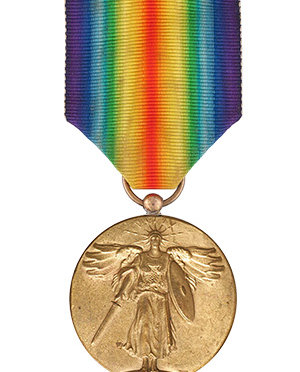
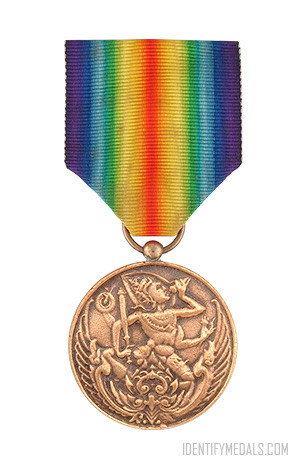
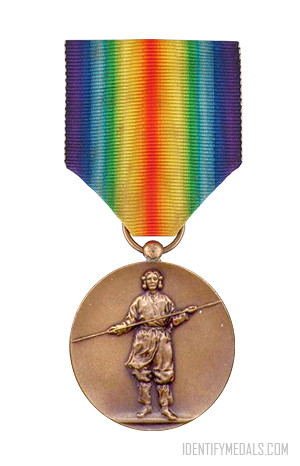
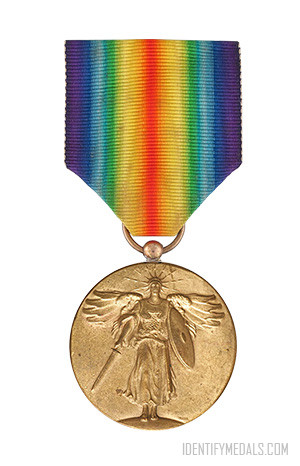
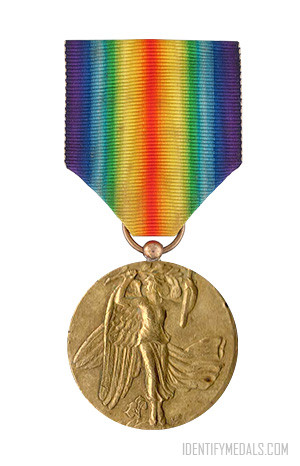
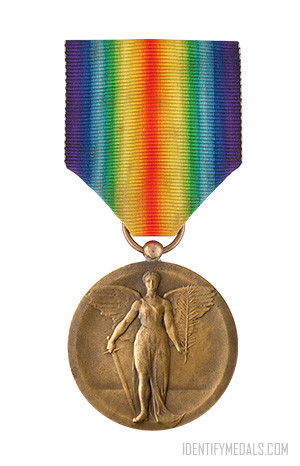
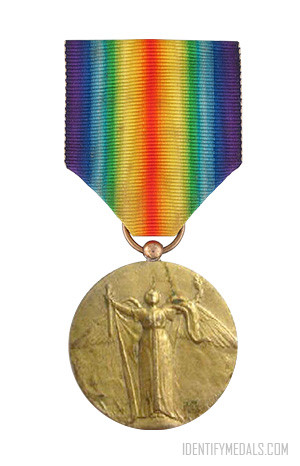
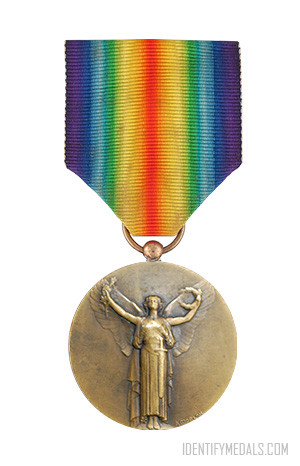
The Victory Medal measures 36 millimetres (1.4 in) in diameter and was designed by William McMillan. The design and ribbon was also adopted by Belgium, Brazil, Cuba, Czechoslovakia, France, Greece, Italy, Japan, Portugal, Romania, Siam, Union of South Africa and the USA. Each allied nation would design a ‘Victory Medal’ for award to their own nationals, all issues having certain common features, including a winged figure of victory on the obverse and the same ribbon.

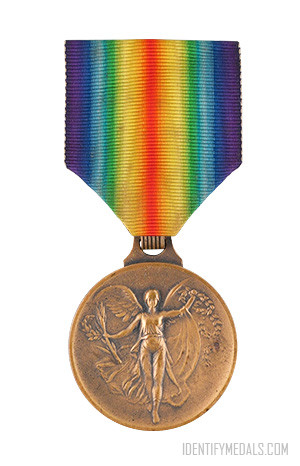
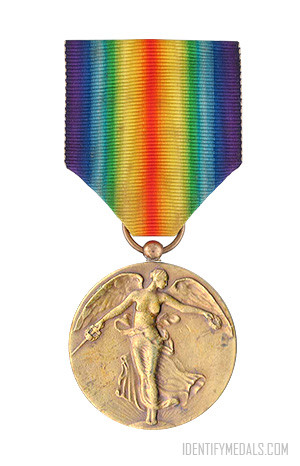
The obverse of the medal features a winged Victory holding a shield and sword on the front. The reverse bears “The Great War For Civilization” in capital letters curved along the top of the medal. Along the bottom of the back are six stars, three on either side of the center column of seven staffs wrapped in a cord. On left side of the staff it lists one World War I Allied country per line: France, Italy, Serbia, Japan, Montenegro, Russia, and Greece. On the right side of the staff the Allied country names read Great Britain, Belgium, Brazil, Portugal, Rumania(spelled with a U), andChina.

The 39 millimeters (1.5 in) wide watered ribbon has an iridescent color scheme, with the violet moving through to a central red stripe where both schemes meet. It attaches to the medal through a ring suspender. The recipient’s name, rank, service number and unit were impressed on the edge of the medal. The name of the regiment or corps was omitted on medals awarded to Army officers.

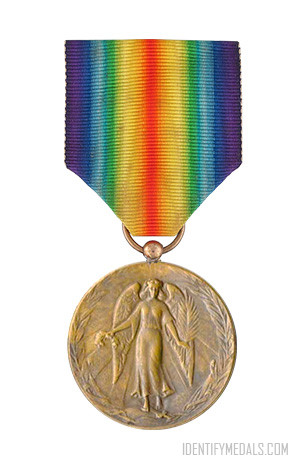
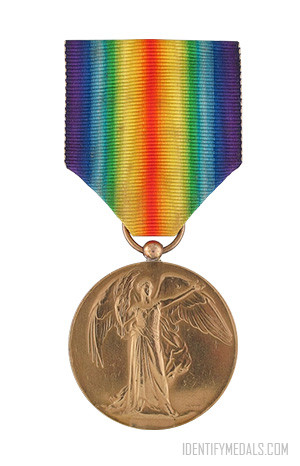
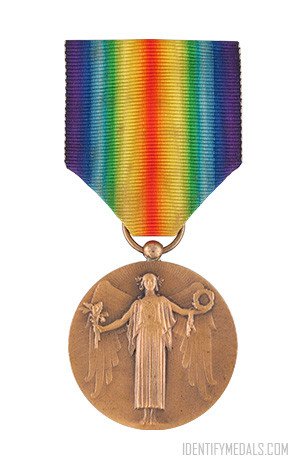
All the Inter-Allied Victory Medal Variations

Although each country designed its own version of the Inter-Allied Victory Medal, all of them shared some common elements, such as a winged victory figure on the obverse and a similar ribbon with rainbow colors symbolizing unity among the Allies. Here are the versions for all countries:

Find an Inter-Allied Victory Medal Online

Right Now on eBay 
Clicking a link to eBay may result in a referral commission being paid if a purchase is made.
Loading...

The Battle of Verdun Medal

The Medal of Verdun was issued for those serving on the Argonne and St Mihiel sectors between 1914 and 1918 during the Battle of Verdun.

Created in late 1916 and even before the end of the battle, the Medal of Verdun was made for soldiers who, for several months under intense pressure from infantry attacks and heavy artillery pounding, held their ground during the WW1 Battle of Verdun.

Around 70% of all the French soldiers that were engaged in World War I participated to the battle of Verdun. Six or seven different designs were put forward for the medal but none were approved by the French Government and all remained unofficial awards that could not be worn on military uniform.

Originally intended to be “awarded to those who served on the Verdun front between 21 February 1916 and 2 November 1916″, the medal was, in fact, awarded to those who served anywhere on the Argonne and St Mihiel sectors between 31 July 1914 and 11 November 1918.

The Battle of Verdun Medal Design

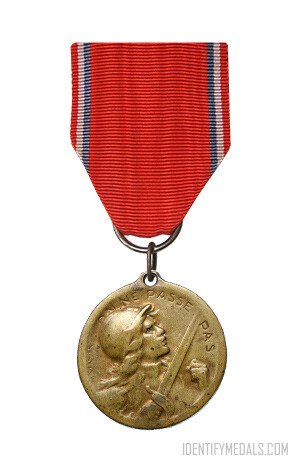
The obverse shows the head of the Republic (a symbol of the Third French Republic) and the famous sentence pronounced by Robert Nivelle: “Ils ne passeront pas”, translated as: “They will not break through”. The reverse bears a French soldier and the inscription “EN AVANT S. QU AU BOUT” (“Forward, always forward” or “Forward until the end.”) The “S” stands for “sans,” which means “without,” so it could be interpreted as “Forward, without stopping, until the end.” Another reverse shows a twin castle gate with the inscriptions “VERDUN” and “21 FEVRIER 1916”.

The medal is fitted with a loose ring suspender and a piece of 37 mm red ribbon that has blue-white-red edges.

The original, and most commonly found, version was by Vernier but since supplies of this medal were inadequate, others created Verdun medals and at least seven versions of varying rarity are known. It is relatively common medal to find but it was an immense measure of respect in the civil life. It was carried with pride to show that these soldiers participated in the biggest attack France had to suffer in its history.

The 9/11 Heroes Medal of Valor

The 9/11 Heroes Medal of Valor is a decoration presented by Pres. George W. Bush that honors public safety officers killed in 9/11.

The 9/11 Heroes Medal of Valor is a decoration in the United States presented by President George W. Bush and created specifically to honor the 442 public safety officers who were killed in the line of duty during the September 11, 2001 terrorist attacks at the World Trade Center and the empty wing of The Pentagon.

The Medals were presented by the President to the families of the fallen officers at The White House on September 9, 2005. During the ceremony nearly 4 years after the devastating terrorist attacks, President Bush would honor the lives of the public safety officers who died in the line of duty as well as comfort the families who were left behind and accepted the medals in remembrance of their deceased relatives. Around 1,200 family members and friends showed up at the ceremony to honor their friends and relatives who died on September 11.

Although not every name could be listed in President Bush’s brief speech, Attorney General Alberto Gonzales read all 442 names out loud so that all who gathered could honor every individual who gave his or her life on one of the most tragic days in American history.

The 442 public service officers included 343 New York City Fire Department members, 50 Port Authority police officers and assistants, 23 NYPD officers, 3 state court officers, and members of the Secret Service, FBI, and private ambulance workers.

The 9/11 Heroes Medal of Valor Design

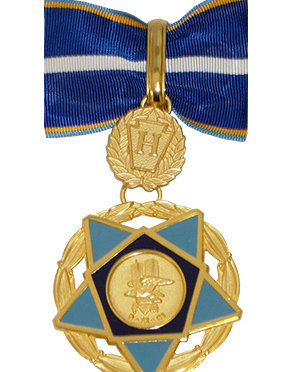
The medal intentionally resembles the Public Safety Officer Medal of Valor and the military’s Medal of Honor. It’s a gilt, light blue-enameled, five-pointed, upside-down star surrounded by a wreath of laurel.

In the obverse, the center has a dark blue-enameled pentagon representing The Pentagon, with a gilt disc bearing the twin towers of the World Trade Center, the American eagle holding the shield of the United States and laurel, and the date “9. 11. 01”.

The Medal is suspended on a gilt disc bearing a letter “H” (for Heroism) inside a keystone, (representing the Keystone State of Pennsylvania) surrounded by a wreath of laurels, which is in turn suspended on a neck ribbon, blue with gold and light blue edge stripes and a white center stripe.

The Public Safety Officer Medal of Valor

The Public Safety Officer Medal of Valor was established in 2000 and is the highest decoration for bravery by public safety officers.

The Public Safety Officer Medal of Valor was established on June 29, 2000 by President Bill Clinton and is the highest decoration for bravery exhibited by public safety officers in the United States, comparable to the military’s Medal of Honor. The medal was originally called the Presidential Medal of Valor for Public Safety Officers.

Before the establishment of the medal, there were no Federal awards to specifically acknowledge the bravery performed by public safety officers throughout the United States (except for medals at state or government level).

Although the award is still presented by the President of the United States, it is now done in the name of the United States Congress. The Attorney General no longer makes recommendations directly to the President but can provide input into the process via the Department of Justice’s National Medal of Valor Office’s support of the Review Board.

The medal can be awarded posthumously.

The Public Safety Officer Medal of Valor Design

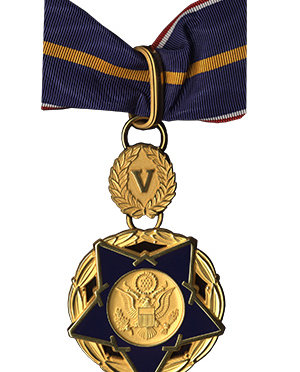
The medal intentionally resembles the military’s Medal of Honor and is a gilt, blue-enameled, five-pointed, upside-down star, with each arm formed by a letter “V” (for Valor), surrounded by a wreath of laurel.

In the obverse, the central disc bears the Great Seal of the United States. The reverse, the legend “FOR EXTRAORDINARY VALOR ABOVE AND BEYOND THE CALL OF DUTY” and the name of the recipient engraved at the center.

The medal is suspended on a gilt disc bearing a letter “V” surrounded by a wreath of laurels, which is in turn suspended on a neck ribbon, blue with white and red edge stripes (the national colors of the USA) and a gold center stripe (symbolizing honor). When the ribbon alone is worn, it carries a miniature gold gilt disc bearing a letter “V” surrounded by a wreath of laurels. There is also a lapel pin, which is the miniature of the medal without suspension.

Find This Medal Online

Right Now on eBay 
Clicking a link to eBay may result in a referral commission being paid if a purchase is made.
Loading...

The Order of the Liberator General San Martin

The Order of the Liberator General San Martin (or Orden del Libertador General San Martín in Spanish) is the highest decoration awarded by the Governement of Argentina. It is given to foreign politicians or military, deemed as worthy of the highest recognition by the country and it’s granted by the sitting President of Argentina.

The order receives its name from José de San Martín, Father of the Land and Liberator. The award was established in 1943 (Decree 5000 from August 17th, 1943) and modified on May 21st 1948 (Decree 16628 from 1957, which creates the Order). The rules used today date from December 18th, 1967.

The Grand Master of the Order presides over a national council and is the President of the Nation, same who confers the award. The Order headquarters is the Ministry of Foreign Relations, International Commerce and Cult.

The grades of the Order are:

  • Collar (Collar)
  • Grand Cross (Gran CruzARG Order of the Liberator San Martin - Grand Cross BAR.png
  • Grand Officer (Gran OficialARG Order of the Liberator San Martin - Grand Officer BAR.png
  • Commander (ComendadorARG Order of the Liberator San Martin - Commander BAR.png
  • Officer (OficialARG Order of the Liberator San Martin - Officer BAR.png
  • Member (CaballeroARG Order of the Liberator San Martin - Knight BAR.png

The Order of the Liberator General San Martin Medal Design

The medal was designed by Ángel Eusebio Ibarra García. It’s struck in gold and shows a condor, the sable and General San Martin’s portrait in a frame made of sun rays.

Only one Order with the Extraordinary grade was awarded: to Eva Perón in 1952. It was made of 3821 pieces of gold and platinum, and 753 precious stones. It was made by the jewelers joyería Ghiso S.A. and designed by Aída Louzao. After the Military Dictatorship of 1955, the collar was disassembled and the pieces went to auction.

The reverse of the Argentinian $5 bill shows the collar of the Order.

The Medal to the Fighters (Argentina)

The Medal to the Fighters is a decoration given by the Argentinian Republic to everyone who fought in the territorial claim of the Falklands, South Georgia and South Sandwich Islands between April 2nd and June 14th 1982.

The medal was established September 30th, 1984, during the government of Raúl Alfonsín and through Decree 3522. It was published in the official bulletin on November 9th, 1984.

A medal and certificate were awarded to everyone who fought in the war. The medal only has one class and can be awarded to civilians and military personnel. It can be awarded posthumously. A golden version of the medal is to be created for the 30th anniversary of the war.

The Medal to the Fighters Design

The medal is made of white metal. The obverse shows the Argentinian flag colors, a relief of the Falklands Islands and the last name of the fighter. The reverse bears the inscription “The Honorable Congress of the Nation to the Fighters”. This same text is repeated in the accompanying certificate.

The Defense Superior Service Medal

The Defense Superior Service Medal is a military decoration of the Department of Defense established by President Gerald R. Ford in 1976.

The Defense Superior Service Medal (or DSSM) is a senior American military decoration of the Department of Defense established by President Gerald R. Ford on February 6, 1976 and awarded to members of the United States Armed Forces who perform “superior meritorious service in a position of significant responsibility“.

The decoration is most often presented to senior officers in the flag and general officer grades. It is analogous to the Legion of Merit, but awarded for service in a “joint” duty capacity for a period of time exceeding 12 months. Service members assigned to or attached to a Joint Task Force as individuals, not members of a specific military service’s unit, can be eligible for the DSSM.

Joint or Department of Defense awards, including the Defense Superior Service Medal, may be awarded posthumously.

The Defense Superior Service Medal Design

When the Defense Superior Service Medal was created, it was decided that it should be done at the lowest possible cost and with as little involvement as possible. It’s because of this that it ranks just below the Defense Distinguished Service Medal for similar service, it was decided to use the same design as the Defense Distinguished Service Medal but finished in silver rather than gold and with a difference inscription on the back.

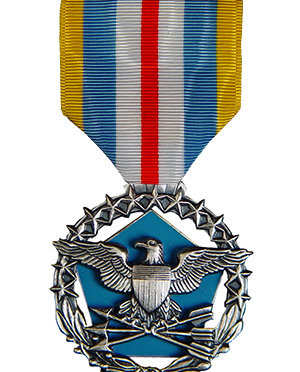
The medal has blue enamel and measures 1 7/8 inches (4.76 cm) in height overall. The obverse depicts a silver American eagle with outstretched wings superimposed over a medium blue pentagon. On its breast is the shield of the United States and in its talons are three crossed arrows in silver. The tips of the wings cover a surrounding arc of silver five-pointed stars encircling the top and sides of the pentagon, while the bottom is surrounded by a silver wreath encircling the base composed of a laurel branch on the left and an olive branch on the right.

The reverse is plain except for the inscription at the top, For Superior Service. Below in the pentagon is the inscription From The Secretary of Defense To.

The medal is suspended from a ribbon 1 3/8 inch (3.49 cm) in width composed of the following vertical stripes: Golden Yellow, Bluebird, White, Scarlet, White, Bluebird and Golden Yellow. 

Find This Medal Online

Right Now on eBay 
Clicking a link to eBay may result in a referral commission being paid if a purchase is made.
Loading...

The Hero of the Russian Federation Medal

The Hero of the Russian Federation Medal was established in 1992 and is the highest honorary title of the Russian Federation.

The Hero of the Russian Federation Medal (or Герой Российской Федерации in Russian) was established in 1992 and is the highest honorary title of the Russian Federation. It’s awarded to persons for “service to the Russian state and nation, usually connected with a heroic feat of valor”. Its recipients wear a golden star that identifies them.

The title “Hero of Russia” is a successor to Hero of the Soviet Union, which was established by Resolution of the Central Executive Committee of the Soviet Union of May 5, 1934. Following the dissolution of the Soviet Union, Russian Federation under president Boris Yeltsin retained a modified award.

The Hero of the Russian Federation Medal has been awarded more than 970 times since its establishment (440 times posthumously). 

The Hero of the Russian Federation Criteria

The title is bestowed by decree of the president of the Russian Federation and can be awarded to foreign citizens and both civilian and military personnel. The title can also be awarded posthumously if the heroic act costs the recipient his or her life.

Early recipients of the Hero of the Russian Federation Medal predominantly fell into two groups: participants in the Chechnya conflicts and cosmonauts. Many recipients were posthumously awarded the title, such as Major Denis Vetchinov, who was killed early in the 2008 South Ossetia War. This category also includes government officials who were assassinated, like Akhmad Kadyrov, the former governor of Chechnya. Kadyrov, a pro-Moscow leader, was killed in a bomb attack during the 2004 Victory Day parade in Grozny.

All Russian cosmonauts receive the Hero of the Russian Federation title following their space missions. Some cosmonauts, like Sergei Krikalev, have received both the Soviet and Russian hero titles, along with the Order of Lenin, for their distinguished service and achievements.

The Hero of the Russian Federation Medal Design

The insignia of the title is also called the “Gold Star” medal (медаль Золотая Звезда) and its design is similar to the Soviet Hero of the Soviet Union variant. It was created by the architect Miron Merzhanov.

The medal is a gold five-pointed star with smooth 15mm dihedral rays on the obverse. The otherwise plain reverse bears the prominent relief inscription in 2mm high letters “HERO OF RUSSIA” (Russian: “ГЕРОЙ РОССИИ”) at its center, in the upper portion, the award serial number in 1mm high numbers. 

The insignia is secured to a standard Russian square mount by a ring through the suspension loop. The mount is covered by a silk moiré tricolor ribbon of white, blue, and red.

The insignia is worn on the left side of the chest above all other medals and decorations and always in full size.

The Königgrätz Commemorative Cross

The Königgrätz Commemorative Cross is a Prussian medal instituted in 1866 by Wilhelm I and awarded to officers, NCOs and officials.

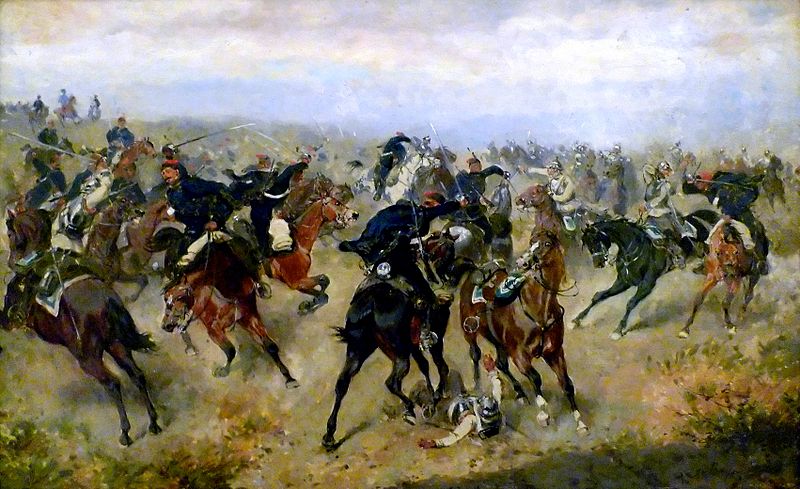
The Königgrätz Commemorative Cross is a Prussian medal instituted on September 20, 1866 by the King of Prussia Wilhelm I. The medal was awarded to Prussian officers, NCOs and other ranks as well as to military officials following the Prussian victory in the Austro-Prussian War (June 17 – July 26, 1866).

This award was named after the Battle of Königgrätz (Schalcht bei Königgrätz, also referred to as the Battle of Sadowa) that took place on July 03, 1866 and  involved the largest number of troops in Europe until that time. The battle ended with one of the highest casualties for a major battle: Austrians and their Saxon allies lost 44,000 men killed in action, wounded and missing in action including 22,000 being held prisoners while Prussians had 360 officers and 8,812 men killed.

A total of 144,000 “combat” crosses and 1,200 non-combatant versions were issued.

The Königgrätz Commemorative Cross Design

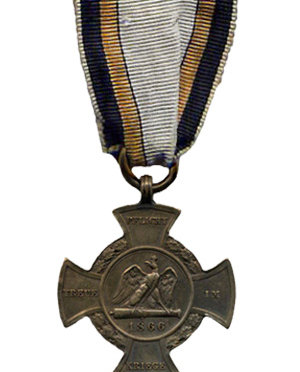
The medal has the shape of a cross pattée with a round medallion superimposed on its center and a round wreath between its arms and is made of bronze from captured Austrian cannons. It was designed by the Prussian court medalist Friedrich Wilhelm Kullrich (1821-1887) and the Prussian royal mint engraver Emil Weigand (1837-1906) and measured 34,5 x 34,5 mm.

A central medallion on its obverse has an image of a crowned Prussian eagle leaning against a captured Austrian cannon (with some variations). There were four different crosses instituted to commemorate “1866 victorious campaign”. All the four crosses share the same reverse design, a crowned cipher of the Prussian king Wilhelm I.

  • Königgrätz Cross: For the military personnel who participated directly in the Battle of Königgrätz. Inscription: “König-Grätz” – “Den 3.” – “Juli” – “1866”.
  • “Main Army” Cross: For the military personnel of a Main army who fought under command of General Eduard Vogel von Falckenstein against troops from Hannover, Hessen, Bavaria, Baden and Wurttemberg. Inscription “Der” – “Main” – “Armee” -“1866”.
  • “Loyal Fighters” Cross: For military personnel who hadn’t participated in the Battle of Königgrätz and were not attached to the Main army. Inscription “Treuen” – “Krie-” – “Gern” – “1866”.
  • “Loyal to its duty in times of war” Cross: For non-combatants. Round wreath is made of oak leaves. Inscription “Pflicht” – “Treue” – “Im” – “Kriege”.

Like other Imperial awards, the Cross was worn either obverse or reverse outwards. The silk ribbon of the first three versions of a Königgrätz Commemorative Cross was black with two yellow-orange and white vertical stripes closer to its edges.

Related Article:

Australian Active Service Medal

The Australian Active Service Medal (AASM) is an Australian military decoration that recognizes prescribed service in warlike operations.

The Australian Active Service Medal (or AASM) is an Australian military decoration created to recognize prescribed service in warlike operations, backdated to February 1975 and authorized on 13 September 1988.

The medal is awarded with a clasp to denote the prescribed operation and subsequent awards of the medal are made in the form of additional clasps. In 2012, it was announced that the medal would no longer be issued for future operations, and was replaced by the Australian Operational Service Medal.

The following clasps were authorised for issue with the AASM: Balkans, Cambodia, East Timor, ICAT, Iraq, Kuwait, Middle East, Namibia, Rwanda, Sierra Leone, Somalia and Vietnam.

Australian Active Service Medal Design

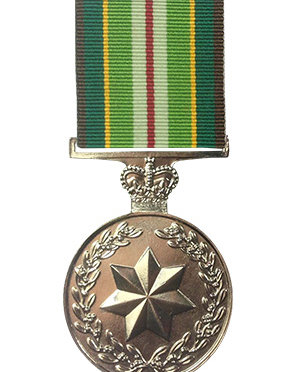
The AASM is a circular nickel-silver medal ensigned with the Crown of St Edward. The obverse has a Federation Star within a wreath of mimosa and bears a laurel wreath surrounding the inscription ‘FOR ACTIVE SERVICE’.

The medal ribbon is 32 millimetres wide and has a central red stripe to symbolize the danger of warlike operations. It is flanked by stripes of silver-green which in turn are flanked by stripes of light green, gold, dark green and brown. The ribbon bar consists of a strip of full-sized ribbon with no emblem.