The Order of Osmanieh

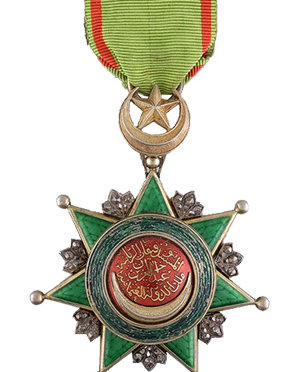
The Order of Osmanieh or Osmaniye is a civil and military decoration of the Ottoman Empire created in January 1862 by Sultan Abdülaziz.

The Order of Osmanieh or Osmaniye (or Osmanlı Devlet Nişanı in Turkish) is a civil and military decoration of the Ottoman Empire created in January 1862 by Sultan Abdülaziz.

It was awarded by the Sultan to Ottoman civil servants and military leaders for outstanding services to the state.

The order was originally established in three classes (expanded to four in 1867):

  • First class (50 members)
  • Second class (200 members)
  • Third class (1000 members)
  • Fourth class (2000 members)

The Order of Osmanieh Design

The badge of the order is a seven-pointed star in dark green enamel, with three short silver rays between each point of the star. In the obverse, the center medallion is in gold, with a red enameled field surrounded by a green enameled band. In the red central portion is a raised gold crescent, and a calligraphic inscription reading “Relying on the Assistance of Almighty God, Abdulaziz Khan, Sovereign of the Ottoman Empire“.

The reverse center medallion is silver, bearing a trophy of arms and the year AH. 699, the year of the creation of the Ottoman Empire.

The badge is suspended by a gold crescent and star, facing upwards.
The Order of the Medjidie

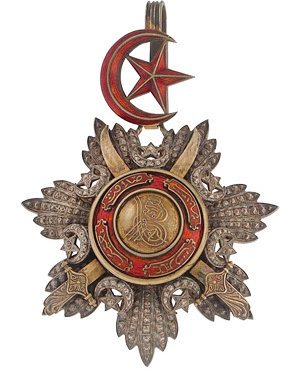
The Order of the Medjidie is a military and knightly order of the Ottoman Empire instituted in 1851 by Sultan Abdülmecid I.

The Order of the Medjidie (or Mecidiye Nişanı in Turkish) is a military and knightly order of the Ottoman Empire instituted in 1851 by Sultan Abdülmecid I. It was given as a reward for distinguished service to members of the British Army and the Royal Navy and the French Army who came to the aid of the Ottoman Empire during the Crimean War against Russia.

The Order was issued in considerable numbers and awarded in five classes, with the First Class being the highest. It was usually conferred on officers although there have been cases of a few enlisted soldiers receiving it as well, and during World War I it was also awarded to a number of German and Austrian officers.

Among notable recipients are Napoleon III Emperor of France and Pedro II of Brazil Emperor of Brazil.

Owners of the order:

  • First Class Order – 50 people (Given by Sultan)
  • Second Class Order – 150 people (Given by Sultan)
  • Third Class Order – 800 people
  • Fourth Class Order – 3,000 people
  • Fifth Class Order – 6,000 people

The Order of the Medjidie Design

On the obverse of the star is Sultan Abdul Mejid’s royal cipher measuring 75.3 mm and surrounded by an inscription on a gold-bordered circle of red enamel. The star has seven triple quills with small crescents and five-pointed stars between them, suspended from a red enameled crescent and star suspender with green enameled edges.

First, second, third and fourth classes are gold. Fifth (lower) class is silver.

The Order of the State of Republic of Turkey

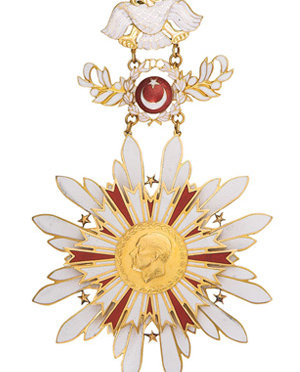
The Order of the State of Republic of Turkey is conferred by the President to foreign nationals, and is the highest state order of its type.

The Order of the State of Republic of Turkey (or Türkiye Cumhuriyeti Devlet Nişanı in Turkish) is the highest state order awarded to foreign nationals. It was first introduced in 14 July 1994. The medal is conferred by the President of the Republic of Turkey to Heads of State and presidents in recognition of their contributions for enhancing the amicable relations between their countries and Turkey.

The medal is:

Given to people for the development of friendly relations with the Republic of Turkey.”

There are two grades:

  • Order of the State, and
  • Order of the Gold Star

The Doggersbank Medal

The Doggersbank Medal was awarded to the officers who took part in the battle of Doggersbank, a naval battle that took place in 1781.

The Doggersbank Medal was awarded to the officers who took part in the battle of Doggersbank, a naval battle that took place on 5 August 1781 during the Fourth Anglo-Dutch War.

Both sides claimed victory although no ships were captured and both convoys escaped. Casualties were high on both sides, considering the number of ships involved. Because the Dutch merchantmen reached the harbor and the British fleet first left the battlefield, it was a victory in the eyes of the Dutch.

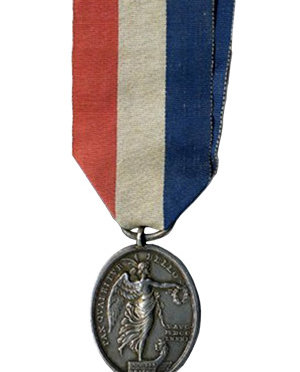
The Netherlands honored the fleet with numerous parades, receptions, poems and plays. As well as receiving a monetary reward, surviving officers, midshipmen and non-commissioned officers weew awarded a commemorative medal, the Doggersbank Medaille. Nineteen gold medals with a red, white and blue ribbon were awarded to Admiral Zoutman, his first officer (Van Kinsbergen) and the 17 captains of the escorting fleet. Willem V personally hung them around the neck of the flag and supreme officers.

The Doggersbank Medal Design

The Doggersbank medal is oval in shape and thirty-six millimeters high.

On the obverse, the winged Goddess Victoria is depicted on the bow of a warship. In her right hand she holds a wreath of leaves and on the hull of the ship is written “DOGGERSBANK“. Beginning at her right foot and ending at the wreath of  foliage, the left side of the medal reads “PAX QVAERITVR BELLO” (Latin for: “Peace is achieved through war“). The date of the battle “V AVG MDCCLXXXI” (August 5, 1781) is indicated on the right side of the medal.

The reverse of the medal features the text “EXI MIÆ VIRTU TIS PRÆM IVM” (“As a reward for outstanding prowess“) in a wreath of orange tree leaves.

The senior officers received silver medals on the same ribbon. The lieutenants received a silver medal on an orange ribbon.

The Inter Allied Victory Medal (Greece)

The Greek Victory Medal was instituted to commemorate the Allied victory in the First World War. It was designed by Henry-Eugène Nocq.

The Allied Victory Medal was recommended by an inter-allied committee in March 1919. Fourteen victorious countries finally awarded the medal after World War I, and each allied nation would design a ‘Victory Medal’ for award to their own nationals. Certain features were to be shared: a winged figure of Victory on the obverse and the same ribbon.

For most of the war, Greece was officially neutral. Finally in 1918 Greece sided with the allies, sending 230,000 troops to fight in Macedonia. The Greek Victory medal followed the proposal made by French Marshal Ferdinand Foch, who was the supreme commander of the Allied Forces during the war. It was instituted on 22nd September 1920 and was awarded to military personnel who had served at least 3 months active service or had been wounded in action, died of wounds or had been killed in action and to sailors with service of at least a year between 14th June 1917 and 25th November 1918. Approximately 200,000 medals were issued.

The Greece Inter Allied Victory Medal Design

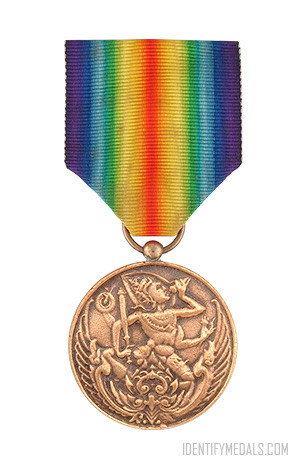
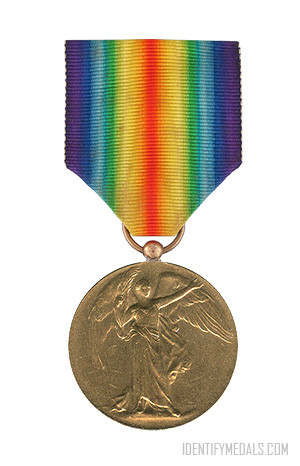
The Victory Medal measures 36 millimetres (1.4 in) in diameter and was designed by William McMillan. The design and ribbon was also adopted by Belgium, Brazil, Cuba, Czechoslovakia, France, Greece, Italy, Japan, Portugal, Romania, Siam, Union of South Africa and the USA. Each allied nation would design a ‘Victory Medal’ for award to their own nationals, all issues having certain common features, including a winged figure of victory on the obverse and the same ribbon.

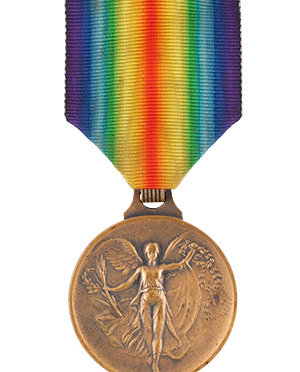
The obverse of the medal bears the winged, full-length figure of Victory designed by Henry-Eugène Nocq (1868–1944), a recognized French sculptor and medalist who lived in Paris, where the medal was also struck. The image of Victory was modeled after the 5th Century BCE statue of Nike by Paionios. The reverse bears “The Great War for Civilization” in Greek, and an infant Hercules wrestling with two snakes. The tablet in the center reads “Allies and Comrades” and lists the allied nations.

The 39 millimeters (1.5 in) wide watered ribbon has an iridescent color scheme, with the violet moving through to a central red stripe where both schemes meet. It attaches to the medal through a ring suspender. The recipient’s name, rank, service number and unit were impressed on the edge of the medal. The name of the regiment or corps was omitted on medals awarded to Army officers.

All the Inter-Allied Victory Medal Variations

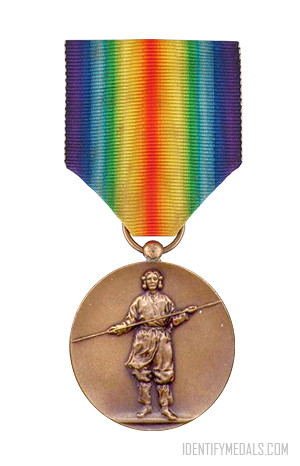
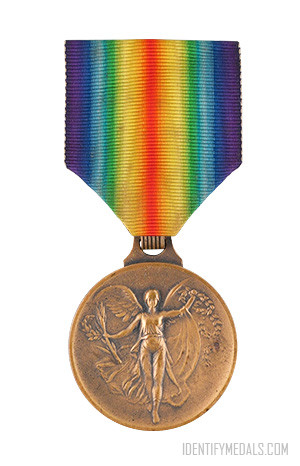
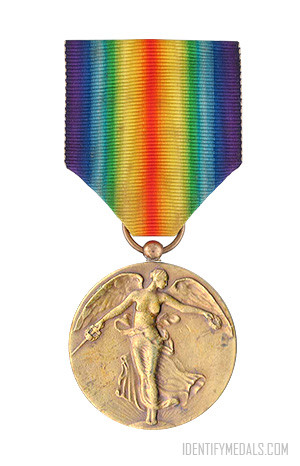
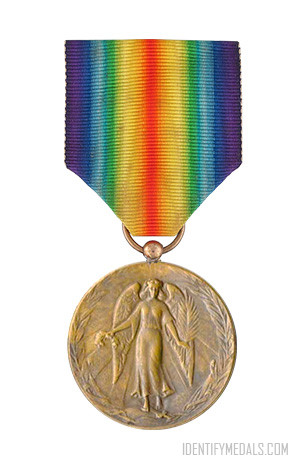
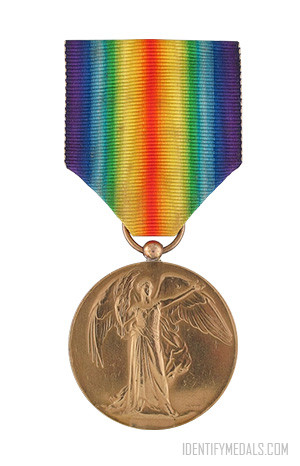
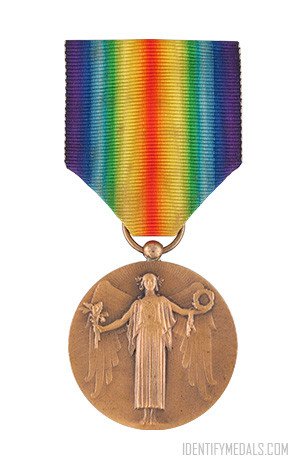
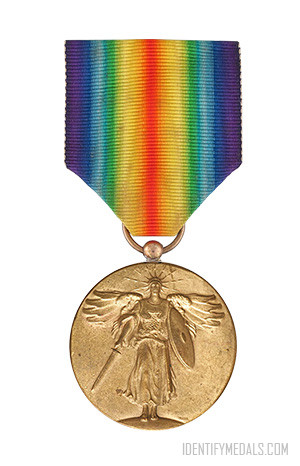
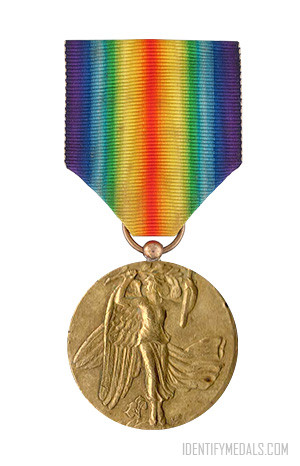
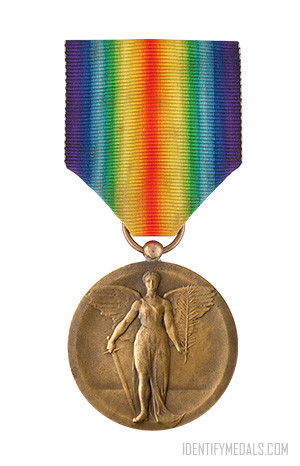
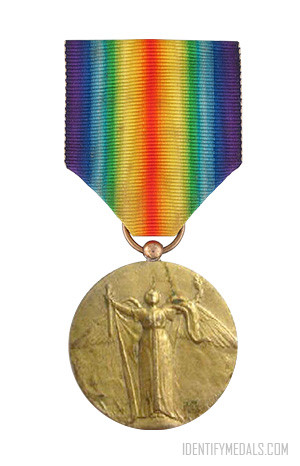
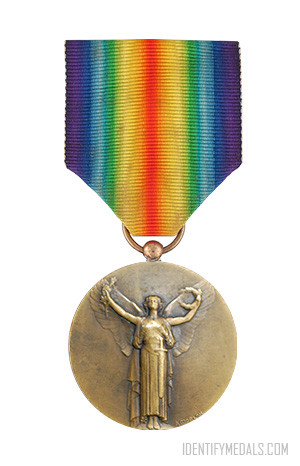
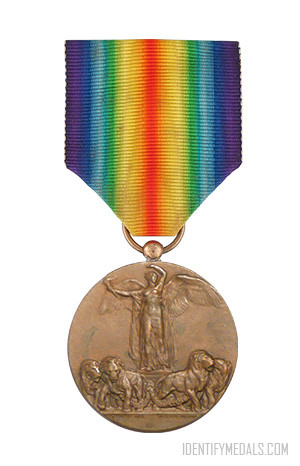
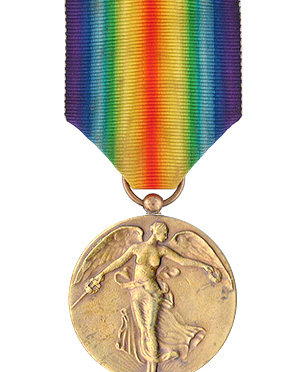
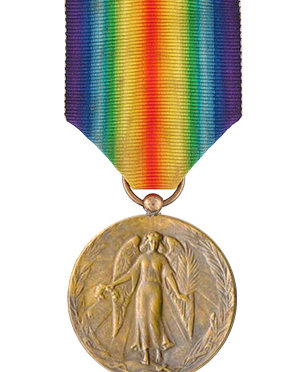
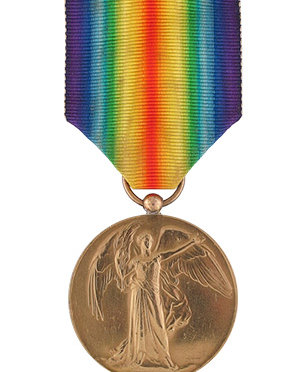
Although each country designed its own version of the Inter-Allied Victory Medal, all of them shared some common elements, such as a winged victory figure on the obverse and a similar ribbon with rainbow colors symbolizing unity among the Allies. Here are the versions for all countries:

Find an Inter-Allied Victory Medal Online

Right Now on eBay 
Clicking a link to eBay may result in a referral commission being paid if a purchase is made.
Loading...

The Inter Allied Victory Medal (Belgium)

The Belgian Victory Medal was established by royal decree on 15 July 1919 and awarded to all members of the Belgian Armed Forces.

The Allied Victory Medal was recommended by an inter-allied committee in March 1919. Fourteen victorious countries finally awarded the medal after World War I, and each allied nation would design a ‘Victory Medal’ for award to their own nationals. Certain features were to be shared: a winged figure of Victory on the obverse and the same ribbon.

The Belgian Victory Medal was established by royal decree on 15 July 1919 and awarded to all members of the Belgian Armed Forces.

The Belgium Inter Allied Victory Medal Design

The Victory Medal measures 36 millimetres (1.4 in) in diameter and was designed by William McMillan. The design and ribbon was also adopted by Belgium, Brazil, Cuba, Czechoslovakia, France, Greece, Italy, Japan, Portugal, Romania, Siam, Union of South Africa and the USA. Each allied nation would design a ‘Victory Medal’ for award to their own nationals, all issues having certain common features, including a winged figure of victory on the obverse and the same ribbon.

The obverse of the medal was designed by Belgian sculptor Paul Du Bois.

The reverse shows the words ‘THE GREAT / WAR FOR / CIVILISATION / 1914-1919’ surrounded by a laurel wreath.

The 39 millimeters (1.5 in) wide watered ribbon has an iridescent color scheme, with the violet moving through to a central red stripe where both schemes meet. It attaches to the medal through a ring suspender. The recipient’s name, rank, service number and unit were impressed on the edge of the medal. The name of the regiment or corps was omitted on medals awarded to Army officers.

All the Inter-Allied Victory Medal Variations

Although each country designed its own version of the Inter-Allied Victory Medal, all of them shared some common elements, such as a winged victory figure on the obverse and a similar ribbon with rainbow colors symbolizing unity among the Allies. Here are the versions for all countries:

Find an Inter-Allied Victory Medal Online

Right Now on eBay 
Clicking a link to eBay may result in a referral commission being paid if a purchase is made.
Loading...

The Inter Allied Victory Medal (Brazil)

The Brazilian Victory Medal was established in January 24, 1919 and awarded to all military personnel or civilians employed in war service.

The Allied Victory Medal was recommended by an inter-allied committee in March 1919. Fourteen victorious countries finally awarded the medal after World War I, and each allied nation would design a ‘Victory Medal’ for award to their own nationals. Certain features were to be shared: a winged figure of Victory on the obverse and the same ribbon.

The President of the United States of Brazil, adopted the proposal of Marshal Foch in January 24, 1919 so that all the fighters of the Great War received a commemorative medal. Brazil had a sizable merchant fleet and had lost a number of ships to German submarines when it joined the allies in October 1917, contributing with two cruisers and two destroyers and their crews placed under command of the British Admiralty.

Brazilians also sent a medical mission to Europe and a number of soldiers to set up several field medical stations and a 300-bed hospital near Paris. Approximately 2,500 medals were produced for these sailors, soldiers and medical personnel.

The Brazil Inter Allied Victory Medal Design

The Victory Medal measures 36 millimetres (1.4 in) in diameter and was designed by William McMillan. The design and ribbon was also adopted by Belgium, Brazil, Cuba, Czechoslovakia, France, Greece, Italy, Japan, Portugal, Romania, Siam, Union of South Africa and the USA. Each allied nation would design a ‘Victory Medal’ for award to their own nationals, all issues having certain common features, including a winged figure of victory on the obverse and the same ribbon.

The obverse of the Brazilian Victory Medal featured a symbolic figure of Victoria fringed with two palms on a plain background.

The reverse shows the words ‘THE GREAT / WAR FOR / CIVILISATION / 1914-1919’ surrounded by a laurel wreath.

The 39 millimeters (1.5 in) wide watered ribbon has an iridescent color scheme, with the violet moving through to a central red stripe where both schemes meet. It attaches to the medal through a ring suspender. The recipient’s name, rank, service number and unit were impressed on the edge of the medal. The name of the regiment or corps was omitted on medals awarded to Army officers.

All the Inter-Allied Victory Medal Variations

Although each country designed its own version of the Inter-Allied Victory Medal, all of them shared some common elements, such as a winged victory figure on the obverse and a similar ribbon with rainbow colors symbolizing unity among the Allies. Here are the versions for all countries:

Find an Inter-Allied Victory Medal Online

Right Now on eBay 
Clicking a link to eBay may result in a referral commission being paid if a purchase is made.
Loading...

The Medal for the Victory over Germany in the Great Patriotic War

The Medal for the Victory over Germany was established in 1945 to denote military participation in the victory over Nazi Germany.

The Medal “For the Victory Over Germany in the Great Patriotic War 1941–1945” was a military decoration of the Soviet Union established on May 9, 1945 to denote military participation in the victory of the Soviet armed forces over Nazi Germany in the Great Patriotic War.

It was awarded to all military and civilian personnel of the Red Army, of the Navy and of the troops of the NKVD who were directly involved on the different fronts of World War II. Award of the medal was made on behalf of the Presidium of the Supreme Soviet of the USSR.

The Medal "For the Victory Over Germany in the Great Patriotic War 1941–1945" Design

The medal was 32mm in diameter, circular and made of brass, with a raised rim on both sides. It was worn on the left side of the chest.

On its obverse, the left profile bust of Joseph Stalin in the uniform of a Marshal of the Soviet Union, along the upper circumference of the medal, the relief inscription “OUR CAUSE IS RIGHTEOUS”, along the lower circumference of the medal, the relief inscription “WE ARE VICTORIOUS”. On the reverse, at the bottom, a small five pointed star, along the medal circumference, the relief inscription “FOR VICTORY OVER GERMANY”, in the center, the relief inscription on three rows “IN THE GREAT PATRIOTIC WAR OF 1941–45”.

Notable Recipients

Here are five notable recipients of the Medal “For the Victory over Germany in the Great Patriotic War 1941–1945”:

  1. Joseph Stalin: As the leader of the Soviet Union during World War II, Joseph Stalin played a crucial role in guiding the country to victory over Nazi Germany. His leadership, strategic decisions, and mobilization of resources were instrumental in the Soviet Union’s success on the Eastern Front.

  2. Georgy Zhukov: Marshal Georgy Zhukov was one of the most prominent Soviet military commanders during World War II. He played a key role in several major battles, including the defense of Moscow, the Battle of Stalingrad, and the Battle of Berlin. Zhukov’s tactical brilliance and leadership skills were vital to the Soviet victory over Germany.

  3. Vasily Zaytsev: Sergeant Vasily Zaytsev was a Soviet sniper who became famous for his remarkable marksmanship during the Battle of Stalingrad. He is credited with killing hundreds of enemy soldiers, including numerous German officers. Zaytsev’s exploits made him a symbol of Soviet resistance and contributed to the morale of Soviet troops.

  4. Lyudmila Pavlichenko: Sergeant Lyudmila Pavlichenko was one of the most successful female snipers in history. She recorded 309 confirmed kills during her service in World War II, making her one of the top snipers of the conflict. Pavlichenko’s courage and skill earned her widespread recognition and accolades, including the Medal “For the Victory over Germany”.

  5. Aleksandr Solzhenitsyn: While primarily known as a writer and dissident, Aleksandr Solzhenitsyn also served as a captain in the Red Army during World War II. He was awarded the Medal “For the Victory over Germany” for his contributions to the war effort. Solzhenitsyn later gained international acclaim for his literary works, including “One Day in the Life of Ivan Denisovich” and “The Gulag Archipelago”.

The Inter Allied Victory Medal (South Africa)

The South African Victory Medal was awarded to all those South Africans who were awarded the 1914–15 Star or the British War Medal.

The Allied Victory Medal was recommended by an inter-allied committee in March 1919. Fourteen victorious countries finally awarded the medal after World War I, and each allied nation would design a ‘Victory Medal’ for award to their own nationals. Certain features were to be shared: a winged figure of Victory on the obverse and the same ribbon.

The South-African Victory medal was awarded to all those South Africans who were awarded the 1914–15 Star or the British War Medal. The Union of South Africa awarded its own version of the Victory Medal, identical to the British version on the obverse, but with the inscription on the reverse in English and Dutch, the two official languages of South Africa at the time. Recipients had to have entered a theatre of the war between 5 August 1914.

The South Africa Inter Allied Victory Medal Design

The Victory Medal measures 36 millimetres (1.4 in) in diameter and was designed by William McMillan. The design and ribbon was also adopted by Belgium, Brazil, Cuba, Czechoslovakia, France, Greece, Italy, Japan, Portugal, Romania, Siam, Union of South Africa and the USA. Each allied nation would design a ‘Victory Medal’ for award to their own nationals, all issues having certain common features, including a winged figure of victory on the obverse and the same ribbon.

The obverse of the medal bears the winged, full-length and full-front figure of Victoria, with her left arm extended and holding a palm branch in her right hand. The reverse reads “THE GREAT WAR FOR CIVILISATION” in three lines above and “DE GROTE OORLOG VOOR DE BESCHAVING” in three lines below, with the two inscriptions separated by “•••••” and with the years “1914-1919”, all surrounded by a laurel wreath.

The 39 millimeters (1.5 in) wide watered ribbon has an iridescent color scheme, with the violet moving through to a central red stripe where both schemes meet. It attaches to the medal through a ring suspender. The recipient’s name, rank, service number and unit were impressed on the edge of the medal. The name of the regiment or corps was omitted on medals awarded to Army officers.

All the Inter-Allied Victory Medal Variations

Although each country designed its own version of the Inter-Allied Victory Medal, all of them shared some common elements, such as a winged victory figure on the obverse and a similar ribbon with rainbow colors symbolizing unity among the Allies. Here are the versions for all countries:

Find an Inter-Allied Victory Medal Online

Right Now on eBay 
Clicking a link to eBay may result in a referral commission being paid if a purchase is made.
Loading...

The Inter Allied Victory Medal (Portugal)

The Portuguese Victory Medal was designed by Joao da Silva. Portugal had to defend against German attacks on her colonies.

The Allied Victory Medal was recommended by an inter-allied committee in March 1919. Fourteen victorious countries finally awarded the medal after World War I, and each allied nation would design a ‘Victory Medal’ for award to their own nationals. Certain features were to be shared: a winged figure of Victory on the obverse and the same ribbon.

Portugal had to defend against German attacks on her colonies, Angola and Mozambique, after it seized 72 German merchant ships that were in Portuguese harbors and Germany declared war on it.

The Portugal Inter Allied Victory Medal Design

The Victory Medal measures 36 millimeters (1.4 in) in diameter and was designed by William McMillan. The design and ribbon was also adopted by Belgium, Brazil, Cuba, Czechoslovakia, France, Greece, Italy, Japan, Portugal, Romania, Siam, Union of South Africa and the USA. Each allied nation would design a ‘Victory Medal’ for award to their own nationals, all issues having certain common features, including a winged figure of victory on the obverse and the same ribbon.

The obverse of the medal was designed by Joao da Silva, a renowned Portuguese sculptor of the time. The reverse reads “MEDALHA DA VITORIA” or “Victory Medal” (instead of the usual “The Great War for Civilization”) and omits the names of the allied nations.

The 39 millimeters (1.5 in) wide watered ribbon has an iridescent color scheme, with the violet moving through to a central red stripe where both schemes meet. It attaches to the medal through a ring suspender. The recipient’s name, rank, service number and unit were impressed on the edge of the medal. The name of the regiment or corps was omitted on medals awarded to Army officers.

All the Inter-Allied Victory Medal Variations

Although each country designed its own version of the Inter-Allied Victory Medal, all of them shared some common elements, such as a winged victory figure on the obverse and a similar ribbon with rainbow colors symbolizing unity among the Allies. Here are the versions for all countries:

Find an Inter-Allied Victory Medal Online

Right Now on eBay 
Clicking a link to eBay may result in a referral commission being paid if a purchase is made.
Loading...