The Turkish Medal of Independence

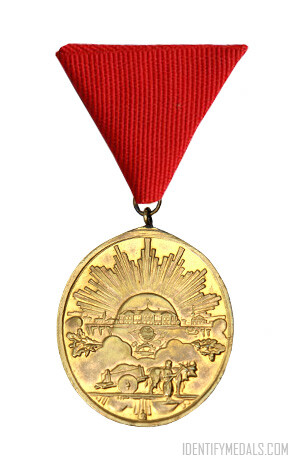
The Turkish Medal of Independence was issued in 1920 in limited number and awarded for contributions during the Turkish War of Independence.

The Medal of Independence (or İstiklal Madalyası in Turkish) holds a distinctive place as a military decoration of great significance, issued in limited numbers by the Grand National Assembly of Turkey in accordance with Act 66 of November 29, 1920.

This prestigious award was reserved for military personnel and civilians who made noteworthy contributions to the country’s cause during the Turkish War of Independence, a pivotal period in Turkey’s history. Notably, in recognition of their valiant efforts and sacrifices, the flags of all regiments belonging to the Turkish National Forces that participated in campaigns during the occupation of Izmir between May 15, 1919, and September 9, 1922, were also honored with this esteemed medal.

The Medal of Independence symbolizes the spirit of resilience, courage, and unity that characterized Turkey’s struggle for independence during this tumultuous period. It serves as a testament to the bravery and dedication of those who fought tirelessly for the nation’s sovereignty and freedom, both on the battlefield and on the home front.
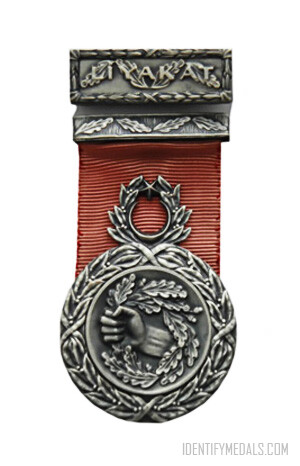
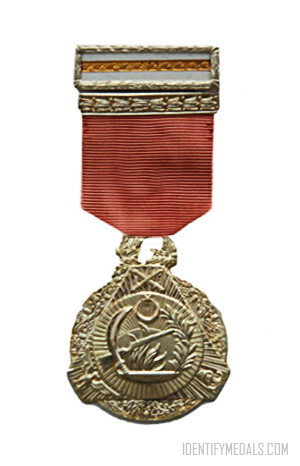
The Turkish Armed Forces Medal of Merit

The Turkish Armed Forces Medal of Merit is awarded to those who show great skill in the achievement of the tasks assigned to them.

The Turkish Armed Forces Medal of Merit (or TSK Liyakat Madalyası in Turkish) is presented to individuals who demonstrate exceptional proficiency in accomplishing their assigned tasks or who achieve success in diverse undertakings, the medal also honors those who foster the advancement of amicable relations between the Turkish Armed Forces and the armed forces of allied nations.

Furthermore, the medal is bestowed upon individuals who play a pivotal role in bridging the gap between nations, thereby fostering mutual understanding and cooperation on an international scale.

The Turkish Armed Forces Medal of Merit Design

The insignia is made of bronze and consists of three parts  (the medal itself, a rosette, and a miniature).

The total weight for the medal is 60 grams.

The Turkish Armed Forces Medal of Achievement

The Turkish Armed Forces Medal of Achievement is awarded for exceptional success in the performance of important missions during war time.

The Turkish Armed Forces Medal of Achievement (or TSK Başarı Madalyası in Turkish) holds a significant place among the honors bestowed upon individuals who demonstrate outstanding performance and dedication in their service to the nation.

In times of war, this accolade is reserved for individuals who exhibit remarkable success in executing crucial missions with unparalleled skill and valor. Whether facing the rigors of combat or navigating complex military operations, recipients of this medal exemplify the highest standards of excellence and courage on the battlefield.

In periods of tranquility, the Turkish Armed Forces Medal of Achievement is awarded to those whose contributions and achievements in service surpass the expectations placed upon them. Whether through innovative leadership, exemplary professionalism, or extraordinary commitment to duty, recipients of this honor distinguish themselves through their unwavering dedication to upholding the values and principles of the Turkish Armed Forces.

The Turkish Armed Forces Medal of Distinguished Courage and Self-Sacrifice

This medal is awarded to those who fulfill the duties entrusted to them with great courage while putting their lives in danger.

The Turkish Armed Forces Medal of Distinguished Courage and Self-Sacrifice (or Türk Silahlı Kuvvetleri Üstün Cesaret ve Feragat Madalyası in Turkish) stands as one of the most prestigious honors conferred by the Turkish Armed Forces (TAF), established on July 3, 1975.

In times of war or peace, the medal is awarded to individuals or military units who have demonstrated exceptional courage and self-sacrifice while carrying out their duties, often risking their lives in the process.

This prestigious accolade may be bestowed upon civilians or military personnel of any nationality. Recommendations for its awarding can be made by the Deputy Minister for National Defense or by any of the Commanders representing the four branches of the Turkish Armed Forces (TAF): the Army, the Navy, the Air Force, or the Gendarmerie (excluding the Commander of the fifth branch, the Coast Guard). Final approval for the award rests with the Chief of the General Staff.

The Medal of Distinguished Courage Design

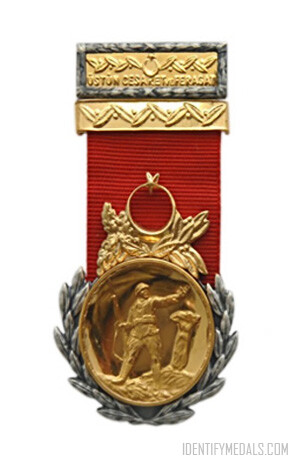
The medal features silver laurels surrounding a gold medal with an engraving of Mehmetçik, the legendary Turkish soldier, atop.

The regular size decoration consists of three pieces. Made of bronze, it is minted with 5 micrometer silver and 0.2 micrometer gold-plating. It weighs 59 grams and has a diameter of 3.5 cm. The miniature size decoration also comprises three pieces. Made of bronze, the miniature medal is minted with 5 micrometer silver and 0.2 micrometer gold-plating. It weighs 15 grams and has a diameter of 1 cm.

The ribbon is red with a golden crescent moon and a star on top.

Order of Merit of the Republic of Turkey

Order of Merit of the Republic of Turkey (Türkiye Cumhuriyeti Liyakat Nişanı) is awarded to foreign scientists, academics, and artists.

The Order of Merit of the Republic of Turkey (or Türkiye Cumhuriyeti Liyakat Nişanı in Turkish) is conferred by the President of Turkey based on recommendations from relevant Cabinet members, taking into account input from the Ministry of Foreign Affairs and the Atatürk Supreme Council for Culture, Language, and History.

This honor is bestowed upon foreign scientists, academics, artists, and intellectuals as a token of appreciation for their efforts in promoting and highlighting the Republic of Turkey on the global stage through their contributions to science and the arts.

  • Eligibility: Foreign scientists, academics, artists and intellectuals.
  • “Given to people who foreign nationals in recognition of their contributions for international promotion and glorification of the Republic of Turkey in science and arts.”

The Order of the Republic of Turkey

The Order of the Republic (Türkiye Cumhuriyeti Cumhuriyet Nişanı) is the second highest Turkish state order after the Order of the State.

The Order of the Republic (or Türkiye Cumhuriyeti Cumhuriyet Nişanı in Turkish) holds the distinction of being the second-highest state order in Turkey, following the Order of the State.

It is awarded by the President of Turkey, upon the recommendation of the Council of Ministers, to individuals such as prime ministers, ministers, and foreign mission members. This recognition is bestowed in appreciation of their efforts to foster closer ties and strengthen friendly relations between their nations and the Republic of Turkey.

  • Eligibility: Foreign Prime Ministers, Ministers and foreign representative members.
  • Awarded for: “Given to people for the development of friendly relations and with the Republic of Turkey.”

The Turkish Armed Forces Medal of Distinguished Service

The Turkish Armed Forces Medal of Distinguished Service (Türk Silahlı Kuvvetleri Üstün Hizmet Madalyası) was first created in 1967.

The Turkish Armed Forces Medal of Distinguished Service (or Türk Silahlı Kuvvetleri Üstün Hizmet Madalyası n Turkish) was first created on July 27, 1967 (although it took its current form on July 29, 1983). 

During war or peace, the medal is bestowed upon individuals whose contributions to the strengthening of the Turkish Armed Forces (TAF) have been extraordinarily high, serving national interests with exemplary determination and contributing greatly to the prestige and strength of the TAF.

This can encompass any military, scientific, material, or administrative contribution, in or outside the territory of the Republic of Turkey.

The medal can be given to civilians or soldiers, regardless of nationality. It is bestowed by any of the Commanders of the four main branches of the TAF (the Army, the Navy, the Air Force, or the Gendarmerie). 

The Turkish Armed Forces Medal of Distinguished Service Design

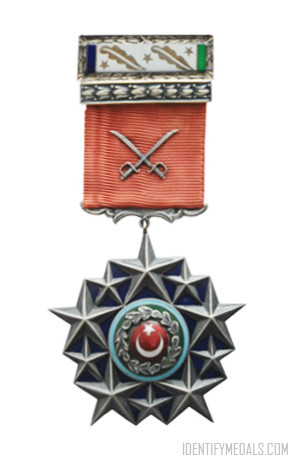
The medal is struck in bronze and measures 60 mm wide. It has five large and five small stars on dark blue background circling an insignia of a crescent moon and a star on red background (the symbol of the Turkish flag) pointing upwards.

The Chelengk

The Chelengk (çelenk) was a military decoration of the Ottoman Empire that continued to be awarded for military merit up to the 1820s.

The Chelengk (çelenk) was a military decoration of the Ottoman Empire that continued to be awarded for military merit up to the 1820s.

A çelenk was “a bird’s feather which one attaches to the turban as a sign of bravery” and became institutionalized practice amongst the Ottoman military. 

A specially-made Chelengk was awarded to Horatio Nelson by Sultan Selim III after the Battle of the Nile (a major naval battle fought between the British Royal Navy and the Navy of the French Republic at Aboukir Bay on the coast off the Nile Delta) in 1798. This was the first time that a Chelengk was conferred on a non-Ottoman. Selim III also gave a chelengk to Russian Admiral Fyodor Ushakov after the capture of Corfu in 1799.

The Chelengk Medal Design

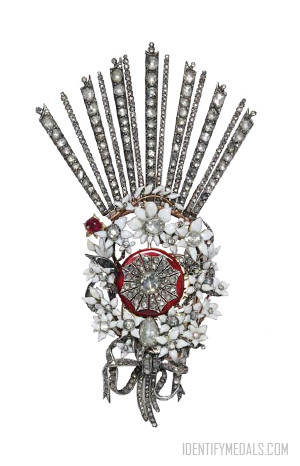
The Chelengk is a jeweled aigrette (the tufted crest or head-plumes of the egret, used for adorning a headdress) consisting of a central flower with leaves and buds, and upward-facing rays.

The Red Crescent Medal

The Red Crescent Medal was instituted in 1912 to reward services to the Red Crescent (the equivalent of the Red Cross in Islamic countries).

The Red Crescent Medal was instituted in 1912 by the 35th Sultan of the Ottoman Empire Mehmed V Reshad to reward services to the Red Crescent (the equivalent of the Red Cross in Islamic countries). It was issued to Red Crescent members and volunteers regardless of their gender for merits in care of sick and wounded.

This medal came in three classes: Gold, silver and bronze. Recommendations for award of the two lower classes were made by the Executive Committee of the Red Crescent, but only the Sultan himself could recommend a recipient of the first class.

This medal continued to be awarded after World War I, until the establishment of the Republic.

The Red Crescent Medal Design

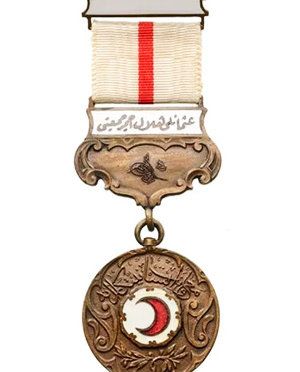
The Red Crescent medal is round, 29 mm in diameter. The obverse bears a red crescent facing left on a white field enameled in the center. Below it is a sprig of laurel, and above it the inscription “Humane Assistance“. The suspension bar bears the tughra of Sultan Mehmed Reshad V below a white enameled bar reading “Ottoman Red Crescent Association.” There is also a bar at the top of the ribbon, enameled white, which is sometimes seen with year designations on the bar, indicating years served with the Red Crescent.

The medal was worn suspended from a silk white ribbon with a central vertical red stripe. Women recipients wore decoration on a traditional bow.

The Liyakat Medal

The Liyakat Medal (Liyakat Madalyasi) was a decoration of the Ottoman Empire established in 1890 and awarded in two classes: gold or silver.

The Liyakat Medal (or Liyakat Madalyasi in Turkish) was a decoration of the Ottoman Empire established in 1890 and awarded in two classes: gold or silver. The medal was not strictly a military award and could be awarded for general merit in society such as to civilians for general merit to society.

The medal was a common military decoration through the end of the First World War. In 1905 the statutes were amended to allow women to receive the medal for charitable work, service to mosques or schools, and other decidedly civilian merits.

The Liyakat Medal Design

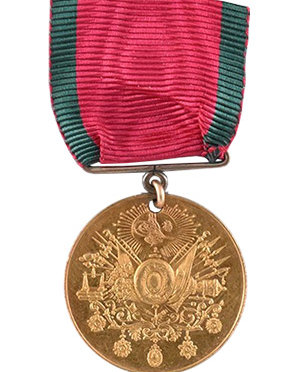
The medal measured 25 mm in diameter came in both gold and silver classes. It’s suspended from a red ribbon with narrow green side stripes.

The obverse bears the ottoman trophy of arms with the sultan’s cipher above it. The reverse bears the inscription “Medal of Merit Especially for Those Who Have Shown Loyalty and Bravery” and the date AH 1308 (1890 AD).

During World War I a clasp of two crossed swords was attached to the ribbon with the date AH 1333 (1915) inscribed upon them. Copies of the Liyakat medal made in Germany and Austria around the First World War are sometimes found with and without the crossed sabers device.  These copies are rarer than original pieces, and command a premium among collectors.