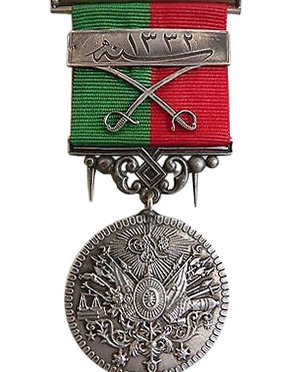
The Imtiyaz Medal

The Imtiyaz Medal (İmtiyaz Madalyası), also known as Nishan-i-Imtiaz (Nişan-ı İmtiyaz) is an Ottoman military decoration instituted in 1882.

The Imtiyaz Medal (or İmtiyaz Madalyası in Turkish), also known as Nishan-i-Imtiaz (Nişan-ı İmtiyaz) is an Ottoman military decoration that was instituted in 1882.

The gold Imtiyaz medal was the highest-ranking military decoration of the Ottoman Empire while the silver one ranked above the silver Liyakat Medal, but below the gold Liyakat.

A few examples of this medal are known to have been struck with the name of the recipient in raised letters, usually given to the heads of state of Turkey’s allies during World War I.

The Imtiyaz Medal Design

The medal is presented in two classes: gold and silver. The medal measures 37 mm and bears the Ottoman military coat of arms on the obverse, with its inscription “Relying on Divine Guidance and Assistance, Abdulhamid Khan, Sultan of the Ottoman Empire“. The tughra of Sultan Abdulhamid II is at the top.

The reverse has an inscription in Ottoman that translates roughly as “Medal for Those That Have Shown Exceptional Loyalty and Bravery for the Ottoman Empire“. Below that is a curved rectangular area where the name of the recipient could be engraved, and at the bottom is the date 1300 (1882).

The ribbon of this medal is half red, half green. Awards dating from World War I have a ribbon device, in the same material as the medal itself, consisting of a bar with the year 1333 (1915) above a pair of crossed sabers.
The Turkish Medal for the Siege of Silistria

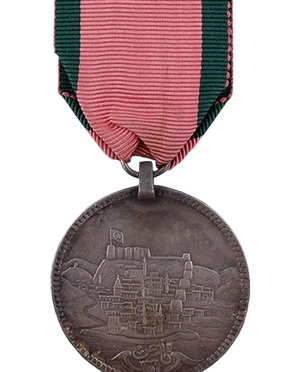
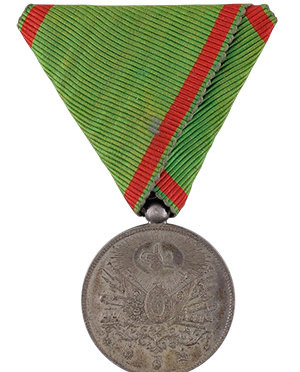
The Turkish Medal for the Siege of Silistria is a campaign medal issued to British personnel present during the period of the Crimean War.

The Turkish Medal for the Siege of Silistria (or Silistre Madalyası in Turkish) is a campaign medal issued to the handful of British personnel who were present during the period of the Crimean War (28 March 1854 to 30 March 1856).

During the battle, Russian forces besieged the Ottoman fortress of Silistra. If the Russians were to make a success of their campaign on the Danube, they needed to capture the stronghold of Silistria, but the successful resistance mounted by the Turks during the course of a two month siege (April-June 1854) was unexpected by the Russians. While initially successful, the Russians were forced after several weeks to abandon the siege and retreat due to political pressure. The failure of the siege signaled a general withdrawal by Russia from the Principalities, which was largely completed by September 1854.

The Medal for the Siege of Silistria Design

The medal is made in silver and measures 36.5 mm.

The Iftikhar Sanayi Medal

The Iftikhar Sanayi Medal is a medal made of gold or silver awarded by the Ottoman Empire and first granted by Sultan Abdulhamid II.

The Iftikhar Sanayi Medal (also known as Medal of Iftikhar or Medal of Sanayi) is a medal made of gold or silver awarded by the Ottoman Empire and first granted by Sultan Abdulhamid II.

The medal was generally awarded for loyalty, valor, heroism, and accomplishments in various fields such as agriculture, arts, and crafts. These medals were also used as war medals by attaching inscribed clasps to their ribbons. The name of this medal was originally “Iftihar Madalyasi“, which was used earlier for the General Service Medal, but was later changed to “Sanay-i Nefise Madalyasi” which translates roughly as “Medal of Beautiful Arts“.

Most of the recipients were artists and artisans such as personnel of the Yildiz porcelain factory, or performers at the private theater of Sultan Abdulhamid II at the palace.

The medal was awarded in two classes: Gold and Silver.

The Iftikhar Sanayi Medal Design

The obverse of the Sanayi medal features an Ottoman trophy of arms and on the reverse side has a laurel wreath in the center, leaving a blank space for the awardee’s name to be engraved.

The Gallipoli Star or 1915 Turkish Campaign Star

The Gallipolli Star or Ottoman War Medal is a military decoration awarded by the Ottoman Empire and instituted in 1915 for gallantry in battle.

The Gallipolli Star or Ottoman War Medal (Harp Madalyası in Turkish) is a military decoration awarded by the Ottoman Empire and instituted by Sultan Mehmed V on 1 March 1915 for gallantry in battle. This was the “entry level” gallantry award of the Turkish military in World War I, ranking below the silver Liyakat Medal.

The decoration was awarded to Ottoman and other Central Powers troops, primarily in Ottoman areas of engagement. It wasn’t a campaign medal, but a medal for military merit.

The decoration is the only Ottoman one which not awarded by authority of the Sultan, but rather was authorized by Enver Pasha, the Commander-in-Chief of the Ottoman military.

The Gallipoli Star Design

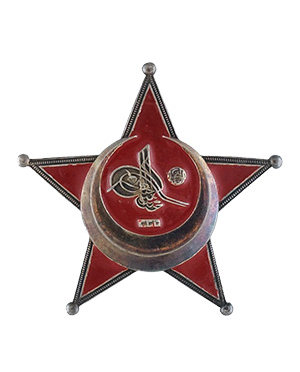
The Gallipoli Star is made of nickel-plated brass and measures 56 mm across the diagonal span of the arms. The tips of the star are capped by ball finials and enclosed in a raised silver edge with the field in red lacquer or enamel. A raised crescent, open at the top, encircles the center of the badge.

Inside the crescent on the obverse is the tughra or cipher of the decoration’s creator, Sultan Mehmed V Reşâd, over the date 1333 AH (AD 1915). The reverse is flat, unadorned and has a straight pin.

The original issue pieces of this award came in two varieties: silvered brass with red enamel and white metal with thin red lacquer. Those medals issued to officers were enameled and manufactured by a company that used the mark “BB&Co.“, a maker reputedly located in Berlin.

The award includes a badge, ribbon and campaign bar.

The Order of Osmanieh

The Order of Osmanieh or Osmaniye is a civil and military decoration of the Ottoman Empire created in January 1862 by Sultan Abdülaziz.

The Order of Osmanieh or Osmaniye (or Osmanlı Devlet Nişanı in Turkish) is a civil and military decoration of the Ottoman Empire created in January 1862 by Sultan Abdülaziz.

It was awarded by the Sultan to Ottoman civil servants and military leaders for outstanding services to the state.

The order was originally established in three classes (expanded to four in 1867):

  • First class (50 members)
  • Second class (200 members)
  • Third class (1000 members)
  • Fourth class (2000 members)

The Order of Osmanieh Design

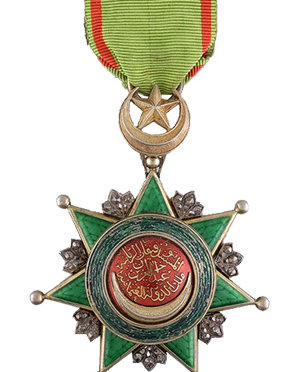
The badge of the order is a seven-pointed star in dark green enamel, with three short silver rays between each point of the star. In the obverse, the center medallion is in gold, with a red enameled field surrounded by a green enameled band. In the red central portion is a raised gold crescent, and a calligraphic inscription reading “Relying on the Assistance of Almighty God, Abdulaziz Khan, Sovereign of the Ottoman Empire“.

The reverse center medallion is silver, bearing a trophy of arms and the year AH. 699, the year of the creation of the Ottoman Empire.

The badge is suspended by a gold crescent and star, facing upwards.

The Order of the Medjidie

The Order of the Medjidie is a military and knightly order of the Ottoman Empire instituted in 1851 by Sultan Abdülmecid I.

The Order of the Medjidie (or Mecidiye Nişanı in Turkish) is a military and knightly order of the Ottoman Empire instituted in 1851 by Sultan Abdülmecid I. It was given as a reward for distinguished service to members of the British Army and the Royal Navy and the French Army who came to the aid of the Ottoman Empire during the Crimean War against Russia.

The Order was issued in considerable numbers and awarded in five classes, with the First Class being the highest. It was usually conferred on officers although there have been cases of a few enlisted soldiers receiving it as well, and during World War I it was also awarded to a number of German and Austrian officers.

Among notable recipients are Napoleon III Emperor of France and Pedro II of Brazil Emperor of Brazil.

Owners of the order:

  • First Class Order – 50 people (Given by Sultan)
  • Second Class Order – 150 people (Given by Sultan)
  • Third Class Order – 800 people
  • Fourth Class Order – 3,000 people
  • Fifth Class Order – 6,000 people

The Order of the Medjidie Design

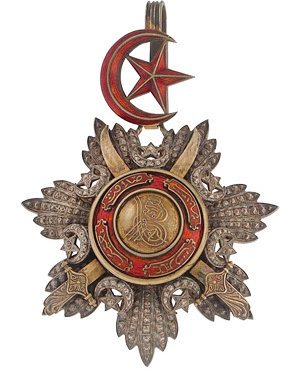
On the obverse of the star is Sultan Abdul Mejid’s royal cipher measuring 75.3 mm and surrounded by an inscription on a gold-bordered circle of red enamel. The star has seven triple quills with small crescents and five-pointed stars between them, suspended from a red enameled crescent and star suspender with green enameled edges.

First, second, third and fourth classes are gold. Fifth (lower) class is silver.

The Order of the State of Republic of Turkey

The Order of the State of Republic of Turkey is conferred by the President to foreign nationals, and is the highest state order of its type.

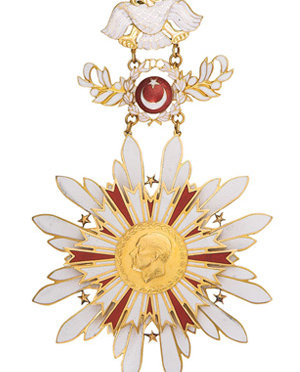
The Order of the State of Republic of Turkey (or Türkiye Cumhuriyeti Devlet Nişanı in Turkish) is the highest state order awarded to foreign nationals. It was first introduced in 14 July 1994. The medal is conferred by the President of the Republic of Turkey to Heads of State and presidents in recognition of their contributions for enhancing the amicable relations between their countries and Turkey.

The medal is:

Given to people for the development of friendly relations with the Republic of Turkey.”

There are two grades:

  • Order of the State, and
  • Order of the Gold Star