The Order of Alexander Nevsky

The Order of Alexander Nevsky is an order of merit bestowed to civil servants for twenty years + of highly meritorious service.

The Order of Alexander Nevsky (or орден Александра Невского in Russian) is an order of merit of the Russian Federation bestowed to civil servants for twenty years or more of highly meritorious service and named in honor of saint Alexander Nevsky (1220–1263). It was awarded to Red Army commanders who displayed personal bravery in fighting for their country in World War II, for courage, bravery and skillful leadership that ensured success.

It was originally established by the Soviet Union as a military honor during World War II on July 7, 1942. Its statute was amended by Decree of the Presidium of the Supreme Soviet of the USSR of February 26, 1947.

The Order of Alexander Nevsky was reinstated by the Soviet Union for award to officers of the army for personal courage and resolute leadership. The Order was retained by the new Russian Federation following the dissolution of the USSR but was never awarded. The September 7, 2010 Decree №1099 amended the statute of the Order making it a purely civilian award.

The Order of Alexander Nevsky Design

The Order of Alexander Nevsky (in its Soviet and early Russian Federation version) is made of silver, measures 50 mm wide and is a high ruby-red enameled, five-pointed convex star superimposed on a decagon composed of polished diverging rays. The star had gold-plated rims and edges.

In the center of the star, a central medallion bearing the left profile relief image of a helmeted Alexander Nevsky and the inscription along the left and right circumference in prominent letters “ALEXANDER NEVSKY” («АЛЕКСАНДР НЕВСКИЙ»). The central medallion is surrounded by a gilt laurel wreath bisected at its base by a silver shield bearing the hammer and sickle, the shield is superimposed over gilded sword, spear, bow and quiver of arrows. Two gilt pollaxes cross behind the central medallion, their outward facing blades protruding on either side of the five pointed star’s top arm and extending slightly past the decagon’s outer edge, their base visible just inside of the star’s two lower arms.

The original Order was suspended by a ring through a suspension loop, which was changed in 1943 to a threaded stud and nut attachment on the reverse. The design of the early Russian Federation variant of the Order differed from the Soviet variant only in the abrogation of the hammer and sickle from the silver shield on the obverse.
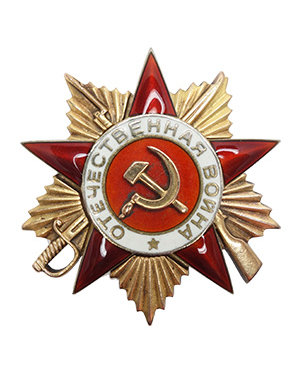
The Order of the Patriotic War (USSR)

The Order of the Patriotic War (Орден Отечественной войны) is a  Soviet military decoration established in 1942 and awarded for heroic deeds.

The Order of the Patriotic War (or Орден Отечественной войны in Russian) is a  Soviet military decoration established on 20 May 1942 and awarded for heroic deeds during WW2 or the German-Soviet War to all soldiers in the Soviet armed forces, security troops, as well as to partisans.

This was the first Soviet order established during the war, and the first Soviet order divided into classes. Deeds are awarded with the order (shooting down three aircraft as a fighter pilot, destroying two heavy or three medium or four light tanks, capturing a warship, repairing an aircraft under fire after landing on a hostile territory, etc) were awarded with the first class.

The medal was also given to some allied troops and commanders, including western allies. Altogether, over 324,903 of the 1st class and 951,652 of the 2nd class were issued during the war. 

The Order of the Patriotic War Classes

The Order of the Patriotic War had two classes:

  1. First Class: Awarded for acts of bravery and courage displayed in combat against the enemy. It was typically bestowed upon soldiers, sailors, and airmen who demonstrated exceptional valor or leadership on the battlefield. Recipients of the First Class were often recognized for their direct involvement in significant military operations, such as leading successful assaults, repelling enemy attacks, or capturing strategic objectives.

  2. Second Class: Awarded for various contributions to the war effort, including acts of bravery, distinguished service, or significant achievements in support of the Soviet war machine. While the criteria for the Second Class were less stringent than those for the First Class, recipients were still required to demonstrate commendable conduct and dedication to the defense of the Soviet Union. This class of the order was often bestowed upon individuals who displayed courage under fire, rendered valuable assistance to their comrades, or made significant sacrifices for the cause of victory.

The Order of the Patriotic War Medal Design

The Order of the Patriotic War medal features a red enamel five-pointed star, made of silver, with straight rays in the background, and crossed sabre and a Mosin rifle. The rays in the background are golden for the First Class and silver for the Second Class.

The central disc has a golden hammer and sickle on a red enamel background, surrounded by a white enamel ring with the words ОТЕЧЕСТВЕННАЯ ВОЙНА (“Patriotic War”). Anniversary orders of 1985 were made cheaper, as a single silver piece, gold-plated in the 1st class.

The ribbon varies slightly depending on the class:

  • Order of the Patriotic War – First Class Ribbon
  • Order of the Patriotic War – Second Class Ribbon
The Order of the Patriotic War - MEDIA

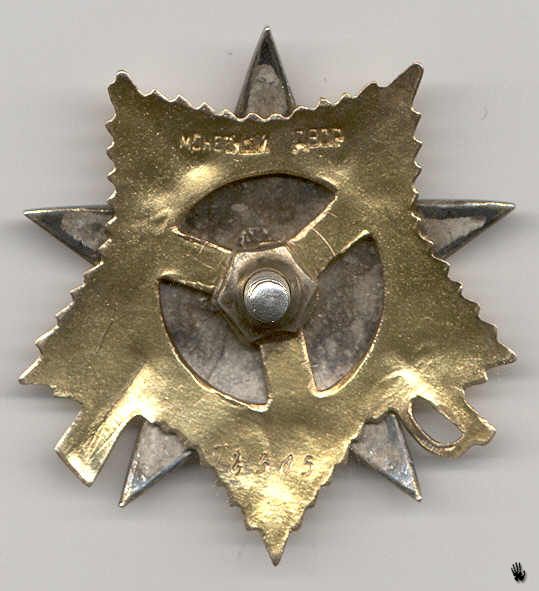
The Order of the Patriotic War, 1st class, reverse.
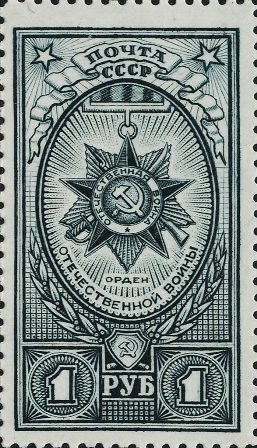
Order of the Patriotic War depicted on a 1943 postage stamp.
The Order of the Patriotic War depicted on a 1943 postage stamp. Wikipedia.

The Voluntary Medical Service Medal

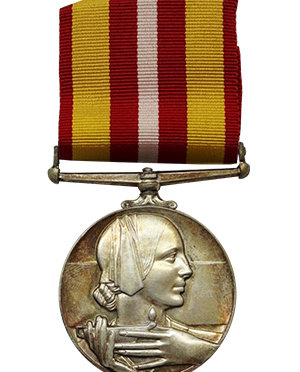
The Voluntary Medical Service Medal is a medal instituted in 1932 by George V and awarded by the British Red Cross and St Andrew’s First Aid. 

The Voluntary Medical Service Medal is a medal instituted in 1932 at the direction of George V and awarded by the British Red Cross and St Andrew’s First Aid.

To qualify for the medal, a member has to accrue fifteen years’ continuous efficient service as a first aid volunteer in either the Red Cross or St Andrew’s. They also need to provide a minimum of ten hours field service per year.

The Voluntary Medical Service Medal Design

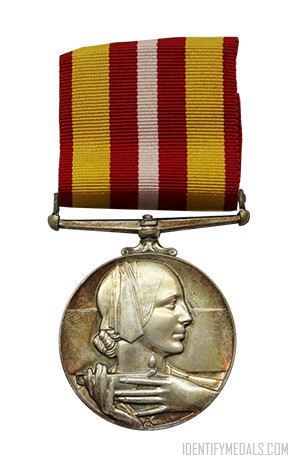
The medal measures 36 millimeters (1.4 inches) in diameter and was designed by Percy Metcalfe, an English artist sculptor and designer recognized mostly for his coin designs and his contribution to the Ashtead Pottery Collection.

The obverse of the medal bears a symbolic representation of Florence Nightingale carrying a lamp. The reverse features a design of both the Geneva and St Andrew’s crosses to denote the two qualifying organizations. Between the upper arms of the St Andrew’s Cross is the text “LONG AND EFFICIENT SERVICE”.

The medal was originally made of silver, later of silver plated copper, and since the 1960’s of copper-nickel. It is suspended from a straight swivel bar and hangs from a ribbon of red with yellow stripes at the edges and a thin white stripe in the centre. On the suspension ribbon of the medal, clasps embellished with the Geneva cross (St Andrew’s cross in Scotland) are worn to denote five additional years of qualifying service. Up to four silver-gilt emblems can replace the silver type to denote 25, 30, and 35 years of service in the applicable voluntary organisation.
Find Red Cross Medals Online

More Red Cross Medals

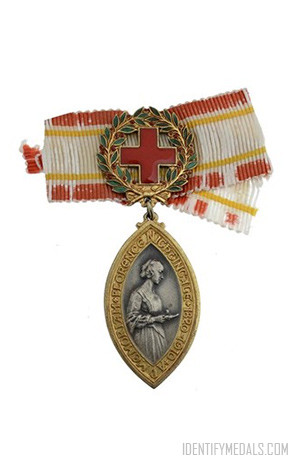
The British Red Cross Medal for Proficiency

Members of the Red Cross had to have three successive certificates in appropriate subjects (nursing, first aid, hygiene and sanitation).

Members of the Red Cross had to have three successive certificates in appropriate subjects (nursing, first aid, hygiene and sanitation) with an interval of at least 12 months between the dates of each certificate gained.

A proficiency badge was awarded after the third successful examination, and after the 4th and subsequent examinations the Red Cross members would be given proficiency bars. Each proficiency badge had the relevant subject on the ornamental brooch and a different ribbon for each subject.
The British Red Cross Society and the Order of St John formed the Joint War Organisation, offering extensive services for the sick and wounded, for prisoners of war, and for civilians needing relief as a result of enemy action, at home and abroad. The joint organization created ambulance departments for the transportation of the wounded, established convalescent homes and auxiliary hospitals, sometimes in private properties across the UK.

The British Red Cross Medal for Proficiency Badge Design

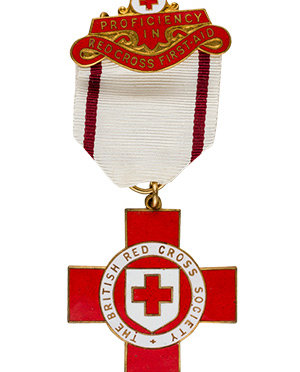
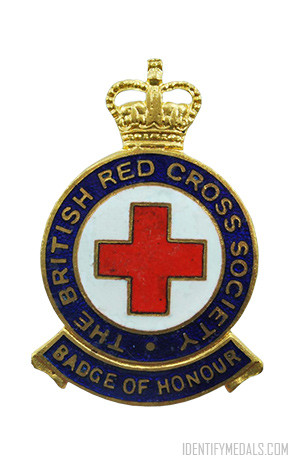
On the obverse of the medal is a red cross enamel medal with a central white shield and another red cross in the center surrounded by a circular white band with the following inscription in gold: “THE BRITISH RED CROSS SOCIETY”.

Suspended to the white with two thin purple striped ribbon is a metal clasp with inscription in gold on red enamel background “PROFICIENT IN RED CROSS FIRST AID” and a red cross on the white circular background.

On the reverse is engraved the ID and the full name of the person awarded the badge. The badge measures approximately 3.7”x 1.6” at its widest points.

Find Red Cross Medals Online

More Red Cross Medals

The Inter Allied Victory Medal (Czechoslovakia)

The Czechoslovakian Victory Medal was awarded to all military personnel or civilians who participated in WW1 and has an Art Deco style.

  • Time Period: World War I
  • Institution: 1919
  • Country: Czechoslovakia

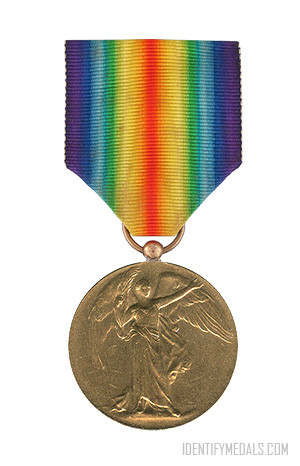
The Allied Victory Medal was recommended by an inter-allied committee in March 1919. Fourteen victorious countries finally awarded the medal after World War I, and each allied nation would design a ‘Victory Medal’ for award to their own nationals. Certain features were to be shared: a winged figure of Victory on the obverse and the same ribbon.

During the war, Czechs and Slovaks living in France were given the choice of military service or internment as enemy aliens. The Inter-Allied Victory medal was awarded to soldiers who served in the various Czech legions under the French, Italian and Russian Armies, to those who fought in the army of any allied nation, and to those who joined the French Foreign Legion.

The Czechoslovakia Inter-Allied Victory Medal Design

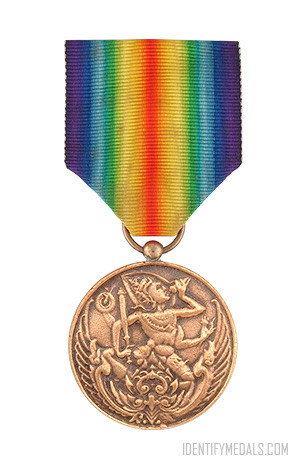
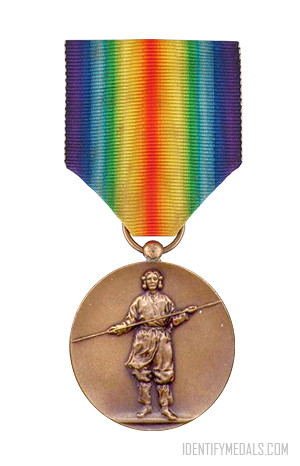
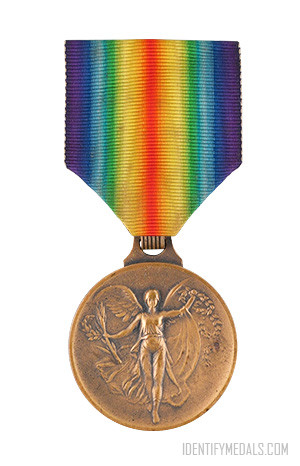
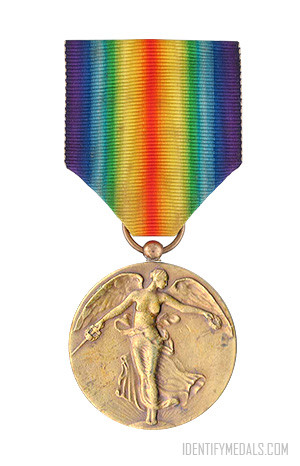
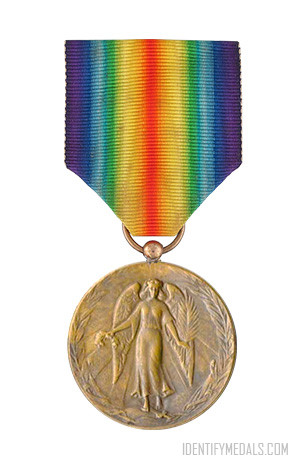
The Victory Medal measures 36 millimetres (1.4 in) in diameter and was designed by William McMillan. The design and ribbon was also adopted by Belgium, Brazil, Cuba, Czechoslovakia, France, Greece, Italy, Japan, Portugal, Romania, Siam, Union of South Africa and the USA. Each allied nation would design a ‘Victory Medal’ for award to their own nationals, all issues having certain common features, including a winged figure of victory on the obverse and the same ribbon.

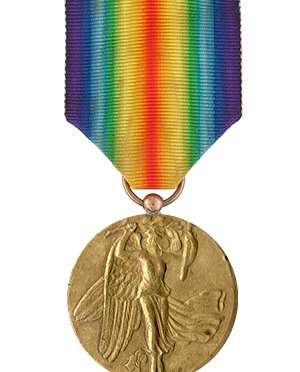
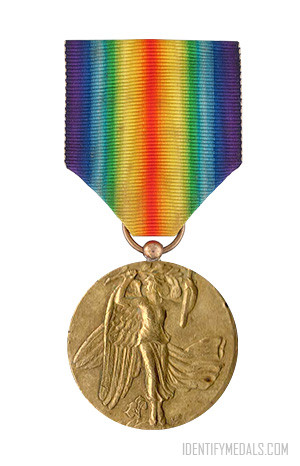
The obverse of the Czechoslovakian Victory Medal featured an Art Deco style winged Victory. The linden tree, symbol of the Czech nation, sprouts near Victory’s feet. The back has a shield with the lion of Bohemia with the arms of Silesia on its chest, surrounded by linden leaves.

The reverse shows the words ‘THE GREAT / WAR FOR / CIVILISATION / 1914-1919’ surrounded by a laurel wreath.

The 39 millimeters (1.5 in) wide watered ribbon has an iridescent color scheme, with the violet moving through to a central red stripe where both schemes meet. It attaches to the medal through a ring suspender. The recipient’s name, rank, service number and unit were impressed on the edge of the medal. The name of the regiment or corps was omitted on medals awarded to Army officers.

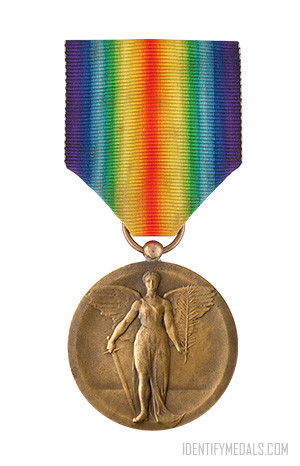
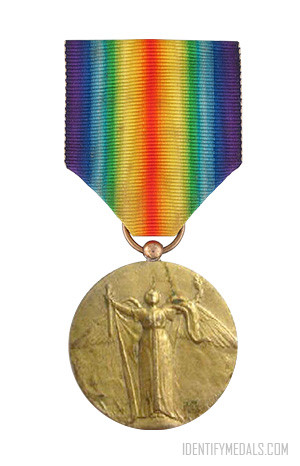
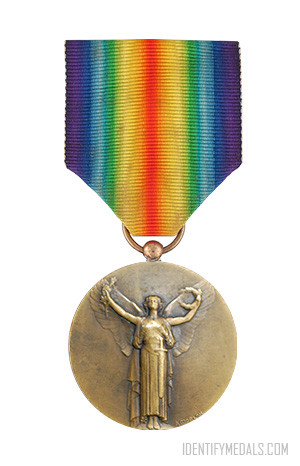
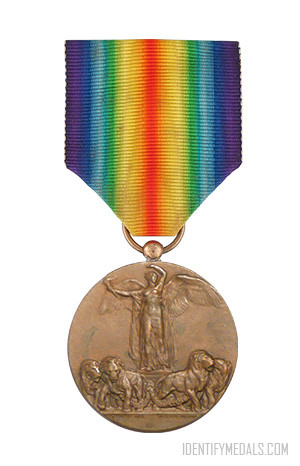
All the Inter-Allied Victory Medal Variations

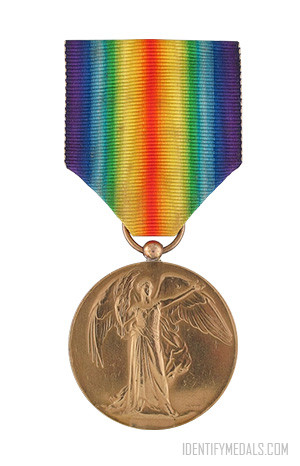
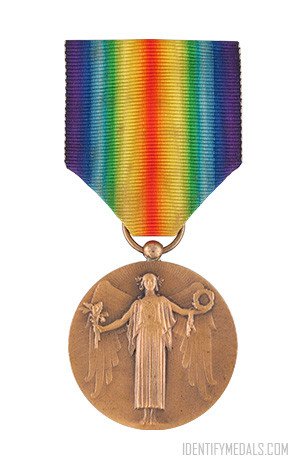
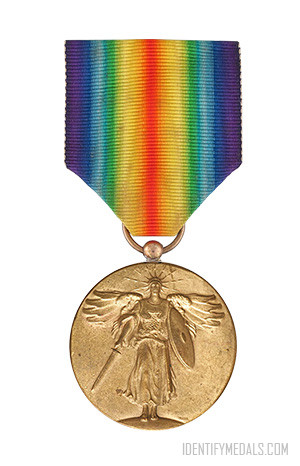
Although each country designed its own version of the Inter-Allied Victory Medal, all of them shared some common elements, such as a winged victory figure on the obverse and a similar ribbon with rainbow colors symbolizing unity among the Allies. Here are the versions for all countries:

Find an Inter-Allied Victory Medal Online

Right Now on eBay 
Clicking a link to eBay may result in a referral commission being paid if a purchase is made.
Loading...

The 1900 Boxer War Medal (Japan)

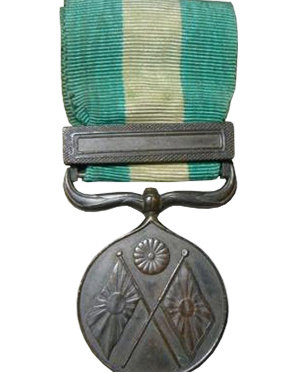
The 1900 Boxer War Medal was a Japanese medal created by Imperial Edict in 1901 to commemorate those that fought during the Boxer Rebellion.

The 1900 Boxer War Medal was a Japanese medal created by Imperial Edict No. 142 and issued on April 21, 1901. It’s a commemorative medal for those who had participated in the relief of the Beijing legations during the Boxer Rebellion.

The Military Medal of Honor (or 従軍記章 jugun kisho in Japanese) was a military decoration for meritorious service to the Empire of Japan, formerly awarded to all military personnel who participated in battles in a war and effectively abolished during the Allied Occupation of Japan in the post-war years (1945–1951).

The plausible re-institution of a modern equivalent was made unlikely by the adoption of Japan’s post-war Constitution which disavows the right of the state to engage in aggressive war.

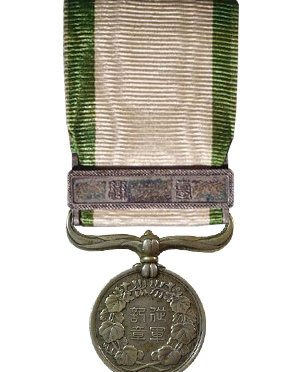
The 1894-95 Sino-Japanese War Medal

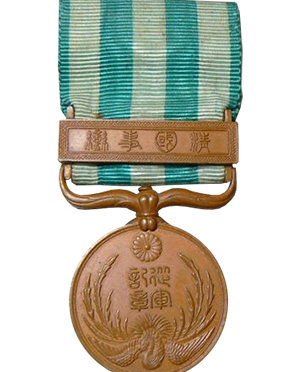
The 1894-95 Sino-Japanese War Medal was awarded in commemoration of the First Sino–Japanese War, which lasted from 1894 to 1895.

The 1894-95 Sino-Japanese War Medal was awarded in commemoration of the First Sino–Japanese War, which lasted from 1 August 1894 to 17 April 1895.

The war was fought between Qing Dynasty China and Meiji Japan, primarily over control of Korea. After more than six months of continuous successes by the Japanese army and naval forces, as well as the loss of the Chinese port of Weihai, the Qing leadership sued for peace in February 1895.

The Military Medal of Honor (or 従軍記章 jugun kisho in Japanese) was a military decoration for meritorious service to the Empire of Japan, formerly awarded to all military personnel who participated in battles in a war and effectively abolished during the Allied Occupation of Japan in the post-war years (1945–1951).

The plausible re-institution of a modern equivalent was made unlikely by the adoption of Japan’s post-war Constitution which disavows the right of the state to engage in aggressive war.

The 1874 Formosa Expedition War Medal

The 1874 Formosa Expedition War Medal was established in 1875 to commemorate the 3000 Japanese warriors who went to Formosa.

The 1874 Formosa Expedition War Medal was established by Daijou-kan Law #54 on April 10, Meiji 8 [1875]. Revised (Law #141) on November 15, 1876.

The Japanese expedition of 1874 to Taiwan Province, also referred to as the Taiwan Expedition of 1874, was in response to the Mudan Incident of 1871. Fifty-four shipwrecked Ryukyuan sailors were killed by Paiwan aborigines in December 1871 in southern Taiwan. In seeking restitution from Qing China, Japan reached an impasse when the Chinese claimed that they were not responsible for the actions of the aborigines in territory that was nominally under Chinese sovereignty.

The Japanese government sent an expedition of 3,600 soldiers led by Saigō Tsugumichi in May 1874. The Japanese won a decisive victory at the Battle of Stone Gate on 22 May 1874. Thirty aborigines were either killed or mortally wounded in the battle, and a great number wounded. Japanese casualties were six killed and thirty wounded.

In November 1874 the Japanese forces withdrew from Taiwan after the Qing government agreed to an indemnity of 500,000 Kuping taels.

The Military Medal of Honor (or 従軍記章 jugun kisho in Japanese) was a military decoration for meritorious service to the Empire of Japan, formerly awarded to all military personnel who participated in battles in a war and effectively abolished during the Allied Occupation of Japan in the post-war years (1945–1951).

The plausible re-institution of a modern equivalent was made unlikely by the adoption of Japan’s post-war Constitution which disavows the right of the state to engage in aggressive war.

The 1874 Formosa Expedition War Medal Design

The obverse of the medal bears branches of Imperial Paulonia Leaves. Inscribed ‘War Medal.’ The reverse is inscribed ‘Meiji 7 [1874] Year of the Dog.’ The latter refers to the Chinese Sexagenary Cycle.

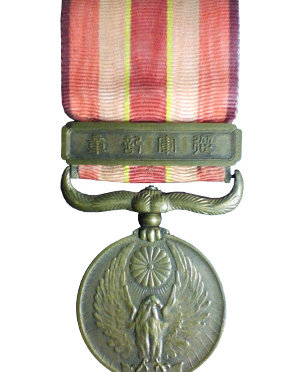
The 1931-34 China Incident War Medal

The China Incident Medal (Sina jihen jugun kisho) medal was created in 1939 and awarded for service in China during the Shōwa period.

The China Incident Medal (Sina jihen jugun kisho) medal was created by Imperial Edit No. 496 on July 27, 1939 and awarded for service in China at any time from the 12th through the 20th years of the Shōwa period — Shōwa 12-20 (1937–1945). The decoration was abolished in 1946 by government ordinance No. 177.

Although the Japanese government still uses “China Incident” in formal documents, media in Japan often paraphrase it with other expressions like Japan-China Incident (日華事変 Nikka jihen) or (日支事変 Nisshi jihen). The word Shina is now construed by China as a derogatory term.

The Military Medal of Honor (or 従軍記章 jugun kisho in Japanese) was a military decoration for meritorious service to the Empire of Japan, formerly awarded to all military personnel who participated in battles in a war and effectively abolished during the Allied Occupation of Japan in the post-war years (1945–1951).

The plausible re-institution of a modern equivalent was made unlikely by the adoption of Japan’s post-war Constitution which disavows the right of the state to engage in aggressive war.

The Order of the Precious Crown

The Order of the Precious Crown (Hōkan-shō) is an Order from Japan established in 1888 by Emperor Meiji and usually reserved for females.

  • Time Period: Pre-WW1
  • Institution: 4 January 1888
  • Country: Medals from Japan Japan

The Order of the Precious Crown (or 宝冠章 Hōkan-shō in Japanese) was established on January 4, 1888, by Emperor Meiji. It’s the lowest ranking of the Japanese orders currently awarded and conventionally reserved for female recipients (such as female members of the royal family).

Until 2003, the Order of the Precious Crown ranked below the Order of the Rising Sun but above the Order of the Sacred Treasure, and was bestowed as a female-only version of the Order of the Rising Sun. The Order of the Precious Crown is now only bestowed upon female members of the Imperial Family and foreign ladies of distinction.

Originally the order had five classes, but on April 13, 1896, the sixth, seventh, and eighth classes were added. Unlike many European counterparts can be awarded posthumously. 

The Order of the Precious Crown is given by the Emperor of Japan at the monarch’s pleasure and, since 2003, no longer uses numbers to represent rank.

The Classes of the Order of the Precious Crown

The Order of the Precious Crown had eight classes (today, it has six. The 7th and 8th classes were abolished in 2003). The First Class is usually awarded to female royalty or, occasionally, to the royal family in foreign countries. This typically happens when necessary for diplomatic ceremonies. 

These are the ribbon bars of the order:

  • JPN Hokan-sho 1Class BAR.svg Grand Cordon, Paulownia 
  • JPN Hokan-sho 2Class BAR.svg Second Class, Peony
  • JPN Hokan-sho 3Class BAR.svg Third Class, Butterfly
  • JPN Hokan-sho 4Class BAR.svg Fourth Class, Wisteria
  • JPN Hokan-sho 5Class BAR.svg Fifth Class, Apricot
  • JPN Hokan-sho 6Class BAR.svg Sixth Class, Ripples
  • JPN Hokan-sho 7Class BAR.svg Seventh Class, Medal
  • JPN Hokan-sho 8Class BAR.svg Eighth Class, Medal 

The Order of the Precious Crown Badge Design

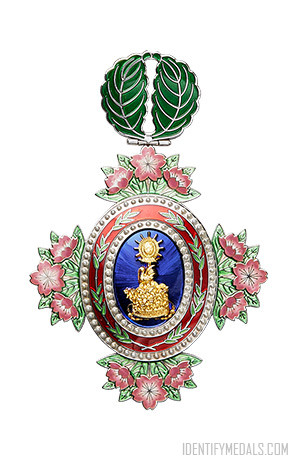
The badge of the order is a gold oval medallion with floral designs at its four ends. Aat the centre is an ancient Japanese crown on a blue background, surrounded by a red ring. It is suspended from a smaller badge, its design varies according to class. 

The ribbon of the Order of the Precious Crown is yellow with red stripes near the borders. For the 1st class, a sash is worn on the right shoulder (all other classes use a bow on the left shoulder).

The star of the order is worn only by the first class and has five rays studded with pearls, with floral designs between the rays. The central disc features a Ho-o or phoenix on a blue background, surrounded by a red ring emblazoned with a laurel wreath.

The medal for the 6th and 7th classes is golden bronze. The face presents the crossed flags of Japan and the Emperor, both surmounted by the Rising Sun. The obverse presents a conventional monumental shaft flanked by a branch of laurel and a palm branch.