The Order of Culture (Japan)

The Order of Culture (Bunka-kunshō) is an order of Japan established in 1937 and conferred by the Emperor of Japan in person.

The Order of Culture (or 文化勲章 Bunka-kunshō in Japanese) is an order of Japan established on February 11, 1937 and conferred by the Emperor of Japan in person on Culture Day (November 3) each year.

Candidates for the Order of Culture are selected from the Persons of Cultural Merit by the Minister of Education, Culture, Sports, Science, and Technology, upon hearing the views of all the members of the selection committee for the Persons of Cultural Merit. The Minister then recommends the candidates to the Prime Minister so that they can be decided by the Cabinet.

The order only has one class and may be awarded to men and women of any country for contributions to Japan’s art, literature, science, technology, or anything related to culture in general. Those that receive the order are also entitled to an annuity for life.

The Order of Culture Design

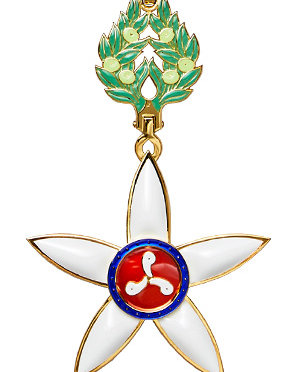
The badge of the Order of Culture is made in gold with white enamel. It has the form of a Tachibana orange blossom, with the central disc bearing three crescent-shaped jades (magatama).

The badge is suspended on a gold and enamel wreath of mandarin orange leaves and fruit, which is in turn suspended on a purple ribbon worn around the neck.

The Cross to the Heroic Valour in Combat (Argentina)

The Cross to the Heroic Valour in Combat (or Cruz la Nación Argentina al Heroico Valor en Combate in Spanish) is the highest military decoration of the Argentinian Republic.

The medal was first issued in 1982, and according to the Laws 22 607 (1982) and 24 229 it’s to be awarded to military personnel, security forces personnel, civilian police force, Argentinians or foreigners who, in combat motivated by extraordinary circumstances, exhibit heroic acts in the function of war, isolated or in the exercise of command, or ponderable actions or distinguish themselves in conduct.

A totally of 21 medals were given to Argentine heroes of the Falklands War, all of them having fought
in the war, and eight of them having given the medal post-mortem.

The Cross to the Heroic Valour in Combat Medal Design

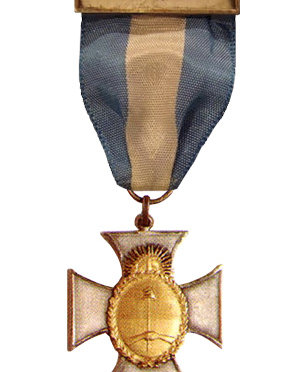
The medal is a circular medal cast in bronze and silver. The decoration consists of a silver cross pattée bearing the Coat of arms of Argentina in gold.

The medal is suspended from a chest ribbon of equal light blue-white-light blue stripes.

The Argentine Nation to the Valour in Combat Medal

The Argentine Nation to the Valor in Combat Medal (or Medalla de la Nación Argentina al Valor en Combate in Spanish) is the second highest military decoration given by the President of Argentina (the highest one being the Cross to the Heroic Valour in Combat).

The conditions for its award are to “recognize acts during the Southern Atlantic war for merits, valor and heroism in the defense of the Motherland“. The medal can be given to Argentinian citizens as well as foreigners, from the military, police or civilian personnel. A total of 56 people have received this award: 24 Officials, 21 NCOs and 11 soldiers.

The Argentine Nation to the Valor in Combat Medal Design

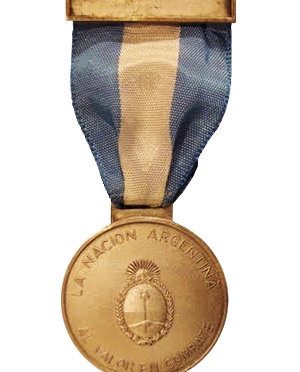
The medal is a circular medal cast in bronze. The obverse depicts the Coat of arms of the Argentinian Republic and the words “The Argentinian Nation” (“La Nación Argentina“) and “Valor in Combat” (“Al Valor Heroico“).

The medal is suspended from a chest ribbon of equal light blue-white-light blue stripes.

The Navy and Marine Corps Medal

The Navy and Marine Corps Medal is the highest non-combat decoration awarded for heroism to the members of the U.S. Navy and Marine Corps.

The Navy and Marine Corps Medal is the highest non-combat decoration awarded for heroism to the members of the United States Navy and United States Marine Corps.

The medal was established by an act of Congress on 7 August 1942 and it was first bestowed during World War II (as retroactive to 6 December 1941). During the mid-20th century, the Navy and Marine Corps Medal was awarded instead of the Silver or Gold Lifesaving Medal, for sea rescues involving risk to life.

For heroic performance to rise to this level it must be clearly established that the act involved very specific life-threatening risk to the awardee.

The Navy and Marine Corps Medal Criteria

The Navy and Marine Corps Medal is typically awarded for actions taken to save or attempt to save the lives of others, such as rescuing individuals from drowning, providing aid during a disaster, or protecting others from harm. It is also presented to those who display significant courage in non-combat situations, such as when risking their lives to protect naval or marine assets or personnel.

The Navy and Marine Corps Medal Design

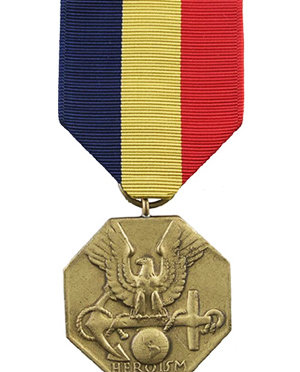
The Navy and Marine Corps Medal is an octagonal bronze medal.

The obverse of the Navy and Marine Corps medal depicts an eagle holding a fouled anchor over a globe. The word Heroism is inscribed below the globe. 

The medal’s ribbon is three equal stripes of navy blue, old gold, and apple red.

Additional awards of the medal are denoted by gold or silver ​516 inch stars.

Buy a Navy and Marine Corps Medal

Note: As an eBay partner, I earn from qualifying purchases. This is all done automatically when you use a link and at no extra cost to you.

Right Now on eBay 
Clicking a link to eBay may result in a referral commission being paid if a purchase is made.
Loading...

The Distinguished Service Medal (Navy & Marines)

The Navy Distinguished Service Medal is a military decoration created in 1919 for the United States Navy and United States Marine Corps.

  • Time PeriodThe Great War
  • Institution: 4 February 1919
  • Country: United States

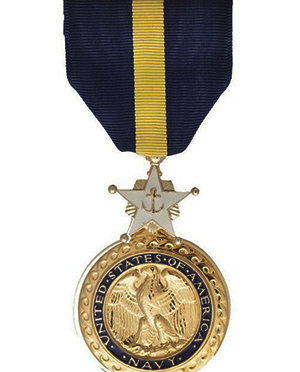
The Navy Distinguished Service Medal is a military decoration, first created in 1919, of the United States Navy and United States Marine Corps. It recognizes distinguished and exceptionally meritorious service to the country while serving in a duty or position of great responsibility.

At the start of World War I, the Navy had the Medal of Honor as the only decoration with which to recognize heroism. At a level below, the Navy Distinguished Service Medal and the Navy Cross were created by Public Law 253 on 4 February 1919. The Navy Distinguished Service Medal remained senior to the Navy Cross until August 1942, when the precedence of the two decorations was reversed. 

To justify this decoration, exceptional performance of duty must be clearly above that normally expected, and contributes to the success of a major command or project. The decoration is normally only bestowed to senior Navy flag officers and Marine Corps general officers, or extremely senior enlisted positions. In rare instances, it has also been awarded to Navy captains and Marine Corps colonels.

The Navy Distinguished Service Medal Design

The Navy Distinguished Service Medal is a gilt bronze medallion measuring 1.25 inches (32 mm) in diameter.

The obverse features an American bald eagle in the center displaying its wings (the eagle holds an olive branch in its right talon and arrows in its left talons and is surrounded by a blue enameled ring with the words “UNITED  STATES OF AMERICA” at the top and “NAVY” at the bottom).

Surrounding the blue enamel ring is a gold border of scroll waves depicted moving in a clockwise direction. The medal is surmounted by a white five-pointed star, point up, the points of the star being tipped with gold balls. In the center of the star is a blue anchor, while gold rays radiate between the arms of the star.

The reverse depicts a trident surrounded by a laurel wreath, and surrounded itselft by a blue enamel ring containing the inscription “FOR DISTINGUISHED SERVICE”

The medal’s suspension and service ribbon is navy blue with a single central stripe of yellow. Additional awards of the Navy Distinguished Service Medal are denoted by gold and silver 5/16 inch stars worn on the medal’s suspension and service ribbon.

Find This Medal Online

Right Now on eBay 
Clicking a link to eBay may result in a referral commission being paid if a purchase is made.
Loading...

The Hero of Socialist Labor Medal

The Hero of Socialist Labour Medal was the highest Soviet degree of distinction for exceptional achievements in national economy and culture.

The Hero of Socialist Labour Medal (or Геро́й Социалисти́ческого Труда́in Russian) was the highest degree of distinction for exceptional achievements in national economy and culture. It was introduced by decree of the Presidium of the Supreme Soviet of the Soviet Union on December 27, 1938 as an honorary title of the Soviet Union and other Warsaw Pact countries.

The first recipient of the award was Joseph Stalin, awarded by the Presidium of the Supreme Soviet in December 20, 1939. By 1991, at the dissolution of the Soviet Union, over 20,000 people had been awarded the title.

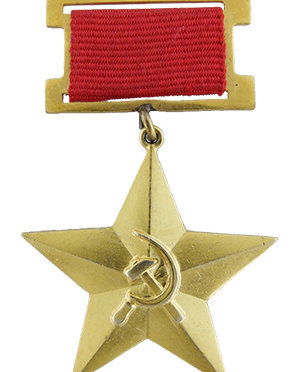
Originally, Heroes of Socialist Labour were awarded the highest decoration of the Soviet Union, the Order of Lenin and a certificate. In order to distinguish it from other Order of Lenin recipients, the “Hammer and Sickle” gold medal was introduced by decree of the Presidium on 22 May 1940. Heroes of Socialist Labour who attained further exceptional achievements were awarded a second “Hammer and Sickle” medal and bronze busts of the Heroes were to be constructed in their hometowns to mark the occasion.

The award provided a similar status to the title Hero of the Soviet Union Medal that was awarded for heroic deeds, but unlike the latter, was not awarded to foreign citizens.

The Hero of Socialist Labor Medal Design

The Honorary title was designed by the artist A. Pomansky as a five-pointed star with smooth dihedral rays on the obverse. The diameter of the star was 33.5 mm. In the center of the obverse, a relief hammer and sickle respectively of 14 and 13 mm. 

The reverse was plain and was surrounded by a slightly raised rim. In the center, the relief inscription “Hero of Socialist Labor” (“Герой Социалистического Труда” in Russian) in 2mm high letters, the award serial number was inscribed just above in 1mm high numbers. The medal weighed 15.25 grams.

The insignia was secured to a standard 25 X 15mm Soviet square mount by a ring through the suspension loop. The mount was covered by a red silk moiré ribbon.

The Hero of the Soviet Union Medal

The title Hero of the Soviet Union Medal was the highest distinction in the Soviet Union. It was established on April 16, 1934.

The title Hero of the Soviet Union Medal (or Герой Советского Союза in Russian) was the highest distinction in the Soviet Union. It was established on April 16, 1934, by the Central Executive Committee of the Soviet Union and was awarded personally or collectively for heroic feats in service to the Soviet state and society.

The first recipients of the title originally received only the Order of Lenin, the highest Soviet award, along with a certificate describing the heroic deed from the Presidium of the Supreme Soviet of the USSR.

Those who received the award were entitled to special privileges, which included a pension with survivor benefits, first priority on the housing list with 50% rent reduction, tax exempt, an annual round-trip first class airline ticket, free bus transportation, and medical and entertainment benefits.

In total, during the existence of the USSR, the title of Hero of the Soviet Union was awarded to 12,777 people, including twice – 154 (9 posthumously), three times – 3 and four – 2. Ninety-five women were awarded the title. The title could also be given to foreigners. In total, forty-four foreign citizens were awarded with it.

The Hero of the Soviet Union title was also given posthumously, though often without the actual Gold Star medal given.

The Hero of the Soviet Union Medal Design

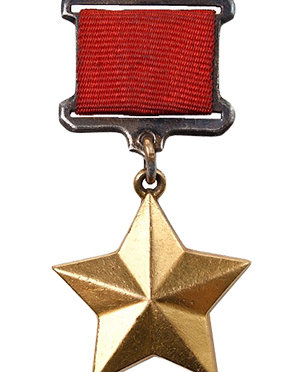
The medal is a gold star hanging from a rectangular suspension device. The medallion measures 32.5 mm in height including the eyelet, 30.3 mm in width; weighs 20.6 g not including the suspension and connecting link. The star is in 23 K gold; the suspension device is in gilded silver.  It has a ribbon in the color(s) of the issuing state (red for the USSR, white/blue/red for the Russian Federation, blue/yellow for Ukraine, red/green for Belarus).

The Hero of the Soviet Union is worn on the left side of the chest above all other orders and medals.

The Medal for Distinguished Labor (Russia)

The Medal For Distinguished Labor was an award of the Soviet Union established in 1938 and bestowed to especially deserving workers.

The Medal “For Distinguished Labor” (or Медаль «За трудовое отличие» in Russian) was a civilian labor award of the Soviet Union established on December 27, 1938 by decree of the Presidium of the Supreme Soviet of the USSR and bestowed to especially deserving workers to recognize and honor high performances in labor or contributions in the fields of science, culture or the manufacturing industry.

In just over fifty years of existence, the medal was bestowed to over two million deserving citizens. The first investiture took place on January 15, 1939 where the Medal “For Distinguished Labor” was presented to 19 employees of the Kalinin armaments plant number 8 for exceptional service to the country in the creation and development of new weapons for the Workers’ and Peasants’ Red Army.

Its statute was amended three times by further decrees and ceased to be awarded following the December 1991 dissolution of the Soviet Union.

The Medal for Distinguished Labor Medal Design

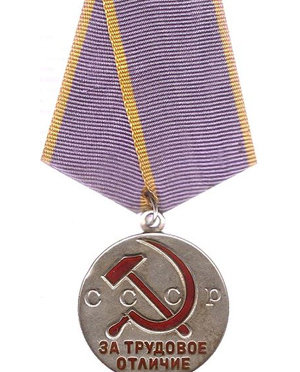
The Medal for Distinguished Labor measured 32 mm in diameter and is circular and struck from .925 silver with a raised rim on both sides.

In the upper 3/4 of the obverse, a 21 mm high by 20 mm wide ruby-red enameled image of the hammer and sickle over the relief inscription “USSR” («СССР») in 3.5 mm high letters. In the lower quarter of the obverse below the hammer and sickle, the sunken and red enameled inscription on two rows “FOR DISTINGUISHED LABOUR” («ЗА ТРУДОВОЕ ОТЛИЧИЕ») in 2 mm high letters. On the otherwise plain reverse, the relief inscription on two rows of 2.5 mm high letters “LABOUR IN THE USSR – A MATTER OF HONOUR” («ТРУД В СССР — ДЕЛО ЧЕСТИ»). The medal was numbered until 1945.

Early awards hung from a small triangular mount covered with a red ribbon with a threaded stub and screw for attachment to clothing. Following the 1943 decree, it was secured by a ring through the medal suspension loop to a standard Soviet pentagonal mount covered by a 24mm wide lilac colored silk moiré ribbon with 2 mm wide yellow edge stripes.

The Medal for Labor Valor (Russia)

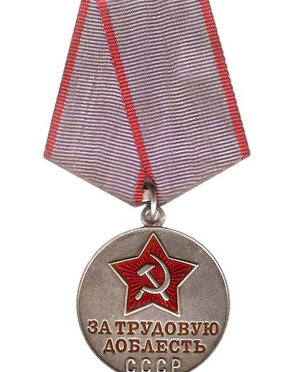
The Medal for Labor Valor (Медаль «За трудовую доблесть») was a civilian labor award of the Soviet Union established on December 27, 1938.

The Medal for Labor Valor (or Медаль «За трудовую доблесть» in Russian) was a civilian labor award of the Soviet Union established on December 27, 1938 by decree of the Presidium of the Supreme Soviet of the USSR and bestowed to especially deserving workers to recognize and honor dedicated and valorous labor or significant contributions in the fields of science, culture or the manufacturing industry.

The medal’s statute was amended three times by further decrees. During its existence of just over fifty years, it was bestowed to almost two million deserving citizens, including workers, farmers, specialists of the national economy, workers of science, culture, education, health and other to citizens of the USSR, and in exceptional cases, to foreign nationals.

The first investiture took place on January 15, 1939 where the Medal “For Labor Valor” was presented to 22 employees of the Kalinin armaments plant number 8 for exceptional service to the country in the creation and development of new weapons for the Workers’ and Peasants’ Red Army. The medal ceased to be awarded following the December 1991 dissolution of the Soviet Union.

The Medal for Labor Valor Medal Design

The medal measured 34 mm in diameter (some struck in 1945 measured 35 mm), was circular and struck from .925 silver with a raised rim on both sides.

In the upper obverse, a ruby-red enameled 19.2 mm wide five pointed star with a silver hammer and sickle at its center. Below the star, the inscription in two rows of sunken and red enameled 2.8 mm high letters “FOR VALOUR LABOUR” («ЗА ТРУДОВУЮ ДОБЛЕСТЬ»), at the very bottom, the relief inscription in 3.3 mm high letters “USSR” («СССР»). On the otherwise plain reverse, the relief inscription on two rows of 2.5 mm high letters “LABOUR IN THE USSR – A MATTER OF HONOUR” («ТРУД В СССР — ДЕЛО ЧЕСТИ»).

Early awards hung from a small triangular mount covered with a red ribbon with a threaded stub and screw for attachment to clothing. Following the 1943 decree, the medal was secured by a ring through the medal suspension loop to a standard Soviet pentagonal mount covered by a 24mm wide lilac coloured silk moiré ribbon with 2 mm wide red edge stripes.

The Medal For Battle Merit (Russia)

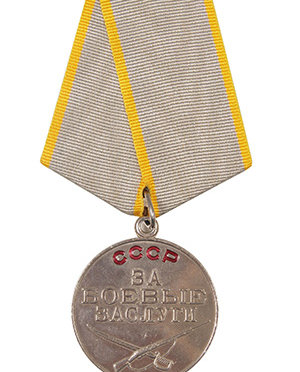
The Medal for Battle Merit was a Soviet military medal created in 1938 and awarded for combat action resulting in a military success.

The Medal for Battle Merit (or Медаль «За боевые заслуги» in Russian) was a Soviet military medal created on October 17, 1938 by the decision of the Presidium of the Supreme Soviet of the Soviet Union. It was awarded for “courageous defense of the state borders“, “combat action resulting in a military success” or “successful military and political training and preparation“.

The Medal for Battle Merit was Like the Medal for Courage, its status was revised to prevent the medal from being given for years of service (a practice that was rampant in the USSR) rather than actual bravery during a battle.

More than 5,210,000 medals were awarded between 1938 and 1991.

The Medal For Battle Merit Medal Design

The Medal for Battle Merit  is a 32mm in diameter circular silver color medal with a raised rim on both the obverse and reverse.

The medal is secured to a standard Russian pentagonal mount by a ring through the medal suspension loop. The mount is covered in a 24mm wide grey ribbon with a yellow 2mm edge stripe on each side.