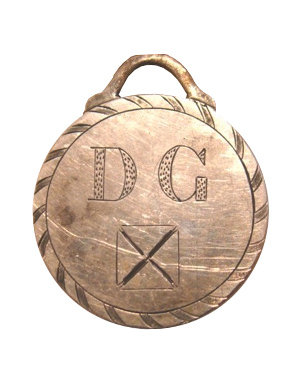
The Davis Guard Medal

The Davis Guard Medal is a military decoration bestowed by the State of Texas for the victory at the Second Battle of Sabine Pass.

The Davis Guard Medal is a military decoration bestowed by the State of Texas to the members of F Battery, 1st Texas Heavy Artillery Regiment, for the victory at the Second Battle of Sabine Pass. Some consider it to be the only medal issued by the Confederate States of America during the war.

The award was funded by a collection from Houston citizens. It was presented as a one-time award to exactly 50 men. In addition to the 49 members of the battery, the award was also presented to Jefferson Davis as the unit’s honorary commander. President Davis had his medal on him at the time of his capture in May 1865, but it was stolen by a Union soldier. A replacement was given him by three veterans in 1875.

The Davis Guard Medal Design

The medal consisted of a silver Mexican coin polished smooth with the letters “DG” on the front above a cross pattee. The reverse bore the inscription “Sabine Pass Sept. 23, 1864” in cursive script.

The medal hung from a green ribbon, in honor of the Irish origins of the unit’s members. The 50 recipients of the Davis Guard Medal were also listed on the Confederate Roll of Honor.
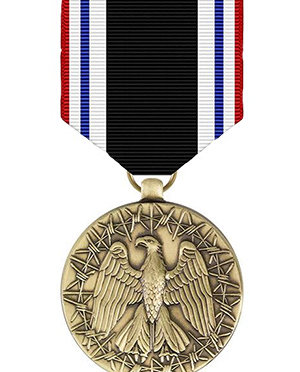
The Prisoner of War Medal (USA)

The Prisoner of War Medal is a military award authorized by Congress and signed into law by President Ronald Reagan on 8 November 1985.

The Prisoner of War Medal is a military award of the United States Armed Forces that was authorized by Congress and signed into law by President Ronald Reagan on 8 November 1985. It is awarded to any person who was taken prisoner or held captive while engaged in an action against an enemy of the United States; while engaged in military operations involving conflict with an opposing Armed Force; or while serving with friendly forces engaged in armed conflict against an opposing Armed Force in which the United States is not a belligerent party.

The Prisoner of War Medal may be awarded to any person who was a prisoner of war after April 5, 1917 (the date of the United States’ entry into World War I was April 6). The person’s conduct, while in captivity, must have been honorable. This medal may be awarded posthumously to the surviving next of kin of the recipient. 

Due to a provision in the FY1996 National Defense Authorization Act, service secretaries are required to award the Purple Heart to any POW Medal recipients wounded in captivity. The law specified that “[a] person shall be considered to be a former prisoner of war for purposes of this section if the person is eligible for the prisoner-of-war medal under section 1128 of title 10, United States Code.”

The Prisoner of War Medal Design

The medal was designed by Jay C. Morris of the United States Army Institute of Heraldry. The activities of the institute encompass research, design, development, standardization, quality control, and other services relating to official symbolic items—seals, decorations, medals, insignia, badges, flags, and other items awarded to or authorized for official wear or display by government personnel and agencies. Limited research and information services concerning official symbolic items are also provided to the general public. The Institute of Heraldry is located at Fort Belvoir, a military installation within the metropolitan area of Washington, D.C. The staff consists of thirty-two civilians.

No more than one Prisoner of War Medal may be awarded. For any subsequent award of the medal, service stars will be awarded and worn on the suspension and service ribbon of the medal.

The Coast Guard Commendation Medal

The Coast Guard Commendation Medal is a United States military decoration presented for sustained acts of heroism or meritorious service.

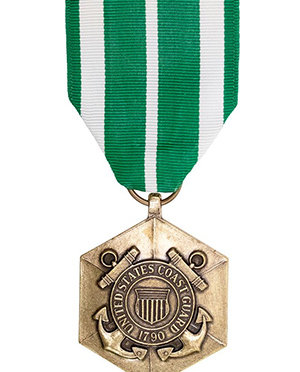
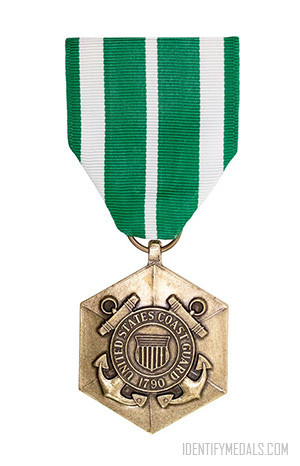
The Coast Guard Commendation Medal is a mid-level United States military decoration that is presented for sustained acts of heroism or meritorious service within the Coast Gard forces. Each branch of the United States Armed Forces has its own version of this medal, with a fifth version existing for acts of joint military service performed under the Department of Defense.

The U.S. Coast Guard awards a separate Coast Guard Commendation Medal, with a ribbon similar in design to that of its Navy and Marine Corps counterparts. This was initially established as the Coast Guard Commendation Ribbon in 1947, and redesignated as the Coast Guard Commendation Medal in 1959. 

The Coast Guard Commendation Medal Design

The Commendation Medal was originally only a service ribbon awarded by the U.S. Navy and U.S. Coast Guard (this was around 1943). In 1949, the Navy, Coast Guard, and Army Commendation ribbons were renamed the “Commendation Ribbon with Metal Pendant” and by 1960, the ribbons were authorized as full medals.

The Coast Guard Commendation Medal is gold with silver 5/16 inch stars to denote additional awards. 

Other Commendation Medals

The different versions of the Commendation Medal in the United States military are typically associated with specific branches of service. While the criteria for receiving the Commendation Medal remain similar across branches, the designs may vary to reflect the unique identity and traditions of each service.

Buy a Commendation Medal

Note: As an eBay partner, I earn from qualifying purchases. This is all done automatically when you use a link and at no extra cost to you.

Right Now on eBay 
Clicking a link to eBay may result in a referral commission being paid if a purchase is made.
Loading...

The Army Commendation Medal

The Army Commendation Medal is a mid-level U.S. military decoration presented for sustained acts of heroism or meritorious service.

The Army Commendation Medal is a mid-level United States military decoration that is presented for sustained acts of heroism or meritorious service. Each branch of the United States Armed Forces has its own version of this medal, with a fifth version existing for acts of joint military service performed under the Department of Defense.

The Army Commendation Medal is awarded to any member of the Armed Forces of the United States other than General Officers who, while serving in any capacity with the U.S. Army after December 6, 1941, distinguished themselves by heroism, meritorious achievement or service. The medal can also be awarded to a member of another branch of the U.S. Armed Forces or of a friendly foreign nation who, after June 1, 1962, distinguishes themselves by an act of heroism, extraordinary achievement, or significant meritorious service which has been of mutual benefit to the friendly nation and the United States.

The Army Commendation Medal Design

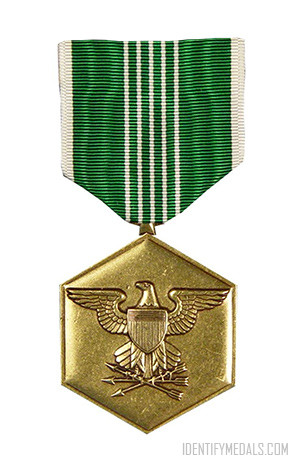
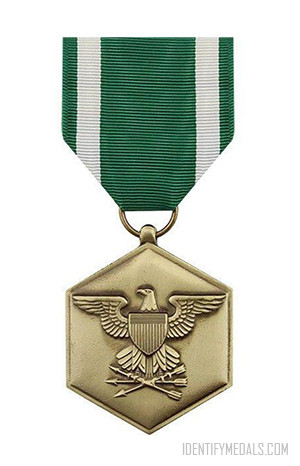
The medallion of the Army Commendation Medal is a bronze hexagon, 1​38 inches wide. On the obverse of the medallion is an American bald eagle with wings spread horizontally, grasping in its talons three crossed arrows. On its breast is a shield paly of thirteen pieces and a chief.

The reverse bears a panel for naming between the words FOR MILITARY above and MERIT below, all placed above a laurel sprig. The ribbon is 1​38 inches wide, primarily of myrtle green. It is edged in white, and in the center are five thin white stripes spaced equally apart.

Devices:
  • Oak leaf cluster (for subsequent awards)
  • “V” Device (for valorous actions in direct contact with an enemy)
Combat Commendations:
 
  • “C” Device (for meritorious service or achievement under combat conditions. Unofficially called the Combat Commendation. Retroactive Awards are not authorized for medals awarded before 7 January 2016) 
  • “R” Device (for direct and immediate impact on combat operations from a remote location) 

Other Commendation Medals

The different versions of the Commendation Medal in the United States military are typically associated with specific branches of service. While the criteria for receiving the Commendation Medal remain similar across branches, the designs may vary to reflect the unique identity and traditions of each service.

Buy a Commendation Medal

Note: As an eBay partner, I earn from qualifying purchases. This is all done automatically when you use a link and at no extra cost to you.

Right Now on eBay 
Clicking a link to eBay may result in a referral commission being paid if a purchase is made.
Loading...

The Joint Service Commendation Medal

The Joint Service Commendation Medal is a mid-level United States military decoration presented for sustained acts of heroism or service.

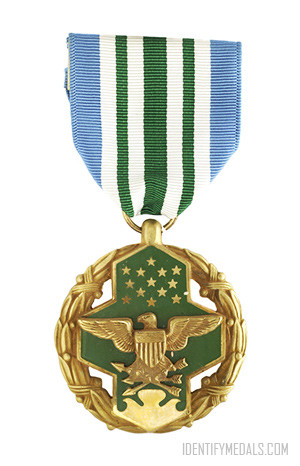
The Joint Service Commendation Medal is a military decoration of the United States that is presented for meritorious service and/or sustained acts of heroism. It is a mid-level decoration, which each branch of the Armed Forces having its own version.

The medal was established on 25 June 1963. It is given in the name of the Secretary of Defense to members of the United States Armed Forces who have distinguished themselves in a joint duty capacity. The award i designed to recognize senior service and precedes server-specific Commendation Medals (therefore, it’s worn above them in the uniform).

How Many Commendation Medals Are There?

Each branch of the United States Armed Forces issues its own version of the Commendation Medal, with a fifth version existing for acts of joint military service performed under the Department of Defense. These are:

Joint Service Commendation Medal Devices

There is a Commendation Medal with “V” Device or Combat “V” given for valorous actions in direct contact with an enemy. It is of a lesser degree than the Bronze Star Medal. A “C” Device or Combat “C” was created on January 7, 2016 for wear on the service and suspension ribbon of the Commendation Medal (it’s awarded for meritorious service or achievement under arduous combat conditions; for example, when someone was personally exposed to hostile action. The Operational Distinguishing Device (or “O” device)can be worn on the Coast Guard Commendation Medal upon approval. Its Order of Precedence is following the Air Medal but before the Prisoner of War Medal and all campaign medals. 

The Joint Service Commendation Medal Design

The Commendation Medal consisted of, initially, just a service ribbon awarded to the Navy and Coast Guard (1943). In 1949, the Navy, Coast Guard, and Army Commendation ribbons were renamed to the “Commendation Ribbon with Metal Pendant,” but by 1960 the ribbons were changed into full medals.

The Navy and Marine Corps Commendation Medal and the Coast Guard Commendation Medal are gold, with silver 5/16 inch stars to denote additional awards.

Additional awards are denoted by bronze and silver oak leaf clusters.

Buy a Commendation Medal

Note: As an eBay partner, I earn from qualifying purchases. This is all done automatically when you use a link and at no extra cost to you.

Right Now on eBay 
Clicking a link to eBay may result in a referral commission being paid if a purchase is made.
Loading...

The Air Force and Space Force Commendation Medal

The Air Force & Space Force Commendation Medal is a United States military decoration presented for sustained acts of heroism and service.

The Air Force & Space Force Commendation Medal is a mid-level United States military decoration that is presented for sustained acts of heroism or meritorious service. Each branch of the United States Armed Forces has its own version of this medal, with a fifth version existing for acts of joint military service performed under the Department of Defense.

The U.S. Air Force began issuing its own Air Force Commendation Medal in 1958, with additional awards denoted by oak leaf clusters. Prior to this time, USAF recipients received the Army Commendation Medal. It was not until 1996 that the “V” device was authorized on the Air Force Commendation Medal; prior to 1996, there was not a valor distinction in effect for the Air Force Commendation Medal. On January 7, 2016, the “C” device and “R” device was authorized on the Air Force Commendation Medal as well. For USAF enlisted personnel, the Air Force Commendation Medal is worth three points under the Air Force enlisted promotion system.

The Air Force Commendation Medal is awarded to both American and foreign military personnel of any service branch in the U.S. military grade of O-6 and below, the NATO grade of OF-5 and below, or of any other Allied or Coalition nation in the grade of Colonel or equivalent or below, or the naval grade of Captain or equivalent or below, who have performed noteworthy service in any capacity with the United States Air Force.

The Air Force & Space Force Commendation Medal Design

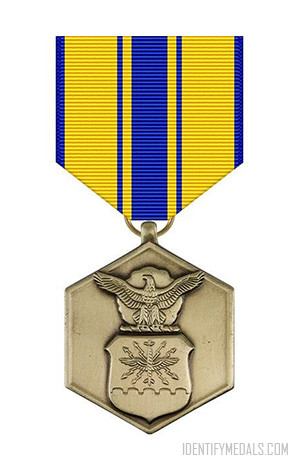
The Air Force Commendation Medal is a bronze hexagonal medallion. On the medallion is a shield surmounted by an eagle superimposed over clouds. On the shield bears a pair of flyer’s wings and a vertical baton with an eagle’s claw at either end; behind the shield are eight lightning bolts. The design on the shield is derived from the Seal of the Department of the Air Force. The ribbon of the Air Force Commendation Medal is golden yellow with blue edges. In the center are three bands of blue, the outer stripes are thin with the center stripe being wider.

Devices:
  • Oak leaf cluster (for subsequent awards)
  • “V” device (for valorous actions in direct contact with an enemy)
  • “C” device (for meritorious service in direct contact with an enemy)
  • “R” device (for employment of a remote weapon system during military operations)

Other Commendation Medals

The different versions of the Commendation Medal in the United States military are typically associated with specific branches of service. While the criteria for receiving the Commendation Medal remain similar across branches, the designs may vary to reflect the unique identity and traditions of each service.

Buy a Commendation Medal

Note: As an eBay partner, I earn from qualifying purchases. This is all done automatically when you use a link and at no extra cost to you.

Right Now on eBay 
Clicking a link to eBay may result in a referral commission being paid if a purchase is made.
Loading...

The Navy & Marine Corps Commendation Medal

The Navy & Marine Corps Commendation Medal is a United States military decoration presented for sustained acts of heroism and service.

The Commendation Medal is a mid-level United States military decoration that is presented for sustained acts of heroism or meritorious service. Each branch of the United States Armed Forces has its own version of this medal, with a fifth version existing for acts of joint military service performed under the Department of Defense.

After the First World War, the Department of the Navy authorized the Navy Commendation Star, a ribbon device to be placed on the World War I Victory Medal. An independent Navy Commendation Ribbon was established in November 1943. On 22 March 1950 a metal pendant (of the same design as the pendant of the Army Commendation Medal) was authorized and the Commendation Ribbon was renamed the Navy Commendation Ribbon with Metal Pendant. This award was re-designated as the Navy Commendation Medal in September 1960, and renamed the Navy and Marine Corps Commendation Medal in 1994.

In contrast to the Army and the Air Force, in the U.S. Navy and U.S. Marine Corps, the Navy and Marine Corps Commendation Medal has historically considered its commendation medal to be a higher level and less frequently awarded decoration.

The Navy & Marine Corps Commendation Medal Design

The Commendation Medal was originally only a service ribbon and was first awarded by the U.S. Navy and U.S. Coast Guard in 1943. An Army Commendation Ribbon followed in 1945, and in 1949, the Navy, Coast Guard, and Army Commendation ribbons were renamed the “Commendation Ribbon with Metal Pendant”. By 1960, the Commendation Ribbons had been authorized as full medals and were subsequently referred to as Commendation Medals.

Additional awards of the Army and Air Force Commendation Medals are denoted by bronze and silver oak leaf clusters. The Navy and Marine Corps Commendation Medal and Coast Guard Commendation Medal are authorized gold and silver 5/16 inch stars to denote additional awards. The Operational Distinguishing Device (“O” device) is authorized for wear on the Coast Guard Commendation Medal upon approval of the awarding authority. Order of Precedence is following the Air Medal but before the Prisoner of War Medal and all campaign medals. Each of the military services also awards separate Achievement Medals which are below the Commendation Medals in precedence.

Other Commendation Medals

The different versions of the Commendation Medal in the United States military are typically associated with specific branches of service. While the criteria for receiving the Commendation Medal remain similar across branches, the designs may vary to reflect the unique identity and traditions of each service.

Buy a Commendation Medal

Note: As an eBay partner, I earn from qualifying purchases. This is all done automatically when you use a link and at no extra cost to you.

Right Now on eBay 
Clicking a link to eBay may result in a referral commission being paid if a purchase is made.
Loading...

The Distinguished Flying Cross (United States)

The Distinguished Flying Cross is an American military decoration for operations by heroism or extraordinary achievement.

The Distinguished Flying Cross is an American military decoration awarded to any officer or enlisted member of the United States Armed Forces who distinguishes himself in support of operations by “heroism or extraordinary achievement while participating in an aerial flight, subsequent to November 11, 1918.”

The first award of the Distinguished Flying Cross was made by President Calvin Coolidge on May 2, 1927, to ten aviators of the U.S. Army Air Corps 🔗 who had participated in the Army Pan American Flight which took place from December 21, 1926, to May 2, 1927. Two of the airmen died in a mid-air collision trying to land at Buenos Aires on February 26, 1927, and received their awards posthumously.
Charles Lindbergh 🔗 received the first presentation of the actual medal about a month later from Coolidge during the Washington, D.C. homecoming reception on June 11, 1927, from his trans-Atlantic flight.

The medal had hurriedly been struck and readied just for that occasion. The first Distinguished Flying Cross to be awarded to a Naval aviator was received by Commander Richard E. Byrd 🔗, USN for his trans-Atlantic flight from June 29 to July 1, 1927, from New York City to the coast of France. Byrd and his pilot Machinist Floyd Bennett 🔗 had already received the Medal of Honor for their historic flight to the North Pole on May 9, 1926.

During World War II, the medal’s award criteria varied widely depending on the theater of operations, aerial combat, and the missions accomplished. In the Pacific, commissioned officers were often awarded the DFC, while enlisted men were given the Air Medal. In Europe, some crews received it for performances throughout a tour of duty, and different criteria were used elsewhere.

The Distinguished Flying Cross in World War II

During World War II, the Distinguished Flying Cross (DFC) was awarded to numerous individuals for their exceptional actions and achievements in aerial combat and aviation operations. Here are a few examples of people who received the DFC for their actions during this time:

  • Lieutenant Colonel Jimmy Doolittle 🔗: Jimmy Doolittle, an American aviator and Air Force general, was awarded the Distinguished Flying Cross for leading the famous Doolittle Raid in April 1942. This daring mission involved the first U.S. air raid on the Japanese mainland, boosting American morale after the devastating attack on Pearl Harbor.

  • Lieutenant Richard I. Bong 🔗: Richard I. Bong, a U.S. Army Air Forces pilot, was awarded the DFC multiple times during World War II. Bong became one of the most successful American fighter aces, achieving 40 confirmed aerial victories. His exceptional skills and bravery earned him the distinction of being the highest-scoring American ace of the war.

  • Lieutenant Colonel John C. Meyer 🔗: John C. Meyer, a fighter pilot in the U.S. Army Air Forces, earned the DFC for his courageous actions during the air campaign in Europe. He was recognized for his exceptional leadership and flying skills, notably during the Battle of the Bulge, where he achieved aerial victories against German aircraft.

  • Lieutenant Colonel Robert M. Hanson 🔗: Robert M. Hanson, a Marine Corps aviator, was awarded the Distinguished Flying Cross for his extraordinary actions as a dive-bomber pilot in the Pacific Theater. He demonstrated exceptional accuracy and bravery in attacking enemy targets, notably during the Battle of Guadalcanal.

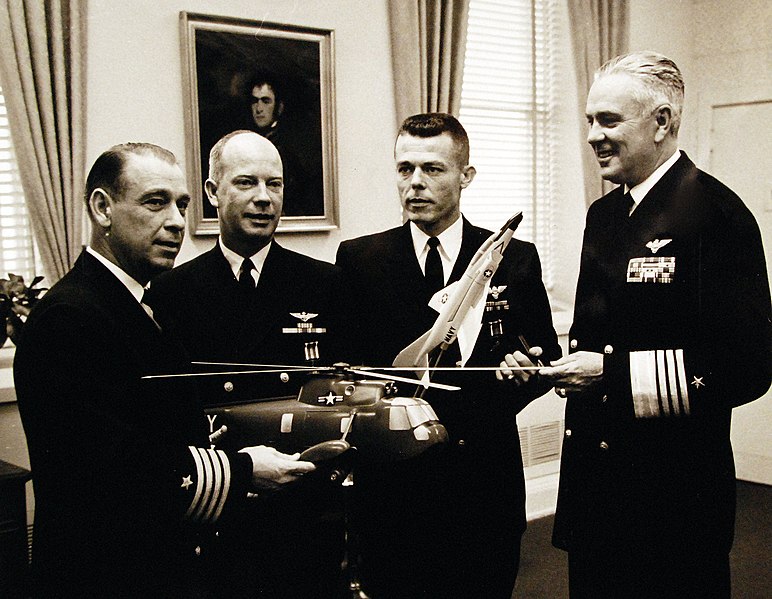
Three Naval Aviators were presented Distinguished Flying Crosses by Chief of Naval Operations Admiral George W. Anderson, USN, (right), in Pentagon ceremonies.
Three Naval Aviators were presented Distinguished Flying Crosses by Chief of Naval Operations Admiral George W. Anderson, USN, (right), in Pentagon ceremonies. Image courtesy of Wikipedia.

The Distinguished Flying Cross Design

The Distinguished Flying Cross is a bronze cross pattee designed by Elizabeth Will and Arthur E. DuBois.

On the obverse is superimposed a four-bladed propeller, 1 11/16 inches in width. Five rays extend from the reentrant angles, forming a one-inch square. The reverse is blank; it is suitable for engraving the recipient’s name and rank. The cross is suspended from a rectangular bar.

The suspension and service ribbon of the medal is 1 3/8 inches wide and consists of the following stripes: 3/32 inch Ultramarine Blue 67118; 9/64 inch White 67101; 11/32 inch Ultramarine Blue 67118; 3/64 inch White 67101; center stripe 3/32 inch Old Glory Red 67156; 3/64 inch White 67101; 11/32 inch Ultramarine Blue 67118; 9/64 inch White 67101; 3/32 inch Ultramarine Blue 67118.

Additional awards of the Distinguished Flying Cross are shown with bronze or silver Oak Leaf Clusters for the Army and Air Force, and gold and silver ​516 Inch Stars for the Navy, Marine Corps, and Coast Guard. The Air Force, Navy, and Marine Corps may authorize the “V” device for wear on the DFC to denote valor in combat; Navy and Marine Corps, Combat “V”.

Fin da Distinguished Flying Cross Design

Right Now on eBay 
Clicking a link to eBay may result in a referral commission being paid if a purchase is made.
Loading...

The Air Medal (USA)

The Air Medal is a decoration of the U.S. Armed Forces created in 1942 and awarded for single acts of heroism or meritorious achievement.

The Air Medal is a military decoration of the United States Armed Forces created in 1942 by Executive Order 9158, signed by Franklin D. Roosevelt. It is awarded for single acts of heroism or meritorious achievement while participating in aerial flight.

The Air Medal is awarded for a variety of accomplishments, including acts of heroism, successful completion of numerous combat missions, participation in aerial combat, or extraordinary performance of aviation duties. It recognizes the significant contributions and sacrifices made by aviators and aircrew members.

The U.S. Air Medal Criteria

The original award criteria set by an Army Policy Letter dated September 25, 1942 was for one award of the Air Medal:

  • per each naval vessel or three enemy aircraft in flight confirmed destroyed. An entire aircrew would be credited for the destruction of a ship, but only the pilot or gunner responsible would be credited for destroying an enemy aircraft.
  • per 25 operational flights during which exposure to enemy fire is expected.
  • per 100 operational flights during which exposure to enemy fire is not expected.

These criteria were altered by the commanding generals of each numbered Air Force to fit the conditions of their theater of operations and to maintain morale.

The Distinguished Flying Cross would usually be awarded for roughly twice to five times the requirements of the Air Medal. This led to automatic “score card” awards of the Air Medal and Distinguished Flying Cross for completing a set number of operational missions rather than distinguished service, meritorious action, or bravery, as had been intended. On August 5, 1943, such score card awards were officially abolished by a Headquarters Army Air Forces Awards Board memorandum due to the embarrassment when airmen received the Air Medal for “score carding” five missions or more but were later removed from flying duties for “lack of moral fibre“. Commanders could still issue the awards on those grounds, but the recipient must perform exceptional or meritorious service as well.

During World War II, the medal’s award criteria varied widely depending on the theater of operations, the aircraft flown, and the missions accomplished. The Army may award the Air Medal for peacetime service, but approval authority is by general-grade officers at the group or brigade level or higher.

The Air Medal Design

The Air Force medal design is prescribed by law. It was created by Walker Hancock, who had competed for the design as a civilian, but prior to the award of the competition had been inducted into the army.

The Air Medal is a Bronze compass rose 1​1116 inches circumscribing diameter and charged with an eagle volant carrying two lightning flashes in its talons. A fleur-de-lis at the top point holds the suspension ring. The points of the compass rose on the reverse are modeled with the central portion plain for engraving the name of the recipient.

The ribbon is 1​38 inches wide and consists of the following stripes:

  1. 18 inch Ultramarine Blue 67118;
  2. ¼ inch Golden Orange 67109;
  3. center ​58 inch Ultramarine Blue;
  4. ¼ inch Golden Orange; and
  5. 18 inch Ultramarine Blue.

Buy an Air Medal

Note: As an eBay partner, I earn from qualifying purchases. This is all done automatically when you use a link and at no extra cost to you.

Right Now on eBay 
Clicking a link to eBay may result in a referral commission being paid if a purchase is made.
Loading...

The Pilot / Observer Badge of the Luftwaffe

The Pilot/Observer Badge (or Flugzeugführer- und Beobachterabzeichen in German) was a WW2 German decoration instituted by Hermann Göring.

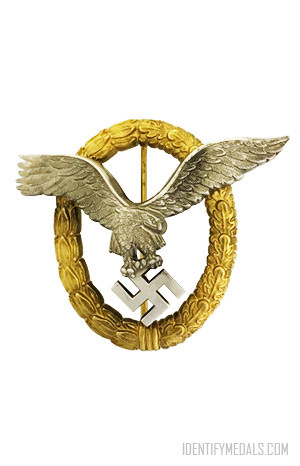
The Pilot/Observer Badge (or Flugzeugführer- und Beobachterabzeichen in German) was a World War II German military decoration instituted on 26 March 1936 by the Commander in Chief of the Luftwaffe Hermann Göring and awarded to Luftwaffe service personnel who had already been awarded the Pilot’s Badge and Observer Badge.

It was  It was worn on the lower part of the left breast pocket of the service tunic, underneath the Iron Cross 1st Class if awarded. It was to replace the older 1933 Aircrew Badge.

The Pilot/Observer Badge Design

The badge was originally manufactured in bronze, and later zinc. The badge can be distinguished from the Pilot’s Badge by the gold wreath; the Pilot’s Badge had a silver wreath.

There was also a cloth version of the badge which used embroidered bullion for the officer’s version and cotton for the NCO’s version. The presentation case was dark blue, with a blue satin top liner and a blue velvet bottom liner on the inside.

There is an exclusive variant of the Pilot/Observer Badge in Gold with Diamonds (or Gemeinsame Flugzeugführer- und Beobachterabzeichen in Gold mit Brillanten in German). It was bestowed by Göring to honour exceptional achievement and on rare occasions as an honorary award. The first recipients were General Walther Wever, Chief of the Luftwaffe General Staff and General der Flieger Erhard Milch, State Secretary of the Reichsluftfahrtministerium on 11 November 1935.

More Luftwaffe War Badges

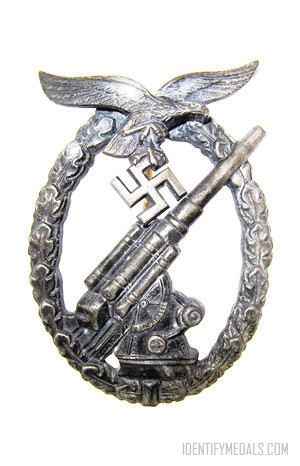
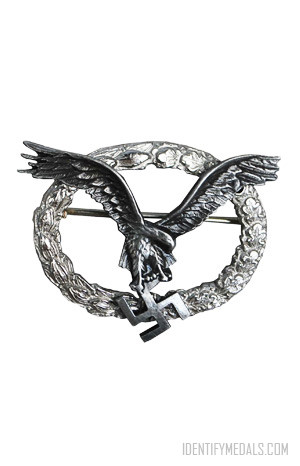
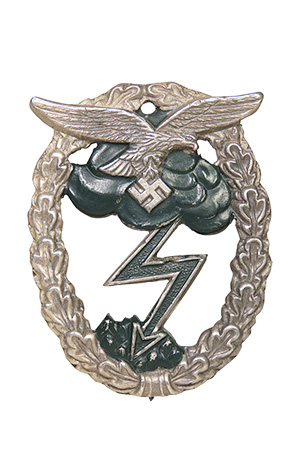
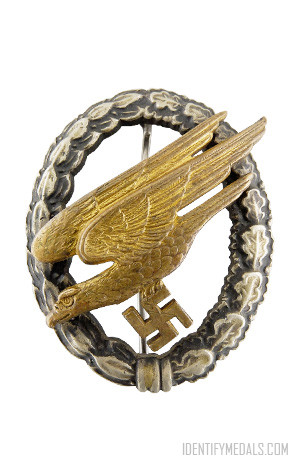
Awarded to members of the German Luftwaffe for their achievements and contributions to air warfare, the Luftwaffe War Badges symbolized excellence, courage, and skill in aerial combat and support roles. Explore the complete collection below: