The National Order of Vietnam

The National Order of Vietnam was a military-civilian decoration and the highest honor that could be bestowed by the Republic of Vietnam.

The National Order of Vietnam (or Bảo-Quốc Huân-Chương in Vietnamese) was a military-civilian decoration created in 1950 and considered the highest honor that could be bestowed upon an individual by the Republic of Vietnam government.

The decoration was awarded to any person who performed “grandiose works, remarkable deeds, exhibited bravery, or for those who have honored and served the country by lofty virtues and outstanding knowledge.”

During the Vietnam War, the National Order of Vietnam was bestowed on several members of the United States military, most of whom were senior military and political advisors to the South Vietnamese government. The decoration could also be awarded posthumously.

The National Order was modeled after the French Legion of Honour, and issued in five degrees:

  • Grand Cross;
  • Grand Officer;
  • Commander;
  • Officer; and
  • Knight.

The National Order of Vietnam Design

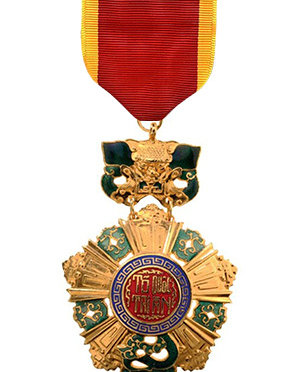
Both the badge and the star of the National Order of Vietnam have the same design. The ribbon, red with yellow borders, was in fact the ribbon of the former Order of the Dragon of Annam when awarded by the Emperor of Annam himself (when awarded by the French Government the ribbon was green with orange borders).

Since the National Order of Vietnam was both a civil and a military decoration, it was displayed above all other awards when worn on a military uniform.
The Vietnam Liberation Order

The Liberation Order Badge is a military badge given by North Vietnam during the Vietnam War and awarded for outstanding performance

The Liberation Order Badge is a military badge given by North Vietnam during the Vietnam War originally instituted on August 9, 1965 and awarded t0 groups and individuals for outstanding performance in combat, production, official-business and to families separated by the struggle in the South.

The original order was eventually replaced by an entirely different and larger (40mm) planchet and its ribbon changed. The Order was adopted as an official order of the Socialist Republic of Vietnam (SRV).

The Vietnam Liberation Order Design

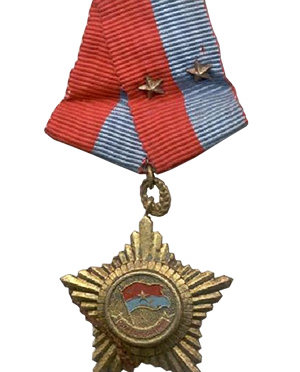
The early version of the National Liberation Front (NLF or Viet Cong) Liberation Order is a 37mm five-pointed star with seven rays between each point.

The obverse is a central disk with the NLF flag between two shocks of grain and a toothed-gear below. The inscription of the curved ribbon reads, GIAI PHONG or “Liberation”. The reverse is plain. The affiliated decoration, also an official decoration of the SRV, retains the original characteristics of the early order. The decoration is smaller (33mm) and utilizes the same blue-red-blue ribbon combination as the original version of the order.

The Defeat American Aggression Badge

The Defeat American Aggression Badge is a military badge established in 1965 and given during the Vietnam War by North Vietnam.

The Defeat American Aggression Badge is a military badge established in 1965 and given during the Vietnam War by North Vietnam. The badge was awarded to units and individuals who performed outstanding services against American forces. This included any individual, who took part in combat after August 2, 1964, and received a commendation or the appellation good fighter.

The Defeat American Aggression Badge Design

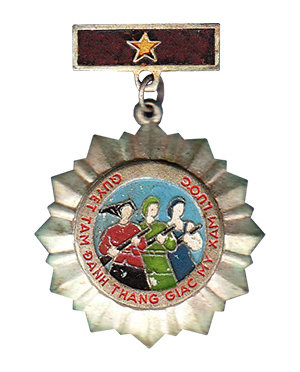
The Defeat American Aggression Badge is a tiny (measuring 30mm) and colorful badge.

The obverse of the 12-pointed star depicts three women clutching rifles. The red blouse represents farmers, the green blouse represents soldiers and the blue blouse represents the workers. The inscription reads, QUYET-TAM-DANH-THANG GIAC MY XAM-LUOC (“Resolved to defeat American Aggression”).

The badge is suspended from a red, hero-style bar, with a gold star. The bar measures 19mm by 5mm.

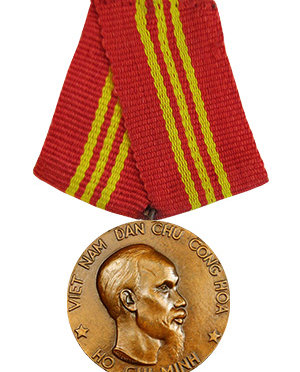
The Order of Ho Chi Minh

The Order of Ho Chi Minh is a decoration of the Socialist Republic of Vietnam that was first instituted in 1947 by president Hồ Chí Minh.

The Order of Ho Chi Minh (or Huân chương Hồ Chí Minh in Vietnamese) is a decoration of the Socialist Republic of Vietnam that was first instituted on 6 June 1947 by president Hồ Chí Minh. Currently, the Ho Chi Minh Order is the second highest national order of the Socialist Republic of Vietnam.

The Order is conferred (can be done posthumously) on individuals who have rendered great meritorious services, recorded numerous outstanding achievements in one of the political, economic, social, literature, art, scientific, technological, defense, security, diplomatic or other domains.

When first instituted, the Ho Chi Minh Order had 3 classes, but since 1981 the Order has become a single one. The Order is bestowed on citizens who have rendered outstanding services to the State, or members of the Vietnamese People’s Armed Forces for acts of bravery in action against an enemy force. The decoration may also be awarded to cities, regions, collectives, military units and ships for the same reasons.

The Order of Ho Chi Minh Design

The medal is round and struck in bronze, and features the portrait of President Hồ Chí Minh in profile.

The National Defense Service Medal

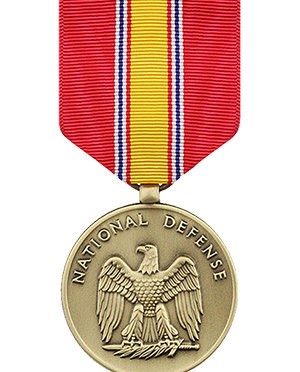
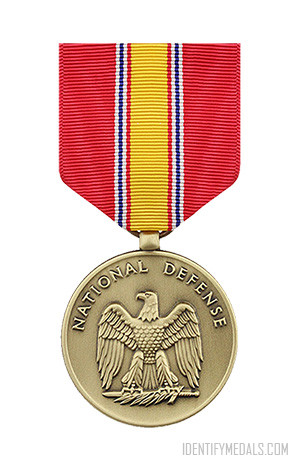
The National Defense Service Medal (NDSM) is a service medal of the United States Armed Forces created by President Eisenhower in 1953. 

The National Defense Service Medal (or NDSM) is a service medal of the United States Armed Forces established by President Dwight D. Eisenhower in 1953. Currently, the National Defense Service Medal is the oldest service medal (as opposed to decorations for particular achievements) currently awarded by all branches of the United States Armed Forces.

It was first intended to be a “blanket campaign medal” awarded to service members who served honorably during a designated time period of which a “national emergency” had been declared during a time of war or conflict. It may also be issued to active military members for any other period that the Secretary of Defense designates. While no document is known which explains the rationale for the award, it was apparently established to recognize all service members who served during the Korean War to include those who did not serve in the war zone.

To date, the NDSM has been awarded for four specific time periods, which roughly correspond to the Korean, Vietnam and Gulf War eras as well as the Global War on Terrorism. As the NDSM has been awarded to all military personnel during four wartime periods, it has millions of recipients and is probably the most widely awarded medal in the history of the United States military, with the possible exception of World War II Victory Medal.

The National Defense Service Medal Design

The obverse of the medal shows a North American bald eagle, perched on a sword and palm. Above this, in a semicircle, is the inscription “National Defense“. The reverse shows a shield, taken from the coat of arms of the United States; it is half encircled below with an open wreath, the right side of oak leaves and laurel leaves the left.

The ribbon has a wide yellow stripe in the center, flanked by narrow stripes of red, white, blue, white and wide red stripes.

How Do You Request a National Defense Service Medal?

If you are eligible for the National Defense Service Medal (NDSM) and need to request a replacement or a new one, you can typically do so through the appropriate military branch’s records office or the National Personnel Records Center (NPRC).

You can submit your request through various means, including mail, fax, email, or online, depending on the specific requirements of the records office you are dealing with.

Buy a National Defense Service Medal

Right Now on eBay 
Clicking a link to eBay may result in a referral commission being paid if a purchase is made.
Loading...

Other Service Medals

A service medal is a type of military decoration awarded to members of the armed forces, government employees, and, in some cases, civilians in recognition of their service, participation in specific military campaigns, or the fulfillment of certain criteria. Here are related to this one:

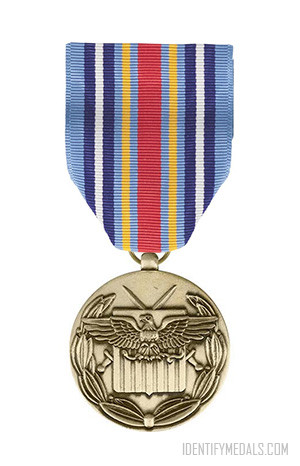
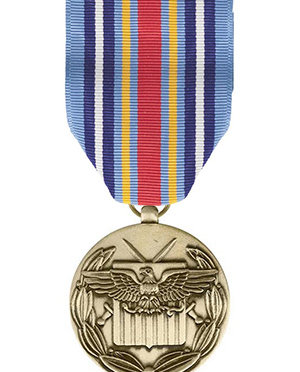
The Global War on Terrorism Expeditionary Medal

The Global War on Terrorism Expeditionary Medal (or GWOT-EM) is a United States Armed Forces award created by George W. Bush on 12 March 2003

The Global War on Terrorism Expeditionary Medal (or GWOT-EM) is a United States Armed Forces award created by George W. Bush on 12 March 2003, to recognize those military service members who have deployed overseas in direct service to the War on Terror from 11 September 2001 to a date to be determined.

To be awarded the Global War on Terrorism Expeditionary Medal a military service member must perform duty in a deployed status and must participate in designated anti-terrorism operation for a period of either 30 consecutive or 60 non-consecutive days of duty. For those who were engaged in combat, killed, or wounded in the line of duty (for example, those injured and requiring medical evacuation), the time requirement is waived.

Prior to 30 April 2005, the medal was awarded for service within Iraq and Afghanistan, but has been replaced with the Iraq Campaign Medal and Afghanistan Campaign Medal and now serves primarily as recognition for personnel who have deployed in support of the War on Terror to locations beyond Iraq and Afghanistan.

The Medal Service Stars

The Global War on Terrorism Expeditionary Medal may be awarded with service stars denoting subsequent awards of the medal. Each service star represents a subsequent deployment or campaign for which the medal was awarded.

These stars are typically worn on the suspension and service ribbon of the medal to indicate multiple awards of the GWOT-EM. Service members who have been deployed to multiple qualifying areas or campaigns in support of the Global War on Terrorism may receive additional service stars to recognize each deployment or campaign.

The Medal Operations

Some of the major approved operations and campaigns that qualify for the GWOT-EM include:

  1. Operation Enduring Freedom (OEF): This operation encompasses military operations in Afghanistan and other locations to combat terrorism and support the Afghan government.

  2. Operation Iraqi Freedom (OIF): This operation involved military operations in Iraq to remove Saddam Hussein’s regime and combat insurgency.

  3. Operation New Dawn: This operation succeeded Operation Iraqi Freedom and focused on supporting the Iraqi government and security forces after the withdrawal of U.S. combat troops.

  4. Operation Inherent Resolve (OIR): This ongoing operation involves military operations against the Islamic State of Iraq and Syria (ISIS) in Iraq and Syria.

  5. Operation Freedom’s Sentinel: This operation involves the continued U.S. military presence in Afghanistan to support Afghan security forces and counter terrorism.

A U.S. Army crew chief with 17th Cavalry Regiment surveys the area over Jalalabad, Afghanistan.

The Global War on Terrorism Expeditionary Medal Design

The medal was designed by John Sproston of the Army’s Institute of Heraldry. The Global War on Terrorism Expeditionary Medal may be awarded with the devices:

  • Arrowhead device – For qualified Army and Air Force service members.
  • Service stars – effective 9 February 2015, to recognize individual participation in each of the approved operations that a service member participates in, a 316 inch bronze service star is worn on the suspension and service ribbon of the medal, with a 316 inch silver star being worn in lieu of five bronze stars.
  • Fleet Marine Force Combat Operation Insignia – for qualified Navy service members such as hospital corpsmen assigned to Marine Corps units that participate in combat during the assignment.

Buy a Global War on Terrorism Expeditionary Medal

Right Now on eBay 
Clicking a link to eBay may result in a referral commission being paid if a purchase is made.
Loading...

Other Service Medals

A service medal is a type of military decoration awarded to members of the armed forces, government employees, and, in some cases, civilians in recognition of their service, participation in specific military campaigns, or the fulfillment of certain criteria. Here are related to this one:

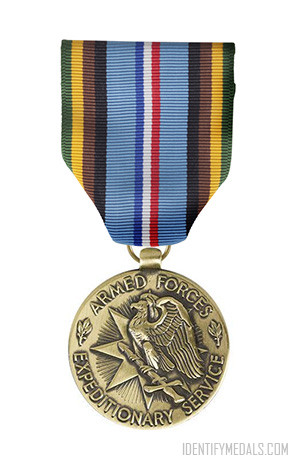
The Armed Forces Expeditionary Medal

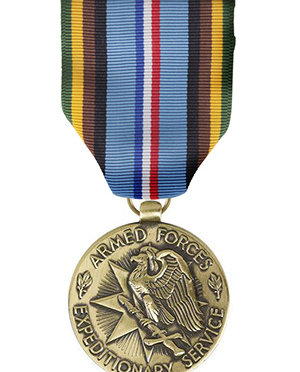
The Armed Forces Expeditionary Medal is a military award of the U.S Armed Forces created in 1961 by Executive Order of President John Kennedy. 

The Armed Forces Expeditionary Medal (or AFEM) is a military award of the United States Armed Force created in 1961 by Executive Order of President John Kennedy. The medal is awarded to members of the U.S. Armed Forces who, after July 1, 1958, participated in U.S. military operations, U.S. operations in direct support of the United Nations (UN), or U.S. operations of assistance for friendly foreign nations.

Since its original conception in 1961, the Armed Forces Expeditionary Medal has been awarded for United States participation in over forty-five designated military campaigns. The first was the Cuban Missile Crisis (military service between October 1962 and June 1963.) The AFEM was made retroactive to 1958 and issued for actions in Lebanon, Taiwan, Republic of the Congo, Quemoy and Matsu, and for duty in Berlin between 1961 and 1963. 

During the early years of the Vietnam War, the Armed Forces Expeditionary Medal was issued for initial operations in South Vietnam, Laos, and Cambodia. In 1965, with the creation of the Vietnam Service Medal, the AFEM was discontinued for Vietnam War service. 

In 2003, with the creation of the Global War on Terrorism Expeditionary Medal, the AFEM was discontinued for Iraq, Saudi Arabia, and Kuwait.

The Armed Forces Expeditionary Medal Operations

The Armed Forces Expeditionary Medal (AFEM) is awarded for participation in U.S. military operations that are designated as “expeditionary” in nature. Some of the operations for which the Armed Forces Expeditionary Medal may be awarded include:

  1. Operation Urgent Fury (Grenada)
  2. Operation Just Cause (Panama)
  3. Operation Desert Shield and Operation Desert Storm (Gulf War)
  4. Operation Uphold Democracy (Haiti)
  5. Operation Joint Guardian (Kosovo)
  6. Operation Enduring Freedom (Afghanistan)
  7. Operation Iraqi Freedom (Iraq)
  8. Operation Odyssey Dawn (Libya)

It’s worth mentioning that, while Operation Southern Watch was not explicitly designated as an expeditionary operation, service members who participated in the operation may have been eligible for the Armed Forces Expeditionary Medal (AFEM) if they met the criteria outlined by the Department of Defense.

The Armed Forces Expeditionary Medal Design

The medal is issued as a bronze medal, 1-1/4 inches in diameter. The obverse consists of an eagle, with wings addorsed and inverted (representing the strength of the United States Armed Forces), standing on a sword loosened in its scabbard, and superimposed on a radiant compass rose of eight points, (representing the readiness to serve wherever needed) all within the circumscription “ARMED FORCES” above and “EXPEDITIONARY SERVICE” below with a sprig of laurel on each side.

On the reverse side of the medal is the shield from the United States Coat of Arms above two laurel branches separated by a bullet, all within the circumscription “UNITED STATES OF AMERICA“.

The ribbon is 1 3/8 inches wide and consists of the following stripes: 3/32 inch Green; 3/32 inch Golden Yellow ; 3/32 inch Spicebrown ; 3/32 inch Black ; 7/32 inch Bluebird ; 1/16 inch Ultramarine Blue ; 1/16 inch White ; 1/16 inch Scarlet; 7/32 inch Bluebird; 3/32 inch Black; 3/32 inch Spicebrown; 3/32 inch Golden Yellow; and 3/32 inch Green.

Buy an Armed Forces Expeditionary Medal

Right Now on eBay 
Clicking a link to eBay may result in a referral commission being paid if a purchase is made.
Loading...

Other Service Medals

A service medal is a type of military decoration awarded to members of the armed forces, government employees, and, in some cases, civilians in recognition of their service, participation in specific military campaigns, or the fulfillment of certain criteria. Here are related to this one:

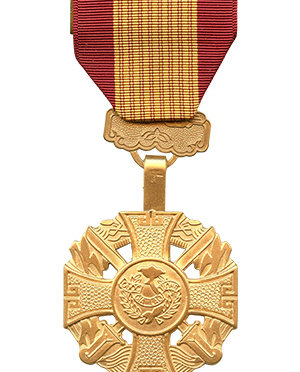
The Vietnam Gallantry Cross (South Vietnam)

All military personnel of all branches were awarded the Vietnam Cross of Gallantry if they had served in Vietnam between 1961 and 1973.

Under the Department of the Army General Order (DAGO) 43, 1970, all military personnel of all branches were awarded the Vietnam Cross of Gallantry if they had served in Vietnam between March 1, 1961 and March 28, 1973.

In addition, according to DAGO 8, 1974, the Vietnam Gallantry Cross, Unit Citation with Palm was awarded to Headquarters U.S. Military Assistance Command (MACV) and all subordinate units during February 8, 1962 to March 28, 1973. This meant that all military personnel who were assigned to units that served in-country Vietnam during this period were considered as assigned to MACV, regardless of service or component.

In other words, the Republic of Vietnam authorized this award for all foreign military personnel and units for valorous achievement and participation during the Vietnam War. Equivalent to the French Croix de Guerre, the medal demonstrates South Vietnam’s gratitude to the American and Allied soldiers who worked, fought, and sacrificed themselves for the freedom of the Republic of Vietnam.

In closing, the Vietnam War has always been a touchy subject. Since the war was quite unpopular, many veterans were not welcomed when they returned, even if they did not personally agree with the conflict. In addition, many Vietnam War vets rarely talked about their experiences during the war and their service—until somewhat recently—went undiscussed.

As a result, besides the Medal of Honor and other prestigious U.S. decorations, many individuals do not know much about the Vietnam War medals, which is unfortunate because they are especially unique.

From the unique device attached to the Republic of Vietnam Campaign Medal to the fact that some medals were issued by a now defunct country—South Vietnam, the medals specifically connected to the Vietnam War have a distinctive story to tell.  

he Republic of Vietnam Gallantry Cross was awarded in four degrees:

  • Gallantry Cross with Palm: cited at the Armed Forces level.
  • Gallantry Cross with Gold Star: cited at the Corps level.
  • Gallantry Cross with Silver Star: cited at the Division level.
  • Gallantry Cross with Bronze Star: cited at the Regiment or Brigade level.

The Gallantry Cross Medal Design

The medal is gold in color, and 35 mm wide. It consists of a Celtic cross with two crossed swords between the arms. The cross is superimposed over a wreath. The center of the cross contains a disc with the outline of the country of Vietnam between two palm branches joined at the bottom. A scroll is on top of the map and is inscribed “QUOC-GIA LAO-TUONG” (Reward of the State).

The suspension ribbon of the medal is 35 mm wide and is made up of the following stripes: 9 mm of Old Glory Red; 17 mm center stripe in Golden Yellow. The center stripe has sixteen strands of Old Glory Red; and 9 mm of Old Glory Red.

The Republic of Vietnam Campaign Medal

The Republic of Vietnam Campaign Medal is a military decoration issued to American troops who aided South Vietnam in a conflict.

The Republic of Vietnam Campaign Medal is a military decoration issued to American troops who aided South Vietnam in a conflict. First introduced during the First Indochina War, the Republic of Vietnam Campaign medal was authorized for wear on American service members as of December 1966 for their service in Vietnam.

In order to receive this medal, military members must have served in the Republic of Vietnam for six months between March 1, 1961 and March 28, 1973 or served outside Vietnam but gave combat support for six months or served less than six months but was wounded, captured and escaped enemy forces, or was killed in action.

The Republic of Vietnam Campaign Medal Design

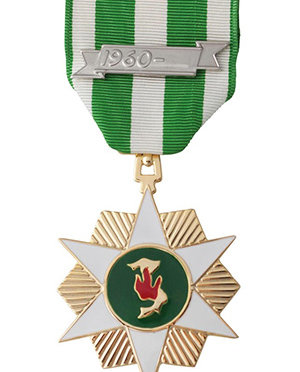
What’s unique about the medal is that it comes with a default device, known as the 1960 device. It reads, “1960-”. Because they were produced and awarded during the war, it reads the start date of the conflict, but no end date was added.

Its design helps to tell the story of the Vietnam War with the colors of the medal—green and white—to represent freedom and purity respectively. In addition, the medallion is made of a gold-colored metal in the shape of a 36 mm wide six-pointed white enamel star, six golden rays between each point in the star, and a map of Vietnam in the center of the medallion. The putative red flames on the map represent the locations of the war.

On the reverse of the medal is a circle bearing the inscription Chiến Dịch (Campaign) above and Bội Tinh (Medal) below the word VIET-NAM in the center. The suspension ribbon and service ribbon of the medal is green (to represent freedom) with three vertical white (to represent purity) stripes.

The Vietnam Service Medal

Authorized by executive order in 1965, the Vietnam Service Medal is a U.S. medal to honor service members who served in SE Asia.

Authorized by executive order in 1965, the Vietnam Service Medal is a U.S. medal to honor service members who served in Vietnam, Laos, Cambodia, and/or Thailand from 1965 to 1973 for 30 consecutive or 60 nonconsecutive days. It was established on 8 July 1965 by order of President Lyndon B. Johnson.

For those who participated in campaigns like the Tet counteroffensive in 1968 and the air offensive phases from 1966 to 1969, bronze stars on mounted on the ribbon for participation.

South Vietnam also issued its own service medal for the Vietnam War, known as the Republic of Vietnam Campaign Medal. This is a separate military award which was accepted by the U.S. Congress and the U.S. military in accordance with DoD 1348 C7. Six months of service in support of South Vietnamese military operations was the general U.S. requirement for the award.

The Vietnam Service Medal Design

The distinctive design has been attributed to both sculptor Thomas Hudson Jones, a former employee of the Army Institute of Heraldry and Mercedes Lee who created the design.

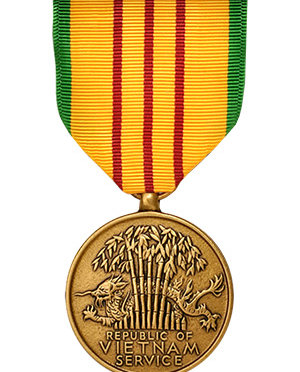
The medal is rounded and bronze shaped and measures 1 14 inches in diameter. The obverse consists of a figure of an oriental dragon (representing the subversive nature of the conflict) behind a grove of bamboo trees located above the inscription “REPUBLIC OF VIETNAM SERVICE“. On the reverse, a crossbow (representing the ancient weapon of Vietnam) facing upwards with a ready to be fired lighted torch of the Statue of Liberty, above an arched inscription “UNITED STATES OF AMERICA“.

The colors of the ribbon are green, yellow, and red, which represents the flag of the Republic of Vietnam at the time—yellow with red stripes running horizontally—and the green Vietnamese jungles. In addition, the three red stripes indicate the three ancient empires of Vietnam Tonkin, Annam, and Cochin China.

Find This Medal Online

Right Now on eBay 
Clicking a link to eBay may result in a referral commission being paid if a purchase is made.
Loading...