The Order of the Phoenix

  • Time Period: Pre-WW1
  • Year of Institution: 13 May 1926
  • Country: Greece

The Order of the Phoenix (or Τάγμα του Φοίνικος) is an order of Greece established on May 13, 1926, by the republican government of the Second Hellenic Republic to replace the defunct Royal Order of George I.

The honor is bestowed by the Greek government to Greek citizens who have excelled in the arts and literature, science, public administration, shipping, commerce, and industry. It is also awarded to foreigners who have helped raise Greece’s international prestige.

The order was retained after the restoration of the monarchy in 1935 and continues to be awarded by the current Third Republic.

The Order has five classes:

  • GRE Order of the Phoenix - Grand Cross BAR.png Grand Cross (‘Μεγαλόσταυρος’) – wears the badge of the Order on a sash on the right shoulder, and the star of the Order on the left chest;
  • GRE Order of the Phoenix - Grand Commander BAR.png Grand Commander (‘Ανώτερος Ταξιάρχης’) – wears the badge of the Order on a necklet, and the star of the Order on the left chest;
  • GRE Order of the Phoenix - Commander BAR.png Commander (‘Ταξιάρχης’) – wears the badge of the Order on a necklet;
  • GRE Order of the Phoenix - Gold Cross BAR.png Officer or Gold Cross (‘Χρυσούς Σταυρός’) – wears the badge on a ribbon on the left chest;
  • GRE Order of the Phoenix - Silver Cross BAR.png Member or Silver Cross (‘Αργυρούς Σταυρός’) – wears the badge on a ribbon on the left chest.

The Order of the Phoenix Design

The badge of the Order is a white-enameled cross, in silver for the Silver Cross class, in gold for the higher classes, with the Phoenix (symbolizing the rebirth of the Hellenic nation) at the center. A five-pointed star is at the upper arm of the cross.

The first version of the Order (1926–1935) featured the letters “E-T-T-A” in Byzantine uncial on each arm of the cross, the initials of the motto Εκ της τέφρας μου αναγεννώμαι (“From my ashes I am reborn”). During the Monarchy (1935–1974) the letters were removed and the badge was topped by a crown, while the badge’s reverse side featured the monogram of the reigning monarch. The current version (since 1975) omits the crown, while the reverse features the Greek National Emblem with the words ΕΛΛΗΝΙΚΗ ΔΗΜΟΚΡΑΤΙΑ (“Hellenic Republic”).

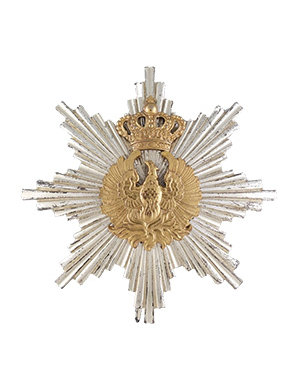
The star of the Order is a silver eight-pointed star with straight rays, with the phoenix at the centre; during the Monarchy it was topped by a crown. The ribbon of the Order is orange with black edges. Crossed swords on the insignia indicate that the award was given in the military division of the Order.

The Royal Order of George I

  • Time Period: Pre-WW1
  • Year of Institution: 16 January 1915
  • Country: Greece

The Royal Order of George I (or Βασιλικόν Τάγμα Γεωργίου Α’) is a Greek order instituted by King Constantine I in 1915 in honor of his father, George I. Since the monarchy’s abolition in 1973, it is considered a dynastic order of the former Greek royal family.

The Order was only the second Greek order to be created after the Order of the Redeemer in 1833 and remained the second senior award of the Greek state for the duration of its existence. The order was closely associated with the Greek monarchy and was hence abolished with the establishment of the Second Hellenic Republic in 1924. The order was restored along with the monarchy in 1935, and continued to be awarded until the final abolition of the monarchy in 1973.

The Order of George I Design

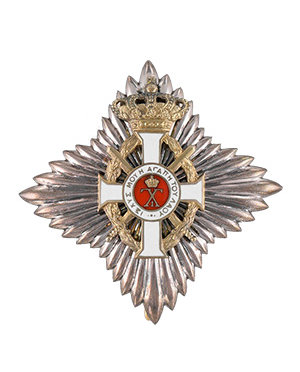
The badge of the Order is a white-enameled Latin cross pattée, in silver for the Silver Cross class, in gold for the higher classes, with a wreath of laurels between the arms of the cross.

The obverse central disc was in red enamel, bearing the royal cypher of George I, two crossed gammas with a crown above and a “I” below, surrounded by a white enamel ring bearing the royal motto ΙΣΧΥΣ ΜΟΥ Η ΑΓΑΠΗ ΤΟΥ ΛΑΟΥ (“The Love of My People is My Strength”). The reverse central disc bears the years of George I’s reign, 1863-1913. The badge is topped by a crown; the military division also had crossed swords behind the badge. The Commemorative Medal’s badge is identical in design, except that the cross is not enameled.

The star of the order is a silver star with straight rays, with eight points for Grand Cross and four points for Grand Commander, and with the obverse of the badge superimposed upon it.

The ribbon of the Order is plain crimson red.

The Cross of Valor (Greece)

The Cross of Valour is the second highest military decoration of the Greek state, awarded for acts of bravery or distinguished leadership.

  • Time Period: Pre-WW1
  • Year of Institution: 13 May 1913
  • Country: Greece

The Cross of Valor (or Αριστείον ΑνδρείαςAristeion Andreias, “Gallantry/Bravery Award“) is the second highest military decoration of the Greek state, awarded for acts of bravery or distinguished leadership on the field of battle.

It has been instituted three times, first on 13 May 1913 during the Balkan Wars but not issued until 1921 during the Greco-Turkish War of 1919–1922, then on 11 November 1940 shortly after the outbreak of the Greco-Italian War and finally in 1974.

The award was liberally distributed during the campaigns of 1921–1922: from the first awards in July 1921 to the end of the war in August 1922. The Cross of Valor continued to be awarded for actions during the Greek Civil War and for the Greek participation in the Korean War, as well as for a few cases from World War II, from 1947 to 1955.

The Royal Decree of 31 March 1921 instituted the Cross of Valor in three grades: Commander’s Cross (Σταυρός Ταξιάρχη), worn as a badge on a necklet, and the Gold Cross (Χρυσούς Σταυρός) and Silver Cross (Αργυρός Σταυρός), worn as badges on chest ribbons. No limit was set on the number of awards in each grade.

The Cross of Valor Design

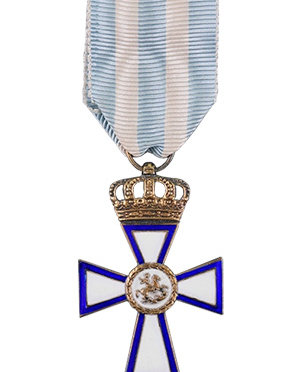
The design of the badge was specified as a “crowned cross, bearing in the middle of the obverse side, in a circle of narrow laurel leaves, the image of St. Demetrios, while on the middle of the reverse side in a similar circle it bears the words ΑΞΙᾼ (“for valor” in Greek)”.

The Silver Cross was to be made entirely of silver, while the Gold and Commander’s crosses were enameled in white with blue edges. The ribbon consists of five pale blue and white stripes. For each repeat award, a silver 4-millimeter star was added to the ribbon.

For World War II awards, a bar with “1940” was placed on the ribbon to distinguish it from the earlier 1913 version.

The Order of the Redeemer

The Order of the Redeemer is an order of merit of Greece and the oldest and highest decoration awarded by the modern Greek state.

  • Time Period: Pre-WW1
  • Year of Institution: 1829
  • Country: Greece

The Order of the Redeemer (or Τάγμα του Σωτήρος, Tágma tou Sotíros), also known as the Order of the Saviour, is an order of merit of Greece and the oldest and highest decoration awarded by the modern Greek state.

According to the original decree, the Order was to be awarded to those Greek citizens who partook in the War of Independence, or “who should distinguish themselves henceforth in any branch of public service, in the army and navy, in the diplomatic and judicial corps, in public administration, in the arts, science, agriculture and industry, commerce, or should distinguish themselves in any other social field through outstanding civic virtue, and through illustrious services to the Throne, for the Glory of the Hellenic name and for the welfare of the fatherland”, while foreigners were admitted either for past services to Greece, or due to their ability “to bring honour to the Order, through their outstanding personal virtues and excellence“.

The Order was established by the Fourth National Assembly at Argos in 1829, during the final year of the Greek War of Independence. The decision was not immediately implemented, however, and the relevant decree was signed on May 20, 1833. According to the decree of the establishment, the name of the Order “shall recall the, by divine assistance miraculously and fortuitously accomplished, the salvation of Greece“.

The Order of the Redeemer has five classes:

  • GRE Order Redeemer 1Class.png Grand Cross (‘Μεγαλόσταυρος’) – wears the badge of the Order on a sash on the right shoulder, and the star of the Order on the left chest;
  • GRE Order Redeemer 2Class.png Grand Commander (‘Ανώτερος Ταξιάρχης’) – wears the badge of the Order on a necklet, and the star of the Order on the left chest;
  • GRE Order Redeemer 3Class.png Commander (‘Ταξιάρχης’) – wears the badge of the Order on a necklet;
  • GRE Order Redeemer 4Class.png Gold Cross (‘Χρυσούς Σταυρός’) – wears the badge on a ribbon on the left chest;
  • GRE Order Redeemer 5Class.png Silver Cross (‘Αργυρούς Σταυρός’) – wears the badge on a ribbon on the left chest.

The Order of the Redeemer Medal Design

The form of the various insignias has been altered a number of times since the establishment of the order, the most obvious change being the removal of the crown during the periods of Republican rule.

The original decree of 1833 described the badge of the Order as consisting of a white enamelled Maltese cross (silver for the Silver Cross, gold for the higher grades), surmounted by a crown, set on a green enamelled wreath, one half of which is an oak branch and the other half a laurel branch.

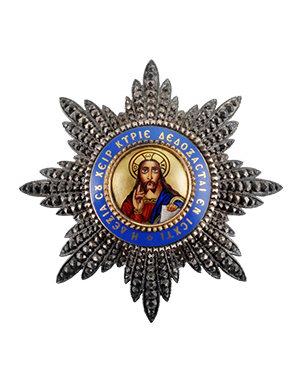
The obverse featured a white cross on a blue background (the coat of arms of Greece) with Otto’s Bavarian arms in an inescutcheon in the centre, surrounded by this inscription on an outer ring: Η ΔΕΞΙΑ ΣΟΥ ΧΕΙΡ, ΚΥΡΙΕ, ΔΕΔΟΞΑΣΤΑΙ ΕΝ ΙΣΧΥΙ (“Thy right hand, O Lord, is become glorious in power”, Exodus, 15:6). The reverse featured a portrait of Otto with the circular inscription: ΟΘΩΝ, ΒΑΣΙΛΕΥΣ ΤΗΣ ΕΛΛΑΔΟΣ (“Otto, King of Greece”).

After Otto’s deposition in 1863, his portrait was removed and substituted by an icon of Jesus, the Redeemer of Orthodox Christian soteriology.

The Afghanistan Campaign Medal (USA)

The Afghanistan Campaign Medal is a military decoration awarded to any members who performed duty within the borders of Afghanistan.

The Afghanistan Campaign Medal (or ACM) is a military award of the United States military created by Executive Order 13363 of President George W. Bush on November 29, 2004, and became available for general distribution in June 2005. The medal is retroactive to October 24, 2001, and is active until a date to be determined. 

The medal is awarded to any member of the United States military who has performed duty within the borders of Afghanistan (or its airspace) for a period of thirty consecutive days or sixty non-consecutive days.

Personnel who have been engaged in combat with an enemy force, or personnel who have been wounded in combat within Afghanistan, may receive the ACM regardless of the number of days spent within the country. The medal is also awarded posthumously to any service member who dies in the line of duty within Afghanistan, including from non-combat injuries such as accidents and mishaps.

The Afghanistan Campaign Medal Design

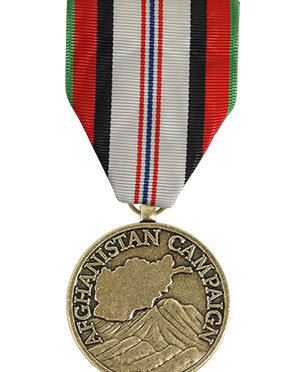
The medal was designed by the U.S. Army Institute of Heraldry. The medal is bronze in appearance and measures 1 14 inches in diameter. It depicts above a range of mountains a map of Afghanistan. Around the top is the inscription “AFGHANISTAN CAMPAIGN.”

On the reverse, a radiating demi-sun superimposed by an eagle’s head couped. Inscribed across the bottom half of the reserve side are the three lines “FOR SERVICE IN AFGHANISTAN“, enclosed by a laurel wreath.

Find This Medal Online

Right Now on eBay 
Clicking a link to eBay may result in a referral commission being paid if a purchase is made.
Loading...

The Iraq Campaign Medal (USA)

The Iraq Campaign Medal is a military award of the Armed Forces awarded during the Iraq War, from 29 November 2004 to 31 December 2011.

The Iraq Campaign Medal (or ICM) is a military award of the United States Armed Forces which was created by Executive Order 13363 of U.S. President George W. Bush on 29 November 2004, and became available for general distribution in June 2005.

The Iraq Campaign Medal was awarded to any member of the U.S. military who performed duty within the borders of Iraq (or its territorial waters) for a period of thirty consecutive days or sixty non-consecutive days. The medal was also awarded posthumously to any service member who died in the line of duty within Iraq, including from non-combat injuries such as accidents and mishaps.

The Iraq Campaign Medal replaced the Global War on Terrorism Expeditionary Medal (GWOT-EM) for service in Iraq from 19 March 2003, through 30 April 2005.

The Iraq Campaign Medal Design

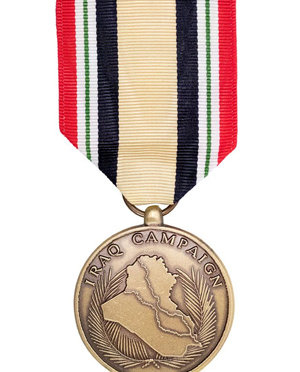
The medal was designed by the U.S. Army Institute of Heraldry. The medal is bronze in appearance, 1 14 inches (32mm) in diameter.

The obverse depicts a north-oriented relief of the map of Iraq, surmounted by two lines representing the Tigris and Euphrates rivers throughout, superimposed over a palm wreath. Above is the inscription “IRAQ CAMPAIGN.” On the reverse, the Statue of Freedom surmounts a sunburst, encircled by two scimitars pointing down with the blades crossing at the tips. Below is the inscription “FOR SERVICE IN IRAQ.”

The medal is suspended from a ribbon 1 38 inches (34.9 mm) wide. The stripes of the ribbon invoke the colors of the Iraqi flag and are: 532 inch scarlet at the edges, followed by 116 inch white, 132 inch green, and 116 inch white. The white is separated by a 532 inch black with a 716 inch stripe in chamois in the center.

Find This Medal Online

Right Now on eBay 
Clicking a link to eBay may result in a referral commission being paid if a purchase is made.
Loading...

The Air Force Cross and Medal (United Kingdom)

The Air Force Cross is a British military decoration awarded to officers for “acts of exemplary gallantry while flying against the enemy”

Time Period: WW1 The Great War
Year of Institution: 3 June 1918
Country: Great Britain

The Air Force Cross (or AFC) is a military decoration awarded to officers for “an act or acts of exemplary gallantry while flying, though not in active operations against the enemy“. Since 1993 it’s also given to other ranks, of the United Kingdom Armed Forces, and formerly also to officers of the other Commonwealth countries.

The award was established on 3 June 1918, shortly after the formation of the Royal Air Force (RAF). It was originally awarded to RAF commissioned officers and Warrant Officers, but was later expanded to include Royal Navy and army aviation officers. Recipients of the Air Force Cross are entitled to use the post-nominal letters “AFC”.

Between 1919 and 1932 the AFC was also awarded to civilians, on the same basis as for RAF personnel. The AFC had also been awarded by Commonwealth countries but by 1990’s most, including Canada, Australia, and New Zealand, had established their own honors systems and no longer recommended British honors.

The Air Force Cross and Medal Design

The Cross

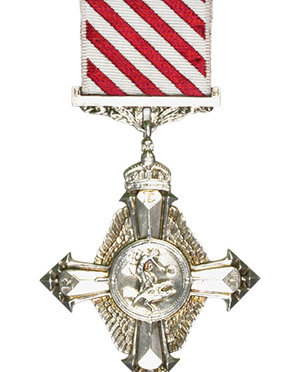
The Air Force Cross is a silver cross measuring 60 millimeters (2.4 in) in height and 54 millimeters (2.1 in) in width, representing aircraft propeller blades, with wings between the arms. It was design by Edward Carter Preston.

The obverse depicts Hermes, riding on the wings of a hawk holding a laurel wreath. At the top of the upper arm is the royal crown, while the other three arms bear the royal cipher of the reigning monarch at the time of issue. The reverse is plain, except for a central roundel bearing the reigning monarch’s cipher and the date ‘1918’. Originally awarded unnamed, from 1939 the year of issue was engraved on the reverse lower limb of cross, and since 1984 it has been awarded named to the recipient.

The suspender is straight and decorated with laurel wreaths. The ribbon bar denoting a further award is silver, with the Royal Air Force eagle in its centre. Bars awarded during World War II have the year of award engraved on the reverse. The 32 mm (1.25 inch) ribbon was originally white with red broad horizontal stripes, but changed in July 1919 to the current white with red broad diagonal stripes at a 45-degree angle.

The Medal

The Air Force Medal is an oval struck in silver and measures 42 mm tall and 32 mm wide. It has a laurel border and features, on the obverse, the sovereign’s effigy. The reverse Hermes mounted on a hawk bestowing a laurel wreath.

The medal is suspended by a pair of wings from a straight bar. The ribbon, originally with horizontal narrow stripes or white and crimson, changed in 1919 to diagonal ones of the same colors.

The Civil Actions Medal (South Vietnam)

The Republic of Vietnam Civil Actions Medal is a military decoration awarded by the former South Vietnamese gov. during the Vietnam War.

The Republic of Vietnam Civil Actions Medal (or Dân-Vụ Bội-Tinh in Vietnamese, also known as the Vietnam Civil Actions Medal or Civil Actions Medal) is a military decoration created on May 12, 1964 during the Vietnam War by the former South Vietnamese government.

The medal was awarded to the South Vietnamese military and its allies’ military personnel or units that performed outstanding achievements in the field of civil affairs. It was awarded in two classes, with the first class intended for commissioned officers and the second class for enlisted personnel. Individuals who were cited received the medal, ribbon, and a citation.

The Civil Actions Unit Citation Emblem was awarded to all members of a military command or unit who had participated in civic actions to such a degree as would warrant an individual Vietnam Civil Actions Medal.

The Civil Actions Medal Design

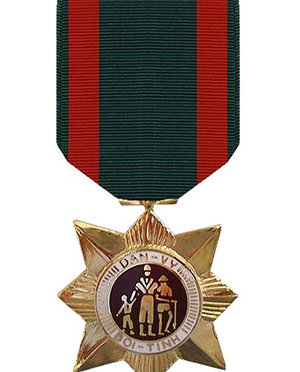
The Civil Actions Medal is a bronze eight-pointed star with alternating points of the star lined, superimposed by a disk with a figure of a soldier, a child, and a farmer with a shovel, all enclosed by a white enamel designation band inscribed Dân Vụ (Civil Action) at the top and Bội Tinh (Medal) at the bottom.

The Civil Action Medal, First and Second Class, has a suspension ribbon and service ribbon that is Bottle Green and Scarlet. The first class color is distinguished from the second class color by the first class medal having two narrow red stripes in the center of the medal’s ribbon. The Civil Actions Unit Citation Emblem is in the first class color only. The first Civil Action Medal was awarded without a ribbon device. Each additional award of the medal had one of four devices representing four levels an individual was cited from; a large palm indicated a citation from the Armed Forces level. The Republic of Vietnam made some revisions pertaining to the Civil Actions Medal in 1965 and 1967.

The Vietnam Military Merit Medal

The Military Merit Medal is the highest military decoration for enlisted personnel by the Republic of Vietnam during the years of the War.

The Military Merit Medal (or Quân-Công Bội-Tinh in Vietnamese) was established on August 15, 1950. It’s the highest military decoration bestowed to enlisted personnel by the Republic of Vietnam during the years of the Vietnam War.

The Military Merit Medal is awarded or awarded posthumously to Non-Commissioned Officers (including Aspirants) and Enlisted Men in the Armed Forces, who have: Previously received citations at the Armed Forces level; Been wounded once or many times in combat; Distinguished themselves by their heroic actions or Served in an honorable manner for at least 13 years.

The Military Merit Medal was modeled after the French Médaille Militaire and was awarded mostly to Enlisted Men for valor in combat. The Vietnamese National Order of Vietnam was considered the equivalent decoration for military officers.

The United States military authorized the Military Merit Medal as a foreign decoration and permitted the medal to be worn on U.S. uniforms by enlisted personnel. A high number Military Merit Medals were issued posthumously as the medal was most often awarded to United States servicemen who were killed in action.

The Vietnam Military Merit Medal Design

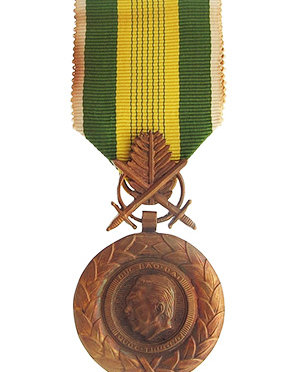
The Military Merit Medal is a circular gold-colored medal, the obverse bearing the words ‘TO-QUOC-TRI-AN‘ (‘The gratitude of the Fatherland’) in a central disc. A thin band around the disc contains the words ‘QUAN-CONG-BOI-TINH‘, and the whole is surrounded by a wreath. The reverse is similar, but the words ‘VIET-NAM CONG HOA‘ appear in the central disc.

The medal is suspended from a pair of rings supporting a trophy of arms (crossed swords). The ribbon is yellow, with a broad green and narrow white stripe at each edge. In the center are seven closely grouped green lines.

The Vietnam Distinguished Service Order

The Vietnam Distinguished Service Order was a military decoration of South Vietnam awarded throughout the years of the Vietnam War.

The Vietnam Distinguished Service Order (or Huân-Chương-Việt Nam in Vietnamese) was a military decoration of South Vietnam awarded throughout the years of the Vietnam War. The decoration was bestowed for meritorious or heroic deeds related to wartime operations and was awarded for both combat and non-combat service.

The decoration ranked immediately below the National Order of Vietnam and the Vietnam Military Merit Medal. It was among the less commonly bestowed medals, in contrast to such decorations as the Vietnam Gallantry Cross and Vietnam Campaign Medal.

The Vietnam Distinguished Service Order was also provided to foreign militaries, and in the United States military, the decoration was considered the equivalent of the Legion of Merit. For foreign officers, the 2nd class of the order was also provided to officers.

The Vietnam Distinguished Service Order Design

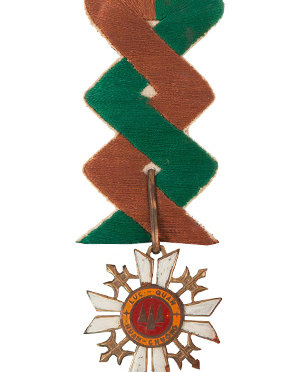
The Vietnam Distinguished Service Order is Maltese cross in white enamel with divided rays. Between the rays are golden trident heads, and in the center is a red disc containing three narrow triangles in gold, surrounded by an orange band containing the words ‘LUC-QUAN HUAN CHUONG’ in gold. On the reverse is stamped the words ‘VIET-NAM‘ in a lined circle. The ribbon is a two-armed embroidered design in tan and green, each arm crossing the other three times and ending in a hanging fringe behind the medal.

There were two classes of the Vietnam Distinguished Service Order, the first class being for officers and the second class for enlisted personnel. The first class of the order was differentiated by a blossom device centered on the medal and ribbon.