The Order of the Aztec Eagle

The Order of the Aztec Eagle is the highest Mexican order awarded to foreigners in the country and forms part of the Mexican Honours System.

The Order of the Aztec Eagle (or Orden Mexicana del Águila Azteca in Spanish) is the highest Mexican order awarded to foreigners in the country and forms part of the Mexican Honours System. It’s awarded for services to the Mexican nation or to humanity, and it’s reciprocally given to Mexican public service providers living abroad.

The order was created by decree on December 29, 1933 by President Abelardo L. Rodríguez although it is based on the temporal Aztec Eagle decoration, which was created on September 30, 1932. This award had a light blue ribbon and was given as a thank you to foreigners, in particular to ministers from the Chilean Foreign Issues Office.

It corresponds to similar distinctions given to Mexican citizens such as the Miguel Hidalgo Order or the Belisario Domínguez Medal of Honor. It is given by the office of the foreign minister on the instructions of a Council established for this purpose headed by the President.

The Order of the Aztec Eagle Design

There is some design similarity of the order with the coat of arms of Mexico, particularly the golden eagle holding a rattlesnake, which is associated with the Aztec civilization.

Prior to the 2011 reform, the classes were, in descending order:

  1. MEX Order of the Aztec Eagle 1Class BAR.png Collar (“Collar”), awarded to heads of state;
  2. MEX Order of the Aztec Eagle 2Class BAR.png Grand Cross (“Cruz”), awarded to prime ministers and heads of government
  3. MEX Order of the Aztec Eagle 3Class BAR.png Sash (“Banda”), awarded to government ministers, secretaries and ambassadors
  4. MEX Order of the Aztec Eagle 4Class BAR.png Medal (“Medalla”), awarded to government undersecretaries, plenipotentiary ministers, as well to those whose category is tantamount to the previous;
  5. MEX Order of the Aztec Eagle 5Class BAR.png Placard (“Placa”), awarded to ad hoc business representatives, colonels and lieutenant colonels, captains of a ship, equivalent servants of embassies in Mexico), as well to those whose category is tantamount to the previous;
  6. MEX Order of the Aztec Eagle 5Class BAR.png Venera (a type of insignia), awarded to ad interim business representatives and other members of diplomatic missions;
  7. MEX Order of the Aztec Eagle 5Class BAR.png Insignia proper, awarded under the Council’s discretion; and
  8. MEX Order of the Aztec Eagle 5Class BAR.png Honorable Mention (“Mención Honorífica”).

Since the reform of March 2011, the classes are :

  1. MEX Orden del Aguila Azteca 2011 Collar BAR.svg Collar (“Collar”), awarded to heads of state;
  2. MEX Orden del Aguila Azteca 2011 Banda Especial BAR.svg Sash of Special Category (“Banda en Categoría Especial”), awarded to prime ministers and heads of government, hereditary princes(ses), consorts of heads of state, or to people whose category is tantamount to the previous;
  3. MEX Orden del Aguila Azteca 2011 Banda BAR.svg Sash (“Banda”), awarded to government ministers, secretaries, members of royal families, ambassadors, or individuals whose category is tantamount to the previous;
  4. MEX Orden del Aguila Azteca 2011 Placa BAR.svg Plaque (“Placa”), awarded to government undersecretaries, plenipotentiary ministers, consuls general, brigadier generals, rear admirals, as well to those whose category is tantamount to the previous;
  5. MEX Orden del Aguila Azteca 2011 Venera BAR.svg Venera (a type of insignia), awarded to ad hoc business representatives, colonels and lieutenant colonels, captains of a ship, equivalent servants of embassies in Mexico, as well to those whose category is tantamount to the previous;
  6. MEX Orden del Aguila Azteca 2011 Insignia BAR.svg Insignia, awarded to ad interim business representatives and other members of diplomatic missions; captain, navy lieutenant, as well to those whose category is tantamount to the previous and to those cases the Council considers pertinent.

All grades except the collar may be awarded, under the Council’s discretion, to distinguished foreigners.
The Cross of Charity or Mercy

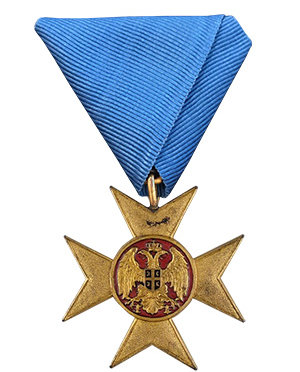
The Cross of Charity or Mercy is a decoration established in the Kingdom of Yugoslavia by King Peter I of Serbia on 7 (19) June 1913. Peter I was the king of Serbia during a period of great Serbian military success, he was remembered by the Serbian people as King Peter the Liberator, and also known as Old King.

The medal was to be awarded to men or women in or out of the military who aided victims of the 1912-13 First Balkan War (which lasted from October 8, 1912 to May 30, 1913), the sick and wounded. It could be awarded to Serbians and non-Serbians alike, to military and civilians, and to Red Cross volunteers. 

During the Balcan War, foreign awards could be granted for service in a red cross or medical capacity. Many women who served with the French or the Serbs were awarded decorations, although there is no gazette entry for them.

The Cross of Charity or Mercy Design

The Cross was manufactured by Arthus Bertrand of Paris and Huguenin Frères of Le Locle, Switzerland. It is made in bronze gilt maltese cross with a loop for ribbon suspension and red and black enamels and measures 39.7 mm.

The obverse bears a central circular red enamel medallion with the inscription in gilt letters ‘For Mercy‘ and circumscribed “For Tending the Wounded and the Sick 1912″.

The reverse shows the Serbian royal arms and the eagle with a fleur de lis beneath its claws.

Men and women versions of this medal are differentiated only by the suspension; a classical light-blue triangular one for men, and a ribbon in a bow shape of the same color for women (although this was not always the case).

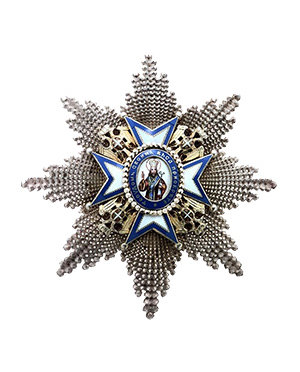
The Order of St. Sava

The Order of St. Sava was a decoration of merits established originally to recognize civilians for meritorious achievements to the Church, to arts and sciences, the royal house and the state and awarded by the Kingdom of Serbia, the Kingdom of Serbs, Croats and Slovenes and the Kingdom of Yugoslavia from 1883 to 1945.

The Order of St Sava was then awarded by the king of Yugoslavia until the abolishment of the monarchy in 1945.

Since 1985, the Order has been awarded on the occasion of the 800th anniversary of St. Sava. This order is dedicated to ecclesiastic and secular persons, who have special merits for the Serbian Orthodox Church. According to the ordinance of the church, each person who received a medal of third grade, may receive the medal of the higher grade as well as the first grade for future merits, provided that three years have passed at least since the previous award.

The Order of St. Sava Design

Five grades were awarded: Grand Cross, Grand Officer, Commander, Officer and Knight.

The first grade was a medal, worn with a sash over a shoulder and additionally with a breast star. The second and third grade laureates wore the Order with a neckband. The fourth grade with a triangular suspension, a rosette was attached to the ribbon above the medal. The fifth grade had a triangular suspension without a rosette. The medals of the fourth and fifth grades were worn on the breast. All white ribbons had two light blue stripes.

The order is determined in three grades: the first one is white, the second red and the third blue colored.

The Order of the White Eagle (Serbia)

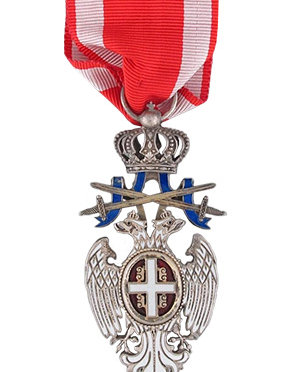
Order of the White Eagle was a Royal Order in the Kingdom of Serbia (1883–1918) and the Kingdom of Yugoslavia (1918–1945) instituted by King Milan I of Serbia on 23 January 1883. In the period between 1883 and 1898 Order of the White Eagle was the highest award in the Kingdom of Serbia.

The Order had five classes and was conferred on Serbian and Yugoslav citizens for achievements in peace or war, or for special merits to the Crown, the state and nation.  In 1898 the Royal Order of Miloš the Great took precedence over the White Eagle and in 1904 the former was replaced by the Order of the Karađorđe’s Star.

After his accession to the throne in 1903, King Peter I of Serbia continued awarding the Order of the White Eagle, but the reverse of the medallion had the year of the proclamation of the Kingdom (1883) instead of the cipher of Milan I.

The Order is conferred by the Crown. Recent awards include last Grand Master of the Sovereign Order of St. John (Fr. Angelo de Mojana di Cologna), as well as posthumous conferment upon three Crown Council Members.

The Order of the White Eagle Design

The Order of the White Eagle is made in silver gilt with red, white and blue enamels. It measures 31.8 mm (w) x 68 mm (h) inclusive of its crown suspension.

The Order had five degrees, and could be awarded with swords for the military services, with or without swords for civil merit. The classes were:

  • SRB-SHS-YUG Orden Belog Orla VKrst BAR.svg 1st Class – Grand Cross
  • SRB-SHS-YUG Orden Belog Orla VOficir BAR.svg 2nd Class – Grand Officer’s Cross
  • SRB-SHS-YUG Orden Belog Orla Komandir BAR.svg 3rd Class – Commander’s Cross
  • SRB-SHS-YUG Orden Belog Orla Oficir BAR.svg 4th Class – Officer’s Cross
  • SRB-SHS-YUG Orden Belog Orla Kavalir BAR.svg 5th Class – Knight’s Cross

The sash of the Order is worn from the left shoulder to the right hip.

The Order of Karađorđe’s Star

The Order of Karađorđe’s Star (or Orden Karađorđeve zvezde in Serbian) is Serbia’s highest civilian and military decoration and was instituted by the royal decree of King Peter I on 1 January 1904, commemorating his recent accession to the Serbian throne as well as the one-hundredth anniversary of the First Serbian Uprising.

The medal originated in the Kingdom of Serbia, and was initially awarded exclusively to Serbian citizens in return for services rendered to the Serbian monarchy, the Serb people and the Serbian state, though it is now bestowed upon Serbs and non-Serbs alike. During the Balkan Wars and World War I, the Order was mostly awarded for acts of bravery on the battlefield.

Following the breakup of Yugoslavia, Serbia ceased using many of the awards and decorations established during the communist period, though it was not until 2010 that the Serbian Government officially reinstated the Order of Karađorđe’s Star as Serbia’s highest decoration.  In February 2012, tennis player Novak Djokovic became the first person to receive the Order after it was reinstated.

The Order of Karađorđe’s Star Design

The Order comes in either gold or silver depending on class. The medals themselves were originally manufactured by foreign makers of decorations and medals, such as France’s Arthus-Bertrand and Switzerland’s Huguenin Fréres; during the interwar period (1919–39) they were produced domestically.

The obverse features a white enameled cross pattée with gilt rays protruding from each of the arms and intersected diagonally by a pair of sabers when the recipient is awarded an Order “with swords”. Orders from the royal period contain a blue medallion at the center depicting a Serbian cross with a fire-steel at each corner, with the words “For Faith and Freedom, 1804” etched into the small circle in the middle of the cross.

The reverse of the Order contains a red medallion depicting a white eagle, with the words “Peter I, 1904” written around it.

The bravery medals awarded from June 1915 forward are almost identical to the Orders awarded before that date, save for the crossed swords being present on all of them regardless of class. Such Orders also lacked the phrase etched into the obverse of the older ones and the date 1904 on the reverse, which marked the centenary of the First Serbian Uprising. Instead, they merely had King Peter’s name on the obverse beside the year when the Order was bestowed.

The Cross for Loyalty to the Assassinated President Venustiano Carranza

The Cross for Loyalty to Carranza is a medal issued during 1910 and 1920 when control of Mexico’s government was attempted by several parties. 

The Cross for Loyalty to the Assassinated President Venustiano Carranza is a medal issued during the early years of the twentieth century, between 1910 and 1920 when control of Mexico’s government was attempted by several parties.

The United States involvement in the Mexican Revolution was varied and seemingly contradictory, first supporting and then repudiating Mexican regimes during the period 1910-1920. For both economic and political reasons, the U.S. government generally supported those who occupied the seats of power, whether they held that power legitimately or not.

When Francisco I. Madero was elected president in October 1911, the U.S. president was a lame duck. The U.S. Ambassador to Mexico, Henry Lane Wilson was initially sympathetic to the new regime, but quickly came into conflict with it. Ambassador Wilson conspired with General Victoriano Huerta to oust Madero.

The United States government under newly inaugurated president Woodrow Wilson refused to recognize Huerta’s government and sent troops to occupy Veracruz. President Wilson’s government recognized the government of Venustiano Carranza in 1915.

The Cross for Loyalty to the Assassinated President Venustiano Carranza Design

The Cross for Loyalty is typically designed in the shape of a cross, which is a common motif for many military medals and decorations. At the center of the cross, there is usually a circular medallion. This medallion features a depiction of President Venustiano Carranza. The image of Carranza may vary in detail but typically includes his profile or bust.

Around the outer edge of the central medallion, there may be an inscription. This inscription may include Carranza’s name, title, and dates of birth and death, as well as the words “Por la Lealtad” (For Loyalty) or similar phrases. The cross often has arms that radiate outward from the central medallion, creating a cross-like shape. These arms are usually plain but may sometimes feature decorative elements or symbols.

The medal is typically suspended from a ribbon that allows it to be worn around the neck or pinned to a uniform. The ribbon’s color and design may vary but often incorporate the national colors of Mexico, which are green, white, and red.

The Cross for the Defenders of Veracruz

The Cross for the Defenders of Veracruz is a medal issued 1910-1920 when control of Mexico’s government was attempted by several parties. 

The Cross for the Defenders of Veracruz is a medal issued during the early years of the twentieth century, between 1910 and 1920 when control of Mexico’s government was attempted by several parties.

The United States involvement in the Mexican Revolution was varied and seemingly contradictory, first supporting and then repudiating Mexican regimes during the period 1910-1920. For both economic and political reasons, the U.S. government generally supported those who occupied the seats of power, whether they held that power legitimately or not.

When Francisco I. Madero was elected president in October 1911, the U.S. president was a lame duck. The U.S. Ambassador to Mexico, Henry Lane Wilson was initially sympathetic to the new regime, but quickly came into conflict with it. Ambassador Wilson conspired with General Victoriano Huerta to oust Madero.

The United States government under newly inaugurated president Woodrow Wilson refused to recognize Huerta’s government and sent troops to occupy Veracruz. President Wilson’s government recognized the government of Venustiano Carranza in 1915.

The Cross for the Defenders of Veracruz Design

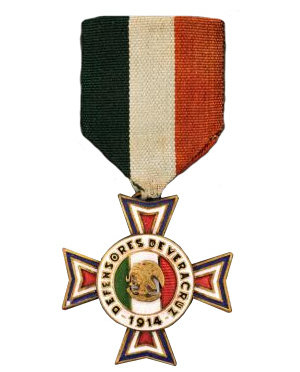
Like many Mexican military decorations, the Cross for the Defenders of Veracruz is typically designed in the shape of a cross. The cross shape is a common motif for such awards. At the center of the cross, there is usually a circular medallion. This medallion often features the image of a Mexican soldier or a patriotic symbol associated with the defense of Veracruz. The image may vary in detail but generally represents the valor and dedication of those who defended the city.

Around the outer edge of the central medallion, there may be an inscription. This inscription typically includes the words “Defensores de Veracruz” (Defenders of Veracruz) or similar phrases, highlighting the purpose and significance of the decoration. The cross often has arms that radiate outward from the central medallion, creating a cross-like shape. These arms are usually plain but may sometimes feature decorative elements or symbols.

The medal is typically suspended from a ribbon that allows it to be worn around the neck or pinned to a uniform. The ribbon’s color and design may vary but often incorporate patriotic colors, such as green, white, and red, which are the national colors of Mexico. At the top of the medal, there is a small ring or loop through which a ribbon or chain is threaded to allow for wearing or display.

The Cross for Revolutionary Merit 1913-14

The Cross of Revolutionary Merit is a medal issued during 1910 and 1920 when control of Mexico’s government was attempted by several parties. 

The Cross of Revolutionary Merit is a medal issued during the early years of the twentieth century, between 1910 and 1920 when control of Mexico’s government was attempted by several parties.

The United States involvement in the Mexican Revolution was varied and seemingly contradictory, first supporting and then repudiating Mexican regimes during the period 1910-1920. For both economic and political reasons, the U.S. government generally supported those who occupied the seats of power, whether they held that power legitimately or not.

When Francisco I. Madero was elected president in October 1911, the U.S. president was a lame duck. The U.S. Ambassador to Mexico, Henry Lane Wilson was initially sympathetic to the new regime, but quickly came into conflict with it. Ambassador Wilson conspired with General Victoriano Huerta to oust Madero.

The United States government under newly inaugurated president Woodrow Wilson refused to recognize Huerta’s government and sent troops to occupy Veracruz. President Wilson’s government recognized the government of Venustiano Carranza in 1915.

The Cross for Revolutionary Merit 1910-11

The Cross of Revolutionary Merit is a medal issued during 1910 and 1920 when control of Mexico’s government was attempted by several parties. 

The Cross of Revolutionary Merit is a medal issued during the early years of the twentieth century, between 1910 and 1920 when control of Mexico’s government was attempted by several parties.

The United States involvement in the Mexican Revolution was varied and seemingly contradictory, first supporting and then repudiating Mexican regimes during the period 1910-1920. For both economic and political reasons, the U.S. government generally supported those who occupied the seats of power, whether they held that power legitimately or not.

When Francisco I. Madero was elected president in October 1911, the U.S. president was a lame duck. The U.S. Ambassador to Mexico, Henry Lane Wilson was initially sympathetic to the new regime, but quickly came into conflict with it. Ambassador Wilson conspired with General Victoriano Huerta to oust Madero.

The United States government under newly inaugurated president Woodrow Wilson refused to recognize Huerta’s government and sent troops to occupy Veracruz. President Wilson’s government recognized the government of Venustiano Carranza in 1915.

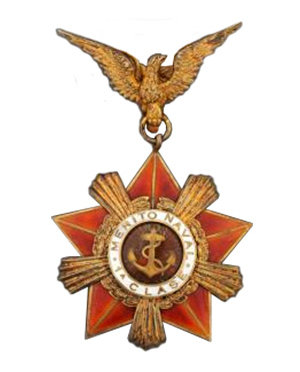
The Star for Naval Merit (Mexico)

The Star for Military Merit was a medal issued during the twentieth century for the suppression of revolts and for general military service as the Mexican army put down rebellions by Mayan Indians.

In Spanish colonial times, the Yucatán (like most of New Spain) population operated under a legal caste system: peninsulares (officials born in Spain) were at the top, the criollos of Spanish descent in the next level, followed by the mestizo population (of mixed European-Amerindian descent), then descendants of the natives who had collaborated with the Spanish conquest of Yucatán, and at the bottom were the other native indios.

The Caste War of Yucatán (1847–1901) began with the revolt of native Maya people of Yucatán, Mexico against the European-descended population, called Yucatecos. The latter had long held political and economic control of the region. A lengthy war ensued between the Yucateco forces in the north-west of the Yucatán and the independent Maya in the south-east.

The war officially ended in 1901 when the Mexican army occupied the Maya capital of Chan Santa Cruz and subdued neighboring areas. Another formal end was made in 1915, when a Mexican general was sent to subdue the territory. However, skirmishes with small settlements that refused to acknowledge Mexican control continued until 1933.