The Order of the Black Star

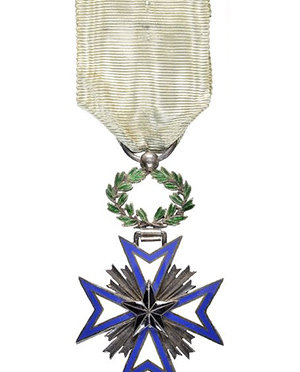
The Order of the Black Star (Ordre de l’Étoile Noire) was an order of knighthood established by Toffa, future king of Dahomey, today Benin.

The Order of the Black Star (or “Ordre de l’Étoile Noire”) was an order of knighthood established on 1 December 1889 at Porto-Novo by Toffa, future king of Dahomey (today the Republic of Benin).

Approved and recognized by the French government on 30 July 1894, after the establishment of the new statutes of 30 August 1892, according this distinction to all those who worked to develop French influence on the west coast of Africa.

The order has five classes:

  • Grand-croix (grand cross)
  • Commandeur avec plaque (commander with plaque)
  • Commandeur (commander)
  • Officier (officer)
  • Chevalier (knight)

The order was deprecated by decree on 3 December 1963, and superseded by the Ordre National du Mérite. Extant members of the order are permitted to wear their original decorations.

The Indochinese Order of Merit

The Indochinese Order of Merit (or “Ordre du Mérite indochinois”) was a regional award of France awarded by the Governor-General of Indochina for the local population of French Indochina.

Established April 30, 1900 by Governor-General of French Indochina Paul Doumer the order was to reward the local population of Indo-China for services to agriculture, commerce, industry and art.

This award had no status as an official French colonial award but was a local only award for the population of Laos, Cambodia, Tonkin, Cochin China, and Annam.

Governed by an Order Council, it was divided into three classes with limit on the number of members for each class. The 3rd class, was limited to 500 members. The 2nd Class, was limited to 100 members. The 1st class, was limited to 15 members.

The Indochinese Order of Merit Design

The badge of the order is a ball tipped six-pointed star with concave sides. In the center of the star is a round rimmed medallion. In the center of the medallion is the inscription in Annamese ideographic writing “It is worthy to develop knowledge“.

On the rim is the inscription INDOCHINE FRANCAISE (French Indochina). Attached to the ball of the top most arm of the star are two laurel branches, which act as a ring to attach the star to its ribbon.

The ribbon of the order is yellow Moire silk. The Order was presented in the 1st degree in gold, 2nd degree silver, and third degree bronze.

The Honour Medal for Firefighters

  • Time Period: Pre-WW1
  • Institution: 16 February 1900
  • Country: France

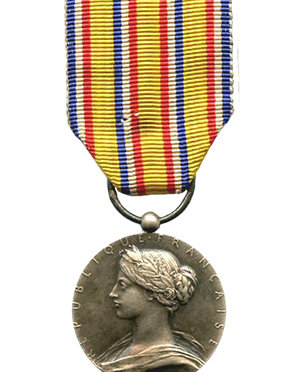
The Honour medal for firefighters (or “Médaille d’honneur des Sapeurs Pompiers”) is a state decoration of France bestowed by the Ministry of the Interior to members of the French Fire Service.

Although possessing a two-century-old firefighting tradition, the French government proved slow in recognizing the service and courage of the men and women who face risk on a daily basis to save lives and property. Not until 1875 was a service certificate established and bestowed for thirty years of service.

The decree of 4 March 1981 saw a new design and ribbon for the Honour medal for firefighters awarded for exceptional service.

The Honour medal for firefighters is bestowed to firefighters:

  • who have always displayed devotion to duty (long service); or,
  • who have particularly distinguished themselves (exceptional service).

The Honour Medal for Firefighters Design

The Honour medal for firefighters bestowed “for long service” is a 30mm in diameter (27mm before 1935) circular medal.

Its obverse bears the effigy of the republic in the form of the relief image of the left profile of a woman wearing a firefighter’s helmet, also visible is her uniform collar bearing the distinctive grenade insignia of the firefighting corps in France. On either side, the relief inscription along the circumference “RÉPUBLIQUE FRANÇAISE” (“FRENCH REPUBLIC”).

The medal is struck in silver, silver-gilt and gold. The silver grade award’s ribbon suspension bar is adorned with opposing fire hose nozzles. Each grade above silver is denoted by an increasingly intricate ornamentation on the ribbon suspension bar. 

The reverse of the medal bears at its center, the relief image of a fireman’s helmet partially covering a building on fire above the inscription “HONNEUR AU DEVOUEMENT” (“HONOUR TO DEVOTION”) itself above a blank area reserved for the recipient’s name and year of award. The relief image of flames at the very bottom and on either side of the fire hall. At the top along the medal circumference, the relief semi circular inscription “MINISTÈRE DE L’INTÉRIEUR” (“INTERIOR MINISTRY”).

The current, post-1981 Honour medal for firefighters bestowed “for exceptional services” is a 32mm in diameter circular medal. Its obverse bears the relief image of the left profile of a helmeted male firefighter, above his head, the relief semi circular inscription “MINISTÈRE DE L’INTÉRIEUR” “INTERIOR MINISTRY”) along the medal’s upper circumference. The ribbon suspension bar is adorned with two crossed firemen’s axes resting atop two laurel branches from which flames shoot upwards to just above opposing horizontal fire hose nozzles. The medal is struck in silver or silver-gilt variants. The reverse bears a Phrygian cap with between two axes below the initials “R.F.”.

The medal hangs from a 37mm wide silk moiré ribbon of red on the right edge watering into yellow across its width. The ribbon bears a rosette of the same colours to indicate that it is an award “for exceptional services”.

The Honour Medal of the National Police

The Honour medal of the National Police (or Médaille d’honneur de la Police nationale) is the highest award of the French National Police, which falls under the jurisdiction of the Ministry of the Interior.

Created by the Decree of 3 April 1903 at the request of Monsieur Émile Combes, Minister of the Interior, the medal was originally called the “Médaille d’honneur de la Police Municipale et Rurale” (“Honour medal of the rural and municipal police). The decree of 17 November 1936 will rename it the “Médaille d’honneur de la Police française” (“French Police honour medal). Finally, Decree No. 96-342 of 22 April 1996 will give the medal its current designation.

The award was extended in 1972, to administrative staff and senior officers of the National Police. The medal is awarded under the following conditions:

  • to police officers, for 20 years of service;
  • to members of the administrative staff, for 25 years of combined civil and military service.

The award may be bestowed posthumously regardless of time of service. It may also be awarded in exceptional cases for acts of courage or exceptional service to the police force by national or foreign police officers regardless of time of service. Under these circumstances, the medal ribbon is adorned with a five-pointed silver star.

The Honour Medal of the National Police Design

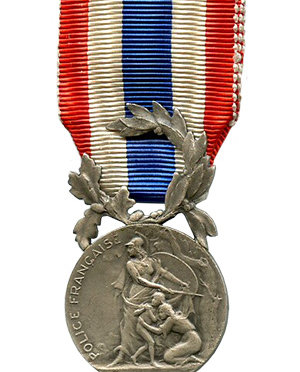
The Honour medal of the National Police, a design of engraver Marie Alexander Coudray, is a 27mm in diameter circular silver medal.

The obverse bears the relief image of the protecting Republic, in the form of a standing helmeted woman holding a sword and a shield, protecting a kneeling woman pulling a frightened child to her, behind them a tree. Along the right circumference, the semi circular relief inscription “POLICE FRANÇAISE” (“FRENCH POLICE”).

The reverse bears at its bottom a framed rectangular area destined to receive the name of the recipient and year of the award. Along the upper medal circumference, the relief inscription “RÉPUBLIQUE FRANÇAISE” (“FRENCH REPUBLIC”), at its center, the inscription “MINISTÈRE DE L’INTÉRIEUR” (“INTERIOR MINISTRY”).

The medal hangs from a 3cm wide silk moiré tricolor ribbon with an 8mm wide central blue stripe bordered by 6mm wide white stripes and 5mm red stripes at its edges. The ribbon’s suspension loop is adorned with a crown composed of an olive branch and a sprig of oak with an opening on the right.

The Honour medal of the rural and municipal police in Algeria included a clasp on the ribbon consisting of a star placed on a crescent of Islam. Today, the only ribbon device is in the form of a silver five pointed star when the medal is awarded in exceptional circumstances.

The Honour Medal of Foreign Affairs

  • Time Period: Pre-WW1
  • Institution: Type 1 award 28 July 1816 – Type 2 award 30 August 2010
  • Country: France

The Honour medal of Foreign Affairs (or Médaille d’honneur des affaires étrangères or President’s Medal) is a state decoration bestowed by the French Republic in the form of an honour medal for work.

It was originally created by a Royal decree of 28 July 1816 as a single grade medal to reward acts of courage displayed by French nationals on foreign soil. Although still bestowed in wartime for courage, the modern award is now aimed at rewarding civil servants of the ministry for Foreign Affairs.

The Honour medal of Foreign Affairs is currently divided into three grades, bronze, silver and gold. The Honour medal of Foreign Affairs may be exceptionally awarded regardless of seniority and set quotas to reward bravery and dedication.

The wartime award with swords is bestowed as follows:

  • In bronze to privates;
  • In silver to non-commissioned officers;
  • In gold (silver-gilt prior to 2010) to officers.

The Honour Medal of Foreign Affairs Design

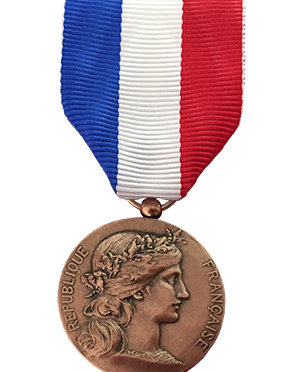
The Honour medal of Foreign Affairs, a design of engraver Daniel Dupuis, is a 27mm in diameter circular medal in bronze, silver or gold.

The obverse bears the relief effigy of the republic surrounded by the relief inscription “RÉPUBLIQUE FRANÇAISE” (“FRENCH REPUBLIC”) along the left and right circumference. The reverse bears a crown of half laurel and half oak leaves with the relief inscription “AFFAIRES ÉTRANGÈRES” (“FOREIGN AFFAIRS”) with a bare center destined to receive the recipient’s name and year of award.

The medal hangs from a silk moiré tricolour ribbon composed of three equal blue-white-red vertical stripes. The wartime award includes a wreath of oak leaves with two crossed swords on the suspension ring.

The Honour Medal for Courage and Devotion

The Honour medal for courage and devotion (or “Médaille d’honneur pour acte de courage et de dévouement”) is a French decoration that can be bestowed to individuals and whole units. It is awarded for acts of courage during a rescue.

The Honour medal for courage and devotion was created on 2 March 1820 by King Louis XVIII. It has gone through several designs during its long history. The award was given its present name by a decree of 16 November 1901.

Any person who risks his or her life to come to the rescue of one or many persons in danger, may be recognized with the medal. When the act of rescue does not warrant an award of the medal, a letter of congratulations for a successful rescue or an honorable mention for a recognized meritorious act in the form of an official certificate type scroll may be granted.

The Honour medal for courage and devotion is divided into five grades:

  • Bronze (Bronze)
  • Silver 2nd class (Argent de 2ème classe)
  • Silver 1st class (Argent de 1ère classe)
  • Silver-gilt (Vermeil)
  • Gold (Or)

The Honour Medal for Courage and Devotion Design

The design of the Honour medal for courage and devotion changed many times through the decades. It is now a 27mm in diameter circular medal struck in bronze, silver, silver-gilt or gold.

Its obverse bears the relief image of a standing woman holding palms and crowns surrounded by scenes of rescues under the relief inscription “DÉVOUEMENT” (“DEVOTION”). The reverse bears along its upper circumference, the relief inscription “RÉPUBLIQUE FRANÇAISE” (“FRENCH REPUBLIC”), at its center, the inscription “MINISTÈRE DE L’INTÉRIEUR” (“INTERIOR MINISTRY”) over a framed rectangular area destined to receive the name of the recipient and year of the award.

The medal hangs from a 3cm wide silk moiré tricolour ribbon of equal width blue, white and red vertical stripes. The 3cm wide and 22mm high ribbon suspension loop is cast as an integral part of the medal in the form of oak leaves. The leaves of the suspension loop change colour depending on the grade of the award, bronze for the bronze grade, silver for the silver grade second class, silver-gilt for the silver grade first class and silver-gilt grade, and gold for the gold grade.

Different devices may be worn on the service ribbon to denote the grade of the award when only the ribbons are worn. A plain ribbon is worn for the bronze grade, the silver grade second class is denoted by the addition of a silver five pointed star, a silver and a silver-gilt star for the silver grade first class, a silver-gilt star for the silver-gilt grade and a rosette for the gold grade.

The Order of Agricultural Merit

The Order of Agricultural Merit is an order of merit by the French Republic for outstanding contributions to agriculture.

The Order of Agricultural Merit (or Ordre du Mérite agricole) is an order of merit bestowed by the French Republic for outstanding contributions to agriculture.

When it was created in 1883, it was second in importance only to the Legion of Honour within the French order of precedence. The order was established on 7 July 1883, based on the proposition of the then Minister of Agriculture Jules Méline, in an effort to adequately reward services to agriculture in view of the maximum number of the Legion of Honour that could be awarded yearly. Labour was intensive and never-ending, devotion was commonplace but the rewards were rare.

The Order comprises approximately 340,000 recipients to date, of which approximately 23,000 are alive at any given time, including all living former ministers of agriculture. Officers number approximately 60,000 to date with approximately 5,000 living, and approximately 4800 were made commanders to date, with approximately 400 living at any given time.

Award prerequisites are as follows:

  • Knight: be at least thirty years of age with fifteen years of service/work;
  • Officer: at least five years as a Member of the order;
  • Commander: at least five years as an Officer of the order.

Conditions of age and of seniority may be lowered for candidates who have outstanding qualifications.

The Order of Agricultural Merit Design

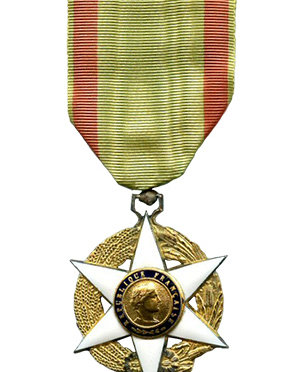
The Order of Agricultural Merit is in the form of a 40mm (35mm for pre-November 1999) wide star, 60mm for the commander’s insignia, with six white enameled arms, the arms resting on a gilt wreath of wheat on the right and of corn on the left.

On the obverse at its center, a gilt medallion bearing the effigy of the republic in the form of the relief right profile of a woman’s head, the medallion is surrounded by a narrow blue enameled band bearing the golden semi-circular inscription “RÉPUBLIQUE FRANÇAISE” (“FRENCH REPUBLIC”).

On the reverse, the gilt medallion bears the relief inscription on three lines “MÉRITE” “AGRICOLE” “1883” (“AGRICULTURAL MERIT 1883”), it is surrounded by a plain blue enameled band.

The officers’ and commanders’ badges also bear a gilt wreath, half vine and half olive branch, between the insignia and the ribbon suspension ring. The knight’s insignia is made of silver, the officer’s is made of silver-gilt, the commander’s is made of silver-gilt or gold.

The order hangs from a 37mm wide silk moiré green ribbon with 5mm amaranth vertical stripes located 1mm from the edges. The commander’s insignia is worn on a cravat around the neck.

The Order of Academic Palms

  • Time Period: Pre-WW1
  • Institution: Decoration: 1808, Order: 1955
  • Country: France

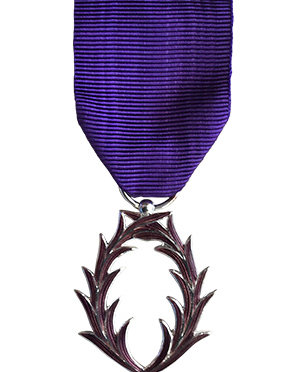
The Order of Academic Palms (“Ordre des Palmes académiques“) is a national order bestowed by the French Republic to distinguished academics and figures in the world of culture and education.

Originally established in 1808 by Emperor Napoleon as a decoration to honor eminent members of the University of Paris, it was changed into its current form as an order of merit on 4 October 1955 by President René Coty.

The early Palmes académiques was instituted on 17 March 1808 and was bestowed only upon teachers or professors. In 1850, the decoration was divided into two known classes:

  • Officier de l’Instruction Publique (Golden Palms);
  • Officier d’Académie (Silver Palms).

In 1866, the scope of the award was widened to include major contributions to French national education and culture made by anyone, including foreigners. It was also made available to any French expatriates making major contributions to the expansion of French culture throughout the rest of the world.

The Order of Academic Palms Design

Since 1955, the Ordre des Palmes académiques has comprised three grades, each grade having a fixed number of recipients:

  • Commander (Commandeur) — gold cross of 60 mm with a coronet (“couronne”) worn on necklet.
  • Officer (Officier) — gold cross of 55 mm worn on ribbon with rosette on the left breast.
  • Knight (Chevalier) — silver cross of 50 mm worn on ribbon on the left breast.

The Military Medal (France)

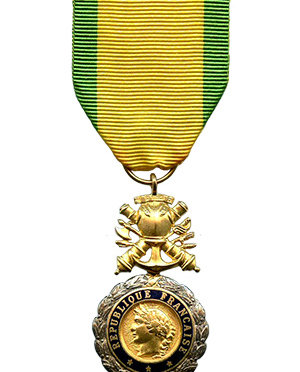
The Military Medal (Medaille Militaire) is a military decoration of the French Republic for meritorious service and acts of bravery.

The Military Medal (or Medaille Militaire) is a military decoration of the French Republic for other ranks for meritorious service and acts of bravery in action against an enemy force.

It is the third-highest award of the French Republic, after the Légion d’honneur, a civil and military order, and the ordre de la Libération, a second world war-only order. The Médaille militaire is therefore the most senior entirely military active French decoration.

The award was first established in 1852 by the first President of the French Republic, Louis-Napoléon Bonaparte who may have taken his inspiration from a medal established and awarded by his father, Louis Bonaparte, King of Holland.

During World War One, 230 000 médailles were awarded, when 1 400 000 French Army soldiers were killed and 3 000 000 wounded. After the First World War, the Military Medal was also temporarily awarded for wounds received in combat.

The Military Medal Award Criteria

Like many other French awards, the médaille can be awarded for different reasons. It can be awarded to foreign nationals serving with or alongside the French armed forces.

  • To members of the military other than commissioned officers;
    • As an award for valour, it is the second highest award ranking immediately after the Légion d’honneur.
    • As an in between medal for enlisted members, NCO and O(D) awarded the Légion d’honneur for “combat actions”, nowadays mostly done posthumously.
    • As a service medal, for long-serving NCOs.
  • To generals and admirals who have been commanders-in-chief, as a supreme award for leadership. These general officers must already have been awarded the grand cross of the Légion d’honneur.

The Military Medal Design

The Médaille militaire is a silver laurel wreath, 28 mm (1.1 in) in diameter, wrapped around a central gold medallion bearing the left profile of Marianne, effigy of the French Republic, the original 2nd Empire variant bore the left profile of Emperor Napoleon III.

The central gold medallion is surrounded by a blue enamelled ring bearing the gilt inscription “RÉPUBLIQUE FRANÇAISE” (FRENCH REPUBLIC) with a small gilt five-pointed star at the bottom for a 4th Republic award, three stars for a 5th Republic variant, the 3rd Republic variant bore the date 1870, the 2nd Empire variant bore the gilt inscription “LOUIS-NAPOLEON” in lieu of “RÉPUBLIQUE FRANÇAISE” and had flowers on both sides of the small star at the bottom.

The original variant was topped by a silver imperial eagle with a loop through which the suspension ring passed, all other variants were and are topped by a device composed of a breastplate superimposed over crossed cannons, a naval anchor, sabres, swords and battle axes, to which the suspension ring passes through a loop for attachment to a ribbon.

The reverse of the medallion is common to all variants since inception of the award, it bears the relief inscription on three lines “VALEUR ET DISPLINE” (“VALOUR AND DISCIPLINE”) and is surrounded by a blue enamelled ring.

The ribbon of the Médaille militaire is 37 mm (1.5 in) wide, yellow in color with 6 mm-wide (0.24 in) green stripes on each edge.

The Order of Military Merit (France)

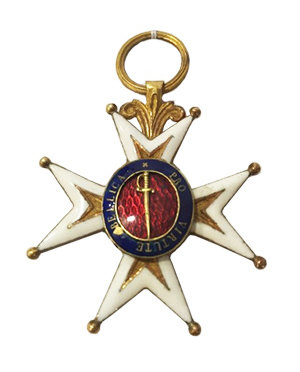
The Order of Military Merit, initially known as the Institution of Military Merit (or Institution du Mérite militaire) was an order of the French Ancien Régime created on 10 March 1759 by King Louis XV. It was created to reward the non-Catholic officers of the French Army.

By the 18th Century there were regiments of Swedish, German, and Swiss troops in service to France, the most famous being the Swiss Guards. Since many of these regiment’s officers were Protestant there lacked a suitable reward for distinguished service. The Order of Saint Louis was intended as a reward for exceptional military officers, but could only be awarded to those of the Roman Catholic faith. King Louis XV created the Institution du Mérite militaire to be an outward sign of distinction, but not an order since French orders were limited to Catholics.

In 1792, after the proclamation of the Republic the Décoration Militaire was abolished. King Louis XVIII continued to make awards of the order while in exile. On 28 November 1814, during the restoration Louis XVIII reaffirmed the Order of Military Merit, increasing the number of Grand Crosses to four and Grand Cordons to eight. The ribbon color was also changed to match that of the Order of St. Louis. The last appointment to the order was made in 1829.

The Order of Military Merit Design

Presented in three grades the names of which were formalized as Knight, Grand Cordon, and Grand Cross in 1785, mirroring those of the Order of St. Louis. King Louis was careful to promote the prestige of the award by appointing the most talented officers. The first Grand Crosses were presented to Swiss Field Marshal Count Waldner and German Lieutenant General Prince William of Nassau-Saarbrücken.