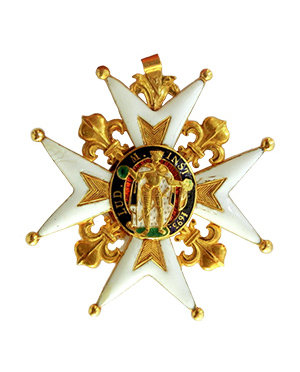
The Order of Saint Louis

The Royal and Military Order of Saint Louis (or Ordre Royal et Militaire de Saint-Louis) is a dynastic order of chivalry founded 5 April 1693 by King Louis XIV, named after Saint Louis (King Louis IX of France).

It was intended as a reward for exceptional officers, notable as the first decoration that could be granted to non-nobles. By the authorities of the French Republic, it is considered a predecessor of the Legion of Honour, with which it shares the red ribbon (though the Legion of Honour is awarded to military personnel and civilians alike).

The King was the Grand Master of the order, and the Dauphin was automatically a member as well. The Order had three classes:

  • Grand-Croix (Grand Cross)
  • Commandeur (Commander)
  • Chevalier (Knight)

The entire order included 8 Grand Crosses, 28 Commanders and a variable number of Knights. Officers of the Order included, after the Grand Master, a Trésorier (Treasurer), a Greffier (Registrar) and a Huissier (Gentleman Usher).

Conditions for being inducted did not include nobility; however, Catholic faith was mandatory, as well as at least ten years’ service as a commissioned officer in the Army or the Navy. Members of the Order received a pension. Hereditary nobility was granted to a knight’s son and grandsons.

Although officially abolished by the government authorities of the July Revolution in 1830 following the French Revolution, its activities carried on as a dynastic order of the formerly sovereign royal family. As such, it is still recognised by the International Commission on Orders of Chivalry.

The Order of Saint Louis Design

The badge of the order consisted of a portrait of Saint Louis surrounded by the motto « LUD(OVICUS) M(AGNUS) IN(STITUIT) 1693 » (“Louis the Great instituted it in 1693“).

The reverse features a sword interlaced with a laurel crown and a white sash, with the inscription « BELL(ICAE) VIRTUTIS PRAEM(IUM) » (“reward of wartime valour”). Knights wore the badge suspended from a ribbon on the breast, Commanders wore a red ribband (sash) over the right shoulder, and recipients of the Grand Cross wore the ribband as well as a star on the left breast.

The general assembly of the Order was held annually on 25 August, the feast day of Saint Louis, in the residence of the King.
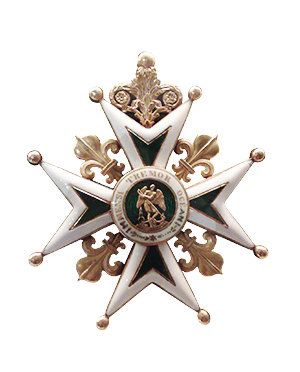

The Order of Saint Michael

The Order of Saint Michael (or Ordre de Saint-Michel) is a French dynastic order of chivalry founded by Louis XI of France on 1 August 1469.

The Order of Saint Michael (or Ordre de Saint-Michel) is a French dynastic order of chivalry, founded by Louis XI of France on 1 August 1469, in competitive response to the Burgundian Order of the Golden Fleece founded by Philip the Good, duke of Burgundy and Louis’ chief competitor for the allegiance of the great houses of France.

As a chivalric order, its goal was to confirm the loyalty of its knights to the king. Originally, there were a limited number of knights, at first thirty-one, then increased to thirty-six including the king. An office of Provost was established in 1476. The Order of St Michael was the highest Order in France until it was superseded by the Order of the Holy Spirit.

Although officially abolished by the government authorities of the July Revolution in 1830 following the French Revolution, its activities carried on. It is still recognized by the International Commission on Orders of Chivalry.

The Order’s last member died in 1850. However, 10 nominations of knights were conferred in 1929, 1930, and in the 1970s and 1980s. As is mentioned by the French Government, it would be considered as the origin of the Ordre des Arts et des Lettres: “Saint-Michel Order (1460–1830) can be considered as the precursor of the Order of the Arts and Lettres. Originally destined to the aristocracy, from 17th to 18th Centuries it became an order of civil merit, which distinguished many artists, architects, collectors, and people of lettres…”

The motto of the order was “immensi tremor oceani” (meaning the tremor of the immense ocean) derived from the idea of Saint Michael looking out over the Atlantic from Mont Saint-Michel.

The Order of Saint Michael Design

The Order of St. Michael dedicated to the Archangel Michael conveyed to every member a gold badge of the image of the saint standing on a rock (Mont Saint-Michel) in combat with the serpent.

It was suspended from an elaborate gold collar made of scallop shells (the badge of pilgrims, especially those to Santiago de Compostela) linked with double knots. The statutes state that the badge could be hung on a simple chain, and later it was suspended from a black ribbon.

Find This Medal

Right Now on eBay 
Clicking a link to eBay may result in a referral commission being paid if a purchase is made.
Loading...

The Order of the Holy Spirit

  • Time Period: Pre-WW1
  • Institution: 31 December 1578
  • Country: France

The Order of the Holy Spirit (or Ordre du Saint-Esprit, sometimes translated into English as the Order of the Holy Ghost), is a French order of chivalry founded by Henry III of France in 1578. Today, it is a dynastic order under the House of France.

During the French Revolution, the Order of the Holy Spirit was officially abolished by the French government, along with all other chivalric orders of the Ancien Régime, although the exiled Louis XVIII continued to acknowledge it. Following the Bourbon Restoration, the order was officially revived, only to be abolished again by the Orleanist Louis-Philippe following the July Revolution in 1830. Despite the abolition of the order, both the Orléanist and Legitimist pretenders to the French throne have continued to nominate members of the order, long after the abolition of the French monarchy itself. The order is still recognised by the International Commission on Orders of Chivalry.

The King of France was the Sovereign and Grand Master (Souverain Grand Maître), and he made all appointments to the order. Members of the order can be split into three categories:

  • 8 Ecclesiastic members;
  • 4 Officers;
  • 100 Knights.

Initially, four of the ecclesiastic members had to be cardinals, whilst the other four had to be archbishops or prelates.

The Order of the Holy Spirit Design

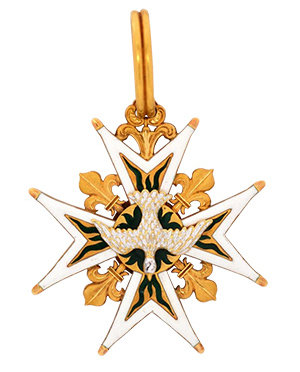
The symbol of the order is known as the Cross of the Holy Spirit (a Maltese Cross). At the periphery, the eight points of the cross are rounded, and between each pair of arms there is a fleur-de-lis. Imposed on the centre of the cross is a dove.

The eight rounded corners represent the Beatitudes, the four fleur-de-lis represent the Gospels, the twelve petals represent the Apostles, and the dove signifies the Holy Spirit. The Cross of the Holy Spirit was worn hung from a blue riband (“Le cordon bleu”).

The badge of the Order is a gold Maltese cross with white borders, each of the eight points ending in a gold ball (points boutonnées) and with a gold fleur-de-lys between each adjacent pair of its arms. At the center of the cross, was set a white dove descending (i.e., with its wings and head pointing downward) surrounded by green flames. The back of this cross worn by the knights was the same as the front except with the medallion of the Order of Saint Michael at the center rather than the dove and flames (those of ecclesiastical members were the same on the back as on the front).

During the ceremonies, the cross of officers and commanders officers was attached to a collar of links of gold fleur-de-lis alternating with links consisting of a white enameled letter H (the first initial of name of the founder) crowned with a gold French royal crown, with identical crowns on either side of it or alternately with a trophy of weapons. Each of these links was surrounded with red enamel flames forming a square around it. More generally, the cross was suspended from a large ribbon of color moirée blue sky, hence the nickname cordon bleu the knights wore.

For the ceremonies of the Order and when the knights of the Order made their Communion, the knights wore a long black velvet mantle sprinkled with embroidered gold and red flames and with a representation of the collar round its edges embroidered in gold, red and silver. The mantle was worn over a white coat (with the star of the Order embroidered on the left breast), waistcoat and puffed hose, heavily embroidered with silver. A black hat with a white plume completed the dress.

The star of the Order had the same design as the front of the badge, but embroidered in silver (later a medal star in silver was used) on both the knights’ coats and their vests.

The Medal for the Military Protection of the Territory

The Medal for the Military Protection of the Territory (or “Médaille de la protection militaire du territoire” in French) is a French state decoration established on 13 July 2015 by presidential decree 2015-853 and awarded to military personnel of the French Armed Forces for service during national security operations on French national territory.

It was created to recognize service following the need for an increased military presence during national security operations following the rise of international terrorism and the many incidents in France over the past years.

The Minister of Defense is responsible for the administration of the medal and will determine by decree:

  • the operations giving the right to the award of the medal and its related clasp;
  • the dates during the same operations that give the right to the award of the medal and its related clasp;
  • the minimum number of days served during the same operations giving the right to the award of the medal and its related clasp.

In exceptional circumstances, the Minister of Defense may award the medal and its related clasp to soldiers killed or wounded during one of these operations.

The Medal for Military Protection of the Territory Design

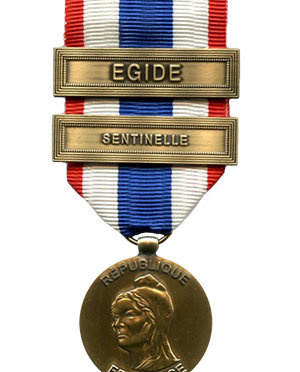
The Medal for the Military Protection of the Territory is a 30 mm in diameter circular medal struck from bronze.

Its obverse bears the effigy of the Republic with the relief inscription above “RÉPUBLIQUE” and below “FRANÇAISE” (“FRENCH REPUBLIC”). The reverse bears the relief inscription on five lines “MÉDAILLE” “DE LA” “PROTECTION MILITAIRE” “DU” “TERRITOIRE” (“MEDAL” “FOR THE” “MILITARY PROTECTION” “OF THE” “TERRITORY”).

The medal hangs from a 38 mm wide silk moiré ribbon passing through a ring through the medal’s ball-shaped suspension loop. The ribbon bears the national colors of France in the following pattern: 14 mm wide blue vertical central stripe bordered by white 8 mm wide stripes with 5 mm wide red edge stripes.

The medal is always awarded with a clasp and multiple clasps may be worn simultaneously. Five clasps are currently approved for wear on the ribbon of the Medal for the Military Protection of the Territory:

  • SENTINELLE for participation in Opération Sentinelle;
  • HARPIE for effective participation in the “Harpie” mission;
  • TRIDENT for effective participation in military surveillance and protection missions of French airspace, waters and land areas between 1 July 2013 to a date not yet specified. 
  • JUPITER for effective participation in military surveillance and protection missions by strategic forces between 1 July 2013 to a date not yet specified. 
  • ÉGIDE for effective participation in the military protection of military assets, public and state buildings, of international organizations and diplomatic and consular missions between 1 July 2013 to a date not yet specified. 

The French Commemorative Medal

The French commemorative medal (or “Médaille commémorative française” in French) is a French decoration intended to recognize civilians and soldiers who took part in specific missions ordered by the French government carried out outside of French national territory after March 1, 1991.

It was established by decree 95-1098 on 9 October 1995 on the initiative of the then Defence Minister, François Léotard. The Minister of Defense decides by individual decree each theatre of operations in which the medal may be earned, the start and end dates for award eligibility, and the minimal time in theatre required to earn the award.

The medal may be awarded to foreign military and civilians having served under French command, subject to approval by their own governments. 

The medal is always worn with at least one clasp. Each operational mission clasp can only be earned once.

The French Commemorative Medal Design

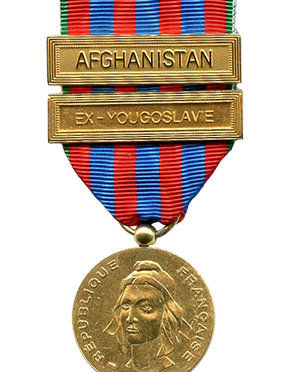
The French commemorative medal is a 30mm in diameter circular gilded medal struck from bronze.

The obverse bears the effigy of the republic three quarters facing and wearing a Phrygian cap surrounded by the relief inscription along the medal circumference “RÉPUBLIQUE FRANÇAISE” (“FRENCH REPUBLIC”). The reverse is arranged akin a stylized globe, at the center, the relief image of a vertical sword pointing up within an olive wreath, the inscription “MÉDAILLE COMMÉMORATIVE FRANÇAISE” (“FRENCH COMMEMORATIVE MEDAL”) superimposed over it in relief.

The medal hangs from a ribbon through a ring passing through the medal’s ball shaped suspension loop. The 38mm wide silk moiré ribbon is divided into four red and three blue alternating 5mm wide stripes and is edged with 1,5mm green stripes.

To date, ten operational mission clasps have been approved for wear on the ribbon:

  • EX-YOUGOSLAVIE 1991
  • HAÏTI 1993, 2004, 2010
  • ALBANIE 1997 – 2001
  • TIMOR-ORIENTAL 1999 – 2000
  • AFGHANISTAN 2001
  • ASIE DU SUD-EST 2004
  • GÉORGIE 2008
  • LIBYE 2011
  • JORDANIE 2012
  • GUINÉE 2015

The Medal of the Nation’s Gratitude

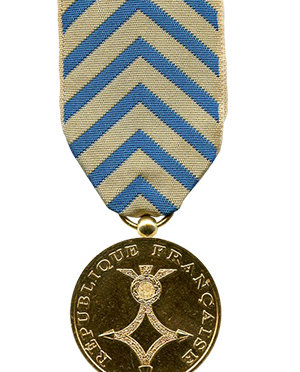
The Medal of the Nation’s Gratitude (or “Medaille de Reconnaissance de la Nation” in French) is a French state decoration established on 12 April 2002 by decree 2002-511 and awarded to civilians, veterans of civil or military service, and to members of the French armed forces previously awarded the “Title of the Nation’s Gratitude”, a governmental scroll certifying to honorable service abroad.

The medal was primarily established to replace the North Africa medal with broader and more inclusive prerequisites following years of pressure on the French government by veterans’ organizations.

The Medal of the Nation’s Gratitude is awarded to persons who have previously been awarded the Title of the Nation’s Gratitude, its particular award criteria were fixed by law No. 93-7 of 4 January 1993. Potential recipients must meet the following conditions:

  • People who, as members of the military, and for at least 90 days, consecutive or not, served in a formation of the French army or who were detached to a foreign army during the time periods and in the theatres of operation determined by the law;
  • Civilians of French nationality who were involved in these conflicts, operations or missions and meeting the prerequisites set by the Minister of Defence.

The Medal of the Nation’s Gratitude Design

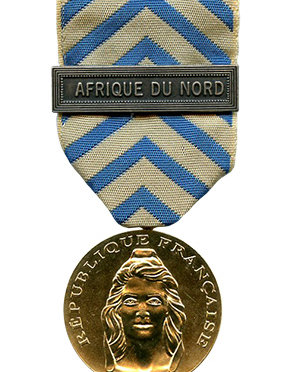
The Medal of the Nation’s Gratitude is a 34mm in diameter circular medal struck from bronze and gilded.

Its obverse bears the effigy of the Republic on surrounded by the relief inscription “RÉPUBLIQUE FRANÇAISE” (“FRENCH REPUBLIC”). The reverse bears the relief inscription on four lines “MÉDAILLE” “DE” “RECONNAISSANCE” “DE LA NATION” (“MEDAL” “OF” “GRATITUDE” “OF THE NATION”) over the relief image of a sprig of three oak leaves.

The medal hangs from a ribbon passing through a ring through the medal’s ball shaped suspension loop. The 34mm wide sand coloured silk moiré ribbon bears inverted 34mm wide and 3mm thick blue chevrons. The undress ribbon bears three such chevrons.

The medal is always awarded with a clasp and may be awarded with multiple clasps. Five clasps are currently approved for wear on the ribbon of the Medal of the Nation’s Gratitude:

  • 1914–1918
  • 1939–1945
  • INDOCHINE
  • AFRIQUE DU NORD (NORTH AFRICA)
  • OPERATIONS EXTERIEURES (FOREIGN OPERATIONS)

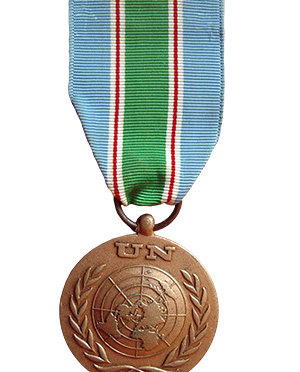
The United Nations Interim Force in Lebanon Medal

A United Nations Medal is an international decoration awarded by the United Nations (UN) to the various world countries’ militaries for participation in joint international military and police operations such as peacekeeping, humanitarian efforts, and disaster relief.

Since 1955, many additional United Nations medals have been created and awarded for participation in various United Nations missions and actions around the world.

The most common United Nations medal is the standard UN decoration known simply as the United Nations Medal. Most countries bestow this award for any action in which a member of the military participated in a joint UN activity.

The United Nations Interim Force in Lebanon Medal Design

In situations where a service member participated in multiple UN operations, service stars, campaign clasps, or award numbers are authorized as attachments to the United Nations Medal. These devices vary depending on the regulations of the various armed forces.

Most operations utilize a different ribbon for each mission, though there have been some notable exceptions. In some countries where the UN Security Council determines a mission in the same geographic region, but changes the mission mandate by way of Security Council Resolution, there may be a number of missions which have identical campaign ribbons and then later will change the ribbon to reflect the changing environment.

The North Africa Medal

The North Africa medal (Médaille d’Afrique du Nord) was established in 1997 for those who had fought in North Africa between 1952 and 1962.

The North Africa medal (or Médaille d’Afrique du Nord in French) was a French commemorative medal established on 29 April 1997 by French President Jacques Chirac via decree 97-424, following an initiative of Pierre Pasquini, Minister for veterans’ affairs and victims of war who expressed “the importance that an exceptional decoration be established for those who had fought in North Africa“.

Unfortunately, not all veterans awarded the “Title of the Nation’s Gratitude” met the new medal’s award prerequisites and almost immediately, new pressures were placed on the government for new medals or for a single one encompassing all bearers of the Title. It took five years for the new award to be established on 12 April 2002 by decree 2002-511. 

The North Africa medal ceased to be awarded that very day following barely five years of existence. It was replaced by the Medal of the Nation’s Gratitude with the clasp “AFRIQUE DU NORD” (“NORTH AFRICA”).

The North Africa medal was bestowed to French civilians and military personnel, as well as to foreign nationals serving in the ranks of the French Foreign Legion, who held the “Title of the Nation’s Gratitude” (“Titre de la Reconnaissance de la Nation” in French) for at least ninety days service in:

  • Algeria between 31 October 31, 1954 and 2 July 1962;
  • Morocco between 31 June 1953 and 1 March 1956;
  • Tunisia between 1 January 1952 and 19 March 1956.

The North Africa Medal Design

The North Africa medal was a 34mm in diameter gilded medal struck from bronze.

The obverse bore the relief image of an Agadez cross (Southern cross) surrounded by the inscription also in relief “RÉPUBLIQUE FRANÇAISE” (“FRENCH REPUBLIC”).

The reverse bore the relief inscription on two lines “MÉDAILLE” “D’AFRIQUE DU NORD” (“MEDAL” “OF NORTH AFRICA”) over the relief image of a sprig of three oak leaves.

The medal hung from a ribbon passing through a ring through the medal’s ball shaped suspension loop. The 34mm wide sand coloured silk moiré ribbon bore inverted 34mm wide and 3mm thick blue chevrons. The undress ribbon bore three such chevrons.

The North Africa Security and Order Operations Commemorative Medal

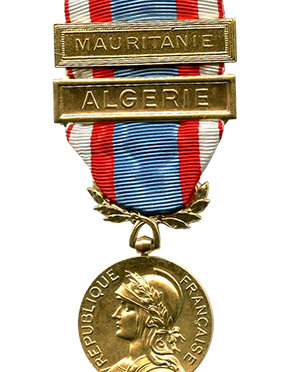
The Commemorative Medal for Security Operations and the Maintenance of Order (or “Médaille Commémorative des Opérations de Sécurité et de Maintien de l’Ordre en Afrique du Nord” in French) is a French commemorative medal established in the late 1950s for award to members of the French armed forces and French civil servants under military authority for service in French North Africa during the hectic years that would become the end of French colonialism in the region.

A medal was initially created by decree 56-1032 of 12 October 1956 and called the Médaille Commémorative des Opérations de Sécurité et de Maintien de l’Ordre en Afrique du Nord (“Commemorative Medal for Security Operations and Maintenance of Order in North Africa”). It was designed to fill this void and recognize their service in what was officially called a “police action” to quell disorder, rather than a military campaign against an armed and organized enemy.

Decree 58-24 of 11 January 1958 modified the design and renamed the award to “Médaille Commémorative des Opérations de Sécurité et de Maintien de l’Ordre” (English: “Security and Order Operations Commemorative Medal”).

Rather than design a new medal for each operation in North Africa, the government decided to extend the eligibility, the existing medal could then be awarded to anyone who had served in North Africa during the 1950s and 1960s.

TheNorth Africa Operations Commemorative Medal Design

The medal is a 30mm in diameter circular medal struck from bronze and gilded.

The obverse, engraved by Georges Lemaire, bore an allegorical image of the warrior French Republic wearing a helmet adorned with and oak leaf wreath and surrounded by the relief inscription along the medal circumference “RÉPUBLIQUE FRANÇAISE” (“FRENCH REPUBLIC”).

On the reverse, the relief inscription on five lines “MÉDAILLE” “COMMÉMORATIVE” “OPÉRATIONS SÉCURITÉ” “ET MAINTIEN” “DE L’ORDRE” (“MEDAL” “COMMEMORATIVE” “SECURITY OPERATIONS” “AND MAINTAINING” “ORDER”) surrounded by a wreath of oak and olive leaves along the medal circumference.

The pre January 1958 variant had the reverse inscription on four lines “MÉDAILLE” “COMMÉMORATIVE” “D’AFRIQUE” “DU NORD” (English: “NORTH” “AFRICA” “COMMEMORATIVE” “MEDAL”).

The medal hung from a ribbon passing through a wreath shaped ring through the medal’s suspension loop. The red silk moiré ribbon was 36mm wide with a 14mm central light blue stripe and two 5mm wide white stripes each 1mm from the edge.

The Middle East Operations Commemorative Medal

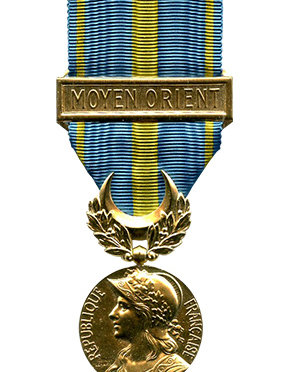
The Middle East operations commemorative medal (or Médaille commémorative des opérations du Moyen-Orient in French) was a French commemorative medal established on 22 May 1957 to recognize the participation of French nationals in the military operations conducted during the Suez Crisis of 1956.

In 1956, Egyptian President Nasser decided to nationalize the Suez Canal Company, this action was against French and British interests in the region leading to a military intervention by both countries. For its part, France decided to send a 10,000 man strong expeditionary force under the command of Admiral Pierre Barjot and General André Beaufre. Under heavy diplomatic pressure from both the United States and the USSR, the Franco-British forces withdrew from the retaken territories and the entire expedition was abandoned after barely four months. The French forces had suffered fifteen dead.

The Middle East operations commemorative medal was awarded to French soldiers from all three services and civilians (including the crews of merchant vessels and civilian airliners) for participation in the operations that took place in the geographical area lying between the 20th and 36th Northern parallels and the 24th and 40th Eastern meridians between 1 September and 22 December 1956.

The Middle East Operations Commemorative Medal Design

The Middle East operations commemorative medal is a 30mm in diameter circular medal struck from bronze, it may be gilt.

The obverse bears the relief image of the “warrior republic” in the form of the left profile of a helmeted woman’s bust, the helmet being adorned by a crown of oak leaves. On either side, the relief inscription along the circumference “RÉPUBLIQUE FRANÇAISE” (FRENCH REPUBLIC).

On the reverse, the relief inscription on five lines “MÉDAILLE COMMÉMORATIVE DES OPÉRATIONS DU MOYEN-ORIENT 1956” (MIDDLE EAST OPERATIONS COMMEMORATIVE MEDAL 1956).

The medal hangs from a ribbon through a ring passing through the medal’s suspension loop. The ring is adorned by a 24mm in diameter bronze laurel wreath and half crescent. The silk moiré ribbon is 37mm wide and is light blue with a yellow central 7mm wide and 2mm wide stripes 2mm from the edges.

A gilt clasp bearing the relief inscription “MOYEN-ORIENT” (MIDDLE EAST”) is worn on the ribbon.