The Order of Maritime Merit

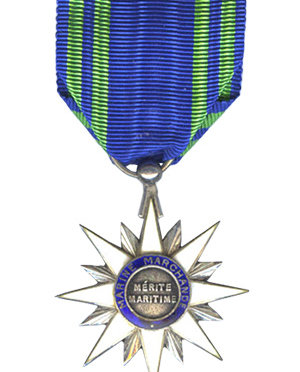
The Ordre du Mérite Maritime (or Order of Maritime Merit in French) is a French order established on 9 February 1930 for services rendered by the seafarers to distinguish the risks involved and the services rendered by seamen.

Stressed over the importance of the economic role of the Merchant Navy to the country. The order was reorganized in 1948, and again by decree on 17 January 2002.

The order can be awarded to merchant marine crew, civilian administrators, and the crews of lifeboats and rescues, naval military personnel and individuals who have distinguished themselves in maritime field.

The Order of Merit has 3 degrees:

  • Commandeur (commander)
  • Officier (officer)
  • Chevalier (knight)

The Order of Arts and Letters

The Order of Arts and Letters (or Ordre des Arts et des Lettres in French) is an Order of France, established on 2 May 1957 by the Minister of Culture. Its purpose is the recognition of significant contributions to the arts, literature, or the propagation of these fields.

French government guidelines stipulate that citizens of France must be at least thirty years old, respect French civil law, and must have, “significantly contributed to the enrichment of the French cultural inheritance” to be considered for award. Membership is not, however, limited to French nationals; recipients include numerous foreign luminaries. Foreign recipients are admitted into the Order, “without condition of age“.

The Order has three grades:

  • Commandeur (Commander) — medallion worn on necklet; up to twenty recipients a year.
  • Officier (Officer) — medallion worn on ribbon with rosette on left breast; up to sixty recipients a year.
  • Chevalier (Knight) — medallion worn on ribbon on left breast; up to 200 recipients a year.

The Order of Arts and Letters Design

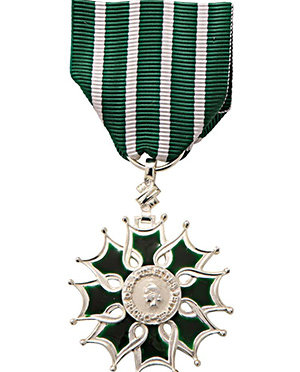
The medal of the Order is an eight-point, green-enameled asterisk, in gilt for Commanders and Officers and in silver for Knights; the obverse central disc has the letters “A” and “L” on a white enameled background, surrounded by a golden ring emblazoned with the phrase “République Française“.

The reverse central disc features the head of Marianne on a golden background, surrounded by a golden ring bearing the words “Ordre des Arts et des Lettres“. The Commander’s badge is topped by a gilt twisted ring.

The ribbon of the Order is green with four white stripes.

The Lombok Cross

The Lombok Cross is a military award established to commemorate service in the Dutch intervention in Lombok and Karangasem.

The Lombok Cross (or Lombokkruis in Dutch) is a military award of the Kingdom of the Netherlands, established to commemorate service in the Dutch intervention in Lombok and Karangasem which took place between June and December 1894.

The medal was established on 13 April 1895 by Queen Regent Emma of the Netherlands, acting for the underage Queen Wilhelmina.

The Lombok Cross Medal Design

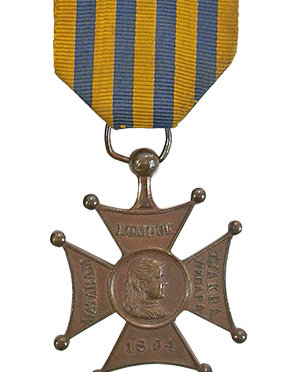
The medal is a bronze Cross pattée with concave ends on the arms and ball finials on the points.

The obverse of the cross bears the effigy of the young queen facing right in the center of the cross. Each arm bears an inscription: On the top is LOMBOKMATARAM, on the left: TJAKRA-NEGARA on the right, and 1894 on the bottom arm.

The reverse of the cross depicts the rampant Dutch lion in a wreath. The arms are inscribed HULDE AAN at the top, LEGER on the left, EN at the bottom, and VLOOT on the right (Homage to Army and Fleet). The medal hangs from a ring suspension on a ribbon 40 mm (1.6 in) wide of nine equal stripes, five in orange-yellow and four of Nassau blue.

The Expedition Cross

The Expedition Cross (or Expeditiekruis in Dutch) was a military decoration of Kingdom of the Netherlands created by King William III.

The Expedition Cross (or Expeditiekruis in Dutch) officially known as the Cross for Important Military Operations (Ereteken voor Belangrijke Krijgsbedrijven) was a military decoration of Kingdom of the Netherlands created by royal decree on 19 February 1869 by King William III.

The cross was awarded for participation in major military operations between 1846 and 1942.

The Expedition Cross Medal Design

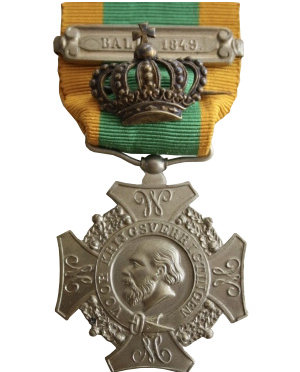
The Expedition Cross is a four-armed silver metal cross measuring 39 millimeters (1.5 in) in diameter.

The obverse bears the effigy of King William III in a round center medallion, surrounded by a garter with the inscription VOOR KRIJGSVERRIGTINGEN (for military operations). Between the arms of the cross is a wreath of oak leaves. On each of the four the arms is a “W” monogram. The reverse is plain.

The ribbon is light green with yellow-orange borders.

The Cross for the Four Day Marches

The Cross for the Four Day Marches is a decoration awarded for successful participation in the International Four Days Marches Nijmegen.

The Cross for the Four Day Marches (or Vierdaagsekruis in Dutch) is a Dutch decoration awarded for successful participation in the International Four Days Marches Nijmegen (Vierdaagse in Dutch) held annually at Nijmegen, The Netherlands.

The full title of the decoration is the Cross for Marching Proficiency (Kruis Voor Betoonde Marsvaardigheid). It is more commonly referred to as the Vierdaagse Cross or Vierdaagsekruis.

The cross was established in 1909 at the time of the first march, to award successful military participants of the Vierdaagse. Since 1910 it has been awarded to all participants who successfully complete all four days, both military and civilian.

The Cross is awarded by the Royal Dutch Walking League (KWBN or Koninklijke Wandel Bond Nederland) who organize the Nijmegen Marches. Prior to 2015 the League was known as the Royal Dutch League for Physical Education (KNBLO or Koninklijke Nederlandsche Bond Voor Lichamelijke Opvoeding) and before 1959, when it received the Royal (Koninklijke) prefix, as the NBVLO.

As well as the Vierdaagse at Nijmegen, the cross was also awarded to those who completed the four-day marches organized in various locations in the Dutch East Indies between 1935 and 1939.

Every year a walker successfully completes the march is marked either by a special cross, or a number to be attached to the ribbon of the last cross awarded. A cross is awarded in bronze for the first march, silver for the fifth and gold for the tenth, with a crown added above the cross for the year after each cross is awarded.

The Cross for the Four Day Marches Medal Design

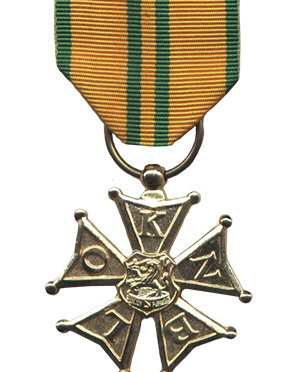
The decoration is a five-armed cross, with each arm bearing an initial of the awarding organization. It has a width of 36 mm at its widest point and is suspended from a green-and-yellow (often orange-yellow) ribbon.

Until 1958 the initials on the five arms read: ‘NBVLO’, with ‘KNBLO’ since 1959 to reflect the Koninklijke (Royal) prefix. There have been other minor changes in design over the years. For example, in 1977 the previous silver-gilt and silver crosses were replaced by base metal versions, with other design modifications in order to reduce costs.

The reverse is plain except for the name of the manufacturer.

All medals were made by Koninklijke Begeer of the South Holland town of Voorschoten until 1976, when the contract moved to W. van Veluw of Zeist, near Utrecht.

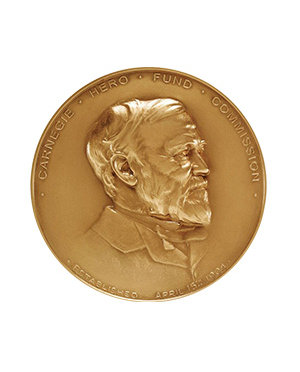
The Carnegie Hero Fund Medal

The Carnegie Hero Fund Commission was established to recognize persons who perform extraordinary acts of heroism in civilian life.

The Carnegie Hero Fund Commission (or Medaille van het Carnegie Heldenfonds in Dutch), also known as Carnegie Hero Fund, was established to recognize persons who perform extraordinary acts of heroism in civilian life in the United States and Canada, and to provide financial assistance for those disabled and the dependents of those killed saving or attempting to save others.

Those chosen for recognition receive the Carnegie Medal and become eligible for scholarship aid and other benefits. A private operating foundation, the Hero Fund was established in Pittsburgh, Pennsylvania, in 1904 with a trust fund of $5 million by Andrew Carnegie, a Scottish-American industrialist and philanthropist.

The fund was inspired by Selwyn M. Taylor and Daniel A. Lyle, who gave their lives in rescue attempts following the Harwick Mine disaster in Harwick, Pennsylvania, just outside Pittsburgh, on January 25, 1904. The disaster claimed 181, including Taylor and Lyle, who were killed during rescue attempts. Greatly touched by Taylor’s and Lyle’s sacrifice, Carnegie had medals privately minted for their families, and within two months he wrote the Hero Fund’s governing “Deed of Trust”, which was adopted by the newly created commission on April 15, 1904.

Administered by a 21-member board still based in Pittsburgh, the Hero Fund has awarded 9,893 medals as of September, 2016, and has given $38.5 million in one-time grants, scholarship aid, death benefits, and continuing assistance.

The Carnegie Hero Fund Medal Design

The three inch (7.13 cm) in diameter bronze medals which are given to awardees, are struck by Simons Brothers Co. of Philadelphia and consist of 90% copper and 10% zinc.

A verse from the New Testament of the Bible encircles the outer edge: “Greater love hath no man than this, that a man lay down his life for his friends” (John 15:13).

The first medals issued by the trust were in bronze, silver and gold. The trust soon stopped issuing gold medals. The last silver medal was issued in 1981.

The Resistance Memorial Cross

The Resistance Memorial Cross or Commemorative Cross is a medal awarded to members of the Dutch resistance during the Second World War.

The Resistance Memorial Cross or Resistance Commemorative Cross (or Verzetsherdenkingskruis in Dutch) is a medal awarded in the Netherlands to members of the Dutch resistance during the Second World War.

The medal was instituted by Royal Decree (No. 104) on 29 December 1980, after the 35th anniversary of the liberation of the Netherlands. The cross is only awarded at the request of a person eligible to receive it. Approximately 15,000 have been awarded, recorded in the Gedenkenboek verzetsherdenkingskruis.

The Resistance Memorial Cross may be awarded to:

  • Members of resistance groups recognized in the Royal Decree dated 5 September 1944 or to any resistance group known to the Council on Extraordinary Pensions or the 1940-1945 Foundation.
  • Anyone recognized by the Council on Extraordinary Pension as a participant in the resistance, regardless of whether they were awarded a pension.
  • Individuals defined by the Law on the Improvement of the Legal Status of Resistance Fighters (law of 1/20/76, Stb. 19) adjudged as having spent time in service to the resistance.
  • Soldiers of the Dutch Internal Armed Forces in occupied territory.
  • Those who participated in actions during World War II in Japanese or Japanese-occupied territory, which after the war, were designated as resistance of the enemy by the committee.
  • Anyone who does not meet any preceding provisions, may still be considered a participant in the resistance in the judgement of the committee.

The Resistance Memorial Cross Design

The medal comprises a silver cross hung from a striped ribbon. The obverse of the cross bears a vertical flaming sword, surmounted by the Dutch royal crown. Below the sword are the dates 1940 above 1945. The horizontal arms of the cross are inscribed with the words DE TYRANNY VERDRYVEN (“to destroy tyranny”), a line in the Dutch national anthem.

The reverse bears a Dutch lion, and the date of institution, 1980. The cross is suspended by a ring from a ribbon colored with asymmetric stripes: the left half is red-white-blue (for the Dutch flag) and the right half orange (the national color of the Netherlands) with a black border on each edge.

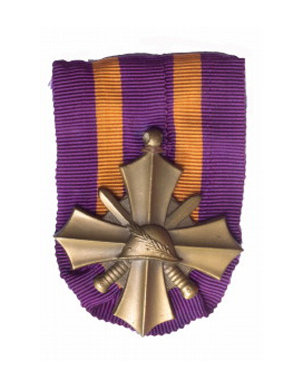
The Mobilisation War Cross

The Mobilization War Cross (or Mobilisatie-Oorlogskruis in Dutch) is a Dutch medal awarded for service during World War II.

The Mobilisation War Cross (or Mobilisatie-Oorlogskruis in Dutch) is a Dutch medal awarded for service during World War II.

The Mobilisation War Cross was established on 11 August 1948 by royal decree of Queen Wilhelmina. Those eligible for the award include military personnel who served for at least six months between 6 April 1939 – 20 May 1940. However, the Cross can also be awarded to non-military personnel or people who did not serve a full six months, as long as the subject performed military tasks for the Kingdom of the Netherlands.

On 1 December 1992, the original royal decree was rescinded and replaced.

The Mobilisation War Cross Design

The decoration is a cross in bronze over a ribbon of colors purple and orange. The obverse shows a helmet and set of swords.

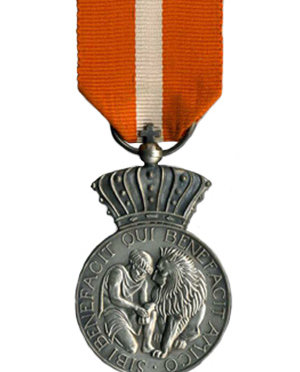
The Medal of Recognition 1940-1945

The Medal of Recognition 1940–1945 is a medal of the Kingdom of the Netherlands that was established by Royal Decree on 9 February 1946.

The Medal of Recognition 1940–1945 (or Erkentelijkheidsmedaille 1940–1945 in Dutch) is a medal of the Kingdom of the Netherlands that was established by Royal Decree on 9 February 1946.

The decoration was of two classes, silver and bronze, and was awarded to those who aided the Dutch during the period of World War II, or afterwards helped relieve those who had suffered from the German occupation.

The Medal of Recognition 1940-1945 Design

The decoration was designed as a circular medal 29 millimeters in diameter and exists in two classes, silver and bronze.

On the front Androcles is portrayed taking the thorn from the lion’s paw. The choice of motif was guided by the fact that the lion is the royal emblem of the Netherlands and the story was once commonly cited as an example of enduring gratitude. The inscription round the front edge reads SIBI BENEFACIT QUI BENEFACIT AMICO (‘He benefits himself who benefits a friend’). On the reverse of the medal the inscription reads POPULUS BATAVUS GRATO ANIMO (‘With the gratitude of the Dutch people’).

The medal’s ribbon is orange with a broad white stripe down the middle, on which there is a small silver or bronze crown according to class.

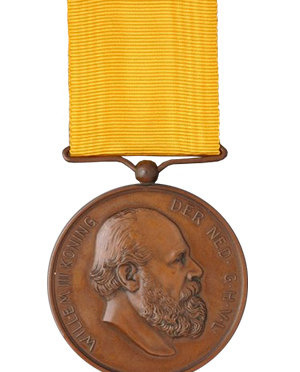
The Flood Disaster Medal

The Flood disaster Medal (Watersnoodmedaille) was created by royal decree on 27 March 1855 by King William III of the Netherlands.

The Decoration for acknowledgment of excellent deeds performed during a flood disaster (or Onderscheidingsteken ter erkenning van uitstekende daden bij watersnood verricht in Dutch), usually called Flood disaster Medal (Watersnoodmedaille), was created by royal decree on 27 March 1855 by King William III of the Netherlands.

The medal is intended for those civilians who have shown zeal, courage, leadership, and self-sacrifice during the event of a flood disaster

The Flood Disaster Medal Design

The Flood Disaster medal is round, made of bronze and features the profile of King William III of the Netherlands. The ribbon is yellow.