The Museum Medal

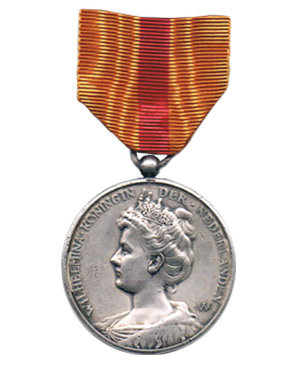
The Honorary Medal for Merits toward Museum Collections (or Museum Medal) is one of the oldest civil decorations of the Netherlands.

The Honorary Medal for Merits toward Museum Collections (or Erepenning voor Verdiensten jegens Openbare Verzamelingen in Dutch), also known as the Museum Medal, is one of the oldest civil decorations of the Netherlands.

It was created by royal decree on 26 June 1817 by King William I of the Netherlands. The decree describes the following: “An honorary medal for appearance of interest in the state collection by donation shown“. The medal is awarded in gold, silver or bronze as a token of appreciation to those who “donate to the Dutch monarch any works of art, that were collected with much effort.

By royal decree, on 5 May 1877, eligibility for this award was extended by King William III of the Netherlands, with the description “to those who donated important works of art to the state museums or who showed praiseworthy acts regarding the different scientific collections or art collection of the state museums“.

Due to this description, the medal obtained its current official name. However, since the end of the 19th century, this decoration is primarily known as the “Museum Medal”.

Eligibility for this award was once again extending, by Queen Wilhelmina, on 28 October 1919 with the description “merit towards community (public) collections“. What was initially a medal for generous donors became now an official royal award for merit.

The Museum Medal Design

Up until 1897, the honorary medal was only a standing decoration, when Queen Wilhelmina of the Netherlands declared that the medal could be worn suspended from a ribbon. Queen Juliana of the Netherlands decided by royal decree on 26 July 1952 that the shape of the medal and ribbon should be changed.

The current ribbon is orange with two red lines descending down the middle. A ribbon bar is also given with the award, with a palm branch device in either gold or silver for recipients of the gold or silver versions of the medal, respectively. Queen Beatrix of the Netherlands later changed the composition of the medallion, and is now depicted on the obverse of the medal.
The De Ruyter Medal

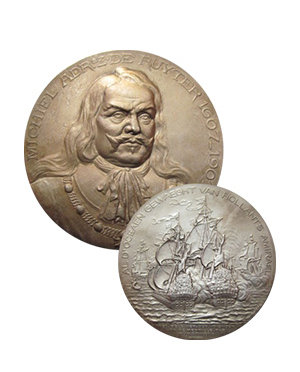
The De Ruyter Medal was created by royal decree to be awarded to those members of the Dutch Merchant fleet who distinguish themselves.

The De Ruyter Medal (or De Ruyter-medaille in Dutch) was created by royal decree no. 1 on 23 March 1907 by Queen Wilhelmina of the Netherlands, to be awarded to those members of the Dutch Merchant fleet who distinguish themselves by praiseworthy acts of duty for the Dutch Ship transport.

With the De Ruyter Medal the Kingdom of the Netherlands honors since 1907 the three-hundredth birthday of Michiel de Ruyter, one of the most famous admirals in Dutch history. The medal can be awarded in gold, silver or bronze. Awarding is on basis of nomination of the Netherlands government and by royal decree.

The Ruyter Medal Design

The Ruyter medal is a round medal with, on the front side, a picture of Michiel de Ruyter. The medal is worn with a dark orange ribbon.

The Airman’s Cross

The Airman’s Cross (Vliegerkruis) is an important military decoration of the Kingdom of the Netherlands created in 1941 for Dutch military.

The Airman’s Cross (or Vliegerkruis in Dutch) is an important military decoration of the Kingdom of the Netherlands created in 1941. The cross is meant for that Dutch military, who displayed during one of more flights in an aircraft, initiative, courage and perseverance against the enemy or during hostile actions. The cross is also awarded to allied pilots, whose actions or performances in the air were of high importance for the Netherlands.

Till 2007 in total of 735 Airman’s Crosses are awarded, most recently to a F-16 pilot, Air Force Major M. Duivesteijn. This because of his “exceptional courage and perseverance” at a flight above former Yugoslavia within the framework of NATO Operation Allied Force in 1999. Well-known recipients are also Erik Hazelhoff Roelfzema, the “Soldier of Orange“, and Prince Bernhard of the Netherlands.

The Airman’s Cross is the fifth highest military decoration still being awarded for bravery and has precedence after the Cross of Merit.

The Cross of Merit Design

The Airman’s Cross resembles the Dutch Bronze Cross but is worn on a diagonally-striped orange and white ribbon inspired by those of the British Distinguished Flying Cross and Air Force Cross.

The cross is silver with four arms. There is a crowned central medallion bearing an albatross in flight with “INITIATIEF MOED VOLHARDING” (INITIATIVE COURAGE PERSEVERANCE) around the edge of the medallion. The date 1941 appears above the body of the albatross. The reverse is plain.

The Cross of Merit (Netherlands)

The Cross of Merit is an award for working in the interest of the Netherlands with distinguishing valor while faced with enemy action.

The Cross of Merit (“Kruis van Verdienste”) is an award for “working in the interest of the Netherlands while faced with enemy actions and distinguishing oneself through valor and resolute behavior“. One did not have to be on the front line to win this award.

On 20 February 1941, the Dutch government in exile in London instituted several new awards for bravery. The new way that wars were fought, with civilian resistance and the merchant navy in great peril, made this necessary. Amongst the new decorations was the “Cross of Merit” (“Kruis van Verdienste”).

The cross has often been awarded to those who managed to flee to England and to the armed resistance. It was rarely awarded after the Korean War, but since the fighting of the Netherlands army in Afghanistan, Uruzgan, this World War II decoration has been awarded again on a regular basis with the latest on 7 October 2009 to eleven Dutch soldiers.

During the second world war in the Far East this cross was awarded to several people employed by the Koninklijke Paketvaart-Maatschappij (K.P.M.) as some of their merchant navy ships had been commissioned by the Dutch Navy during the Battle of the Java Sea.

The Bronze Cross Design

The medal is a bronze cross with a blue and yellow ribbon. There are several issues and types of this decoration.

In case of repeated awards a large “2” or “3” is pinned to the ribbon.

The Bronze Cross (Netherlands)

The Bronze Cross of the Kingdom of the Netherlands was instituted by Queen Wilhelmina during the German occupation of the Netherlands.

The Bronze Cross of the Kingdom of the Netherlands (or “Het Bronzen Kruis” in Dutch) was instituted on 11 June 1940 by Queen Wilhelmina of the Netherlands while she was residing in London during the German occupation of the Netherlands.

The Bronze Cross has precedence after the Resistance Star East Asia, but is the third-highest military decoration still being awarded for bravery.

Several British, American, Canadian and Polish soldiers are among the 3,501 recipients of the Bronze Cross that is awarded by Royal Decree.

The Bronze Cross Design

The medal is a bronze cross pattée. A wreath consisting of tendrils of oak and laurel leaves is tied around the royal cipher.

The orange ribbon has a Nassau blue stripe in the center. Orange is the color of the Queen, the head of the House of Orange, and blue is the heraldic color of the ancestral house of Nassau.

The Cross has no clasps. If it is awarded again a large Arabic golden figure “2” or “3” is attached to the ribbon.

The Resistance Star East Asia

The Resistance Star East Asia (Verzetsster Oost-Azië) was created to commemorate the resistance against the Japanese occupation of Indonesia.

The Resistance Star East Asia (or Verzetsster Oost-Azië in Dutch) was created by royal decree on 26 October 1948 by Queen Juliana to commemorate the resistance against the Japanese occupation of Indonesia, which went underground after the capitulation of the Royal Dutch East Indies Army. This resistance suffered tremendous losses in live.

The medal honors the Dutch subjects in the Netherlands East Indies who showed strength of mind, determination, or solidarity, and performed praise-worthily help for Dutchmen that were made a prisoner of war or interned by the enemy during World War II. Also those of the Dutch resistance in Southeast Asia are honored.

Due to the loss of the archive of the Resistance Star a lot of historiography about this award is lost. Since 1948 the Resistance Star is awarded in total of 471 times. The star is a high award and has precedence just after the Bronze Lion.

The Resistance Star East Asia Design

The bronze six-pointed star with a flaming sun and the words “de geest overwint” (The spirit triumphs) was designed by Frans Smits.

The star is attached to a purple ribbon which has two golden lanes in the middle. The colors are symbolic: the gold-yellow remembers the custom in Southeast Asia to wrap a valuable gift in a gold-colored cloth. At the reverse side the text “maart 1942 – O.Azië – augustus 1945” (“March 1942 – East Asia – Augustus 1945”) is inscribed.

The Bronze Lion

The Bronze Lion (Bronzen Leeuw) is a high Royal Dutch award intended for servicemen who have shown extreme bravery and leadership in battle.

The Bronze Lion (or Bronzen Leeuw in Dutch) is a high Royal Dutch award intended for servicemen who have shown extreme bravery and leadership in battle favoring The Netherlands.

It was first created in 1944 and has since been issued 1210 times. Proposals for an award are reviewed by the Dutch Board for Bravery Awards, which is part of the ministry of Defense. If awarded they are enforced by a Royal Decree. In some special cases, the Bronze Lion can however be awarded to Dutch or foreign civilians.

The Bronze Lion has precedence after the Order of the House of Orange, but is the second highest military decoration still being awarded for bravery (only preceded by the Military William Order).

The Bronze Lion Design

The Bronze Lion is a cross in bronze, covered by a round shield. On the front is a relief of the crowned Dutch Lion.

The cross is attached to a 37 millimeter wide ribbon, divided into nine equal vertical stripes, alternately orange and ‘Nassau blue’, the strips on either edge are Nassau blue. It is possible for a single person to receive more than one award of the Bronze Lion, in which case a number ‘2’ in gold is added on the ribbon of the Bronze Lion.

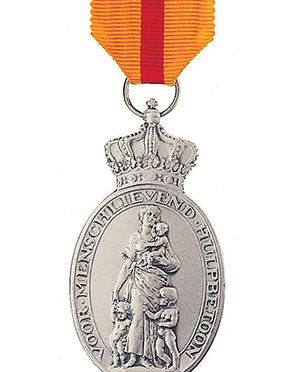
The Honorary Medal for Charitable Assistance

The Honorary Medal for Charitable Assistance is one of the oldest decorations for bravery in the Kingdom of the Netherlands.

The Honorary Medal for Charitable Assistance (or Erepenning voor Menslievend Hulpbetoon in Dutch) was created at 18 June 1822 and is after the Military William Order the oldest decoration for bravery in the Kingdom of the Netherlands.

The Honorary Medal is the highest civilian decoration still being awarded for bravery, and is specifically for those who carried out a voluntary act of bravery or self-sacrifice, with an emphasis on charity.

The medal can be awarded in gold, silver or bronze. Awarding is on basis by nomination of the Netherlands government and by royal decree. The golden medal has precedence only after the Dutch Cross of Resistance (also a civilian bravery decoration, but not awarded anymore), and the silver and bronze medals have precedence after the Airman’s Cross (a military bravery award).

Lieutenant Alexander de Langle was the first person to be rewarded with this medal in 1821 for rescuing a sergeant who was stuck at the bottom of a well. Although this was considered an act of bravery, King William I did not deem it important enough to award the lieutenant the distinguished Military William Order, so inatead a new award for bravery was created: the Honorary Medal for Charitable Assistance.

The Honorary Medal for Charitable Assistance Design

In 1837 King William II decided by royal decree that the size of the golden, silver and bronze medals would be all 50 millimeter. Also his portrait was put on the medals.

Since 1849 the portrait of King William III was shown on the medals and from 1875 a portrait of the older and bold King William III.

When Emma of Waldeck and Pyrmont became the queen regent of the Netherlands she decided to put on the medal the portrait of her minor daughter Queen Wilhelmina. In 1897 a new type of medal was created, the medal did get a ribbon to wear and also did get the same shape as the French “Medal of Saint Helena”.

Since 1912 the medal has its current shape. The medal is ovally shaped with at the top a stylised royal crown. On the medal a mother with three children is portrayed. The motif is taken from the city hall in Bolsward. At the reverse side the words “De koningin aan” (English: The Queen Rewards to) and also some space is reserved for an inscription. The medal is worn with an orange ribbon that has a red band in the middle. The medallion is today still award as gold, silver or bronze.

The Cross for Courage and Fidelity

The Cross for Courage and Fidelity is a military award established by Queen Emma of the Netherlands on 7 March 1898 by Royal Decree.

The Cross for Courage and Fidelity (or Kruis voor Moed en Trouw in Dutch) is a military award established by Queen Emma of the Netherlands on 7 March 1898 by Royal Decree. The cross replaced the old Medal for Courage and Fidelity, which had limited prestige and status according to the Netherlands government.

The cross is the second-highest award of the Kingdom of the Netherlands, preceded only by the Military William Order. The cross was awarded to (and is still worn by) natives of the Netherlands East Indies that showed an exceptional display of bravery and fidelity.

The Governor-General of the Netherlands East Indies was authorized to award the cross. A total of 262 bronze and 13 silver crosses have been awarded, most of them in 1925. The last cross was awarded in 1927; after that natives and native soldiers of the Royal Dutch East Indies Army were also eligible to receive the Military William Order.

The cross, nicknamed the “Military William Order for natives”, has been regarded by many as discriminatory to the natives in the Netherlands East Indies.

The Cross for Courage and Fidelity Design

The cross has a resemblance to the Military William Order and is worn with the same ribbon as that order. The shape of the cross itself is somewhat different in the sense that the cross and crown are made of non-enameled silver.

On the cross of the Military William Order a gold spark rod is shown in the middle. However, on the cross for Courage and Fidelity, a heraldic Dutch Lion is shown. Between the arms of this cross two klewangs are added.

The text on the cross has the description “VOOR MOED EN TROUW” (English: for Courage and Fidelity) and at the back “Daden van Moed en Trouw in Nederlands-Indië door inlanders betoond” (English: Deeds of Courage and Fidelity in the Netherlands East Indies by natives awarded). Between the crown and cross is a spark rod, a distinguishing mark of the Order of the Golden Fleece or the Military William Order.

Those recipients who lost the cross during the Japanese occupation of Indonesia could receive a new cross but without an emblazoned crown.

The Dutch Cross of Resistance

The Cross of Resistance 1940-1945 (or Verzetskruis 1940–1945 in Dutch) is the second highest decoration for valor in the Netherlands.

The Cross of Resistance 1940-1945 (or Verzetskruis 1940–1945 in Dutch) is the second highest decoration for valor in the Netherlands.

The decoration was awarded for extreme bravery awarded to the Dutch Resistance. The Dutch resistance to the Nazi occupation of the Netherlands during World War II can be mainly characterized as non-violent, and was organized by the Communist Party, churches, and independent groups. A peak of over 300,000 people were hidden from German authorities in the autumn of 1944, tended to by some 60,000 to 200,000 illegal landlords and caretakers, and tolerated knowingly by some one million people, including a few incidental individuals among German occupiers and military.

Dutch counterintelligence, domestic sabotage, and communications networks eventually provided key support to Allied forces, beginning in 1944 and continuing until the Netherlands was fully liberated. A number of resistance groups specialized in saving Jewish children, including the Utrechtse Kindercomité, Landelijke Organisatie voor Hulp aan Onderduikers, Naamloze Vennootschap (NV), and Amsterdam Student Group.

The Cross was awarded 95 times (93 of them posthumously).

The Cross of Resistance Design

By Royal Decree of May 3rd 1946 the Resistance Cross was finally instituted. The formal disruption was: “The Bronze decoration of the Resistance Cross resembled a four armed cross, imbedded on a star of flames and covered with the Royal Crown. On the front one can find St. Joris fighting the dragon. On the arms of the cross are engraved the words ‘Trouw tot in den dood’. On the obverse one can find a flaming sword wit two broken chains“, all according to article 4 of the Royal Decree.

The ribbon is colored in Crimson Red with two golden orange lines.