The Order of Saint John in the Netherlands

The Order of Saint John in the Netherlands is a religious order dedicated to providing charitable and humanitarian services.

The Bailiwick of Brandenburg of the Chivalric Order of Saint John of the Hospital at Jerusalem (or Balley Brandenburg des Ritterlichen Ordens Sankt Johannis vom Spital zu Jerusalem in German), commonly known as the Order of Saint John or the Johanniter Order, is the German Protestant branch of the Knights Hospitaller, the oldest surviving chivalric order, which generally is considered to have been founded in Jerusalem in the year 1099 AD.

The medieval Dutch Bailiwick of Utrecht and Commandery of Haarlem formed parts of the German Langue (one of the “Tongues”, the major divisions of the medieval Order of Saint John) until, during the Reformation, they associated themselves with the reformed Bailiwick of Brandenburg. Both the Bailiwick of Utrecht and the Commandery of Haarlem were suppressed in 1810, during the Napoleonic occupation.

Dutch knights of the Bailiwick of Brandenburg formed their own commandery within the Johanniterorden in 1909, when the Dutch monarch afforded it royal protection; and the commandery separated from the German Johanniterorden in 1946.

The commandery became an independent order in 1958 and is known as Johanniter Orde in Nederland, now admitting noblewomen as well as noblemen. The Dutch monarch is an honorary commander. With the German and Swedish orders, the Dutch order helped found the Alliance of the Orders of St. John of Jerusalem on June 13, 1961.

The Order of Saint John in the Netherlands Design

Dutch insignia of the Johanniter Orde in Nederland replace Prussian eagles with the Dutch lion.

The Order of the Golden Ark

The Most Excellent Order of the Golden Ark is a Dutch order of merit established in 1971 by Prince Bernhard of the Netherlands.

The Most Excellent Order of the Golden Ark (or Orde van de Gouden Ark in Dutch) is a Dutch order of merit established in 1971 by Prince Bernhard of the Netherlands.

The order is awarded to people for major contributions to nature conservation. Although not awarded by the government of the Netherlands, it is considered by the government as a recognized chivalrous order.

Since its inception, over 300 people have been recognized by the award. Now that Prince Bernhard has died, the future of the order is uncertain.

The order has three grades:

  • Commander
  • Officer
  • Knight

The Order for Loyalty and Merit

The Order for Loyalty and Merit (or Orde van Trouw en Verdienste in Dutch) is a house order of the Dutch Royal House of Orange-Nassau.

The Order for Loyalty and Merit (or Orde van Trouw en Verdienste in Dutch) is a house order of the Dutch Royal House of Orange-Nassau. The Order came into being as a result of Queen Juliana‘s reorganization of The House Order of Orange in 1969.

The Order for Loyalty and Merit is conferred “upon those persons who have loyally and faithfully, and with merit and character assisted the Head of State or the members of the Royal House during their obligations and their daily work.”

The order has two grades:

  1. Cross for Loyalty and Merit in Gold;
  2. Cross for Loyalty and Merit in Silver.

The Order for Loyalty and Merit Design

The cross in gold or silver is worn on a ribbon on the left chest. The decorations are awarded after 25 and 40 years of service.

The monarch is lenient as far as the number of years in her service are concerned. Hardly anyone manages to work until his or her 65th birthday. Many servants of the Queen receive their Cross of merit for Loyalty and Merit in Gold after 35 years in the Royal Household.

The Order of the Crown (Netherlands)

The Order of the Crown is a house order that came into being as a result of the reorganization of the Order of the House of Orange.

The Order of the Crown (or Kroonorde in Dutch) is a house order of the Dutch Royal House that came into being as a result of Queen Juliana‘s reorganization of the Order of the House of Orange in 1969.

The 18 classes of the house order were no longer felt to be appropriate in the ever more egalitarian Dutch society of the 1960s. The Order was divided into five subdivisions. As a house order, it is not subject to ministerial responsibility or influence but is awarded at the discretion of the Dutch monarch alone.

The Order of the Crown is intended for “foreigners who have rendered special service to the Dutch King or his House“. The former queen, Beatrix, instituted a silver medal to commemorate state visits.

The Order of the Crown has the traditional five grades and three medals. This allows the Dutch monarch to dispense the decorations according to rank especially during state visits.

The Order of the Crown Design

The insignia vary considerably depending on the grade:

  1. Grand Cross (Grootkruis) – badge may be worn on a sash on the right shoulder, plus a 4-pointed star on the left chest;
  2. Grand Honorary Cross with Star (Groot erekruis met Plaque) – wears the badge on a necklet, plus a 4-pointed star on the left chest;
  3. Grand Honorary Cross (Groot erekruis) – wears the badge on a necklet;
  4. Honorary Cross with Rosette (Erekruis met Rozette) – wears the badge on a ribbon with a rosette on the left chest;
  5. Honorary Cross (Erekruis) – wears the badge on a ribbon on the left chest;
  6. Medals in Gold, Silver and Bronze (Medaille in goud, zilver en brons) – wears the medal on a ribbon on the left chest.

The Order of the House of Orange

The Order of the House of Orange is a dynastic order of the House of Orange-Nassau, the royal family of the Netherlands.

The Order of the House of Orange (or Huisorde van Oranje in Dutch) is a dynastic order of the House of Orange-Nassau, the royal family of the Netherlands. The order was instituted by Queen Wilhelmina of the Netherlands on 19 March 1905 and is not subject to ministerial responsibility or influence, but is awarded at the discretion of the Dutch monarch alone.

In 1905, Queen Wilhelmina felt the need for a House Order because the Order of the Oak Crown of the Grand Duchy of Luxembourg, used by her father and grandfather to reward Dutch subjects, was no longer available to her, as succession to the throne of Luxembourg was directed by the House treaty of the House of Nassau in a way comparable to the Salic Law within its constitution in 1890.

The Order of the House of Orange had a very complex nomenclature, with 18 different classes and medals.

More than 3200 decorations were conferred between 1905 and 1969, mostly to Court Dignitaries, the Queen’s household, and doctors and lawyers who could choose between sending a bill for their services or a decoration in the House Order.

Since the reorganization in 1969 the House Order itself has these grades:

  1. Grand Cross (Grootkruis) – badge may be worn on a sash on the right shoulder, plus an 8-pointed star on the left chest;
  2. Grand Honorary Cross (Groot erekruis) – wears the badge on a necklet;
  3. Honorary Cross (Erekruis) – wears the badge on a ribbon on the left chest.

The Order of the House of Orange Design

The insignia vary considerably amongst these awards; however they all share the same orange ribbon, symbolizing the House of Orange. The ribbon bar of the Order of the House of Orange was… well, orange.

The Order of the Gold Lion of the House of Nassau

The Order of the Gold Lion of the House of Nassau is a chivalric order shared by the two branches of the House of Nassau.

The Order of the Gold Lion of the House of Nassau (or Huisorde van de Gouden Leeuw van Nassau in Dutch) is a chivalric order shared by the two branches of the House of Nassau (the Ottonian and Walramian lines). The order may be awarded to sovereigns, princes of sovereign houses and heads of state for meritorious service to Luxembourg and the Grand Duke.

In the context of the younger Ottonian line, this order is a house order of the Dutch Royal House of Orange-Nassau and is awarded as a personal gift by the King of the Netherlands on a person who has rendered special service to the Royal House.

The order was founded by royal grand-ducal decree on 31 March 1858 by King-Grand Duke William III. The order originally included only one grade (i.e. “Knight”), but this was increased to four by William III in 1873:

  1. Grand Cross
  2. Grand Officer
  3. Officer
  4. Knight

The further rank of Commander was introduced in 1882. Nowadays, the order is conferred only on rare occasions in the Netherlands or Luxembourg.

Princes who are sons or brothers of the heads of the two lines of the House of Nassau are born knights of the order. In 1984, Queen Beatrix and Grand Duke Jean made an agreement that princesses (daughters of the heads of the two lines of the House of Nassau) may be admitted when they reach the age of majority (18).

The Order of the Gold Lion o the House of Nassau Design

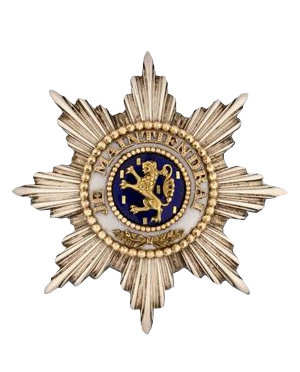
The badge of the order is a white-enameled golden Maltese Cross, with the golden monogram “N” between the arms of the cross. The obverse central disc is in blue enamel, bearing the Gold Lion of the House of Nassau. The reverse central disc is also blue enameled, with the motto Je maintiendrai (“I will maintain”) in gold.

The plaque is an 8-pointed star with straight silver rays; the same obverse of the badge of the order appears at its centre, surrounded by the motto Je maintiendrai in gold letters on white enamel. The ribbon of the sash of the order is yellow-orange moiré with a small blue stripe at each edge.

A knight wears the order’s badge on a sash on the right shoulder, and the plaque (breast star) of the order on the left chest.

The Order of Orange-Nassau

The Order of Orange-Nassau is a civil and military Dutch order of chivalry founded on 4 April 1892 by the Queen regent Emma.

The Order of Orange-Nassau (or Orde van Oranje-Nassau in Dutch) is a civil and military Dutch order of chivalry founded on 4 April 1892 by the Queen regent Emma, acting on behalf of her under-age daughter Queen Wilhelmina and open to “everyone who has earned special merits for society”.

These are people who deserve appreciation and recognition from society for the special way in which they have carried out their activities. The lower grades of the order are comparable with the ranks of the Order of the British Empire in the United Kingdom, but titles, prefixes or post-nominals (other than academic ones) are not used in the Netherlands.

During World War II, the Order of Orange-Nassau was bestowed upon both members of the Netherlands military and members of foreign services who had helped liberate the Netherlands from Nazi German occupation, and those who helped liberate the former Dutch colonies in the Pacific.

In the modern age, the Orange-Nassau is still the most active civil and military decoration of the Netherlands and ranks after the Order of the Netherlands Lion. The order is typically awarded each year on the Monarch’s official birthday with around 3500 appointments to the order made public.

The order is also used to honor foreign princes, ministers, dignitaries and diplomats. The King or Queen Regnant of the Netherlands is the Grand Master of the Order of Orange-Nassau.

The Order of Orange-Nassau Design

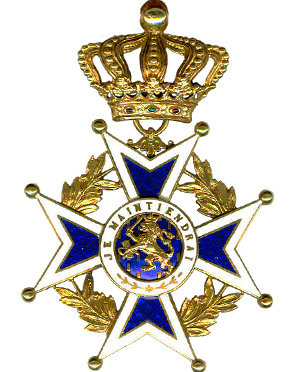
The Order of Orange-Nassau has two divisions, civil and military, the former denoted by a wreath of laurel on the badges, and the latter by crossed swords on both the badges and the stars.

The badge of the order is a blue-enameled, white enamel-bordered Maltese Cross, in gilt for the officers and above, in silver for knights and members. The obverse central disc displays the King’s coat of arms in gold and blue enamel, surrounded by a white enamel ring bearing the national motto Je Maintiendrai (I shall maintain). The reverse central disc has the crowned monogram “W” (for Queen Wilhelmina) surrounded by the motto God Zij Met Ons (God be with us). The badge hangs from a royal crown.

The star of the order is a silver star with straight rays, in 8 points for Grand Cross and in 4 points for Grand Officer; the central disc has the King’s arms in gold and blue enamel, surrounded by a white enamel ring bearing the Dutch national motto Je Maintiendrai. The military division has crossed swords.

Since 1996

In addition to the two divisions, since 1996 the Order of Orange-Nassau has been issued in six classes:

  1. Knight Grand Cross – badge may be worn on a sash on the right shoulder, plus an 8-pointed star on the left chest;
  2. Grand Officer – badge may be worn by men on a necklet, and by women worn on a ribbon tied as a bow at the left chest. Also a 4-pointed star is worn on the left chest;
  3. Commander – badge may be worn by men on a necklet, and by women worn on a ribbon tied as a bow at the left chest;
  4. Officer – wears the badge on a ribbon with a rosette on the left chest;
  5. Knight – wears the badge on a ribbon on the left chest;
  6. Member – wears a smaller badge on a ribbon on the left chest.

For the grades of Knight and Member, the badges are made of silver. For the other grades, the silver is gilded.

For the grades of Knight Grand Cross, Grand Officer and Commander, the badges have a diameter of 60 mm. For the grades of Officer and Knight, they have a diameter of 46 mm. For the grade of Member, a diameter of 35 mm.

After 1966

Until 1996, the Order of Orange-Nassau consisted of five grades. In addition, honorary medals were issued in Gold, Silver and Bronze, but these were only affiliated with the order; the bearers of the medal were not members of the order. Now no longer issued, these were replaced by the sixth grade: “Member”. Recipients wore the medal on a ribbon on the left chest.

The Order of the Netherlands Lion

The Order of the Netherlands Lion is a Dutch order of chivalry founded by King William I of the Netherlands on 29 September 1815.

The Order of the Netherlands Lion (also known as Order of the Lion of the Netherlands or De Orde van de Nederlandse Leeuw in Dutch and L’Ordre du Lion Néerlandais in French) is a Dutch order of chivalry founded by King William I of the Netherlands on 29 September 1815.

The Order of the Netherlands Lion was until recently awarded upon eminent individuals from all walks of life, including generals, ministers of the crown, mayors of large towns, professors and leading scientists, industrialists, high-ranking civil servants, presiding judges and renowned artists. Since 1980 the Order has been primarily used to recognize merit in the arts, science, sport and literature.

The Order ranks after the Military William Order, which is only awarded for military merit. The King of the Netherlands is the Grand Master of the Order.

The following classes and grades exist for the Order:

  1. Knight Grand Cross – Reserved for members of the Royal Family, foreign Heads of State and a select group of former prime ministers, princes and cardinals. Wears the badge on a sash on the right shoulder, plus the star on the left chest.
  2. Commander – Usually conferred upon Dutch Nobel Prize winners, a few distinguished artists, writers and politicians. Wears the badge on a necklet, plus an identical breast cross on the left chest.
  3. Knight – Wears the badge on a ribbon on the left chest.
  4. Brother – No longer issued; see section below. Wore the medal on a ribbon on the left chest.
The Order of the Netherlands Lion Design

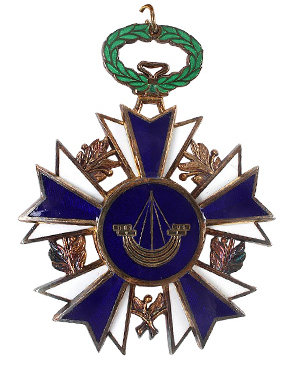
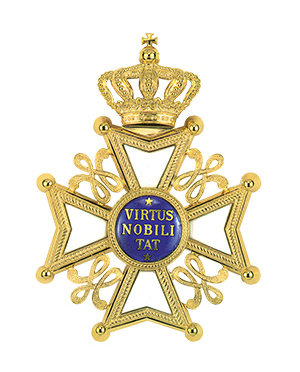
The badge of the Order is a gilt, white-enameled Maltese Cross, with the monogram “W” (for King William I) between the arms of the cross.

The obverse central disc is in blue enamel, bearing the motto Virtus Nobilitat (Virtue Ennobles). The reverse central disc is plain golden, with the lion from the Netherlands coat-of-arms. The badge hangs from a royal crown.

As with all honors awarded by the Netherlands, the insignia comprises a decoration, a miniature and optionally a breast star. The decoration and breast stars are only worn at formal occasions or while in state office. While wearing a smoking, it is allowed to wear the miniature. Decorations are not worn on any other type of clothing.

The badge of honour for Brothers was a silver medal, with the lion from the Netherlands coat of arms on the obverse, and the motto Virtus Nobilitat (English: Virtue Ennobles) on the reverse. The ribbon for Brothers was blue with a single orange central stripe.

The Military Order of William

The Military William Order (Militaire Willems-Orde in Dutch, MWO) is the oldest and highest honor of the Kingdom of the Netherlands.

The Military William Order (also known as Military Order of William or Militaire Willems-Orde in Dutch, abbreviated MWO), is the oldest and highest honour of the Kingdom of the Netherlands.

The Order’s motto is Voor Moed, Beleid en Trouw (For Bravery, Leadership and Loyalty). The chivalric order was established on 30 April 1815 by King William I and was presented for feats of excellent bravery on the battlefield and as a meritorious decoration to senior military officers. Comparable with the French Légion d’Honneur but far less often awarded, the Military William Order is a chivalry order of merit open to everyone regardless of rank and nobility, and not only to Dutch military but also foreigners. To date membership of the Order is extremely rarely awarded and only for excellent bravery in battle. Most knighthoods of the Military Order of William were awarded in 1815 and shortly afterwards to military of the Allies that fought Napoleon at the Battle of Waterloo, in total over 1,000 knighthoods were awarded at this time.

By 1945, the following classes of the Military William Order were in existence.

  • Knight Grand Cross – wears the badge on a sash on the right shoulder, plus the star on the left chest;
  • Commander – wears the badge on a necklet, plus an identical breast cross on the left chest;
  • Knight 3rd Class – wears the badge on a ribbon with rosette on the left chest;
  • Knight 4th Class – wears the badge on a ribbon on the left chest.
The oath to be taken by the accolade to the Military Order of William states: “I swear that I shall conduct myself as a faithful and valiant Knight, to stand ever ready to defend King and Country with my Life, and with all my Powers to always strive to be worthy of this Distinction, which the King has bestowed upon me. So help me God almighty.”

The Military Order of William Design

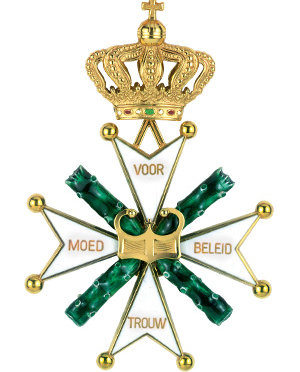
The badge of the Order is a white-enameled Maltese Cross, in silver for the 4th Class and in gilt for higher classes; a green enameled Burgundy Cross appears between the arms of the Maltese Cross.

The obverse bears a golden firesteel at the center, and the motto Voor Moed – Beleid – Trouw (For Bravery – Leadership – Loyalty) on the arms of the Maltese Cross. Both the Burgundy Cross and the firesteel were symbols of the House of Valois-Burgundy during their lordship of the Netherlands and probably are meant to recall its crucial unifying role in the history of the Netherlands. The reverse central disc bears a crowned monogram “W” (for King William I) surrounded by a laurel wreath. The badge hangs from a royal crown.

The star of the Grand Cross is a silver, 8-pointed star with straight rays; the obverse of the badge of the Order, minus the crown, appears at its centre. The breast cross of the Commander is completely identical to the obverse of the badge of the Order. The ribbon of the Order is orange (Royal House of Orange) with blue (Nassau-blue) stripes near the border.

The Inter Allied Victory Medal (France)

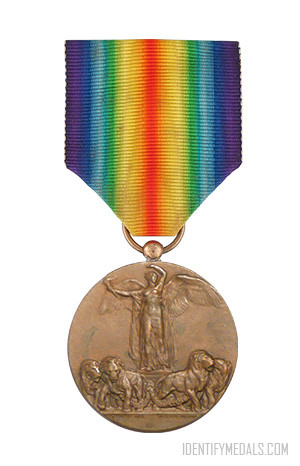
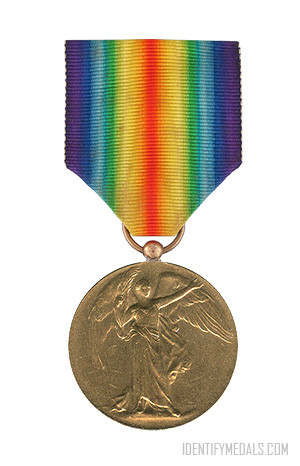
The French Victory Medal was established on 20 July 1922 and awarded to all soldiers who served three months between 1914 and 1918.

The Allied Victory Medal was recommended by an inter-allied committee in March 1919. Fourteen victorious countries were finally awarded the medal after World War I, and each allied nation would design a ‘Victory Medal’ for award to their own nationals. Certain features were to be shared: a winged figure of Victory on the obverse and the same ribbon.

The French Victory Medal was established on 20 July 1922 and awarded to all soldiers who served three months between 2 August 1914 and 11 November 1918, as well as to civilian nurses, aliens who served directly under French command, Marshals and generals who had a command for at least three months, and prisoners of war from Alsace and Lorraine who then served in the French forces.

The France Inter-Allied Victory Medal Design

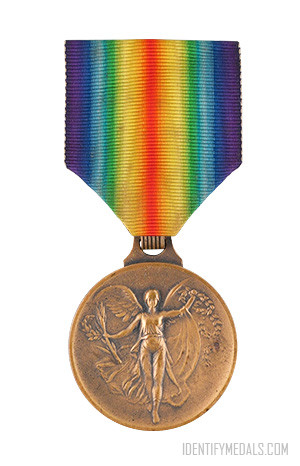
The Victory Medal measures 36 millimetres (1.4 in) in diameter and was designed by William McMillan. The design and ribbon was also adopted by Belgium, Brazil, Cuba, Czechoslovakia, France, Greece, Italy, Japan, Portugal, Romania, Siam, Union of South Africa and the USA. Each allied nation would design a ‘Victory Medal’ for award to their own nationals, all issues having certain common features, including a winged figure of victory on the obverse and the same ribbon.

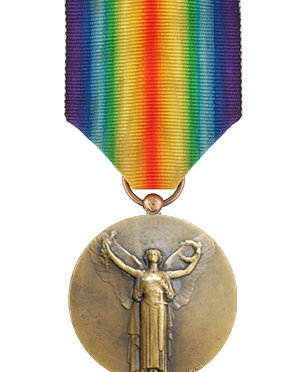
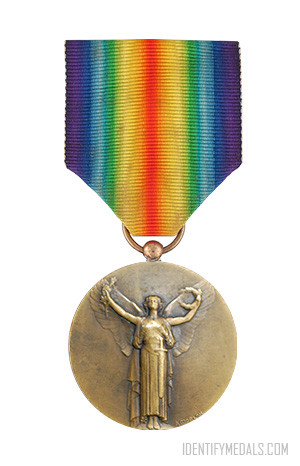
The obverse of the medal bears the winged, full-length and full-front figure of Victoria and the designer’s signature “A. Morlon”. The reverse reads “LA GRANDE GVERRE POUR CIVILISATION 1914-1919” and a Phrygian cap between the letters R. F.

The 39 millimeters (1.5 in) wide watered ribbon has an iridescent color scheme, with the violet moving through to a central red stripe where both schemes meet. It attaches to the medal through a ring suspender. The recipient’s name, rank, service number and unit were impressed on the edge of the medal. The name of the regiment or corps was omitted on medals awarded to Army officers.

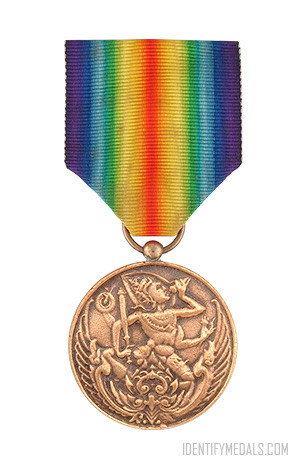
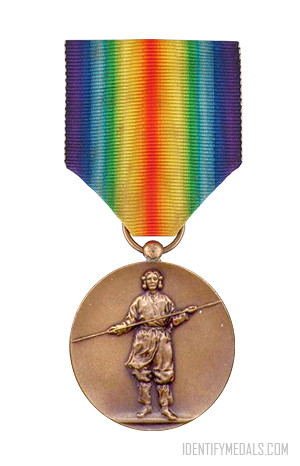
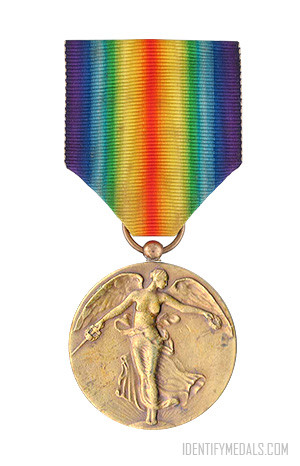
All the Inter-Allied Victory Medal Variations

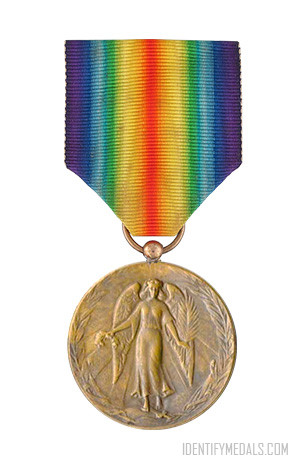
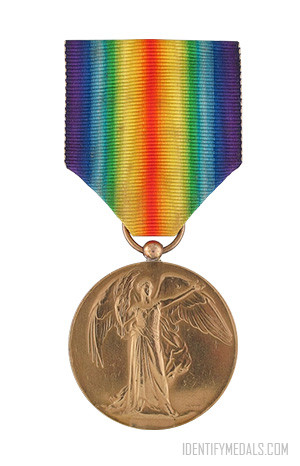
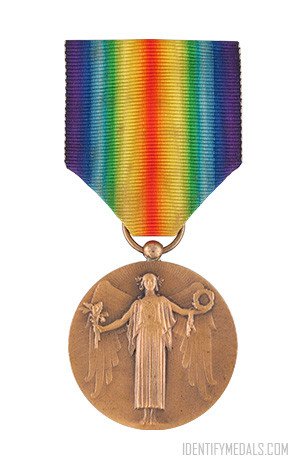
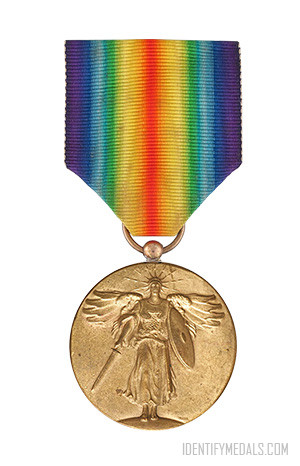
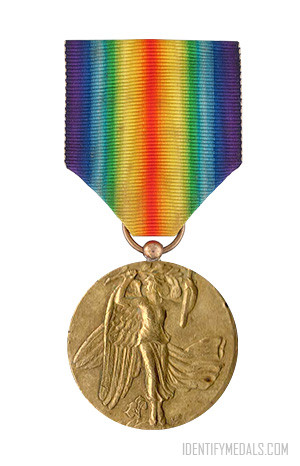
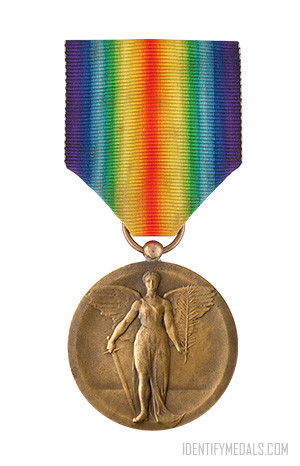
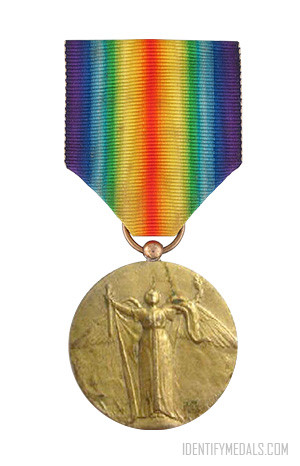
Although each country designed its own version of the Inter-Allied Victory Medal, all of them shared some common elements, such as a winged victory figure on the obverse and a similar ribbon with rainbow colors symbolizing unity among the Allies. Here are the versions for all countries:

Find an Inter-Allied Victory Medal Online

Right Now on eBay 
Clicking a link to eBay may result in a referral commission being paid if a purchase is made.
Loading...