The Medal of Merit for Blood Donation

The Medal of Merit for Blood Donation was established in 1979 and is currently awarded to voluntary blood donors.

The Medal of Merit for Blood Donation is a civil state decoration in Luxembourg, established in 1979 by Grand Duke Jean. This medal honors voluntary blood donors and is awarded by the Grand Duke upon the recommendation of the Minister of Health, who is advised by the Council of Order.

The Medal of Merit for Blood Donation was instituted on 22 October 1979, and initially, the Council of Order comprised five members. A decree on 4 February 1985 expanded the council to seven members, requiring a minimum of six to make a recommendation. Council members are appointed for four-year terms, with the possibility of reappointment. The current council was appointed on 17 February 2016. Foreign donors can also receive the medal if they have donated blood to a recognized Luxembourg organization.

The medal is awarded in three grades:

  • Gold Medal (eighty donations)
  • Silver Medal (forty donations)
  • Bronze Medal (twenty donations)

The plaques, edges of the cross, and the crown are gilded, silver, or bronze, depending on the grade of the medal.

The Medal of Merit for Blood Donation Design

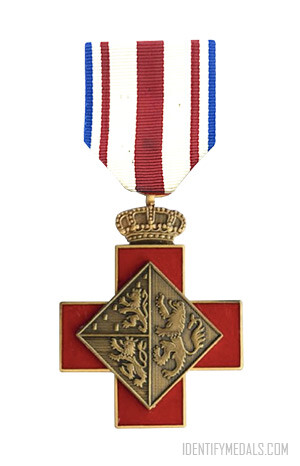
The badge of the Medal of Merit for Blood Donation is a red-enamelled Red Cross, crowned and featuring diamond-shaped plaques.

The obverse displays the coat of arms of the Grand Duchess of Luxembourg, which combines three coats of arms with lions. The upper left quarter shows the lion of Nassau, the lower left quarter features the lion of Luxembourg, and the right half displays the lion of Belgium.

The reverse depicts the profile of Grand Duchess Joséphine Charlotte facing left, surrounded by the inscription “S.A.R Joséphine Charlotte Grande-Duchesse de Luxembourg” (H.R.H. Joséphine Charlotte Grand Duchess of Luxembourg).

The ribbon is white with a red stripe in the middle, flanked by thin blue-white-red stripes at the edges.
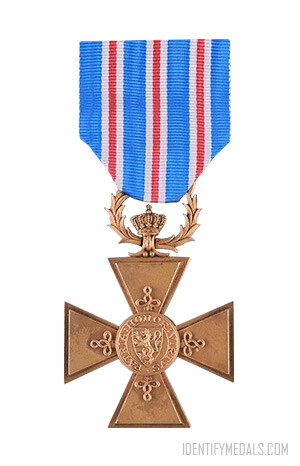
The Luxembourg War Cross

The Luxembourg War Cross was created on 17 April 1945 by Charlotte to recognize military service and feats of bravery.

The Luxembourg War Cross (or Croix de Guerre in French, Kriegskreuz in German) is a distinguished military decoration awarded by Luxembourg. Established on 17 April 1945 by Grand Duchess Charlotte, the War Cross honors acts of military service and bravery. Often referred to as the Luxembourg Croix de Guerre due to French being one of the country’s official languages, this medal recognizes exceptional valor.

The War Cross was awarded to both Luxembourg citizens and Allied Forces members who displayed remarkable bravery during the Liberation of Luxembourg. It could also be conferred upon entire military units for their collective acts of courage. Given the relatively limited combat operations within Luxembourg compared to other regions like Belgium, France, and Germany, the Luxembourg War Cross remains one of the rarest foreign decorations presented to Allied troops.

War Cross 1940–1945

The War Cross 1940–1945 was established in April 1945 by Grand Duchess Charlotte of Luxembourg. This decoration was awarded to members of the armed forces and paramilitary organizations for distinguished service during World War II, and it was also open to foreigners.

War Cross 1951

The War Cross 1951 was instituted in May 1951 to recognize acts of bravery and courage by members of the Luxembourg Military and paramilitary organizations. It can be awarded posthumously and is also open to foreigners. This decoration was created to acknowledge service in the Korean War and future conflicts.

The Luxembourg War Cross Design

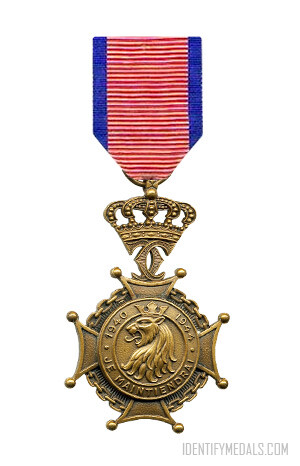
War Cross 1940-1945 Design:

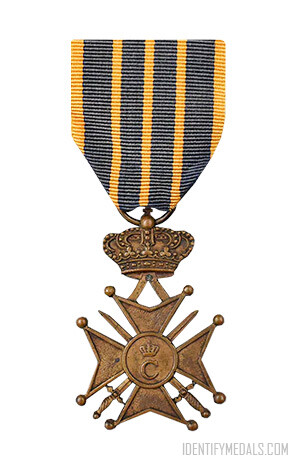
A dark bronze Cross pattée, surmounted by a grand ducal crown. The obverse features a large letter “C” crowned and the reverse bears the date “1940.” Additional elements include crossed swords between the arms of the cross, pointing upward.

The ribbon is nassau blue with three yellow-orange stripes equally spaced from the center, with yellow-orange edges.

War Cross 1951 Design:

The medal is identical to the War Cross 1940–1945, but with a different reverse, which features a wreath of oak leaves instead of the date “1940.”

Cross of Honor and Military Merit (Luxembourg)

Cross of Honor and Military Merit was established by Grand Duchess Charlotte in May 1951, for distinguished service to the military.

The Cross of Honor and Military Merit (or Croix d’Honneur et de Mérite militaire in French) is a prestigious military decoration in Luxembourg, established by Grand Duchess Charlotte in May 1951. This honor recognizes distinguished service within the military during peacetime and extraordinary acts of courage and bravery during wartime.

During times of peace, the Cross of Honor and Military Merit is awarded to military personnel who have demonstrated exceptional service and dedication to their duties.

In times of conflict, the cross is awarded for outstanding acts of heroism and bravery on the battlefield, highlighting the valor of those who go above and beyond the call of duty.

The Cross of Honor and Military Merit is bestowed in three distinct classes, each representing different levels of achievement and service:

  1. Gilt: The highest class, awarded for the most distinguished service or acts of extraordinary bravery.
  2. Silver: The intermediate class, recognizing significant contributions and courageous acts.
  3. Bronze: The entry-level class, awarded for notable service and acts of merit.

Cross of Honor and Military Merit Design

The cross features the inscription “Honor, Virtue, Fatherland” in the obverse.

The Military Medal (Luxembourg)

The Military Medal was established in 1945 by Grand Duchess Charlotte and is the highest military decoration of Luxembourg.

The Military Medal (or Médaille militaire, German: Militärmedaille in French) is Luxembourg’s highest military honor.

The Military Medal was instituted on 30 October 1945 by Grand Duchess Charlotte, following a proposal from then Prince Jean. This creation came in the aftermath of World War II, a period that highlighted the importance of recognizing military heroism and extraordinary service.

The medal is awarded for outstanding achievements and extraordinary deeds, regardless of rank. It can be awarded to all military personnel, regardless of rank, who demonstrate outstanding achievements and extraordinary deeds. This inclusive criterion ensures that valor and exceptional service are recognized across all levels of the military hierarchy.

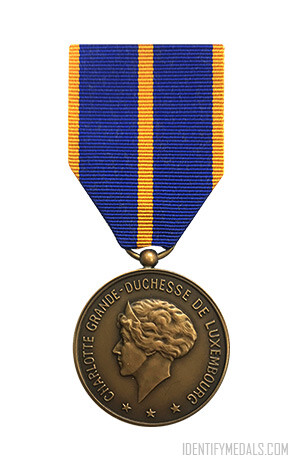
The Military Medal Design

The medal is a bronze circular disc.

The obverse features the left-facing profile of Grand Duchess Charlotte, with the inscription “Charlotte Grande-Duchesse de Luxembourg” around the edge, emphasizing her role in establishing the medal.

The reverse displays the Lesser coat of arms of Luxembourg, with the numbers “19” to the left and “40” to the right of the arms, symbolizing the year 1940.

The medal is suspended from a blue ribbon with a thin central yellow line and yellow edges.

The Order of the Resistance (Luxembourg)

The Order of the Resistance is a civil decoration established in 1946 to recognize civilians who distinguished themselves during WW2.

The Order of the Resistance 1940–1944 is a civilian decoration of Luxembourg, established on March 30, 1946, by decree of Grand Duchess Charlotte. This honor recognizes civilians who demonstrated exceptional service to the national or allied cause during the German occupation of Luxembourg in World War II, through acts of resistance, bravery, and dedication.

Recipients of the Order could be awarded either a cross or a medal, conferred by the monarch of Luxembourg upon the recommendation of the Prime Minister and the Council for the Remembrance of the Resistance. In 2003, it was decided that the cross would only be awarded posthumously, and the medal would no longer be awarded.

The Order of the Resistance Design

The medal is a cross pattée, which features broad arms that narrow towards the center.

At the center of the cross, there is a circular medallion with the letters “R L” (Resistance Luxembourg) prominently displayed, symbolizing the resistance efforts within Luxembourg.

The cross is suspended from a ribbon. The ribbon is red with two narrow black stripes near each edge, reflecting the colors associated with resistance movements.

The Order of the Oak Crown

The Order of the Oak Crown was established in 1841 by Grand Duke William II and is primarily used as an award for Luxembourgish citizens.

The Order of the Oak Crown (or Ordre de la Couronne de chêne in French, Eichenlaubkronenorden in German) is a prestigious honor of the Grand Duchy of Luxembourg, established in 1841 by Grand Duke William II, who was also King of the Netherlands.

Initially, the Order of the Oak Crown served as a Luxembourgish honor during the personal union between Luxembourg and the Netherlands, where both nations shared the same head of state. Despite its legal status as a Luxembourgish order, it was frequently used by William II (who conferred the order to fewer than 30 recipients) and his successor, William III (bestowing 300 decorations), to reward Dutch subjects independently of the Dutch government.

The order consists of five grades:

  1. Grand Cross 
  2. Grand Officer 
  3. Commander 
  4. Officer 
  5. Knight 

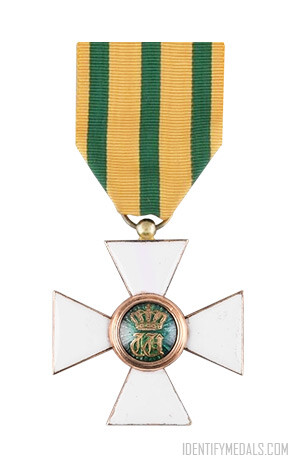
The Order of the Oak Crown Design

The badge of the Order (depicted here) features a gilt cross pattée enameled in white, with the Officer class distinguished by a green enameled oak wreath between the arms of the cross. The central disc showcases a crowned monogram “W” (for William) on a green enamel background.

The plaque for the Order varies by rank: for the Grand Cross, it is an eight-pointed faceted silver star; for the Grand Officer, it is a faceted silver Maltese Cross. Both plaques have a central disc with the crowned monogram “W” on a green enamel background, encircled by a red enamel ring bearing the motto “Je Maintiendrai” (“I Will Maintain”), which is the national motto of the Netherlands, and further surrounded by a green enamelled oak wreath.

The medal of the Order is octagonal, featuring the badge motif without enamel on the obverse and an oak wreath without enamel on the reverse.

The ribbon is yellow-orange moiré with three dark green stripes, symbolizing the oak forests and rue fields of the Luxembourg countryside.

The Order of Merit of the Grand Duchy of Luxembourg

The Order of Merit of the Grand Duchy of Luxembourg was instituted on 23 January 1961 and is an order of merit of Luxembourg.

The Order of Merit of the Grand Duchy of Luxembourg (or Ordre de Mérite du Grand-Duché de Luxembourg in French) is a distinguished honor established on 23 January 1961 by Grand Duchess Charlotte.

The order is open to deputies, state councillors, civil servants, elected officials, and municipal administration personnel, as well as prominent figures in the economic, social, cultural, or sports sectors, and volunteers. Additionally, it can be awarded to foreign nationals.

The order’s Grand Master is the Grand Duke of Luxembourg. In addition to its five classes, the order also includes a gilt medal.

The order comprises five grades:

  • Grand Cross
  • Grand Officer
  • Commander
  • Officer
  • Knight

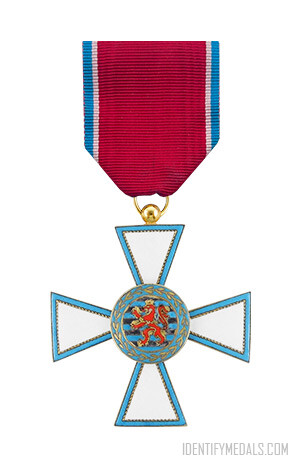
The Order of Merit of the Grand Duchy of Luxembourg Design

The Grand Officer and Commander ranks are identical, but only the Grand Officer is accompanied by a Breast Star. There is at least one other version that differs in composition.

The Order of Adolphe of Nassau

The Order of Civil and Military Merit of Adolph of Nassau was founded in 1858 as a chivalric order of the Duchy of Nassau.

The Order of Civil and Military Merit of Adolph of Nassau (or Ordre de Mérite civil et militaire d’Adolphe de Nassau in French) is a distinguished award of the Grand Duchy of Luxembourg. It recognizes outstanding service to the Grand Duke, the Grand-Ducal House, and Luxembourg.

Established in 1858 by Adolphe of Nassau as a chivalric order in the Duchy of Nassau, it honored his ancestor, Adolf, Count of Nassau, the sole member of the House of Nassau to become Roman King of Germany. Following the annexation of the Duchy by Prussia in 1866 and Adolphe’s accession as Grand Duke of Luxembourg in 1890, he reestablished the order as an order of merit.

The order consists of eight grades:

  1. Grand Cross 
  2. Grand Officer 
  3. Commander of the Crown
  4. Commander (male) / Cross of Honor for Ladies (female) 
  5. Officer of the Crown
  6. Officer
  7. Knight of the Crown
  8. Knight

Foreigners can also be inducted into the order, making it a common diplomatic honor. During World War II, it was awarded to a select number of Allied officers who played a role in liberating Luxembourg from Nazi Germany.

The Order of Adolphe of Nassau Design

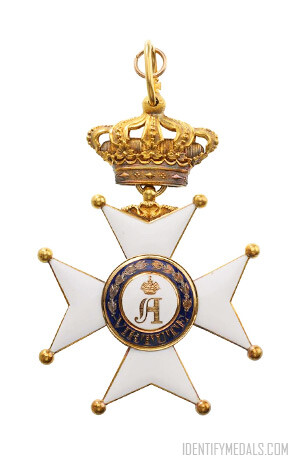
The badge of the order is a gold cross, enamelled in white, with eight points each ending in a gold pearl. The front central disc displays the gold letter “A” in Gothic script, crowned by an imperial crown. This is surrounded by a laurel wreath on a blue-enamelled background, inscribed with the motto “Virtute” in gold letters. The reverse side features the dates “1292” (the year Adolf of Nassau-Weilburg was crowned King of the Romans) and “1858” (the year the order was established by Adolphe, Duke of Nassau) in gold letters on a white-enamelled background. The military division includes two crossed swords under the central medallion. The badge for all classes of the order has a gold crown attached above it.

The plaque (breast star) for the civil division of the order is an eight-pointed faceted silver star for the Grand Cross, or a faceted silver Maltese Cross with silver rays between the arms for the Grand Officer. The central disc is identical to that of the badge. The military division’s plaque also features two crossed swords under the central medallion, with gold hilts and silver blades, and the corresponding badge shows two crossed swords in gold.

The cross mirrors the badge in shape but is not enamelled, and is made of plain gold or silver. The medal is round, available in gold, silver, or bronze, and features the portrait of Adolph, Duke of Nassau.

The ribbon of the order is blue moiré with a narrow orange stripe along each edge. The Grand Cross badge is suspended from a 100 mm wide ribbon. The Grand Officer and Commander wear the badge from a 43 mm wide ribbon, while the Officer and Knight wear it from a 38 mm wide ribbon, with the Officer’s ribbon featuring a rosette in the same colors.

The Order of the Gold Lion of the House of Nassau

The Order of the Gold Lion of the House of Nassau is a chivalric order shared by the two branches of the House of Nassau.

The Order of the Gold Lion of the House of Nassau (or Huisorde van de Gouden Leeuw van Nassau in Dutch) is a chivalric order shared by the two branches of the House of Nassau (the Ottonian and Walramian lines). The order may be awarded to sovereigns, princes of sovereign houses and heads of state for meritorious service to Luxembourg and the Grand Duke.

In the context of the younger Ottonian line, this order is a house order of the Dutch Royal House of Orange-Nassau and is awarded as a personal gift by the King of the Netherlands on a person who has rendered special service to the Royal House.

The order was founded by royal grand-ducal decree on 31 March 1858 by King-Grand Duke William III. The order originally included only one grade (i.e. “Knight”), but this was increased to four by William III in 1873:

  1. Grand Cross
  2. Grand Officer
  3. Officer
  4. Knight

The further rank of Commander was introduced in 1882. Nowadays, the order is conferred only on rare occasions in the Netherlands or Luxembourg.

Princes who are sons or brothers of the heads of the two lines of the House of Nassau are born knights of the order. In 1984, Queen Beatrix and Grand Duke Jean made an agreement that princesses (daughters of the heads of the two lines of the House of Nassau) may be admitted when they reach the age of majority (18).

The Order of the Gold Lion o the House of Nassau Design

The badge of the order is a white-enameled golden Maltese Cross, with the golden monogram “N” between the arms of the cross. The obverse central disc is in blue enamel, bearing the Gold Lion of the House of Nassau. The reverse central disc is also blue enameled, with the motto Je maintiendrai (“I will maintain”) in gold.

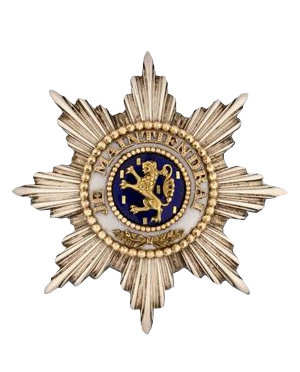
The plaque is an 8-pointed star with straight silver rays; the same obverse of the badge of the order appears at its centre, surrounded by the motto Je maintiendrai in gold letters on white enamel. The ribbon of the sash of the order is yellow-orange moiré with a small blue stripe at each edge.

A knight wears the order’s badge on a sash on the right shoulder, and the plaque (breast star) of the order on the left chest.