The Commemorative Medal of the 1862 Mexico Expedition

The Commemorative medal of the Mexico Expedition is a commemorative campaign medal established by French emperor Napoleon III.

The Commemorative medal of the Mexico Expedition (or Médaille commémorative de l’expédition du Mexique in French) is a commemorative campaign medal established by decree on 29 August 1863 by French emperor Napoleon III. The medal recognizes military service during the 1862-1863 French intervention in Mexico.

On 30 April 1863, sixty two legionnaires resisted for nine hours against over two thousand Mexicans, allowing for the capture of the city of Puebla on 17 May 1863 thus paving the way to Mexico. In the capital, an assembly of notables recognized Archduke Maximilian of Habsburg as Emperor of Mexico. However, even with the support of 20,000 Mexicans who embraced the new emperor, Maximilian’s forces were harassed in their work of pacification by the troops of President Benito Juárez, who had the support of the United States. In February 1867, Emperor Napoleon III ordered the repatriation of all remaining French troops from Mexico.

No minimum time of service was mentioned in the award statute.

The Commemorative Medal of the 1862 Mexico Expedition Design

The medal measures 30 mm in diameter, is circular and struck in silver.

The obverse bears the left profile of Emperor Napoleon III crowned with a laurel wreath surrounded by the relief inscription “NAPOLEON III” “EMPEREUR“. A 4 mm wide relief laurel wreath ran along the entire circumference of both the obverse and reverse of the medal.

On the reverse and within the laurel wreath, a circular relief inscription reads “*EXPEDITION DU MEXIQUE * 1862-1863“, with two small five pointed stars separating the text from the dates. At the center, the relief inscription on five lines of the campaign’s major battles “CUMBRES” “CERRO-BORREGO” “SAN-LORENZO” “PUEBLA” “MEXICO”.

The medal hangs from a 36 mm wide white silk moiré ribbon bearing 5 mm red and green stripes arranged at a 45 degree angle forming a cross, over which was superimposed a black eagle, its wings spread and holding a green snake in its beak and talons, a design inspired by the coat of arms of Mexico.
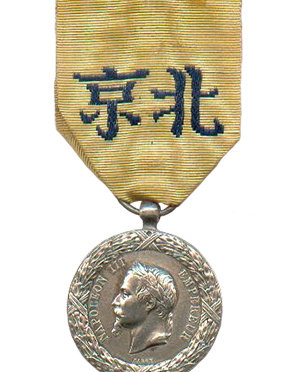
The Commemorative Medal of the 1860 China Expedition

The Commemorative medal of the 1860 China Expedition is a military award of the Second French Empire awarded to soldiers and sailors.

  • Time Period: Pre-WW1
  • Institution: 23 January 1861
  • Country: France

The Commemorative medal of the 1860 China Expedition (or Médaille commémorative de l’expédition de Chine de 1860 in French) is a military award of the Second French Empire awarded to soldiers and sailors who had participated in the Anglo-French expedition to China during the Second Opium War.

The medal was created by imperial decree on 23 January 1861, by Napoleon IIIThe British Empire had been engaged in an ongoing conflict with the Qing Dynasty since 1856. Following the 1857 general election in the United Kingdom, the new parliament decided to seek redress from China. The French Empire, the United States, and the Russian Empire received requests from Britain to form an alliance. France joined the British action against China, prompted by the execution of a French missionary, Father August Chapdelaine. The conflict concluded with the 1858 Treaty of Tianjin in the Convention of Peking on 18 October 1860.

The medal was awarded by the Emperor to all who served in the China Expedition on propositions of the minister overseeing the service in which the potential recipient served. All recipients also received a certificate of award.

The Commemorative Medal of the 1860 China Expedition Design

The medal measures 30 mm in diameter, is circular and struck in silver. It was designed and engraved by Albert Désiré Barre.

The obverse bears the left profile of Emperor Napoleon III crowned with a laurel wreath surrounded by the relief inscription “NAPOLEON III” “EMPEREUR”. A 4 mm wide relief laurel wreath runs along the entire circumference of both the obverse and reverse of the medal.

On the reverse, within the laurel wreath, there’s the circular relief inscription EXPÉDITION DE CHINE 1860. At the center, the relief inscription on four lines of the campaign’s major battles TA-KOU, CHANG-KIA-WAN, PA-LI-KIAO, PE-KING.

The medal is suspended from a 36 mm wide silk moiré yellow ribbon, at its center, the name of the city of Peking woven in blue Chinese characters.

The Commemorative Medal of the 1859 Italian Campaign

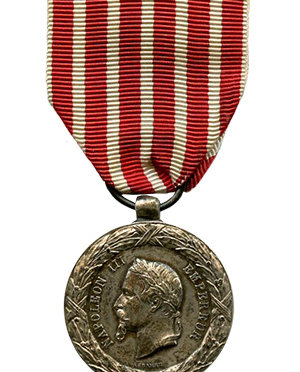
The Commemorative medal of the 1859 Italian Campaign is a French commemorative medal established by Napoleon III in 1859.

The Commemorative medal of the 1859 Italian Campaign (or Médaille commémorative de la campagne d’Italie de 1859 in French) is a French commemorative medal established by Napoleon III in 1859 following the French campaign in Italy during the Second Italian War of Independence.

In Europe, Italian unification was only supported by Emperor Napoleon III of France who, on 28 January 1859, based on the clauses of the Treaty of Turin, decided to bring aid and support from France. France declared war on the Austrian Empire on May 3, 1859. In spite of the lack of preparation of the French army, the soldiers and allies were to illustrate themselves in several famous battles, including that of Magenta on June 4th, which allowed Napoleon III and Victor Emmanuel II to enter triumphantly in Milan on 8 June. An armistice was signed at Villafranca on July 12.

During the three-month campaign, French losses amounted to 8,000 dead and 40,000 wounded. To reward all participants and ensure the memory of this glorious military campaign, the Medal was created by Imperial Decree on August 11, 1859.

Nearly 120,000 medals were awarded to reward all soldiers and sailors who participated in the Italian campaign of 1859. All recipients also received a certificate of award.

The Commemorative Medal of the 1859 Italian Campaign Design

The medal was designed by Albert Désiré Barre. It measures 30 mm in diameter and is circular and struck in silver.

The obverse bears the left profile of Emperor Napoleon III crowned with a laurel wreath surrounded by the relief inscription “NAPOLEON III” “EMPEREUR” (English: “NAPOLEON III” “EMPEROR”). A 4 mm wide relief laurel wreath ran along the entire circumference of both the obverse and reverse of the medal.

On the reverse, within the laurel wreath, the circular relief inscription CAMPAGNE D’ITALIE 1859 (English: ITALIAN CAMPAIGN 1859). At the centre, the relief inscription on six lines of the campaign’s major battles MONTEBELLO, PALESTRO, TURBIGO, MAGENTA, MARIGNAN, SOLFERINO.

The medal hangs from a 36 mm wide silk moiré ribbon bearing six 4 mm wide red stripes and five 2 mm wide white stripes.

The Saint Helena Medal

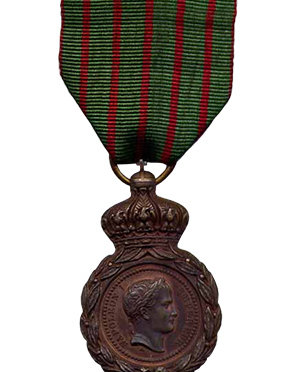
The Saint Helena Medal (or Médaille de Sainte-Hélène in French) is the first French campaign medal, established in 1857 by a decree of emperor Napoleon III. The medal recognizes participation in the campaigns led by emperor Napoleon I, creator of the Legion of Honour and various other orders (who never instituted commemorative campaign medals for his soldiers).

In time, many veterans of these campaigns, sometimes called the “débris de la Grande Armée” (“remnants of the Great Army”), began meeting within various new veterans’ associations. Keeping alive their war memories and the myth of Napoleon in popular culture, they issued many unofficial commemorative and associative medals. It would be forty two years after the exile of the emperor to the island of Saint Helena called for the need to adequately and officially recognize the service of these combat veterans.

The Saint Helena Medal was awarded to all French and foreign soldiers, from the land armies or naval fleets, who served the Republic or the Empire between the years 1792 and 1815 inclusive. It was awarded with no condition of minimum time of service, however, it was necessary to prove one’s right with a record of service or leave record. The Saint Helena Medal could be revoked following a condemnation to a fixed prison term of one year or more for a crime committed by the recipient.

The medal was accompanied by an award certificate from the Grand Chancery of the Legion of Honour and came in a white cardboard box with intricate ornamentation on the lid in the form of an embossed imperial eagle over the inscription on seven lines “AUX COMPAGNONS DE GLOIRE DE NAPOLÉON I DÉCRET IMPÉRIAL DU 12 AOÛT 1857” (English: “TO NAPOLEON I COMPANIONS IN GLORY IMPERIAL DECREE OF 12 AUGUST 1857”).

The Saint Helena Medal Design

The Saint Helena Medal is of irregular (round) shape and struck in bronze. It measures 2 cm in diameter and its medallion is surrounded by a 50mm wide laurel wreath tied with a bow at the bottom.

Atop the medal there is a 2 cm wide Imperial Crown. The obverse bears the relief image of the right profile of Emperor Napoleon I surrounded by the relief inscription “NAPOLEON I EMPEREUR” (English: “NAPOLEON I EMPEROR”). A ring or small orbs separates the central medallion from the wreath. Just below the image of the emperor, a small anchor, the privy mark of the award’s designer, Désiré-Albert Barre.

The reverse is identical except for the medallion which bears the relief circular inscription within a narrow 20mm band “CAMPAGNES DE 1792 A 1815” (English: “CAMPAIGNS OF 1792 TO 1815”). In the centre, the relief inscription on nine lines “A” “SES” “COMPAGNONS” “DE GLOIRE” “SA DERNIÈRE” “PENSÉE” “STE HÉLÈNE” “5 MAI” “1821” (English: “TO HIS COMPANIONS IN GLORY HIS LAST THOUGHT ST HELENA 5 MAY 1821”).

The medal hangs from a 38mm wide green silk moiré ribbon bearing five 1,8mm wide red vertical stripes spaced 4,5mm apart and 1mm red edge stripes.

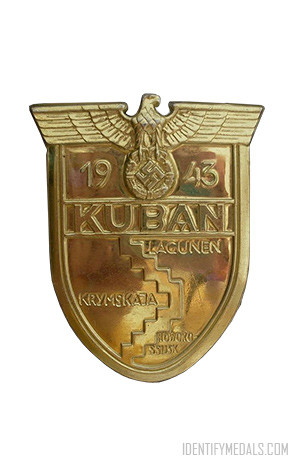
The Kuban Shield

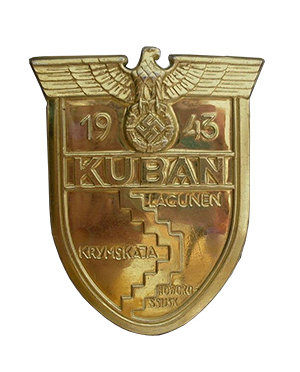
The Kuban Shield is a World War II military decoration awarded to those who fought at the Kuban bridgehead in the Soviet Union.

The Kuban Shield (or Ärmelschild Kuban in German) is a World War II military decoration of Nazi Germany, awarded to those who fought at the Kuban bridgehead in the Soviet Union from February 1943 until it was abandoned in October 1943.

The criteria for award of the shield to military personnel:

  • Served in the bridgehead for 60 days; or
  • Been wounded while defending the bridgehead; or
  • Had been engaged in a single major operation at the bridgehead.

The Kuban Shield Design

The shield is designed in a similar fashion to the Crimea Shield and was struck in sheet metal or zinc and treated with a bronzed wash.

It features a German eagle with outstretched wings clutching a laurel wreath with a swastika. On each side the wreath are the numbers 19 and 43. Directly below the eagle is written KUBAN in block capital letters. Below this name is a stylized map of the Kuban region, with a line representing the defensive line that the men fought to preserve with the location of the bridgeheads – KRYMSKAJALAGUNEN, and NOWOROSSIJSK.

The shield was worn on the upper left sleeve of the tunic. A back plate, which held in place a piece of cloth matching the recipients’ branch of service, was applied to the shield:

  • Green for Heer (army)
  • Blue for Luftwaffe (air force)
  • Black for Panzer units (armoured units)

More Nazi Germany Shields (Ärmelschilde)

These campaign shields were awarded to members of the Wehrmacht (the unified armed forces of Nazi Germany from 1935 to 1945). They were given for participation in specific battles or campaigns and worn on the left upper arm of the uniform jacket.

The Crimea Shield - German WW2 Medals, Badges and Awards

The Crimea Shield

The Crimea Shield (Krimschild) is a WW2 German military decoration awarded to military personnel who fought against Soviet Red Army forces.

Read More »

The Lappland Shield

The Lappland Shield (Lapplandschild) is a World War II German military decoration awarded to military personnel who fought in Lapland.

The Lappland Shield (or Lapplandschild in German) is a World War II German military decoration awarded to military personnel which had been fighting a two-front campaign against the advancing Finnish and Soviet Red Army forces in Lapland between November 1944 and the war’s end in May 1945.

The badge was awarded to men of General Franz Böhme’s 20th Mountain Army who had “honorably served” for six months in the region or had been wounded during operations therein. It was authorized in February 1945 and was the last officially instituted German campaign shield of the war.

The Lappland shield continued to be awarded after the end of the war in May, 1945 by the unit commander.

The Lappland Shield Design

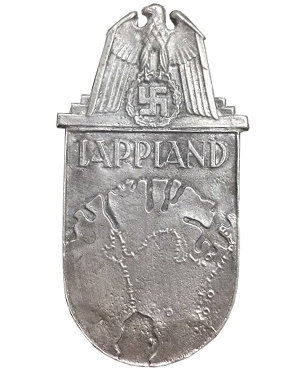
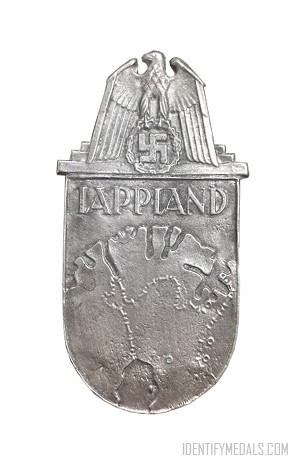
The badge consists of a basic shield with flat top and rounded bottom. It incorporates an eagle at the top but without a swastika. Directly below this, in capital letters, is written “LAPPLAND” and beneath it appears a map of the region.

Four small holes were punched in the shield to allow it to be sewn on the upper left sleeve of the uniform, however, it had no back-plate or uniform cloth section attached.

More Nazi Germany Shields (Ärmelschilde)

These campaign shields were awarded to members of the Wehrmacht (the unified armed forces of Nazi Germany from 1935 to 1945). They were given for participation in specific battles or campaigns and worn on the left upper arm of the uniform jacket.

German WW2 Nazi Awards: The Warsaw Shield

The Warsaw Shield

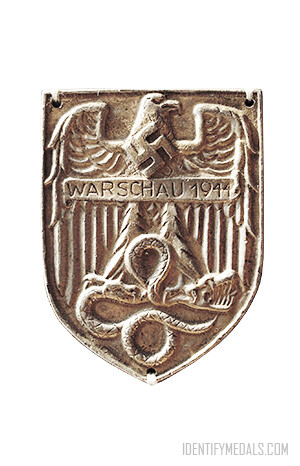
The Warsaw Shield (Ärmelschild Warschau) is a German military decoration for those who took part in the suppression of the Warsaw uprising.

Read More »

The Demyansk Shield

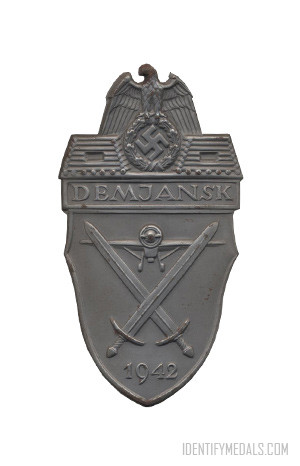
Demyansk Shield is a World War II German military decoration awarded to military personnel who fought in the Demyansk pocket.

Demyansk Shield (or Ärmelschild Demjansk in German) is a World War II German military decoration instituted on 25 April 1943 by Adolf Hitler and awarded to military personnel who fought in the Demyansk pocket, achieved through the use of an airbridge.

The pocket of German troops had been encircled and cut off by the Red Army around Demyansk, south of Leningrad, during World War II on the Eastern Front. It was not bestowed after 1 July 1944.

Requirements for army, Waffen-SS and auxiliary units included honorable service in the besieged area for 60 days or wounded in the besieged area. For Luftwaffe personnel — 50 combat or re-supply missions over the besieged area.

The Demyansk Shield Design

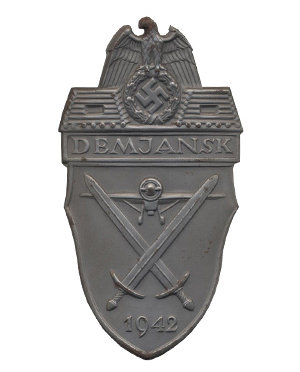
The Demyansk shield features at its apex an eagle with swooped down wings clutching a laurel wreath that surrounds a swastika in the obverse. This is flanked by two pillboxes with gun ports. Below this is capital letters is written DEMJANSK.

The central portion of shield features a head-on single engine aircraft, two crossed swords and at the base, the year 1942. Two minor variations of the aircraft’s propeller exist with either a curved or straight propeller.

The shield was die struck and produced in silver-washed zinc and later in plain zinc. It was affixed to the upper left sleeve of the uniform via a cloth that matched the color of the uniform of the recipient:

  • Light green-grey (field-grey) for Heer (army)
  • Blue for Luftwaffe (air force)
  • Black for Panzer units (armoured units)
  • Field-grey for Waffen-SS

More Nazi Germany Shields (Ärmelschilde)

These campaign shields were awarded to members of the Wehrmacht (the unified armed forces of Nazi Germany from 1935 to 1945). They were given for participation in specific battles or campaigns and worn on the left upper arm of the uniform jacket.

The Crimea Shield - German WW2 Medals, Badges and Awards

The Crimea Shield

The Crimea Shield (Krimschild) is a WW2 German military decoration awarded to military personnel who fought against Soviet Red Army forces.

Read More »

The Crimea Shield

The Crimea Shield (Krimschild) is a WW2 German military decoration awarded to military personnel who fought against Soviet Red Army forces.

The Crimea Shield (or Krimschild in German) is a World War II German military decoration instituted on 25 July 1942 and awarded to military personnel who fought against Soviet Red Army forces and captured the Crimea region between 21 September 1941 and 4 July 1942 under the command of Generalfeldmarschall Erich von Manstein.

The Wehrmacht’s Army Group South advanced through the Crimean peninsula between the Autumn of 1941 and Summer of 1942. The hostilities that ended with the German capture of Sevastopol on 4 July 1942.

The Crimea Shield was the most widely distributed of the various German ones, with approximately 250,000 of them being awarded. It could be awarded to all members of the Wehrmacht and to Luftwaffe and other units affiliated to the campaign in the specified dates. The following conditions needed to have been met for the award:

  • Served in the area for at least 90 days; or
  • Been wounded while serving in the area; or
  • Had been engaged in at least one major operation against the enemy.

Romanian troops serving in the Crimea were also eligible for the award.

The Crimea Shield Design

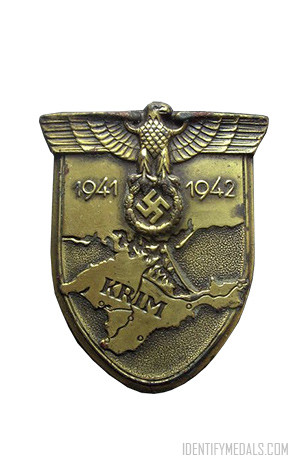
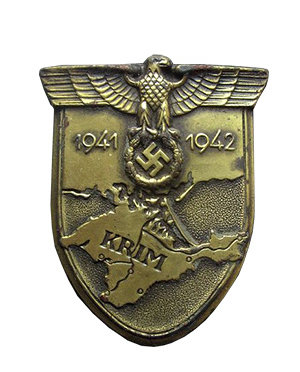
The Crimea shield is headed, on the obverse, by the German eagle clutching a laurel wreath surrounding a swastika. Flanking the eagle are the dates 1941 and 1942, which represent the start and end dates of the campaign. This sits on the backdrop of the Crimean peninsula, where the fighting took place, which has the word KRIM stamped across it.

A special pure-gold version of the Crimea Shield was also produced and first bestowed upon Marshal Ion Antonescu, the military dictator of Romania, at the end of the Siege of Sevastopol on 3 July 1942. It was awarded to him in Bucharest by Erich von Manstein, on Adolf Hitler’s behalf. The second and last Golden Krimschild was awarded to von Manstein himself, on 24 November 1942.

More Nazi Germany Shields (Ärmelschilde)

These campaign shields were awarded to members of the Wehrmacht (the unified armed forces of Nazi Germany from 1935 to 1945). They were given for participation in specific battles or campaigns and worn on the left upper arm of the uniform jacket.

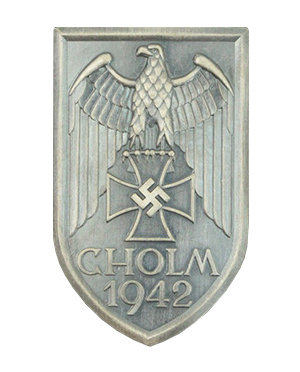
The Cholm Shield

The Cholm Shield (Cholmschild) is a World War II German military decoration awarded to those who fought in the Cholm Pocket.

The Cholm Shield (or Cholmschild in German) is a World War II German military decoration instituted on 1 July 1942 and awarded to those who fought in the Cholm Pocket between 21 January and 5 May 1942.

In January 1942, the Soviet Red Army began a series of counteroffensives against the German Army, while the German occupied city of Cholm. By the end of January the city was surrounded and cut off which led to the creation of the Kholm Pocket. A mixed group of Wehrmacht, Luftwaffe and police personnel led by Generalleutnant Theodor Scherer were supplied by air until they were relieved on 5 May 1942.

To receive the shield, military personnel had to:

  • Have served honourably within the Cholm Pocket between the specified dates; or
  • Have flown and landed at the airfield within the pocket for resupply operations

The Cholm Shield is the rarest of the German combat shields with approximately 5,500 recipients. Bestowing of the award ceased as of 1 April 1943.

The Cholm Shield Design

The design of the commemorative shield was done by Polizei-Rottwachtmeister Schlimmer and sent to Adolf Hitler for approval. Professor Richard Klein made a few minor changes to the design.

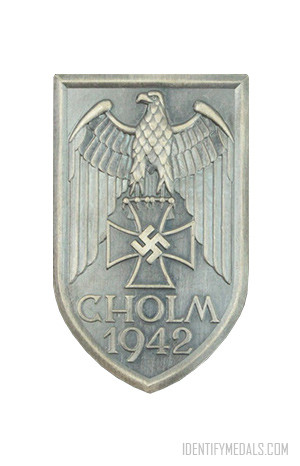
The award features the outline of a shield with a large “open-winged” Wehrmacht-style eagle grasping an Iron Cross with a swastika at its center. Below, in capital letters, is written CHOLM and the date 1942In 1957, the Cholm Shield was denazified (removal of the swastika) to allow recipients to wear the shield on their uniform.

All shields were hollow stamped metal washed in silver. A backing plate was attached to the shield with a number of prongs and affixed to a piece of coloured cloth. The Cholm Shield was worn on the left upper sleeve of the uniform of soldiers and airmen. For civilian clothes a smaller shield roughly 16mm across with a needle fitting could be worn on the left lapel.

More Nazi Germany Shields (Ärmelschilde)

These campaign shields were awarded to members of the Wehrmacht (the unified armed forces of Nazi Germany from 1935 to 1945). They were given for participation in specific battles or campaigns and worn on the left upper arm of the uniform jacket.

The Crimea Shield - German WW2 Medals, Badges and Awards

The Crimea Shield

The Crimea Shield (Krimschild) is a WW2 German military decoration awarded to military personnel who fought against Soviet Red Army forces.

Read More »

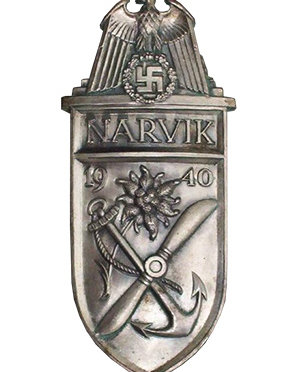
The Narvik Shield

The Narvik Shield (Narvikschild) is a WW2 German military decoration awarded to German forces that took part in the battles of Narvik.

The Narvik Shield (or Narvikschild in German) is a World War II German military decoration awarded to all German forces that took part in the battles of Narvik between 9 April and 8 June 1940.

The decoration was instituted on 19 August 1940 by Adolf Hitler. The Oberkommando der Wehrmacht (OKW) published the order the same day.

A total of 8,577 military personnel received the award. It was bestowed by General Eduard Dietl, the commander of Army Group Narvik.

In 1957, the Narvik Shield, along with many other German military decorations of World War II, was reauthorized for wear by qualifying veterans. The new version was without the eagle and swastika symbol of the Third Reich.

The Narvik Shield Design

Designed by Professor Dr Richard Klein of Munich, the narrow shield features a pointed bottom and, at its apex, an eagle with down-swept wings clutching a laurel wreath that surrounds a swastika. Below this in capital letters is written NARVIK.

The body of the shield features an edelweiss (representing the Heer mountain troops), an anchor (representing the Kriegsmarine), and propeller (for the Luftwaffe). The anchor and propeller are crossed, with the edelweiss placed at the top of the X. The numbers 19 and 40 appear at the top corners of the main body of the shield.

The shield was hollow backed and stamped from sheet metal which was usually zinc. It was worn on the upper left arm of the uniform. The shield was awarded in two versions; silver-gray versions for army and Luftwaffe and a gilded (golden coloured) version for Kriegsmarine.

More Nazi Germany Shields (Ärmelschilde)

These campaign shields were awarded to members of the Wehrmacht (the unified armed forces of Nazi Germany from 1935 to 1945). They were given for participation in specific battles or campaigns and worn on the left upper arm of the uniform jacket.