The German Armed Forces Deployment Medal

The German Armed Forces Deployment Medal is a decoration of the Bundeswehr awarded for military service in a designated military campaign.

The German Armed Forces Deployment Medal (or Einsatzmedaille der Bundeswehr in German) is a decoration of the Bundeswehr, the armed forces of the Federal Republic of Germany, awarded for military service in a designated military campaign.

It is awarded to all German soldiers regardless of rank. It is also the only type of German campaign medal awarded, the only difference is the campaign bar worn on the medal and ribbon.

The decoration has three grades. The grade is awarded without consideration of rank but by the time a served in the designated campaign area:

  • Bronze for 30 days in theatre.
  • Silver is for 360 days in theatre.
  • Gold for 690 days in theatre.

The medal has been awarded for 56 different operations or missions since its establishment. The medal is issued with a clasp denoting foreign the operation recognized by the medal. Like the medal the clasp is either, bronze, silver or gold.

The German Armed Forces Deployment Medal Design

The medal is round, on its center in the obverse is displayed the German eagle surrounded by a wreath of laurel leaves, the reverse side is plain. The combat version differs slightly from standard grades in that the medal is always golden with a black and red rim and a black eagle.

The ribbon has two black stripes on the edges with two red stripes beside it and two golden stripes on the in side with another bold red stripe in the middle, the ribbon bar has the campaign bar attached to it.

The Combat Action Medal of the Bundeswehr

The Combat Action Medal of the Bundeswehr is a military decoration awarded by the German Bundeswehr for active participation in action.

The Combat Action Medal of the Bundeswehr (or Einsatzmedaille Gefecht in German) is a military decoration awarded by the German Bundeswehr for active participation in combat actions or for the suffering from terrorist attacks.

It is awarded only once and, if the recipient was killed in action, posthumously. The medal was initiated by then minister of defense Karl-Theodor zu Guttenberg and introduced by the President of Germany, Christian Wulff in 2010.

The date of qualifying operations is from 29 April 2009 to the present. In 2011, the medal was awarded to a non-german soldier for this first time.

The Combat Action Medal of the Bundeswehr Design

The Combat Action Medal is a special class of the German Armed Forces Deployment Medal and shares many design features and the same ribbon.

The medal is gold in colour, with a black and red enameled border around the edge. The German Federal Eagle in the center is enameled in black. On the suspension ribbon of the medal, and the service ribbon worn in undress, is a gold coloured clasp with the word Gefecht(Combat).

The Badge of Honor of the Bundeswehr

The Decorations of Honor of the Bundeswehr are a series of military decorations of the Bundeswehr awarded for loyal service.

  • Time Period: Post-WW2
  • Institution: October 29, 1980 and October 10, 2008
  • Country: Germany

The Decorations of Honour of the Bundeswehr (or Ehrenzeichen der Bundeswehr in German) are a series of military decorations of the Bundeswehr awarded as a “visible commendation for loyal service and exemplary execution of duties“.

The decorations were introduced in 1980 on the occasion of the 25th anniversary of the Bundeswehr by then Minister of Defence Hans Apel and subsequently approved by President of the Federal Republic Karl Carstens.

The first awards were made on November 6, 1980. In 2008, the decorations were updated and received three grades exclusively reserved for heroic deeds. The new awards were the result of a petition by German citizens to restore the order of the Iron Cross.

Receiving one grade of the award is not a requirement for receipt of the next higher one. If earned, all grades of the award may be worn at the same time.

The Badge of Honour of the Bundeswehr Design

The Medal is round, shows a German eagle on a Cross pattée surrounded by a wreath of oak leaves.

On the reverse it reads FÜR BESONDERE VERDIENSTE BUNDESWEHR (For special merits — Bundeswehr). There is an oak leaf above the word Bundeswehr and that side is also surrounded by an oak leaves wreath.

The ribbon is black with two red stripes beside it and golden stripes on the edges as the colors of the German flag, the ribbon bar has a small clasp of the decoration grade attached to it.

The Bundeswehr Cross of Honor for Valor

The Bundeswehr Cross of Honor for Valor is the highest military decoration of Germany and their first combat valor award since World War II.

The Bundeswehr Cross of Honour for Valour (or Ehrenkreuz der Bundeswehr für Tapferkeit in German) is the highest military decoration of the Bundeswehr, and the highest class of the Bundeswehr Cross of Honour. The decoration is the first combat valour award presented by Germany since World War II.

Since World War II, Germany has seen its military as a defensive force, but during the 1990s Germany began playing a bigger role with its military within the European Union. After the September 11 attacks on the United States, Germany joined ISAF in Afghanistan and has continued to deploy Bundeswehr troops to areas under combat conditions.

The President of Germany Horst Köhler granted authorization for this valour decoration on 18 September 2008. On 10 October 2008, the directive creating the Bundeswehr Cross of Honour for Valour became law upon being published in the Federal Law Gazette and the Federal Gazette. The first recipients of the Cross of Honour for Valour were four soldiers caught up in a suicide attack by Taliban forces on 20 October 2008 southwest of Kunduz, Afghanistan.

The Bundeswehr Cross of Honour Design

The Medal is round, shows a German eagle on a Cross pattée surrounded by a wreath of oak leaves.

On the reverse it reads FÜR BESONDERE VERDIENSTE BUNDESWEHR (For special merits — Bundeswehr). There is an oak leaf above the word Bundeswehr and that side is also surrounded by an oak leaves wreath.

The ribbon is black with two red stripes beside it and golden stripes on the edges as the colors of the German flag, the ribbon bar has a small clasp of the decoration grade attached to it.

The Order of Sidonia

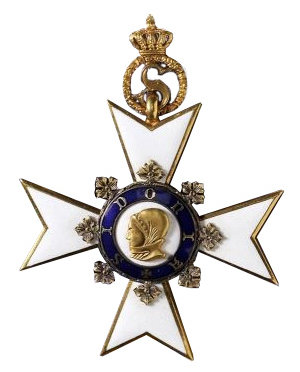
The Order of Sidonia was created on March 14, 1871 by King Johann the German. It’s the Kingdom of Saxony’s chivalric order for women.

The Order of Sidonia was created on March 14, 1871 by King Johann the German. It’s the Kingdom of Saxony’s chivalric order for women, granted to female members of the Saxon nobility until the fall of the monarchy in 1918. By awarding this order, King Johann aimed to reinforce the values and responsibilities associated with the Saxon nobility, encouraging other noblewomen to aspire to such standards.

Named in honor of Saint Sidonia, this order was established to recognize and reward the exemplary service and noble qualities of female members of the Saxon nobility.

The order was granted exclusively to female members of the Saxon nobility. Recipients were typically women who had shown notable service in charitable activities, cultural endeavors, or had supported the monarchy in various capacities.

The Order of Sidonia Design

Members of the Sidonian Order wore a Maltese cross of gold and enamel, suspended from a purple bow with white and green stripes.

Members of the royal family wore a sash instead of the bow. At the apex of the Maltese cross, a medallion featured an image of a helmeted female figure, surrounded with the name “Sidonia”.

The Albert Order

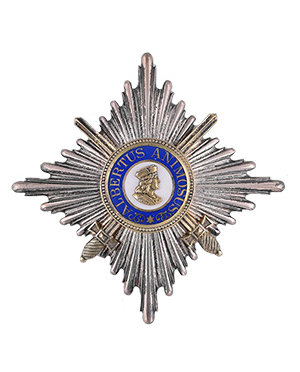
The Albert Order was created in 1850 to be awarded to anyone who had served the state well, for civil virtue, science and art.

The Albert Order (or Albrechts-Orden in German) was to be awarded to anyone who had served the state well, for civil virtue, science and art, and created on 31 December 1850 by King Frederick Augustus II of Saxony to commemorate Albert III, Duke of Saxony

The grade structure of the Albert Order changed several times. At first, there were five classes: Grand Cross (Großkreuz), Commander’s Cross 1st Class (Komturkreuz I), Commander’s Cross 2nd Class (Komturkreuz II), Knight’s Cross (Ritterkreuz) and Small Cross (Kleinkreuz).

An award of Swords indicated a recipient’s bravery in wartime. If, however, a recipient was subsequently awarded a higher grade in the Order, he could lose the bravery distinction attached to the superseded grade (regulations only allowed the display of the insignia of the highest awarded grade). This anomaly was solved in 1906 by allowing the addition of Swords by replacement of insignia. A recipient, however, had to pay the cost of replacement and this appears to have inhibited the numbers of such replacements.

The Albert Order Design

The design of the insignia is a Christian cross with a bust of Albert the Bold at the centre. In 1875, however, it was discovered the bust was in fact the wrong Albert, Albert the Perennial, and the correct image was substituted and used thereafter.

The Civil Order of Saxony

The Civil Order of Saxony is a general order of merit established on 7 June 1815 by King Frederick Augustus I of Saxony.

The Civil Order of Saxony, also known as the Saxon Order of Merit, is a general order of merit established on 7 June 1815 by King Frederick Augustus I of Saxony for the royal subjects of the Kingdom of Saxony for distinguished civic service and virtue.

Upon its founding in 1815, the order was divided into seven classes of merit:

  • Knight Grand Cross
  • Commander First Class
  • Commander Second Class
  • Knight
  • Small Cross
  • Gold Civil Medal
  • Silver Civil Medal

With an amendment of 18 March 1858, the Small Cross became the Cross of Honour, eventually becoming Knight Second Class on 31 January 1876. The decree also replaced the gold and silver medals with civilian crosses of distinction, in gold and silver. The classes of the order thus became:

  • Knight Grand Cross
  • Commander First Class
  • Commander Second Class
  • Knight First Class
  • Knight Second Class
  • Golden Civil Cross
  • Silver Civil Cross

The Civil Order of Saxony Design

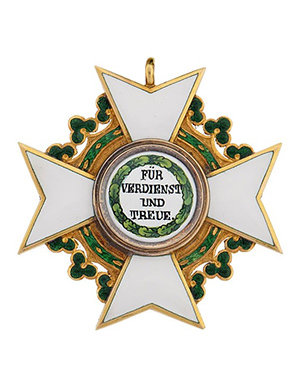
The insignia is a gold Maltese cross with white enameled arms and with green enameled fleur-de-lis between the arms of the cross. It measures 41.63 mm wide x 41.37 mm high and weighs 17.3 grams.

The obverse of the order shows a center white enameled medallion with a Saxon crowned royal monogram painted on the obverse, circumscribed “FRIED.AUG. K. V. SACHSEN. D. 7 JUN. 1815”.

The reverse hjas the inscription “Für Verdiesnt und Treue” (For Merit and Loyalty) within a laurel wreath.

The Military Order of St. Henry

The Military Order of St. Henry is a military order of the Kingdom of Saxony and the oldest military order of the German Empire.

The Military Order of St. Henry (or Militär-St. Heinrichs-Orden in German) is a military order of the Kingdom of Saxony, and the oldest military order of the states of the German Empire.

It was founded on October 7, 1736 by Augustus III, King of Poland and Elector of Saxony. The order underwent several more revisions over the course of the 19th and early 20th centuries, and became obsolete with the fall of the Saxon monarchy in the wake of Germany’s defeat in World War I.

The order came in four classes: Grand Cross (Großkreuz), Commander’s Cross 1st Class (Kommandeurkreuz I. Klasse), Commander’s Cross 2nd Class (Kommandeurkreuz II. Klasse) or sometimes just Commander, and Knight’s Cross (Ritterkreuz). Generally, the rank of the recipient determined which grade he would receive.

The Military Order of St. Henry Design

The badge of the Order of St. Henry is a gold Maltese cross with white enameled edges.

Around the center medallion in the obverse there is a blue-enameled gold ring bearing on the obverse the words “FRIDR AUG D G REX SAX INSTAURAVIT“. The reverse shows the motto “VIRTUTI IN BELLO” (“Bravery in War”). On the obverse, the medallion is yellow-enameled with a painted portrait of St. Henry, the last Saxon Holy Roman Emperor. On the reverse, the medallion bore the Saxon coat of arms (alternating horizontal black and gold stripes with a diagonal rue crown).

Between the arms of the cross were green-enameled rue crowns, a symbol of Saxony. The badge was suspended from a royal crown. 

The star of the order is a silver eight-pointed star featuring a larger version of the medallion with St. Henry of the obverse of the cross, but with the text of the ring of the reverse. 

The ribbon of the order is light blue with yellow stripes near each edge. 

The Order of the Rue Crown

The Order of the Rue Crown is a dynastic order of knighthood of the Kingdom of Saxony created in 1807 by Frederick Augustus I.

The Order of the Rue Crown (or Hausorden der Rautenkrone in German), also known as the Order of the Crown of Saxony is a dynastic order of knighthood of the Kingdom of Saxony created in 1807 by Frederick Augustus I, the first King of Saxony, to be the civil counterpart to the Military Order of St. Henry.

The order takes its name from the green floral crown of rue (crancelin) found in the coat of arms of Saxony. It occupies the highest rank of the former Saxonian honour system.

The order was originally limited to 24 knights, although exceptions were made for members of ruling houses and those whose membership in the order would add to its prestige. The Order of the Rue Crown was presented in a single grade, Knight.

The Order of the Rue Design

The badge of the order is a gold Maltese cross enameled in green with a white border.

The white center medallion features in the obverse the crowned monogram of Frederick Augustus I of Saxony, encircled by a green crown of rue. Between the arms of the cross is a golden crown of rue.

The star of the order is made of silver, and has eight points. The center of the star bears a gold medallion with the motto of the order, PROVIDENTIÆ MEMOR, inside a ring of green rue leaves.

The badge of the order is borne on a ribband of grass green, worn over the right shoulder.

The Order of Theresa

The Order of Theresa is an Kingdom of Bavaria order for noble ladies founded in 1827 by Queen Therese of Bavaria, wife of King Ludwig I.

The Order of Theresa is an Kingdom of Bavaria order for noble ladies founded December 12, 1827 by Queen Therese of Bavaria, wife of King Ludwig I of Bavaria. It continues to function today as an honorary society to which belong the princesses of the House of Wittelsbach as well as other ladies from Bavarian noble families.

Queen Therese established an endowment which paid an annual pension to twelve unmarried noble ladies, six of whom received 300 guilders and six of whom received 100 guilders. The pension ceased when a member married; if, however, the marriage was according to the rank of the member, then the lady was permitted to continue to wear the insignia of the order and be known as an Ehrendame (Lady of Honour).

Various other ladies also held the rank of Ehrendame including all the princesses of the House of Wittelsbach. Bavarian ladies paid a reception fee of 55 guilders while foreign ladies paid 220 guilders.

The Order of Therese Design

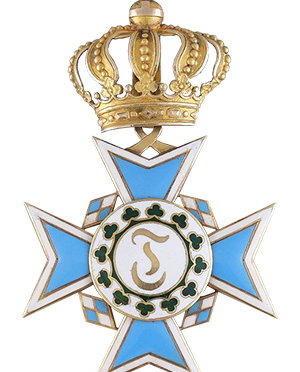
The insignia of the order is worn on the left breast and consists of a blue-enameled Maltese cross with a wide white edge, over which is placed a gold royal crown. In the four angles of the cross are lozenges with the blue-and-white arms of Bavaria.

At the centre of the cross in the obverse is a gold bordered white circular medallion decorated with the letter T. On the reverse of the medallion is the year 1827 and the motto of the order “Unser Leben sey Glaube an das Ewige” (Our life is Faith in Eternity).

The ribbon of the order is white with two sky-blue stripes at the edge, the inner stripe being narrower than the outer stripe. The sash of the order is a similarly-coloured broad ribbon, worn diagonally from the right shoulder to the left hip.