The Order of Theresa

The Order of Theresa is an Kingdom of Bavaria order for noble ladies founded in 1827 by Queen Therese of Bavaria, wife of King Ludwig I.

The Order of Theresa is an Kingdom of Bavaria order for noble ladies founded December 12, 1827 by Queen Therese of Bavaria, wife of King Ludwig I of Bavaria. It continues to function today as an honorary society to which belong the princesses of the House of Wittelsbach as well as other ladies from Bavarian noble families.

Queen Therese established an endowment which paid an annual pension to twelve unmarried noble ladies, six of whom received 300 guilders and six of whom received 100 guilders. The pension ceased when a member married; if, however, the marriage was according to the rank of the member, then the lady was permitted to continue to wear the insignia of the order and be known as an Ehrendame (Lady of Honour).

Various other ladies also held the rank of Ehrendame including all the princesses of the House of Wittelsbach. Bavarian ladies paid a reception fee of 55 guilders while foreign ladies paid 220 guilders.

The Order of Therese Design

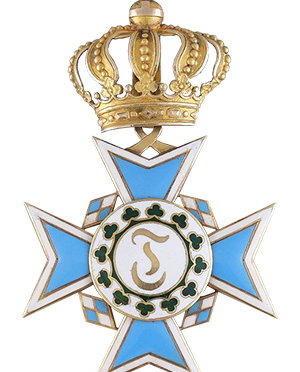
The insignia of the order is worn on the left breast and consists of a blue-enameled Maltese cross with a wide white edge, over which is placed a gold royal crown. In the four angles of the cross are lozenges with the blue-and-white arms of Bavaria.

At the centre of the cross in the obverse is a gold bordered white circular medallion decorated with the letter T. On the reverse of the medallion is the year 1827 and the motto of the order “Unser Leben sey Glaube an das Ewige” (Our life is Faith in Eternity).

The ribbon of the order is white with two sky-blue stripes at the edge, the inner stripe being narrower than the outer stripe. The sash of the order is a similarly-coloured broad ribbon, worn diagonally from the right shoulder to the left hip.
The Order of Saint Elizabeth

The Order of Saint Elizabeth was an all-female chivalric and charitable order established in 1766 in the Kingdom of Bavaria.

The Order of Saint Elizabeth was an all-female chivalric and charitable order in the Kingdom of Bavaria.

The first Consort of the Elector Charles Theodore of the Palatinate, Elizabeth Augusta, daughter of the Palatine Joseph Charles Emanuel of Schultzbach, founded this Order for ladies in honor of her sainted patroness and namesake on the 18th October 1766, as a purely charitable institution for the poor. It was confirmed on the 31st of January 1767, by Pope Clement XII.

The Catholic religion and the Seize Quartiers (the proof of noble descent running through sixteen generations of their own or their husband’s ancestors) were indispensable conditions for candidates.

The nomination took place either on Easter or on Saint Elizabeth’s Day (19th November). There are five classes to the order: Grand Mistress Dame, Dame, Special Class Dame, 1st Class Dame and 2nd Class Dame.

The Order of Saint Elizabeth Design

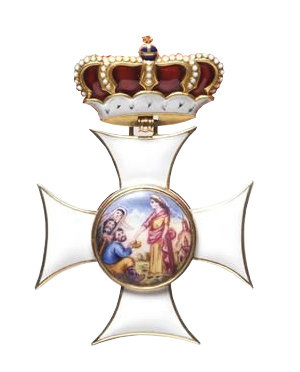
The badge is a white enameled cross, representing on the obverse Saint Elizabeth dispensing charity to the poor, and on the reverse, the initials of the founder.

It is worn on the left breast by a blue ribbon with a red border. No Member can appear in public without it, except by fine of one ducat. The King appoints the Grand Mistress.

The Bavarian Maximilian Order for Science and Art

The Bavarian Maximilian Order for Science and Art was awarded to acknowledge and reward excellent and outstanding achievements.

The Bavarian Maximilian Order for Science and Art (or Bayerischer Maximiliansorden für Wissenschaft und Kunst in German) was awarded to acknowledge and reward excellent and outstanding achievements in the field of science and art and established on 28 November 1853 by King Maximilian II von Bayern.

From 1933 onwards the order was no longer awarded, until 1980 when it was reinstated by the then Minister-President of the Free State of Bavaria Franz Josef Strauß.

The Maximilian Order is preferably awarded to German scientists and artists, although it’s not restricted to citizens of Bavaria. It was instituted in one class and two sections (science and art), and is restricted to 100 living members

The Maximilian Order of Science and Art Design

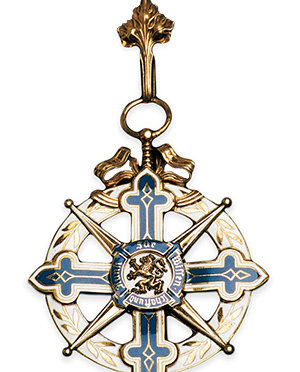
The medal consists of a blue-enameled Gothic cross with a white border and four rays in the corners, surrounded by a white gold-pierced ring.

The center of the cross in the obverse forms a round medallion bordered by gold, which shows, on a white background, the upright standing Bavarian lion  surrounded by the golden inscription: For science and art.

The reverse shows the Bavarian diamond coat of arms and the foundation date: 28. November 1853. The Order is worn as a collar order on a white band with blue edging, in its place a square miniature, a blue and white held rosette or a Fraquette can be worn on the left cuff.

Munich jewellers Hemmerle have been responsible for making the medal since 1905.

The Military Merit Cross (Bavaria)

The Bavarian Military Merit Cross was the Kingdom’s main decoration for bravery and military merit for enlisted soldiers.

]The Bavarian Military Merit Cross (or Militär-Verdienstkreuz in German) was the Kingdom’s main decoration for bravery and military merit for enlisted soldiers, intended “to reward extraordinary merit by non-commissioned officers, soldiers, and lower-ranking officials.”

The cross was established on July 19, 1866 as the 5th Class of the Military Merit Order, the main decoration for bravery and military merit for officers and higher-ranking officials. Civilians acting in support of the army were also made eligible for the decoration.

The first recipient appears to have been Gendarm Johann Winter, who received the Military Merit Cross in the Armee-Befehl of August 20, 1866. The Bavarian Military Merit Cross underwent three major revisions. In February 1891, awards with swords were authorized to distinguish wartime awards, whether for bravery or military merit, from peacetime awards. In 1905, the statutes of the Military Merit Order were revised and the Military Merit Cross was divided into two classes. In 1913, another revision of the statutes of the Military Merit Order divided the Military Merit Cross into three classes.

The Military Merit Cross Design

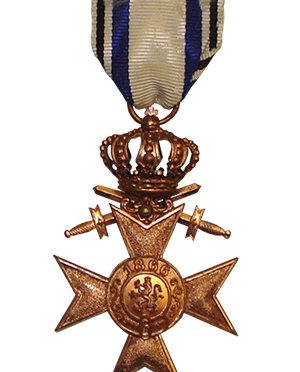
The cross is a maltese cross with a center medallion. The center medallion is enameled.

The obverse of the center medallion shows an “L” cipher of King Ludwig II in the center and the word “MERENTI” on the ring. The reverse has a Bavarian lion with the date of founding, “1866”, on the ring.

The Military Merit Order (Bavaria)

The Bavarian Military Merit Order was established in1866 by King Ludwig II of Bavaria and was the kingdom’s main decoration for bravery.

The Bavarian Military Merit Order (or Militär-Verdienstorden in German) was established on July 19, 1866 by King Ludwig II of Bavaria. The order was the kingdom’s main decoration for bravery and military merit for officers and higher-ranking officials.

Eligible for the decoration were civilians acting in support of the army. The Military Merit Order ranked below the Military Order of Max Joseph, Bavaria’s highest military honor for officers.

The order could be awarded with or without swords (which generally indicated wartime or combat awards). The Grand Cross and 1st Class always came with a breast star, but the 2nd Class could be awarded with or without the breast star. The 3rd and 4th Classes could be awarded with or without a crown. Generally, these distinctions were based on rank.

The Military Order of Merit Design

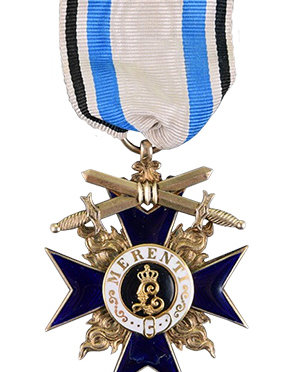
The design of the order is a Maltese cross of blue enamel with a center medallion. Between the arms of most classes are flames (in gold or silver for the 4th Class after the 1905 revisions of the order).

The obverse of the center medallion had a gold crowned “L” cipher (for the founder King Ludwig II) on the black-enameled center and the word “MERENTI” on a ring of white enamel edged in gold (later silver-gilt).

The reverse shows a gold Bavarian lion on black enamel with the date of founding, “1866“, on the white-enameled ring. Most of the various classes of the order were of different sizes and worn differently, as sash badges over the shoulder, as neck badges, or as breast badges suspended from a ribbon.

The Order of Saint Michael (Bavaria)

The Order of Saint Michael was founded by Joseph Clemens of Bavaria, then Archbishop-Elector of Cologne, as a Military order in 1693.

The Order of Saint Michael (or Orden zum Heiligen Michael in German) also known as Royal Merit Order of Saint Michael (Königlicher Verdienstorden vom heiligen Michael) was founded by Joseph Clemens of Bavaria, then Archbishop-Elector of Cologne, as a Military order in 1693.

The Royal Bavarian Order of St. Michael was originally instituted as an award for Catholics. After falling into disuse near the beginning of the 19th century,
it was revived in 1857 by King Ludwig I of Bavaria, as a merit order in three classes to honor devotion to the crown by both Bavarians and foreigners. The Order underwent various further statutory changes in 1855, 1887, 1894, and finally in 1910.

The Order of Saint Michael Design

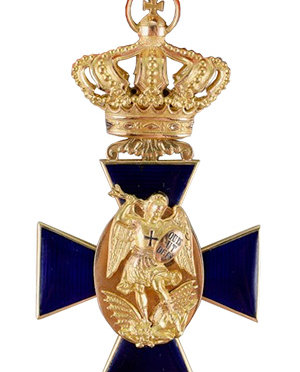
The Order badge of the first three classes consists of a golden, azure-blue enameled cross with eight wide points, surmounted by a king’s crown.

In the middle of the obverse, prominently portrayed in gold, is St. Michael in martial armor with the motto QUIS UT D~US on his shield; on the reverse appears the word VIRTUTI.

On the Order badge for the two divisions of the Second Class the figure of St. Michael is surrounded on all sides with golden rays and the four arms of the cross bear the gold letters P.F.F.P. denoting PRINCIPI FIDELIS FAV~RE PATRIAE.

The Order badge for the Fourth Class is the same as for the Third, with the exception that it is of silver, as are the crown and the figure of St. Michael.

The ribbon of the Order is dark blue for two-thirds of the width and one-third rose colored, with the latter color divided equally on the two outside edges. The Grand Cross alone is worn on a ribbon which is rose colored for two-thirds of the width, and one-third dark blue, with the dark blue on both outside edges in equal proportions.

The Order of Merit of the Bavarian Crown (Star)

The Order of Merit of the Bavarian Crown is an order of merit of the Kingdom of Bavaria established by King Maximilian Joseph I.

The Order of Merit of the Bavarian Crown (or Verdienstorden der Bayerischen Krone in German) is an order of merit of the Kingdom of Bavaria established by King Maximilian Joseph I on 19 March 1808. The order was awarded in several grades: Grand Commander, Grand Cross, Commander, Knight, and medals in gold and silver.

The motto of the order is Virtus et Honos (‘Courage and Honour’). King Maximilian I Joseph founded the order to reward civil servants of the state of all classes and other foreigners who were deserving of recognition of the Kingdom of Bavaria. Both the orders brought non-noble recipients in the collection of personal nobility with the title “Ritter von”.

The Order of Merit of the Bavarian Crown Design

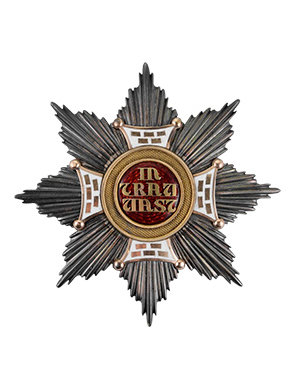
The order is a silver eight-pointed multi-rayed star in silver gilt and enamels and the inscription Virtus et Honos (‘Courage and Honour’), the motto of the order, in red, green, white and blue enamel.

The Order of Merit of the Bavarian Crown measures 53 mm (or 80 mm including the crown suspension). The ribbon is light blue with white stripes.

The Military Order of Max Joseph

The Military Order of Max Joseph was founded on 1 January 1806 by Maximilian I Joseph of Bavaria, the first king of Bavaria.

The Military Order of Max Joseph (or Militär-Max-Joseph-Orden in German) was founded on 1 January 1806 by Maximilian I Joseph of Bavaria, the first king of Bavaria and was the highest military order of the Kingdom of Bavaria.

The order came in three classes: Grand Cross (Großkreuz), Commander’s Cross (Kommandeurkreuz) and Knight’s Cross (Ritterkreuz). Individuals who received the order and were not already members of the nobility were ennobled and would add the title of “Ritter von” to their family name.

The order became obsolete in 1918 with the collapse of the Bavarian monarchy on Germany’s defeat in World War I although the orders chancery continued to process outstanding award recommendations to at least 1922.

The Military Order of Max Joseph Design

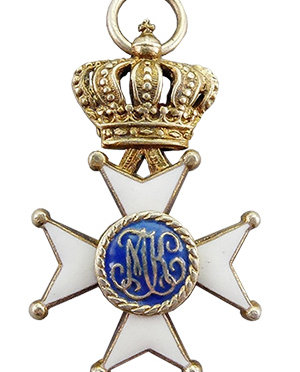
The badge of the order is a white-enameled gold Maltese cross with balls at each cross point.

In the obverse, the center medallion, in blue enamel and edged in gold, features the monogram of Max Joseph (a cursive “MJK“). On the reverse it displays the Latin motto of the order, “Virtuti pro patria” (“Bravery for the fatherland”), both in gold. Above the cross is a gold crown.

The badge of the Knight’s Cross is much smaller than that of many other military orders and decorations, measuring only 28-mm in width (and 50-mm in height including the crown and ring). It was worn from a ribbon on the officer’s medal bar ahead of other decorations or, typically, separately worn through the buttonhole. The badge of a Commander’s Cross was somewhat larger (38-mm by 55-mm) and worn from a ribbon around the neck. The Grand Cross was still larger (68-mm by 100-mm), with golden rays between the arms of the cross.

The star of the order, which only came with the Grand Cross, was a silver eight-pointed star (with each point made of five rays). The center of the star featured a badge of the order, but with an oversized medallion, bearing the motto “Virtuti pro patria”.

The ribbon of the order was black moiré with inner white and outer blue edge stripes.

The Royal Order of Saint George (Immaculate Conception)

The Royal Military Order of Saint George for the Defense of the Faith and the Immaculate Conception was founded by Maximilian II Emanuel.

The Royal Military Order of Saint George for the Defense of the Faith and the Immaculate Conception (also known as the Royal Bavarian House Equestrian Order of Saint George, Königlich Bayerischer Haus-Ritter-Orden vom Heiligen Georg in German) was founded by Maximilian II Emanuel, Elector of Bavaria around 1726 to honor the nobility and recognize distinguished civil and military service.

Its status as a Catholic Order was confirmed in a Papal Bull of 15 March 1728 – specifically comparing the Order with the Teutonic Order, which had likewise been transformed from a Crusading Order to an exclusive chivalric religious institution for the Nobility.

Various Bavarian Princes who in the fifteenth century had made pilgrimages to the Holy Sepulcher and were there invested as knights had each made a promise to Saint George, the patron saint of chivalry. Maximilian’s son, the Elector Karl-Albrecht, gave the new Order its title of Order of the Holy Knight and Martyr Saint George and the Immaculate Conception of the Holy Virgin Mary and established its statutes on March 28, 1729 as a Military Order of Chivalry for Roman Catholic noblemen.

The Royal Order of Saint George Design

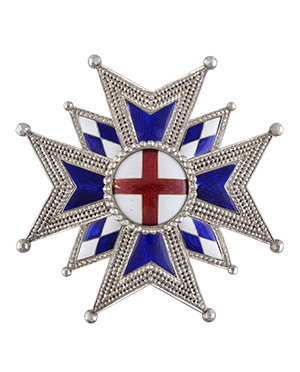
The badge of the Order is a blue enameled gold Maltese cross with white enameled borders and small gold balls on the points. There are blue diagonal lozenges (each bearing a gold letter, V. I. B. I., representing the words Virgini Immaculatae Bavaria Immaculata) between the arms also with white enameled borders.

The round gold medallion in the center obverse has the image of the Virgin Mary within a white enameled border. The reverse of the badge has the same design except that the arms of the cross are enameled red and the blue lozenges bear the letters I. V. P. F. (Justis Vt Palma Fiorebit or “Distinguished for Justice and Glory”). The center gold medallion is of Saint George slaying the Dragon within a green enameled laurel wreath.

The badge hangs from a light blue silk moire ribbon with white stripes near its border with narrow dark blue stripes on the inside of these white stripes. It’s suspended by a gold lion’s head holding in its mouth a blue reverse crescent shaped handle of the gold and enamel strapwork supporting the badge proper.

The officials of the order wore a special heraldic cross, a Maltese cross like the former, but with its round central medallion bearing the red cross of St. George.

On formal occasions the badge is worn by the members of the first class of the order (i.e., Grand Master, Grand Priors and Grand Commanders) from a gold collar formed of links in the form of a gold rectangle with gold Bavarian royal crowns on the either side of this rectangle, or in the form of two gold lions rampart combatant standing on a gold scroll.

The Order of Saint Hubert

The Royal Order of Saint Hubert is a Roman Catholic dynastic order of knighthood founded in 1444 or 1445 by Gerhard VII.

The Royal Order of Saint Hubert is a Roman Catholic dynastic order of knighthood founded in 1444 or 1445 by Gerhard VII, Duke of Jülich-Berg to commemorate his victory over the House of Egmond at the Battle of Linnich on 3 November (Saint Hubert‘s day, which commemorates the conversion of Saint Hubert and his standing as the patron saint of hunters and knights).

The establishment of the Order occurred during a long-term, intermittent territorial dispute that began in the 1430s between the Dukes of Jülich and the Guelders. the Order of Saint Hubert honors a military victory of the Duke of Jülich, on Saint Hubert’s day, 3 November 1444.

Initially, the order was open to men and women, although the number of male companions was limited to sixty. Over time, the award had other uses as a reward for loyalty to the monarch and service to the princely state.

The Order of Saint Hubert Design

The insignia is a gold-enameled cross lying in a white field and surmounted by a crown.

On the obverse is represented the conversion of Saint Hubert, with the legend In trau vast (“Firm in fidelity”) in Gothic letters. On the reverse lies the imperial orb and the Latin inscription In memoriam recuperatæ dignitatis a vitæ 1708 (“In remembrance of the restoration of the original dignity, 1708″).

Originally, the order consisted of a collar (of stylized horns, six for men and four for women) and a pendant jewel (depicting the conversion of Saint Hubert). The great cross was only worn on special days.

The collar of the Order under the Wittelsbach dynasty consisted of forty-four gold links, twenty-two of which consisted of a rectangular representation of the conversion of Saint Hubert in open relief surrounded by a gold and white enamel frame.

The sash of the Order was poppy red moire with narrow green borders, but under the knot, at the ends of this sash, these green borders as well as the ends of the sash were covered with gold metallic ribbon.