The War Merit Cross (With Swords)

The War Merit Cross was a decoration of Nazi Germany during the Second World War awarded to military personnel and civilians.

The War Merit Cross (or Kriegsverdienstkreuz in German) was a decoration of of Nazi Germany awarded to military personnel and civilians during the Second World War. It was created by Adolf Hitler in October 1939 as a successor to the non-combatant Iron Cross which was used in earlier wars.

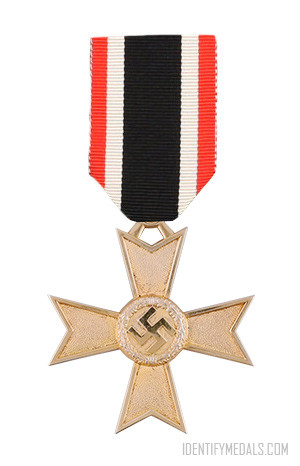
The award had four variantswith swords given to soldiers for exceptional service “not in direct connection with combat”, without swords given to civilians for meritorious service in “furtherance of the war effort”, the Knights Cross of the War Merit Cross, and the rare Knight’s Cross of the War Merit Cross in Gold

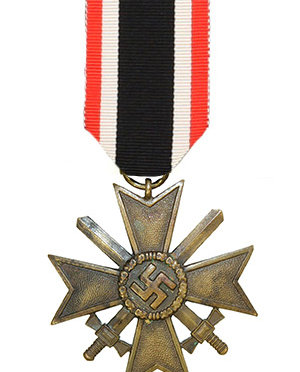
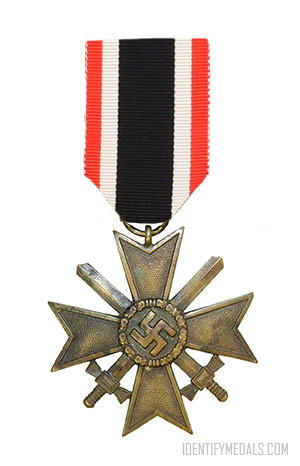
The War Merit Cross 2nd Class with Swords was presented to Military Personnel for bravery not necessarily in the face of the enemy, and in reality there was a gray area in which individuals received the medal when perhaps the non-combatant grade would have been appropriate.  A total of 6,134,950 were issued.

By the end of the war the War Merit Cross was issued in four degrees and had a related civil decoration. It was reissued in 1957 by the Bundeswehr in a de-Nazified version for veterans.

The War Merit Cross With Swords Design

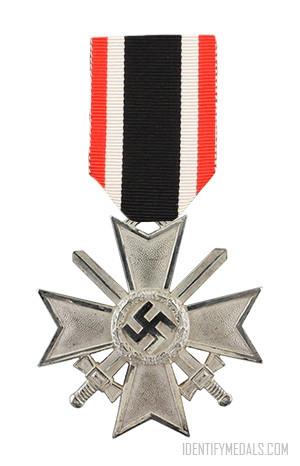
The medal consists of a bronze plated Maltese Cross. The obverse has pebbled arms, with a central wreathed mobile swastika and crossed swords piercing the centrepiece. The reverse has a block hinge and a banjo-style pinback. The War Merit Cross measures 48.51 mm (w) x 48.48 mm (h) and weighs 17.6 grams.

Materials

War Merit Cross with Swords was constructed from a wide range of materials, from zinc with a bronzed wash to a few very rare bronze pieces. As the war progressed, the quality of the materials decreased, and as a result late war crosses lose their bronze wash with the passing of time, yielding a gray appearance.

Ribbon

The ribbon of the War Merit Cross with Swords was in red-white-black-white-red (the colors being reversed from the ribbon of the World War II version of the Iron Cross). The ribbon for the War Merit Medal was similar, but with a narrow vertical red strip in the center of the black field.

Classes

The War Merit Cross without Swords 1st Class was a pin-backed medal worn on the pocket of the tunic. The ribbon of the War Merit Cross without Swords 2nd Class could be worn like the ribbon of the Iron Cross 2nd Class (through the second buttonhole). Combat soldiers tended to hold the War Merit Cross in low regard, referring to its wearers as being in ‘Iron Cross Training’.

Order of Wear

The War Merit Cross with Swords was a neck decoration and worn the same way as the Knights Cross of the Iron Cross.

Medal Variations

The War Merit Cross came in several variations, each with specific criteria and significance:

  1. War Merit Cross 2nd Class: Awarded with swords for bravery in combat or without swords for meritorious service in a non-combat role. This was worn as a ribbon on the uniform.

  2. War Merit Cross 1st Class: A higher distinction, awarded with or without swords, worn as a pin on the chest.

  3. Knights Cross of the War Merit Cross: The highest grade, also with or without swords, for exceptional service.

Find this Medal Online

Right Now on eBay 
Clicking a link to eBay may result in a referral commission being paid if a purchase is made.
Loading...

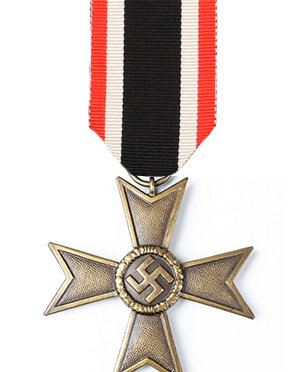
The War Merit Cross (Without Swords)

The War Merit Cross was a decoration of Nazi Germany during the Second World War awarded to military personnel and civilians.

The War Merit Cross (or Kriegsverdienstkreuz in German) was a decoration of Nazi Germany awarded to military personnel and civilians during the Second World War. It was created by Adolf Hitler in October 1939 as a successor to the non-combatant Iron Cross which was used in earlier wars.

The award had four variantswith swords given to soldiers for exceptional service “not in direct connection with combat”, without swords given to civilians for meritorious service in “furtherance of the war effort”, the Knights Cross of the War Merit Cross, and the rare Knight’s Cross of the War Merit Cross in Gold

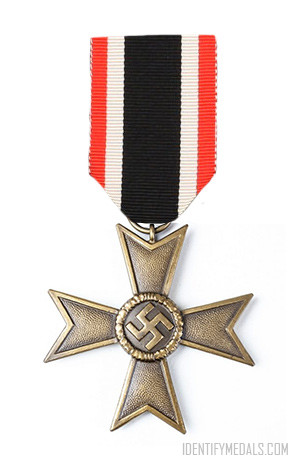
The War Merit Cross 2nd Class without swords was presented to those whose actions were deemed to be in the furtherance of the war effort but not directly involved in military operations, for example teachers, industrialists, or Military personnel on occupation duty or POW camp guards. A total of 1,591,5673 medals were issued.

By the end of the war the War Merit Cross was issued in four degrees and had a related civil decoration. It was reissued in 1957 by the Bundeswehr in a de-Nazified version for veterans.n

The War Merit Cross Without Swords Design

The medal consists of a bronze plated Maltese Cross. The obverse has pebbled arms, with a central wreathed mobile swastika and crossed swords piercing the centrepiece. The reverse has a block hinge and a banjo-style pinback. The War Merit Cross measures 48.51 mm (w) x 48.48 mm (h) and weighs 17.6 grams.

Materials

The War Merit Cross without Swords was constructed from a wide range of materials, from zinc with a bronzed wash to a few very rare bronze pieces. As the war progressed, the quality of the materials decreased, and as a result late war crosses lose their bronze wash with the passing of time, yielding a gray appearance.

Ribbon

The ribbon of the War Merit Cross without Swords was in red-white-black-white-red (the colors being reversed from the ribbon of the World War II version of the Iron Cross). The ribbon for the War Merit Medal was similar, but with a narrow vertical red strip in the center of the black field.

Classes

The War Merit Cross without Swords 1st Class was a pin-backed medal worn on the pocket of the tunic. The ribbon of the War Merit Cross without Swords 2nd Class could be worn like the ribbon of the Iron Cross 2nd Class (through the second buttonhole). 

Order of Wear

The War Merit Cross without Swords was a neck decoration and worn the same way as the Knights Cross of the Iron Cross.

Medal Variations

Find this Medal Online

The Memel Medal

The Return of Memel Commemorative Medal is a decoration of Nazi Germany awarded during the interwar period, and the last of a series.

The Return of Memel Commemorative Medal (or Medaille zur Erinnerung an die Heimkehr des Memellandes; 22. März 1939 in German) is a decoration of Nazi Germany awarded during the interwar period, and the last of the series of German Occupation Medals.

Germany annexed the Klaipėda Region (Memel Territory) from Lithuania on 22 March 1939 after an oral ultimatum. On 23 March an occupation of the city and district was carried out by German Army troops. To commemorate the occupation the “Memel Medal” was authorized on 1 May 1939.

It was awarded until 31 December 1940. The award was presented to all military, political and civil personnel who had distinguished themselves in actions related to the annexation of the district to Germany. In all 31,322 medals were awarded.

The Memel Medal Design

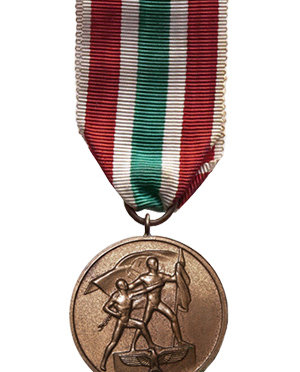
The medal was designed by Professor Richard Klein and die struck in bronze. It was worn on the left tunic pocket suspended from a white ribbon with a green strip in the middle and two red strips on each side, the historic colors of Lithuania Minor.

The obverse was the exactly the same as the previous two medals, but the reverse reads “Zur Erinnerung an die Heimkerhr des Memellandes 22. März 1939” (To commemorate the return of the Memel District. 22 March 1939), surrounded by an oak leave wreath.

The Star of the Grand Cross of the Iron Cross (Nazi)

The Star of the Grand Cross of the Iron Cross was the highest military decoration of the Kingdom of Prussia and the German Empire. 
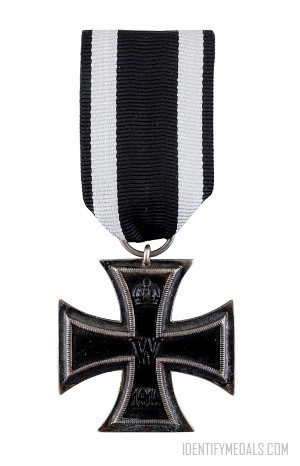
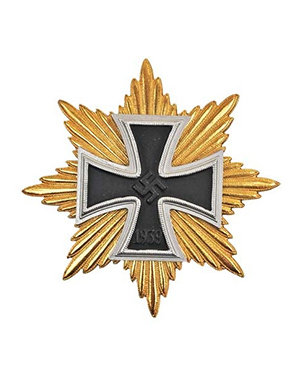
The Star of the Grand Cross of the Iron Cross (or Stern zum Großkreuz des Eisernen Kreuzes in German) was the highest military decoration of the Kingdom of Prussia and the German Empire.
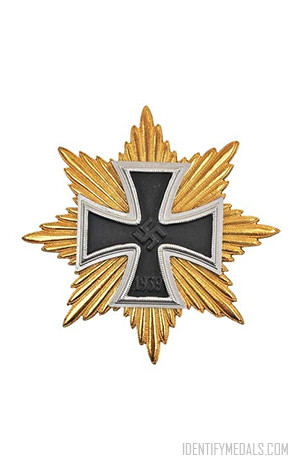
The Star of the Grand Cross of the Iron Cross was awarded to the most outstanding of generals who performed feats of leadership to the extreme benefit of the German state. It was awarded only twice, a century apart, to Field Marshal Gebhard von Blücher in 1815 for his victory over Napoleon at the Battle of Waterloo, and to Field Marshal Paul von Hindenburg in 1918 for his victory at the Battle of Tannenberg. The award is commonly known as “Blücher’s Star” (Blücherstern) after its first recipient.

Paul von Hindenburg received the Grand Cross of the Iron Cross (9 December 1916) to which the Golden Star added on 25 March 1918 (Star of the Grand Cross of the Iron Cross).

During the reign of Nazi Germany, Reichsmarschall Hermann Göring commissioned a new version of the medal, intending to award it to Adolf Hitler once Germany won the Second World War.

Since Germany was defeated in 1945, the award was never bestowed on the intended recipient. Following the Allied victory in May 1945, the US Army seized the only known prototype, which had been stored in a bunker. It is now a part of the collection of the Museum of the United States Military Academy in West Point, New York.

The Star of the Grand Cross of the Icon Cross Design

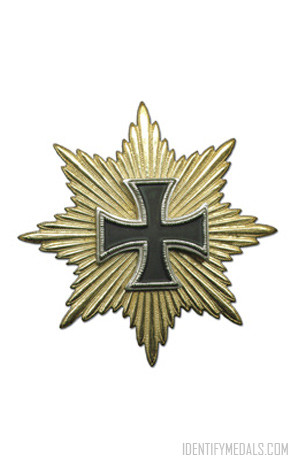
The design of the Star of the Grand Cross of the Iron Cross is similar to that od the Grand Cross of the Iron Cross, but with a golden crown and a swastika symbol.

More Variations of the Iron Cross

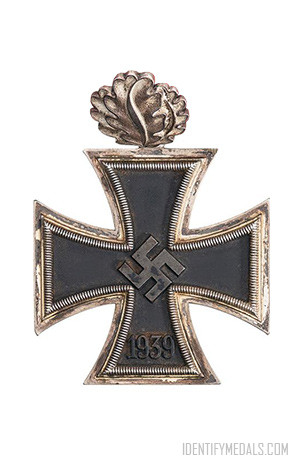
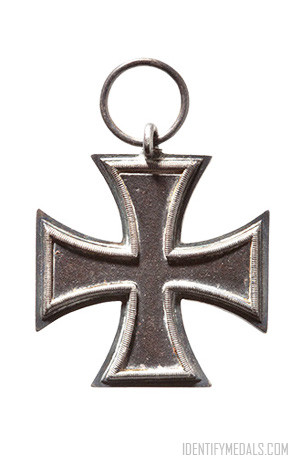
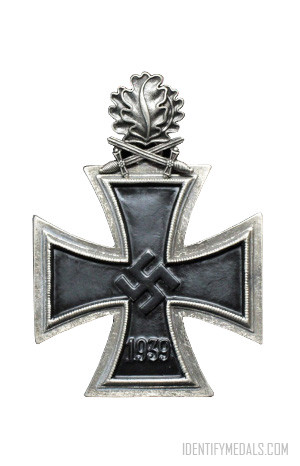
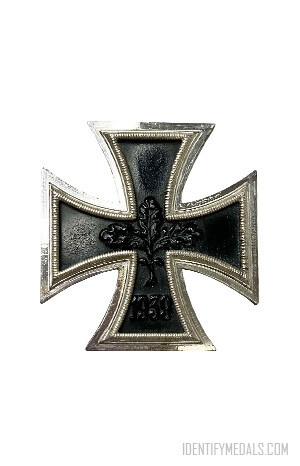
The Iron Cross, a prestigious German military decoration, has undergone several variations since its inception. For example, the Iron Cross 1813 was instituted during the Napoleonic Wars by King Frederick William III of Prussia, the Iron Cross 1914 was awarded during World War I, it was reinstated by Kaiser Wilhelm II, and the Iron Cross 1939 was revived by Adolf Hitler for World War II, with modifications including a swastika.

Find the Iron Cross Medal Online

Right Now on eBay 
Clicking a link to eBay may result in a referral commission being paid if a purchase is made.
Loading...

Further Reading About the Iron Cross

Discover the stories behind the Iron Cross with these compelling books and delve into the rich history and significance of this prestigious military decoration.

The Operational Service Medal Iraq and Syria

The Operational Service Medal Iraq and Syria is a British armed forces campaign medal awarded mostly to military personnel.

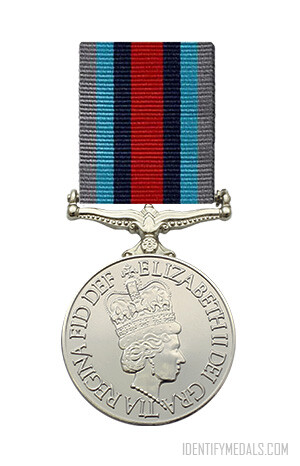
The Operational Service Medal Iraq and Syria (also known as Operation Shader Medal) is a British armed forces campaign medal awarded mostly to military personnel who served in the operational area of, or in support of Operation Shader.

The Operational Service Medal (Iraq and Syria) was first announced by former Defence Secretary, Sir Michael Fallon on 19 September 2017 and was first awarded in July 2018 in London by Defence Secretary Gavin Williamson. The medal is awarded either for 30 days continuous, or 45 days cumulative, service in theatre.

The Operational Service Medal Iraq and Syria Qualifying Criteria

This Operational Service Medal is the first to be awarded to individuals who served outside of the operational area, reflecting the changing nature of warfare. The Operational Service Medal (OSM) was established in 1999 to replace the General Service Medal (1962) for all new operations.

Clasp: Iraq & Syria clasp awarded to those recipients who served in the operational area. A silver rosette denotes the clasp when worn on the ribbon bar.

The Operational Service Medal Iraq and Syria Design

The Operational Service Medal for Iraq and Syria is struck in silver and circular in shape.

The obverse shows the crowned effigy of Queen Elizabeth II with the inscription ELIZABETH II DEI GRATIA REGINA FID. DEF. 

The reverse displays the Union Flag, surrounded by the inscription FOR OPERATIONAL SERVICE and the four major points of the compass with, between the points, four Coronets: Royal (top left), Naval (top right), Mural-Army (bottom left), and Astral-Royal Air Force (bottom right).

The ribbon is a broad central red stripe, flanked each side by a stripe of navy blue and one of light blue, to represent the three services, with an outer stripe of grey.

The General Service Medal Variants

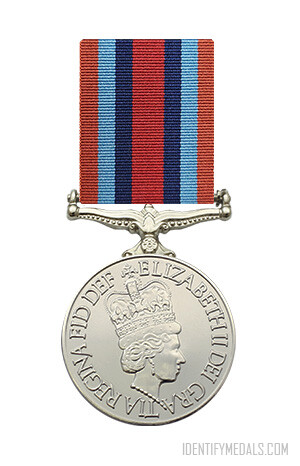
The OSM has been awarded for four separate campaigns, each with a distinctive ribbon. The other three are:

Buy an OSM Medal Online

Right Now on eBay 
Clicking a link to eBay may result in a referral commission being paid if a purchase is made.
Loading...

The Ebola Medal for Service in West Africa

The Ebola Medal for Service in West Africa (also known simply as the Ebola Medal) is a service medal issued to the Armed Forces and to civilians, working either for Her Majesty’s Government or for non-governmental organisations, in support of the British Government’s response to the Ebola crisis in West Africa between March 2014 and March 2016.

The medal is the first medal awarded by the UK Government for a humanitarian crisis response.

The medal is awarded either for 21 days of continuous service within the operating area, or 30 days accumulated service on working visits of 48 hours or more to the operating area. The following groups are eligible for award:

  • Military personnel under the command of Commander, Joint Operations, and other members of UK Armed Forces providing direct support to HM Government’s response.
  • Any volunteer or employee directly deployed by the Department for International Development (DFID), UK-Med, Public Health England, the National Health Service or the Stabilisation Unit in support of HM Government’s response.
  • Any member of Her Majesty’s Civil Service.
  • Any UK national employed by an NGO funded by the DFID supporting HM Government’s response.
  • Any UK national responding to the Ebola crisis in support of HM Government’s response whose service can be verified.

The Ebola Medal for Service Design

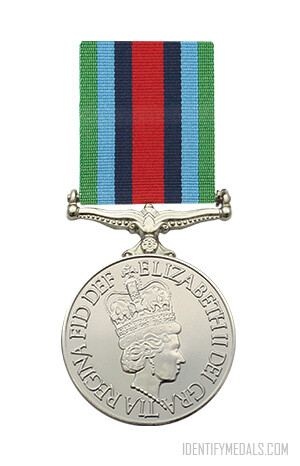
The medal is circular, struck in nickel-silver and manufactured by Worcestershire Medal Service. It measures  36mm diameter and is suspended from a ribbon by way of a swivel straight bar.

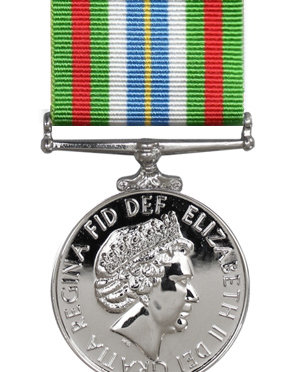
The obverse was designed by Ian Rank-Broadley, has the legend “ELIZABETH II DEI GRATIA REGINA FID.DEF.” and the effigy of Elizabeth II wearing the Girls of Great Britain and Ireland tiara.

The reverse is designed by John Bergdahl, and features a flame on a background depicting the Ebola virus – above this are the words “For Service” and below “West Africa Ebola Epidemic”.

The name of the recipient (name and title if civilian; name, rank and serial number if military) is engraved on the rim of the medal.

The ribbon is a central yellow stripe, flanked by blue and white stripes, and symmetrical red stripes flanked by green stripes either side. These represent the colours from the national flags of the countries in West Africa affected by Ebola.

The Civilian Service Medal (Afghanistan)

The Civilian Service Medal (Afghanistan) is a medal awarded by the British government to civilians (and members of the UK Armed Forces in certain non-combat roles) to recognize service since 19 November 2001 in the transition to democracy in Afghanistan.

The medal can be awarded to:

  • Crown servants, whether recruited in the United Kingdom, Afghanistan or elsewhere;
  • who have served in the geographical territory of Afghanistan on or after 19 November 2001, for 30 days continuously, or 45 days aggregated;
  • No minimum qualifying period for those killed, captured, wounded or disabled during service;
  • The medal was not awarded to those eligible for the Operational Service Medal for Afghanistan.
  • Locally employed civilians were not eligible.

The Civilian Service Medal Design

The Civilian Service Medal (Afghanistan) is circular and measures 36.07 mm in diameter and 4 mm thick. It’s struck in cupro-nickel with a rhodium plating/coating.

On the obverse, the medal has the Ian Rank-Broadley effigy of Queen Elizabeth II with the wording ELIZABETH II DEI GRATIA REGINA FID DEF.

On the reverse, there’s an Afghanistan mountain scene with the word Afghanistan written in Latin and Arabic lettering. The recipient’s name is inscribed on the rim.

  • The medal has a plain, straight suspender. The 32 millimeter-wide ribbon is sand-colored with a broad green central stripe and narrow pale grey stripes towards each edge. The ribbon is the same as for the Iraq Reconstruction Service Medal but with grey, rather than blue thin stripes.

The Iraq Reconstruction Service Medal

Time Period: Post-WW2
Year of Institution: 26 June 2004
Country: Great Britain

The Iraq Reconstruction Service Medal is a British service medal awarded to civilian public servants, contractors and consultants, and to members of the Armed Forces working with British Government Departments, who were either appointed, deployed or employed by Her Majesty’s Government (HMG) to work in Iraq, and who had served at least 40 days. The medal is distributed by the Foreign and Commonwealth Office.

The Iraq Reconstruction Service Medal was not awarded for service that also qualified for the Iraq military (campaign) Medal, although both medals could be awarded for different periods and types of service.

There are no clasps for this medal.

The Iraq Reconstruction Service Medal Design

The medal is circular, made of plated cupro-nickel and produced by the Royal Mint. It measures 36 mm in diameter.

The obverse has the Ian Rank-Broadley effigy of Elizabeth II, with the legend “ELIZABETH II DEI GRATIA REGINA FID.DEF.”

On the reverse are cuneiform symbols which can be roughly translated as “land bringing forth life”, with the stylized depiction of two rivers, based on a relief carving from Mesopotamia in the British Museum. Below is the word “IRAQ”.

The recipient’s name is inscribed on rim of the medal. The ribbon is 32 mm wide and sand-colored with a broad green central stripe and narrow blue stripes towards each edge.

The Iraq Medal

The Iraq Medal is a campaign medal issued to members of the British Armed Forces and certain attached personnel who served between 20 January 2003 and 22 May 2011 on, or in support of, Operation Telic.

The Iraq Medal is a campaign medal issued to members of the British Armed Forces and certain attached personnel who served between 20 January 2003 and 22 May 2011 on, or in support of, Operation Telic – the designation for British operations during the 2003 Invasion of Iraq and its aftermath. It was authorized on 23 February 2004.

The medal was awarded to those meeting the qualifying period of service within the defined operational area. Eligibility was extensive, and included both Regular and Reserve members of the armed forces, foreign and Commonwealth exchange and attached forces, Ministry of Defence civilians, members of the Royal Fleet Auxiliary and embedded journalists.

The medal was awarded with the clasp “19 Mar to 28 Apr 2003″ to British service and attached personnel who:

  • served in Zone 1 (Iraq) between 19 March and 28 April 2003, and:
  • completed seven days continuous service; or
  • served as aircrew flying into Iraq and who completed two or more operational sorties.

A silver rosette denotes the clasp when worn on the ribbon bar.

The Iraq Medal Design

The Iraq Medal is made of cupro-nickel and measures 36 millimeters (1.4 in) in diameter.

The obverse shows the crowned effigy of Queen Elizabeth II facing right, with the inscription ELIZABETH II DEI GRATIA REGINA FID DEF. The reverse shows an image of a Lamassu (an ancient Assyrian statue) above the word IRAQ.

The ribbon measures 32 millimeter (1.25 in) wide and is sand color with three narrow central stripes of black, white, red representing the Iraqi flag.

Find This Medal

Right Now on eBay 
Clicking a link to eBay may result in a referral commission being paid if a purchase is made.
Loading...

The OSM for the Democratic Republic of Congo

The Operational Service Medal for the Democratic Republic of the Congo is a British armed forces campaign medal awarded to military personnel who had served between 14 June and 10 September 2003 on Operation Coral.

The medal with clasp is awarded for 25 days continuous service in Bunia in the Ituri Province of the Congo, or five return operational flights between Entebbe and Bunia, between 14 June and 10 September 2003 on Operation Coral.

The medal was established in 1999 to replace the General Service Medal (1962) for all new operations.  It has been awarded for three separate campaigns:

A DROC clasp awarded with every medal. A silver rosette denotes the clasp when worn on the ribbon bar.

The General Service Medal for Afghanistan Design

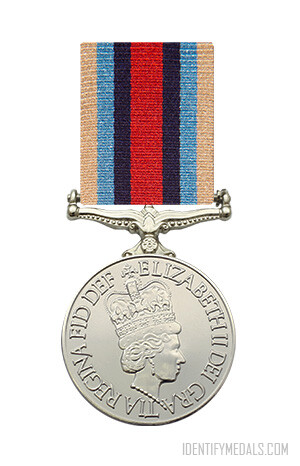
The Operational Service Medal for the Democratic Republic of Congo is struck in silver and circular in shape.

The obverse displays the crowned effigy of Queen Elizabeth II with the inscription ELIZABETH II DEI GRATIA REGINA FID. DEF.

The reverse shows the Union Flag, surrounded by the inscription FOR OPERATIONAL SERVICE and the four major points of the compass with, between the points, four Coronets: Royal (top left), Naval (top right), Mural-Army (bottom left), and Astral-Royal Air Force (bottom right).

The ribbon is a broad central red stripe, flanked each side by a stripe of navy blue and one of light blue, to represent the three services, with an outer stripe of ochre, to represent the Congolese landscape.