The Coast Guard Gold Lifesaving Medal

The Gold Lifesaving Medal is one of the oldest U.S. federal decorations, first authorized by an Act of Congress in 1874 to recognize heroism.

The Gold Lifesaving Medal is one of the oldest U.S. federal decorations, first authorized by an Act of Congress on June 20, 1874 to recognize heroism in saving lives from peril in the water.

Originally administered by the U.S. Life‑Saving Service under the Treasury Department, it became a Coast Guard‑administered award after the Life‑Saving Service merged with the Revenue Cutter Service to form the modern Coast Guard. The current legal authorization comes from Title 14 of the U.S. Code, and the medal continues to be awarded by the Coast Guard today. More than 600 Gold Lifesaving Medals have been issued since its inception.

The Coast Guard Gold Lifesaving Medal Criteria

The Gold Lifesaving Medal is awarded to any person—military or civilian—who rescues or attempts to rescue another person from drowning, shipwreck, or other perils of the water and does so at the risk of their own life, demonstrating extreme and heroic daring. The rescue must occur in waters within the United States or under its jurisdiction, or involve a U.S. citizen or vessel if outside U.S. jurisdiction. Awards may be made posthumously.

The Coast Guard Gold Lifesaving Medal Design

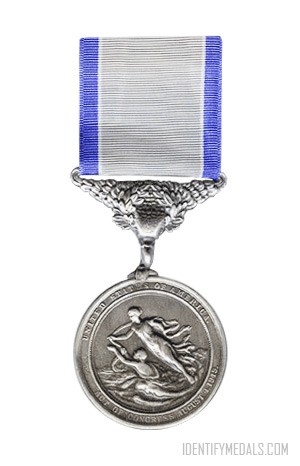
The medal is uniquely struck from pure gold, making it one of the few U.S. decorations made of the precious metal itself. Early versions were large, table‑display pieces; later iterations, dating from the late 19th century onward, were designed to be worn suspended from a ribbon.

The obverse depicts a rescue scene at sea, symbolizing life‑saving action, while the reverse bears inscriptions reflecting its purpose under Act of Congress.

The medal’s ribbon and size were standardized around 1949 to align with other U.S. awards. Subsequent awards are denoted by gold bars inscribed with the recipient’s name.

Buy Coast Guard Medals

Right Now on eBay 
Clicking a link to eBay may result in a referral commission being paid if a purchase is made.
Loading...

The Coast Guard Arctic Service Medal

The Coast Guard Arctic Service Medal was established on May 20, 1976 by the Commandant of the Coast Guard, Admiral Owen W. Siler.

The Coast Guard Arctic Service Medal was established on May 20, 1976 by the Commandant of the Coast Guard, Admiral Owen W. Siler, to recognize Coast Guard personnel who serve in the challenging and unforgiving Arctic region. The medal is awarded retroactively to service dating back to January 1, 1946 for qualifying Arctic duty. It remains a current award within the Coast Guard’s decorations.

The Coast Guard Arctic Service Medal Criteria

This medal is awarded to any member of the United States Coast Guard who completes twenty‑one days of non‑consecutive duty north of the Arctic Circle—either afloat aboard Coast Guard vessels or ashore at designated locations—under competent orders.

Aircrew who fly missions into and out of Arctic areas may also qualify after accumulating twenty‑one qualifying days of service. Eligible duty includes time spent aboard cutters operating in polar waters or at remote stations such as those in Alaska, Greenland, Canada, and Norway. Civilians who support Coast Guard missions in the Arctic may be recommended for the medal as well.

The Coast Guard Arctic Service Medal Design

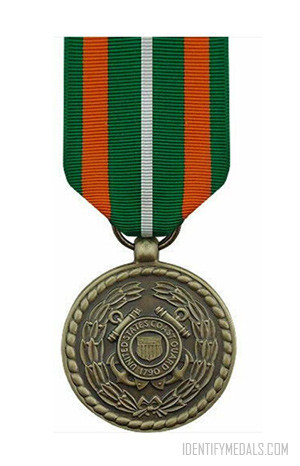
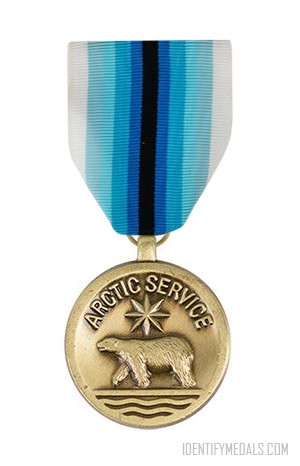
The Coast Guard Arctic Service Medal features a bronze medallion that visually reflects its geographic focus. 

The obverse (front) has a polar bear depicted in profile under an eight‑point star (representing the North Star) with the words “ARCTIC SERVICE” above. The polar bear symbolizes the harsh Arctic environment and the cutter Bear, a historic vessel associated with polar operations. The reverse (back) shows the Coast Guard Shield, signifying the authority and service of the U.S. Coast Guard.

  • Ribbon: The accompanying service ribbon has a distinctive pattern representing Arctic service and is worn on the uniform when the full medal is not displayed.
  • Devices: Although no devices for multiple awards are standard, service stars may be authorized in some cases for subsequent qualifying service.

Buy Coast Guard Medals

Right Now on eBay 
Clicking a link to eBay may result in a referral commission being paid if a purchase is made.
Loading...

The Coast Guard Reserve Good Conduct Medal

The Coast Guard Reserve Good Conduct Medal was created in 1963 as the reserve‑component equivalent of the Coast Guard Good Conduct Medal.

The Coast Guard Reserve Good Conduct Medal was created in 1963 as the reserve‑component equivalent of the active‑duty Coast Guard Good Conduct Medal. It was established to recognize enlisted Coast Guard Reservists who perform their duties with consistent professionalism and good order over an extended period of service.

The Coast Guard Reserve Good Conduct Medal Criteria

The medal is awarded to enlisted members of the U.S. Coast Guard Reserve who complete a standard tour of at least three years of satisfactory service in the Reserve without any disciplinary infractions. Service must be honorable and reflect high standards of conduct and duty performance.

Commissioned officers and warrant officers are not eligible to earn the medal, although they may wear it if they earned it previously while enlisted. Additional awards for subsequent qualifying periods are denoted by service stars worn on the ribbon.

The Coast Guard Reserve Good Conduct Medal Design

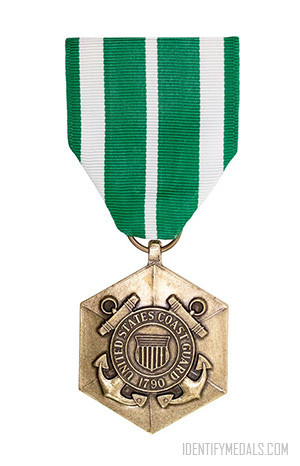
The reserve versions of the Good Conduct medals generally follow the pattern of the active‑duty versions but bear wording that reflects Reserve service.

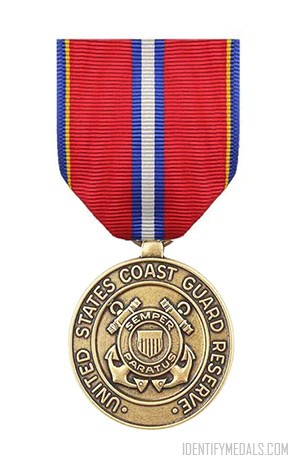
For the Coast Guard Reserve version, the medal includes imagery associated with the Coast Guard (such as the service seal) and the inscription “United States Coast Guard Reserve.”

The ribbon has distinctive striping that differentiates it from other branches’ reserve good‑conduct ribbons. Subsequent awards are indicated by service stars on the ribbon.

Buy Coast Guard Medals

Right Now on eBay 
Clicking a link to eBay may result in a referral commission being paid if a purchase is made.
Loading...

The Coast Guard Good Conduct Medal

The Good Conduct Medal is one of the oldest awards in the U.S. military and has been adopted by each branch of the armed forces.

The Good Conduct Medal is one of the oldest awards in the U.S. military and has been adopted by each branch of the armed forces at different times. The U.S. Navy first introduced its version in 1869, followed by the Marine Corps in 1896, the Coast Guard in 1923, the Army in 1941, the Air Force in 1963, and, most recently, the Space Force in 2023.

The Coast Guard Good Conduct Medal was established in 1923 to recognize enlisted personnel for honorable, faithful, and exemplary service. It is one of the oldest Coast Guard-specific awards and reflects the service’s emphasis on discipline, professionalism, and dedication. Over the decades, it has honored countless Coast Guardsmen who have consistently demonstrated integrity and reliability in carrying out their duties.

The Coast Guard Good Conduct Medal Criteria

The medal is awarded to enlisted members of the Coast Guard who demonstrate:

  • Exemplary behavior, efficiency, and fidelity during a period of service.
  • A standard qualifying period of three continuous years of active service without any disciplinary actions, such as courts-martial or non-judicial punishments.
  • Shorter qualifying periods (often one year) may apply during wartime or national emergencies.
  • Additional awards are denoted by devices (typically bronze or silver stars) added to the ribbon for each subsequent period of qualifying service.

The Coast Guard Good Conduct Medal Design

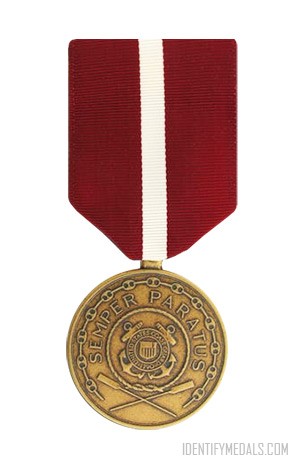
The Coast Guard Good Conduct Medal’s design closely mirrors the Navy’s version but incorporates distinct Coast Guard symbolism. The obverse (front) features a Coast Guard cutter, often depicted with rope and chain edging, symbolizing the maritime mission of the service. The reverse (back) typically bears the inscription honoring faithful and exemplary service.

The medal visually represents the Coast Guard’s values of discipline, loyalty, and “Semper Paratus” (Always Ready) while celebrating sustained, honorable service by enlisted personnel.

  • Ribbon: Primarily red with white stripes, reflecting the traditional colors associated with long-standing honorable service.
  • Devices: Bronze or silver stars indicate subsequent awards for additional qualifying service periods.

Buy Coast Guard Medals

Right Now on eBay 
Clicking a link to eBay may result in a referral commission being paid if a purchase is made.
Loading...

The Coast Guard Medal

The Coast Guard Medal is a distinguished U.S. military decoration awarded for heroism not involving direct conflict with an enemy.

The Coast Guard Medal is a distinguished U.S. military decoration awarded to members of the United States Coast Guard (and other Armed Forces personnel serving with the Coast Guard) for heroism not involving direct conflict with an enemy. It recognizes voluntary acts of outstanding bravery performed in the face of great personal danger, where the individual’s actions go far beyond what is normally expected.

Authorized by Congress on August 4, 1949, the medal was first presented in March 1958 for the heroic rescue of workers trapped in a tunnel beneath Lake Ontario. It ranks above the Bronze Star, and is considered equivalent to the Soldier’s Medal (Army), Navy and Marine Corps Medal, and Airman’s Medal in the other U.S. services.

Recipients of the Coast Guard Medal have included individuals whose voluntary acts of courage saved lives under extreme conditions, such as perilous sea rescues or other hazardous situations.

The Coast Guard Medal Design

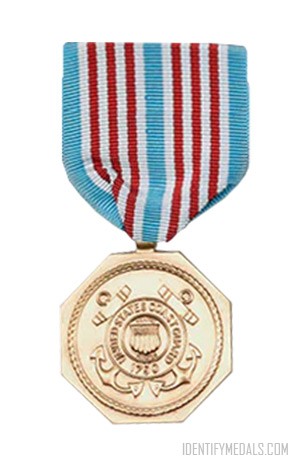
Overall, the design combines maritime imagery with traditional U.S. military award symbolism, visually honoring exceptional leadership and service at the highest levels of responsibility.

Buy Coast Guard Medals

Right Now on eBay 
Clicking a link to eBay may result in a referral commission being paid if a purchase is made.
Loading...

The Coast Guard Distinguished Service Medal

The Coast Guard Distinguished Service Medal (CGDSM) is one of the premier awards of the United States Coast Guard.

The Coast Guard Distinguished Service Medal (CGDSM) is one of the premier awards of the United States Coast Guard. It was established by Act of Congress on August 4, 1949 to recognize Coast Guard personnel for exceptionally meritorious service in roles of great responsibility.

Before its creation, Coast Guardsmen were eligible for the Navy Distinguished Service Medal. The first award was not issued until 1961, and the medal continues to be presented today. The award authority is the Secretary of Homeland Security.

The Coast Guard Distinguished Service Medal Criteria

This medal is awarded to members of the Coast Guard who distinguish themselves through exceptionally meritorious service to the United States Government while performing duties of great responsibility.

The level of performance must be clearly above what is normally expected and have a significant impact on the success of a major command, operation, or project. Although typically bestowed upon senior leaders such as flag officers, it can be awarded to any service member—or even members of other U.S. uniformed services—who meets the eligibility standards while serving with or supporting the Coast Guard. 

The Coast Guard Distinguished Service Medal Design

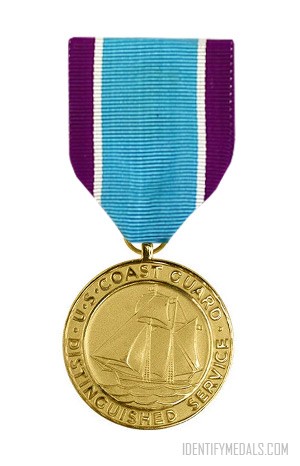
The medal itself is a distinguished bronze decoration. On the obverse is a depiction of a sailing ship encircled by the inscription “U.S. Coast Guard Distinguished Service,” symbolizing the maritime heritage of the service. The accompanying ribbon features a field of blue with white and purple stripes, colors traditionally associated with high‑order service medals. Additional awards of the CGDSM are denoted by small gold stars worn on the ribbon.

Buy Coast Guard Medals

Right Now on eBay 
Clicking a link to eBay may result in a referral commission being paid if a purchase is made.
Loading...

The Coast Guard Cross

The Coast Guard Cross is the United States Coast Guard’s second-highest military decoration, awarded for extraordinary heroism in combat.

The Coast Guard Cross is the United States Coast Guard’s second-highest military decoration, awarded for extraordinary heroism in combat while serving with the Coast Guard when it is not operating under the Department of the Navy. It was established by Act of Congress on October 15, 2010 and is intended to recognize acts of valor that are above and beyond what would merit lesser awards, but not at the level of the Medal of Honor.

Although it is approved and listed in Coast Guard awards regulations, the Coast Guard Cross has not yet been awarded to anyone, making it one of the rarest U.S. military decorations.

In the hierarchy of U.S. military awards, the Coast Guard Cross sits just below the Medal of Honor and is equivalent in stature to the Army’s Distinguished Service Cross, the Navy Cross, and the Air and Space Forces Cross.

The Coast Guard Cross Medal Criteria

  • While participating in combat against an enemy of the United States.
  • While taking part in military operations involving hostilities with a foreign opposing force or an international terrorist organization.
  • While serving alongside allied foreign forces in an armed conflict against an opposing armed force, even if the United States itself is not a direct participant.

The Coast Guard Cross Medal Design

The design features a gold four-armed cross with maritime symbols—including anchors, crossed oars, and a central shield reminiscent of the U.S. Great Seal—suspended from a ribbon of navy blue with scarlet and ultramarine accents. The reverse bears the inscription “FOR VALOR.”

Buy Coast Guard Medals

Right Now on eBay 
Clicking a link to eBay may result in a referral commission being paid if a purchase is made.
Loading...

All the Medals of the United States Coast Guard

The United States Coast Guard’s medals tell the story of courage, dedication, and service across sea and shore. Explores every one of them.

The United States Coast Guard’s medals tell the story of courage, dedication, and service across sea and shore. This article explores every Coast Guard medal, highlighting the history, purpose, and acts of valor or achievement they represent, and honoring the men and women who have earned them.

Beyond their physical design, Coast Guard medals reflect the service’s wide-ranging missions and demanding responsibilities. From lifesaving rescues in dangerous seas to enforcing maritime law and defending national security, each award recognizes the commitment and sacrifice required to protect the nation’s waterways. Together, these medals form a visual record of the Coast Guard’s legacy and the extraordinary individuals who uphold its tradition of service.

About the US Coast Guard and Its Medals

The United States Coast Guard is a unique branch of the U.S. Armed Forces with a broad range of missions that protect the nation’s maritime interests. Operating under the Department of Homeland Security during peacetime—and the Navy during wartime—the Coast Guard serves as both a military service and a federal law enforcement agency.

Its core functions include search and rescue, maritime law enforcement, and environmental protection. Coast Guard crews save thousands of lives each year by responding to emergencies at sea, enforcing laws against smuggling and illegal fishing, and protecting U.S. ports and waterways. The service also plays a vital role in marine safety by inspecting commercial vessels, maintaining navigational aids, and ensuring safe shipping routes. In addition, the Coast Guard safeguards the marine environment by responding to oil spills and hazardous material incidents.

Order of Precedence of the Coast Guard Medals

In the U.S. Coast Guard, medals and ribbons are worn in a defined order of precedence that reflects the relative importance of each award.

At the very top of the hierarchy sits the Medal of Honor, followed by the Coast Guard’s own service cross, the Coast Guard Cross, and then the equivalent heroism or distinguished service awards from other services and federal departments. Next in precedence are high-level service medals, including distinguished service medals from Homeland Security and Transportation as well as the Coast Guard Distinguished Service Medal, followed by combat and valor awards such as the Silver Star and other decorations for heroism and achievement. Lower in the order come commendation and achievement medals, service and conduct awards, and then unit citations.

1. Personal Awards and Decorations of the Coast Guard

Personal Awards and Decorations recognize individual acts of heroism, exceptional service, and professional achievement within the United States Coast Guard. These honors are awarded to Coast Guard members whose actions go above and beyond the normal expectations of duty, often in demanding and dangerous conditions.

From the Coast Guard Cross—the service’s highest award for valor—to the Coast Guard Achievement Medal, each decoration reflects a distinct level of courage, leadership, and dedication. Together, these awards highlight the personal sacrifices and outstanding contributions made by Coast Guardsmen in service to the nation, whether in moments of extraordinary bravery or sustained excellence in performance.

The Coast Guard Medal - USA Medals Post-WW2

The Coast Guard Medal

The Coast Guard Medal is a distinguished U.S. military decoration awarded for heroism not involving direct conflict with an enemy.

The Coast Guard Cross - Obverse.

The Coast Guard Cross

The Coast Guard Cross is the United States Coast Guard’s second-highest military decoration, awarded for extraordinary heroism in combat.

2. Coast Guard Good Conduct and Service Medals

Coast Guard Good Conduct and Service Medals recognize honorable service, professionalism, and commitment over time rather than individual acts of heroism. These awards honor members who consistently demonstrate integrity, discipline, and dedication while fulfilling the Coast Guard’s diverse missions.

From the Coast Guard Good Conduct Medal and its Reserve counterpart to the Coast Guard Arctic Service Medal, each decoration acknowledges sustained service under specific conditions or in unique environments. Together, these medals reflect the importance of reliability, perseverance, and long-term contribution to the success of the Coast Guard and its operations worldwide.

3. Coast Guard Lifesaving Medals

Coast Guard Lifesaving Medals honor extraordinary acts of bravery in the rescue of others from peril at sea or on navigable waters. These prestigious awards recognize individuals who risk their own lives to save others in situations of extreme danger, reflecting the Coast Guard’s longstanding lifesaving tradition.

The Gold and Silver Lifesaving Medals represent the highest recognition for lifesaving heroism, with each awarded based on the level of risk and gallantry displayed during the rescue.

Together, they stand as powerful symbols of selflessness, courage, and the unwavering commitment to saving lives.

4. Coast Guard Unit Awards

Unit Awards recognize the collective achievements of Coast Guard commands or units rather than individual actions. These awards honor teams that demonstrate exceptional performance in missions such as search and rescue, law enforcement, disaster response, or operational excellence.

Examples include the Presidential Unit Citation, Coast Guard Unit Commendation, and Coast Guard Meritorious Unit Commendation. Unit awards are worn by all members assigned to the unit during the period of eligibility and reflect the shared dedication, teamwork, and effectiveness of the unit as a whole. The full list is as follows:

Coast Guard Presidential Unit Citation

DHS Outstanding Unit Award

Coast Guard Unit Commendation

Coast Guard Meritorious Unit Commendation

Meritorious Team Commendation

Coast Guard “E” Ribbon

5. Coast Guard Ribbons

Ribbons are streamlined representations of medals or commendations worn on uniforms for daily duty, allowing quick recognition of achievements without wearing full-size medals. They include awards for personal service, campaign participation, humanitarian operations, or other distinctions that may not carry a full medal.

Some notable examples include the Coast Guard Sea Service Ribbon, Coast Guard Overseas Service Ribbon, and the Coast Guard Special Operations Service Ribbon. Ribbons often come in a distinctive color pattern that symbolizes the award’s purpose or historical significance.

Commandant’s Letter of Commendation Ribbon
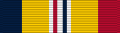
Coast Guard Combat Action Ribbon

Enlisted Person of the Year Ribbon
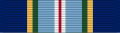
Special Operations Service Ribbon

Coast Guard Sea Service Ribbon

Restricted Duty Ribbon

Coast Guard Overseas Service Ribbon

Coast Guard Basic Training Honor Graduate Ribbon

Coast Guard Recruiting Service Ribbon
6. Coast Guard Marksmanship Awards/Medals

Marksmanship Awards recognize Coast Guard personnel who demonstrate superior skill with firearms, including rifles and pistols, during qualification or competitive shooting events. These awards highlight proficiency, safety, and professionalism in the use of service weapons.

Examples include the Coast Guard Rifle Marksmanship Medal and the Coast Guard Pistol Marksmanship Medal, as well as ribbons for expert and sharpshooter qualifications. Earning these awards reflects both individual skill and commitment to maintaining operational readiness.

  • Coast Guard Distinguished Marksman Award/Badge
  • Coast Guard Distinguished Pistol Shot Award/Badge
  • Coast Guard Rifleman Excellence-In-Competition Award/Badge
  • Coast Guard Pistol Shot Excellence-In-Competition Award/Badge
  • President’s Hundred Tab
  • Coast Guard Expert Rifleman Medal
  • Coast Guard Expert Pistol Shot Medal
  • Coast Guard Rifle Sharpshooter Ribbon
  • Coast Guard Pistol Sharpshooter Ribbon
  • Coast Guard Rifle Marksmanship Ribbon
  • Coast Guard Pistol Marksmanship Ribbon

The Mongolian Order of the Red Banner

The Order of the Red Banner is a Mongolian military decoration originally established as the “Order for Military Merit” in 1926.

  • Time Period: Interwar
  • Institution: 1926 (as “The Order of Military Valour”, renamed to “The Order of the Red Banner in 1931)
  • Country: Mongolia

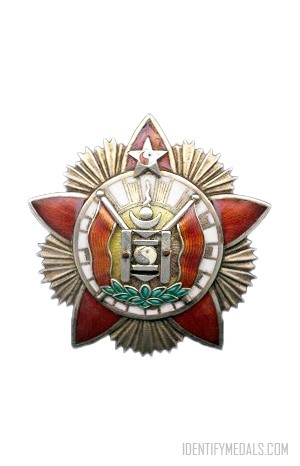
The Order of the Red Banner (Цэргийн гавьяаны улаан туг одон) is a military decoration of the Mongolian People’s Republic, first established in 1926 as the Order for Military Merit. It was created to recognize heroism in combat and distinguished service contributing to Mongolia’s defense and strengthening its armed forces.

The award could be given to Mongolian and foreign citizens, as well as military units, formations, schools, and institutions, reflecting Mongolia’s recognition of both individual and collective contributions to its military efforts. Over time the Order’s name and design evolved: it was simplified to the Order of the Red Banner in 1945, and in 1993 became known as the Order of the Red Banner for Military Valor (or Military Merit). The medallion design has been changed several times across different versions produced between 1926 and later decades. Around 10,000 awards were made over the years, and the Order remained an important part of Mongolia’s honors system.

The Order of the Red Banner Medal Design

The obverse of the Order of the Red Banner has varied with different production types, but core elements remain consistent with its military and symbolic themes. There are five different designs with four sub-variants for the 1940 and 1945 versions (which have four classes each).

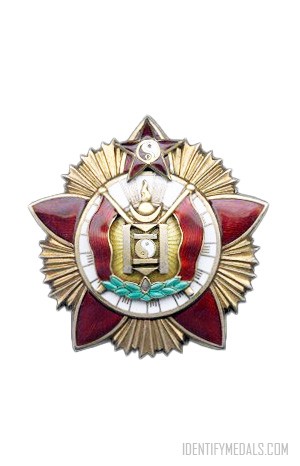
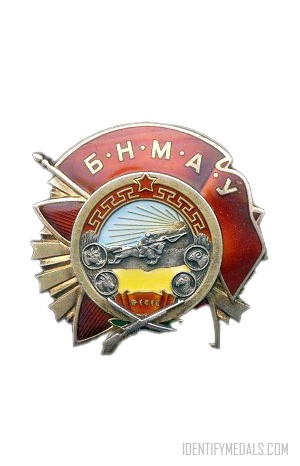
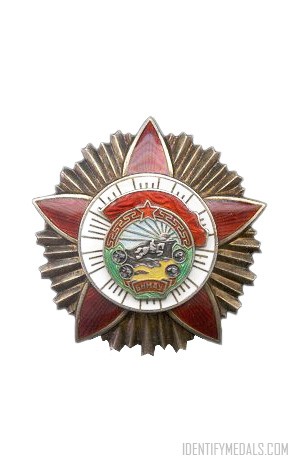
Order of the Red Banner of Military Valour - 1926 Version.
Order of the Red Banner of Military Valour - 1931 Version.
Order of the Red Banner of Military Valour - 1940 Version.
Order of the Red Banner of Military Valour - 1945 Version.

The badge is star-shaped with a prominent central motif and radiating rays — often with enamel and metallic finishes that give the Order a rich, layered appearance. Among earlier types, the central area frequently included a circular enamelled medallion depicting iconic imagery such as a rider on horseback and other figures or state symbols, framed by ornamental details.

Many versions feature a red enamel banner across the top portion of the star; in some examples this banner bears Mongolian Cyrillic initials like БНМАУ (abbreviation for People’s Republic of Mongolia), underscoring the award’s national identity.  The star’s rays and elements are often finished in gilt metal with colored enamels (red, white, yellow, blue and green), giving the insignia distinctive visual contrast. 

Design details changed over the decades — for example the pattern of enamel, the style of the central medallion, and how the banner and motifs were integrated — but the overall form remained recognizably a radiant star with bold military symbolism.

The Order of the Precious Wand

The Order of the Precious Wand was instituted in 1913 (reinstituted 1991) for strengthening democracy and cooperation with Mongolia.

The Order of the Precious Wand, also known as the Order of the Vajra or the Order of the Precious Rod, is a Mongolian state decoration first instituted in 1913 during the era of the Bogd Khanate of Mongolia. Its creation was inspired by Mongolian leaders’ desire to establish a national honours system on the model of Russian imperial awards after Mongolia began asserting independence from Qing China. The first versions were ordered in St. Petersburg and featured multiple classes within three degrees, intended for Mongolian nobles, officials, and foreign dignitaries — especially Russians — as a symbol of diplomatic respect and alliance.

After the Mongolian Revolution of 1921, which overthrew the Bogd Khanate and ushered in a communist government, the original order was abolished as a feudal relic, though some awards were still bestowed briefly during the early revolutionary period.

In 1991, following Mongolia’s democratic transition, the Order of the Precious Wand was re-established as a contemporary state decoration with three degrees but without the older class distinctions. Today it is awarded primarily to foreign statesmen and individuals who have made significant contributions to strengthening democracy and cooperation with Mongolia. Until the establishment of the Order of Chinggis Khaan in 2002, it was once again Mongolia’s highest state award.

The Order of the Precious Wand Medal Design

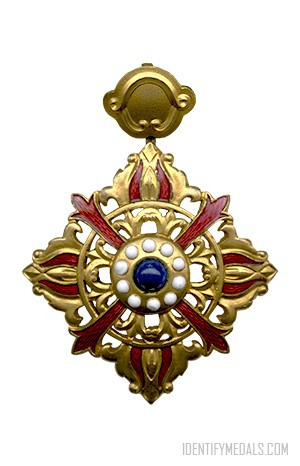
The obverse (front) of earlier versions of the Order of the Precious Wand — particularly the pre-1921 badges — typically featured a central vajra (precious rod or thunderbolt) motif, which in Buddhist symbolism represents indestructibility and spiritual power. Embedded gems or enamel highlighted the vajra and surrounding ornamentation, with gilt metalwork creating a distinguished, radiant badge reflecting the order’s high prestige. These badges were often crafted in multiple classes with differing decorations, colors and metals to indicate rank within the order. 

Modern re-established versions reflect updated state symbolism but preserve the historic emphasis on the vajra/rod motif as the focal point of the obverse. Because current official descriptions do not detail each design element on Wikipedia, visual references from medal collectors are typically used to understand the medallion’s front — which combines traditional emblems with refined metallic and enamel finishes fitting a top diplomatic award.