The Order of Merit (Saudi Arabia)

The Order of Merit was instituted by the Kingdom of Saudi Arabia in 1971 and is awarded for outstanding service. It has three classes.

The Order of Merit (ميدالية الاستحقاق) was established on 20th or 21st March 1971 by King Faisal idn Abdulaziz by Council of Minister Decisions of the Kingdom of Saudi Arabia.

The medal is awarded to civilians for outstanding service and exists in three classes. All initial appointments are for the Third (III) Class, with higher ones being achieved by promotion. 

The Order of Merit Medal Design

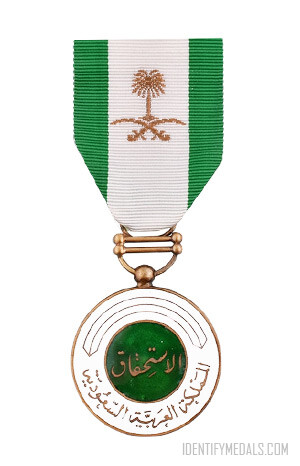
The Order of Merit is circular and measures 35 mm wide. In the obverse is the inscription “Kingdom of Saudi Arabia”.

The ribbon has outer green stripes and a central larger white stripe. The medal in I Class is struck in gold.
The Presidential Unit Citation Award (PUC)

The Presidential Unit Citation or PUC was created by President Franklin D. Roosevelt on 26 February 1942 and awarded in various conflicts.

Time Period: Second World War, Post-WW2
Institution: 1941
Country: United States
 

The Presidential Unit Citation (or PUC) is a military award presented to units of the United States Armed Forces and those of allied countries for extraordinary heroism in action against an armed enemy.

It is one of the highest unit awards that can be bestowed upon a military organization and is considered a significant honor.

The PUC is awarded by the President of the United States in the name of the U.S. Congress. It is typically conferred upon units that have demonstrated exceptional gallantry, determination, and proficiency in combat operations, often under extremely challenging and hazardous conditions.

The Presidential Unit Citation Ribbon Designs

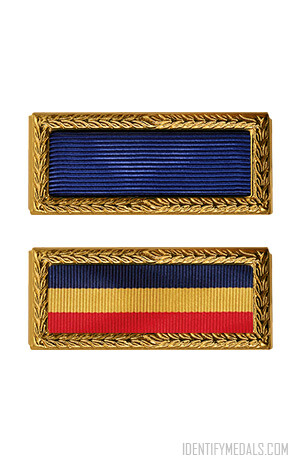
There are several variations of the Presidential Unit Citation, each denoted by a different ribbon or emblem. Recipients of the PUC are authorized to wear the appropriate ribbon or emblem on their uniforms as a symbol of their unit’s extraordinary achievements.

The variations are:

  1. Army Presidential Unit Citation: Awarded to U.S. Army units for extraordinary heroism in action against an armed enemy.

  2. Navy Presidential Unit Citation: Awarded to U.S. Navy units, Marine Corps units, and Coast Guard units when operating under the control of the Department of the Navy for extraordinary heroism in action against an armed enemy.

  3. Air Force Presidential Unit Citation: Awarded to U.S. Air Force units for extraordinary heroism in action against an armed enemy.

  4. Joint Meritorious Unit Award: Awarded to joint units of the U.S. Armed Forces for outstanding meritorious achievement or service in support of combat operations.

  5. Navy Unit Commendation: Awarded to U.S. Navy units, Marine Corps units, and Coast Guard units when operating under the control of the Department of the Navy for outstanding heroism in action against an armed enemy.

The Presidential Unit Citation Submarine Clasps

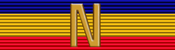
The Presidential Unit Citation Clasps are small emblems or devices worn on the ribbon of the Presidential Unit Citation to denote additional awards or significant achievements by a unit. The USS Nautilus (SSN-571) and USS Triton (SSRN-586) are two submarines that received the Presidential Unit Citation for their historic achievements.

The USS Nautilus (SSN-571) Clasp

Presidential Unit Citation - USS Nautilus (SSN-571) Clasp

The USS Nautilus was the world’s first operational nuclear-powered submarine and made history by completing the first submerged voyage to the North Pole in 1958. This groundbreaking achievement demonstrated the capabilities of nuclear propulsion in submarines and significantly advanced naval technology. As a result of this historic feat, the USS Nautilus was awarded the Presidential Unit Citation for extraordinary heroism and achievement.

The USS Triton (SSRN-586) Clasp

The USS Triton was another nuclear-powered submarine that made history by completing the first submerged circumnavigation of the Earth in 1960. This unprecedented voyage demonstrated the endurance and capabilities of nuclear-powered submarines and provided valuable data for future naval operations. In recognition of this remarkable achievement, the USS Triton was awarded the Presidential Unit Citation.

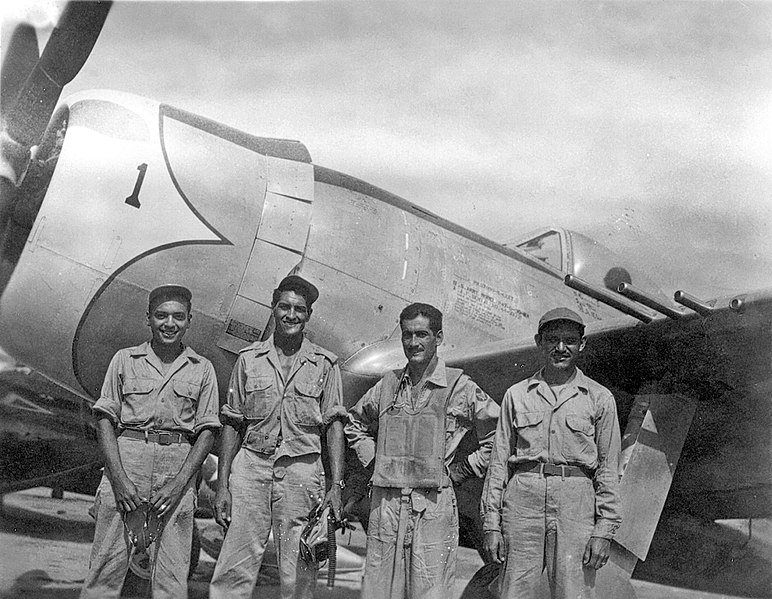
The 201st Fighter Squadron or Mexican Aztec Eagles

The 201st Fighter Squadron, also known as the Escuadrón 201 or the “Aztec Eagles,” received several medals for their service during WW2.

The 201st Fighter Squadron earned a reputation for its skill, bravery, and effectiveness in combat, earning several medals and awards for their contributions during World War II. After the war, the squadron returned to Mexico as heroes, and their service remains a source of pride for the Mexican Air Force and the nation as a whole. 

Delving into the remarkable history of the Aztec Eagles, this article will provide a comprehensive overview of this little-known chapter of World War II – shedding light on their contributions to the Allied victory and their lasting impact on Mexican military history. 

What Was The 201st Fighter Squadron?

The 201st Fighter Squadron, also known as the Escuadrón 201 or the “Aztec Eagles,” was a military unit formed by the Mexican government during World War II. It was part of the Mexican Expeditionary Air Force (Fuerza Aérea Expedicionaria Mexicana) and was composed of volunteer pilots and support personnel from the Mexican Air Force.

The squadron was established in 1944 with the primary objective of providing air support to Allied forces in the Italian Campaign. The Aztec Eagles flew combat missions alongside Allied air forces, conducting ground attack missions, reconnaissance, and escort missions over enemy territory.

The Aztec Eagles' Composition

The squadron was composed of volunteer pilots and support personnel from the Mexican Air Force who were eager to contribute to the Allied war effort. 

The composition of the Aztec Eagles reflected the diversity and dedication of the Mexican personnel who served in the unit. It included skilled pilots who underwent rigorous training to prepare for combat missions in the European theater. These pilots came from various backgrounds and regions of Mexico, united by their commitment to serve their country and support the Allies.

In addition to the pilots, the squadron included ground crew and support staff who played essential roles in maintaining aircraft, preparing for missions, and providing logistical support. These individuals worked tirelessly behind the scenes to ensure the success of the squadron’s operations.

The Medals Awarded to The 201st Fighter Squadron

The 201st Fighter Squadron or “Aztec Eagles” received several medals and awards for their service during World War II. For instance:

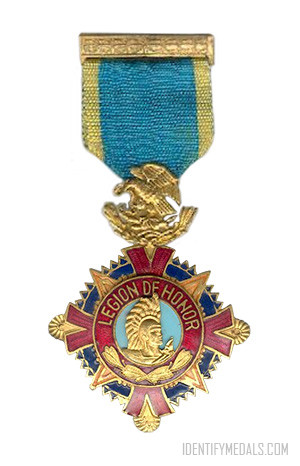
Mexican Legion of Honor

The Mexican Legion of Honor (Legión de Honor Mexicana) was a prestigious military award bestowed by the Mexican government to recognize exceptional acts of valor and service during times of war. Established in 1863, the Legion of Honor played a significant role in honoring Mexican military personnel for their bravery and sacrifice in defense of their country.

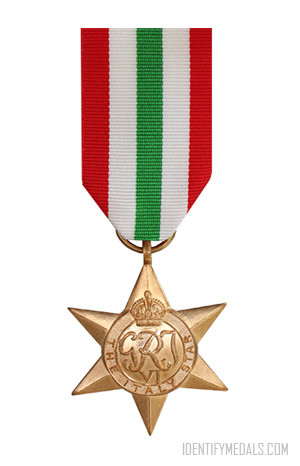
Italy Star

The Italy Star was a military campaign medal awarded by the British Commonwealth to personnel who served in Italy, Sicily, Greece, Yugoslavia, Sardinia, and Corsica during World War II. It was instituted in 1945 to recognize the significant contributions and sacrifices made by Allied forces in the Mediterranean and Italian theaters of operations.

Conclusion

Despite facing logistical and operational challenges, the squadron operated with professionalism and determination, earning respect and admiration for their contributions to the Allied cause.

Overall, the Aztec Eagles’ composition embodied the courage, skill, and unity of purpose that characterized the Mexican Expeditionary Air Force during World War II. Their service remains a testament to Mexico’s commitment to international cooperation and the defense of freedom and democracy during a pivotal moment in history.

The Process of Denazification And Its Impact on German Medals

After World War II, the Allies quickly set to rid German and Austrian society and culture of the Nazi ideology. Awards and medals, too.

After World War II, the Allies quickly set to rid German and Austrian society and culture of the Nazi ideology. Awards and medals, too. This process had several key components, including the division of Germany into four occupation zones (each controlled by one of the allied powers), the removal of nazi symbols, and the disbanding of nazi organizations. This included, of course, the redesign of many German medals and awards.

In this article, we will delve into the five most expensive military medals and awards from Nazi Germany / Third Reich Germany and explain why they these WW2 badges and awards tend to sell for much more than your usual medal at auction. All public displays of Nazi symbols, such as swastikas and flags, were banned in Germany after WW2. Nazi propaganda materials were confiscated and destroyed, too. As the Allies worked to establish democratic institutions in Germany, including a new constitution, free elections, and the rule of law, here’s how things changed for the country’s insignia.

Reshaping Post-War Germany Medals

Denazification, the process of purging Nazi ideology, organizations, and individuals from German society after World War II, played a significant role in reshaping post-war Germany. Alongside the removal of Nazi symbols and the dismantling of Nazi institutions, and as we mentioned above, denazification also had an impact on German medals and awards.

One key aspect of denazification was the transformation of existing German medals and the creation of new ones to reflect the values of democracy and human rights, rather than the Nazi ideology. This was especially important as medals and awards had been used by the Nazi regime for propaganda and to honor individuals who promoted Nazi principles.

Here are some ways denazification influenced German medals:

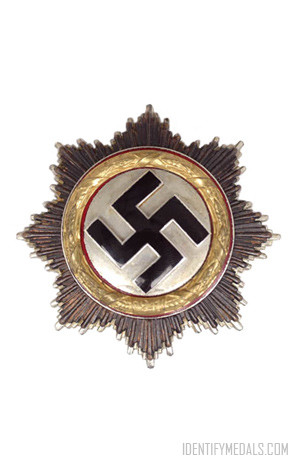
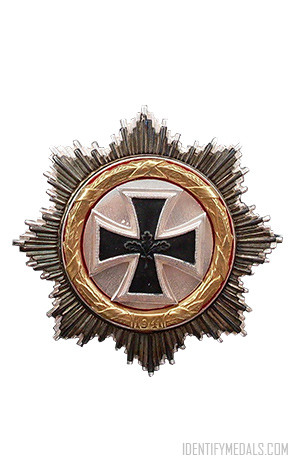
  1. Reevaluation of Existing Medals: Many pre-existing German medals were reevaluated to determine if their namesakes or the reasons for their award were associated with Nazi crimes or propaganda. Those found to have Nazi connections were often discontinued or renamed to reflect their historical significance rather than their Nazi connotations. For example, the German Cross‘ design replaced the central swastica for the iron cross.

  2. Introduction of New Medals: New medals and awards were introduced to honor individuals and organizations who contributed to the reconstruction of Germany and the promotion of democratic values. For example, the Order of Merit of the Federal Republic of Germany (Bundesverdienstkreuz) was established in 1951 to recognize outstanding contributions to society, science, art, and politics.

  3. Changes in Design: The designs of some existing medals were altered to remove Nazi symbolism or references. This included modifications to the Iron Cross and other military medals to ensure they represented the post-war democratic Germany.

  4. Criteria for Awards: The criteria for receiving medals were also adjusted to reflect democratic values. Medals were awarded not just for military valor but also for contributions to society, culture, and humanitarian efforts in line with the new democratic principles.

  5. Educational and Cultural Promotion: Some medals and awards were linked to educational and cultural programs aimed at promoting democracy and human rights. This was a way to use medals as tools for cultural and ideological transformation.

  6. Military Medals: In the case of military medals, their design and criteria were adapted to honor not only military valor but also service to the new democratic Germany and international peacekeeping efforts.

Denazification, therefore, extended to the realm of medals and awards, reflecting the broader effort to redefine Germany’s national identity, values, and societal norms after the defeat of the Nazi regime. By adapting and creating new medals that celebrated democratic principles, Germany sought to distance itself from its Nazi past and build a more inclusive and democratic future.

Nazi Germany Medals and Awards: The German Cross
The German Cross during the Third Reich regime (WW2). Obverse.
Post-WW2 Medals and Awards: The German Cross
The "denazified" German Cross after World War II. Obverse.

Find German Medals Online

Right Now on eBay 
Clicking a link to eBay may result in a referral commission being paid if a purchase is made.
Loading...
]

The New Zealand Suffrage Centennial Medal 1993

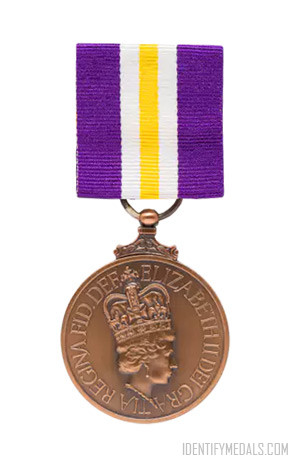
The New Zealand Suffrage Centennial Medal was established on 1 July 1993 to commemorate Women’s suffrage in New Zealand.

The New Zealand Suffrage Centennial Medal 1993 was officially established through a Royal Warrant on July 1, 1993. Its purpose was to honor and celebrate Women’s suffrage in New Zealand and to acknowledge the substantial contributions made by individuals, both from New Zealand and the Commonwealth, to advance women’s rights and address women’s issues within New Zealand. Notably, this medal was exclusively awarded in the year 1993.

The background of this commemorative medal is closely tied to the achievement of Women’s suffrage in New Zealand, which was realized with the passing of the Electoral Act 1893 on September 19, 1893. To mark the centennial anniversary of this historic event, the medal was created. It aimed to pay tribute to those New Zealanders and other Commonwealth citizens who had made significant and recognizable contributions to women’s rights or women’s issues within New Zealand. In total, the medal was presented to 544 deserving individuals.

The New Zealand Suffrage Centennial Medal 1993 Design

The medal, crafted in bronze with an antique finish, takes on a circular form.

On its obverse it features the crowned effigy of Queen Elizabeth II. Meanwhile, the reverse side of the medal carries the inscription “1893 The New Zealand Suffrage Centennial 1993.” This inscription is elegantly encircled by a combination of a fern frond and a sprig of camellia foliage, culminating in a single flower. These elements are artistically intertwined, their stems crossed and tied together with a graceful bow at the base.

The medal is attached to a ribbon that is 32 mm wide. This ribbon is predominantly purple, with three slim stripes in the center—white, yellow, and white. When worn by a woman, the medal may be elegantly suspended using the ribbon, which can be shaped into a bow for added distinction.

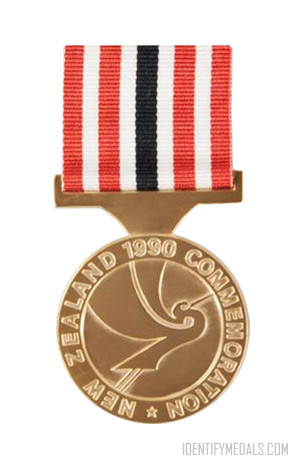
The New Zealand 1990 Commemoration Medal

The New Zealand 1990 Commemoration Medal was awarded in 1990 to celebrate the 150th anniversary of the signing of the Treaty of Waitangi.

The New Zealand 1990 Commemoration Medal, also known as the Sesquicentennial Medal, was established by Queen Elizabeth II through a Royal Warrant on February 9, 1990.

It was specifically intended for award during the year 1990, and around 3,000 individuals were initially chosen to receive it in recognition of their contributions to various aspects of New Zealand life, particularly in connection with the 1990 celebrations. Ultimately, 3,632 medals were conferred.

This medal holds significance as it was issued on the 150th anniversary of the signing of the Treaty of Waitangi on February 6, 1840, by representatives of the British Crown and various Māori chiefs from New Zealand’s North Island.

The New Zealand 1990 Commemoration Medal is an official decoration to be worn on all appropriate occasions. In the order of precedence, it follows Coronation and Jubilee medals but precedes long service decorations and medals. Each recipient is also presented with a certificate bearing the signatures of the Queen, the Governor-General, and the Prime Minister.

The New Zealand 1990 Commemoration Medal Design

The New Zealand 1990 Commemoration Medal is a gilt metal, circular in shape.

On the obverse, it bears the Effigy of the Sovereign surrounded by the inscription “ELIZABETH II • QUEEN OF NEW ZEALAND”. On the reverse is the official 1990 Symbol (a stylized Kotuku, White Heron) and the inscription “NEW ZEALAND 1990 COMMEMORATION”.

The medal is suspended by a ribbon, 32 millimeters in width, consisting of nine narrow stripes of red ochre, white, red ochre, white, black, white, red ochre, white, and red ochre.

Find This Medal

Right Now on eBay 
Clicking a link to eBay may result in a referral commission being paid if a purchase is made.
Loading...

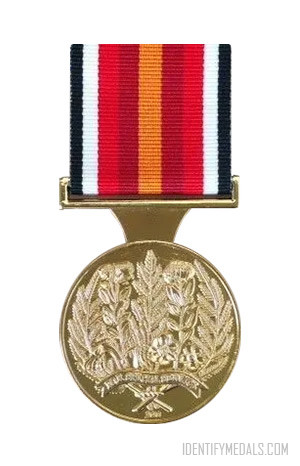
The New Zealand Special Service Medal

The New Zealand Special Service Medal (NZSSM) was established by royal warrant by Elizabeth II in 2002 for military service.

The New Zealand Special Service Medal (NZSSM) was officially instituted by Queen Elizabeth II through a royal warrant on July 23, 2002. This medal is designed to acknowledge military service that wouldn’t typically qualify for a Campaign medal.

The New Zealand Special Service Medal Ribbons

There are three conditions under which the medal is awarded: New Zealand Special Service Medal (Nuclear Testing), New Zealand Special Service Medal (Asian Tsunami), and New Zealand Special Service Medal (Erebus).

New Zealand Special Service Medal (Nuclear Testing)

The NZSSM (Nuclear Testing) is a retrospective honor, established on July 24, 2002, and is bestowed upon individuals who were part of a New Zealand Government mission during atmospheric nuclear tests in the 1950s and one test in 1973.

The tests recognized by this medal were at Maralinga, South Australia, Malden Island, Christmas Island, Nevada Test Site, Enewetak Atoll, and Moruroa.

New Zealand Special Service Medal (Asian Tsunami)

he NZSSM (Asian Tsunami) was created on December 22, 2005, to honor those who helped after the 2004 Indian Ocean earthquake and tsunami.

To earn this medal, you needed to serve for at least 7 days between December 26, 2004, and February 28, 2005, or for at least 14 days from December 26, 2004, to December 26, 2005. This service involved providing relief, helping with recovery, and aiding in reconstruction in countries affected by the tsunami. 

New Zealand Special Service Medal (Erebus)

The NZSSM (Erebus) was created in November 2006 to honor those who served in the aftermath of the Air New Zealand Flight 901 crash on Mount Erebus, Ross Island, Antarctica, on November 28, 1979. Qualifying service includes activities like body recovery, crash investigation, and victim identification.

The New Zealand Special Service Medal Design

The medal is a round one made of gold-plated base metal. On the obverse, there is the New Zealand Coat of Arms, and on the back, there’s a lovely bouquet of native New Zealand flowers, including fern fronds, Pohutukawa, Manuka, Kowhai, and Mount Cook Lily. At the bottom of the bouquet, there’s a scroll that says “FOR SPECIAL SERVICE.

This design is the same for all three medals.

The ribbon is 32 mm wide, and the ribbon’s design can vary depending on the circumstances for which the medal is awarded.

Find This Medal

Right Now on eBay 
Clicking a link to eBay may result in a referral commission being paid if a purchase is made.
Loading...

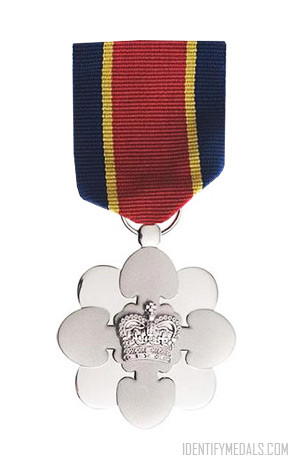
The New Zealand Distinguished Service Decoration

The New Zealand Distinguished Service Decoration (DSD) was instituted as a Royal Honor in 2007 to recognize distinguished military service.

The New Zealand Distinguished Service Decoration (DSD) was established by Royal Warrant in 2007 as a prestigious New Zealand Royal Honor, designed to commend exceptional military service. This decoration recognizes the distinguished contributions of regular, territorial, and reserve members within the New Zealand Defence Force.

Prior to 1995, such commendable service was acknowledged through the presentation of the British Empire Medal (Military Division). However, following the transition to a fully New Zealand Honors system in 1996, these Commonwealth awards were no longer available for recognition of New Zealand military personnel.

The New Zealand Distinguished Service Decoration Eligibility Criteria

The Distinguished Service Decoration is open to all members of the New Zealand Defence Force, as well as uniformed individuals from allied forces operating alongside or in conjunction with New Zealand military units.

It may be conferred for exceptional performance of military duties, whether in warlike or non-warlike operations, or for individual contributions to peacetime and humanitarian efforts that bring significant credit to the New Zealand Defence Force. Such acts must substantially contribute, through unwavering devotion to duty, commitment, discernment, or the application of skills, to the execution of operational deployments, military training, military operations, or the management and execution of projects or activities bearing significant implications for the current or future capabilities of the New Zealand Defence Force.

The Distinguished Service Decoration can be awarded for a singular remarkable achievement or for a cumulative record of extraordinary service rendered over an extended period.

The New Zealand Distinguished Service Decoration Design

The medal, crafted from sterling silver, takes the form of a kotiate, a traditional Māori war club featuring eight blades.

At the heart of the kotiate, on the obverse, one finds the depiction of St Edward’s Crown. The blades are arranged in an alternating pattern of frosted and polished silver.

On the reverse side, you’ll find the inscription “FOR DISTINGUISHED SERVICE,” accompanied by its Māori counterpart, “MO NGA TE MAHI KAHURANGI.

The ribbon adorning the medal is characterized by a dark blue base with a prominent red center stripe flanked by two narrow yellow stripes that separate the red from the blue.

Find This Medal

Right Now on eBay 
Clicking a link to eBay may result in a referral commission being paid if a purchase is made.
Loading...

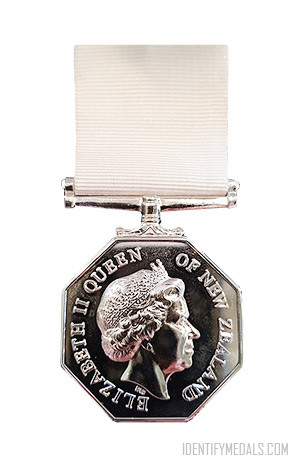
The New Zealand Antarctic Medal

The New Zealand Antarctic Medal was established on 1 September 2006 as a New Zealand royal honor to replace the British Polar Medal.

The New Zealand Antarctic Medal, established on September 1, 2006, as a New Zealand royal honor, was introduced to replace the British Polar Medal (the Polar Medal, initiated in 1904, was bestowed upon individuals who had made significant contributions to polar exploration and knowledge). Recipients of this prestigious award had braved the formidable challenges and hardships posed by polar environments, whether on land, sea, or in the air.

In 1995, the Prime Minister’s Honors Advisory Committee recommended the establishment of the Polar Medal under a New Zealand royal warrant. Simultaneously, they proposed renaming it as “The Antarctic Medal” to better align with New Zealand’s accomplishments and endeavors in Antarctica. On September 1, 2006, Queen Elizabeth II formally instituted the New Zealand Antarctic Medal.

The New Zealand Antarctic Medal is conferred upon New Zealanders and other individuals who, either independently or as part of a New Zealand mission in the Antarctic region, have made exceptional contributions to exploration, scientific research, conservation, environmental protection, or the advancement of knowledge related to Antarctica. Additionally, it may be awarded to those who have supported New Zealand’s objectives or operations in the Antarctic region. Notably, the Medal is not granted for acts of bravery, short-term feats of extreme endurance, long service, or general service in Antarctica.

The New Zealand Antarctic Medal Design

The obverse of the New Zealand Antarctic Medal features Queen Elizabeth II. The ribbon is white. 

Find Antarctic Medals

Right Now on eBay 
Clicking a link to eBay may result in a referral commission being paid if a purchase is made.
Loading...

The New Zealand Queen’s Service Medal

The New Zealand Queen’s Medal is awarded by the government of New Zealand to recognize volunteer service to the community and public service.

The Queen’s Service Medal is a medal bestowed by the New Zealand government to acknowledge and honor volunteer contributions to the community, as well as public service in elected or appointed positions.

This medal was established in 1975 and has a connection to the Queen’s Service Order. The QSM took over the role of the Imperial Service Medal as a New Zealand award.

The New Zealand Queen’s Service Medal Design

There are two versions of the Queen’s Service Medal: 1975-2007 and 2007-present. 

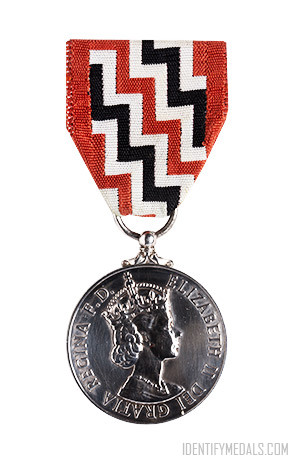
The original medal measured 36 millimeters (1.4 inches) in diameter, was crafted from sterling silver. Its obverse featured the same effigy of Queen Elizabeth II as the Queen’s Service Order badge, encircled by her Royal styles and titles, “ELIZABETH II DEI GRATIA REGINA F.D.” On the reverse, the New Zealand Coat of Arms was displayed, accompanied by the inscription “The Queen’s Service Medal” and the specific sub-division, either “for Community Service” or “for Public Services.” The recipient’s initials and name were engraved on the medal’s rim. These medals were manufactured by the Royal Mint.

The current medal, also composed of sterling silver and measuring 36 mm in diameter, showcases the Ian Rank-Broadley designed effigy of Queen Elizabeth II on its obverse. The effigy is surrounded by her Royal styles and titles, “ELIZABETH II QUEEN OF NEW ZEALAND.” The reverse side features the New Zealand Coat of Arms, bordered by the inscription “The Queen’s Service Medal” above and “for service – MO NGA MAHI NUI” below. 

Both versions of the medal hang from a 36 mm wide ribbon. It has narrow red ochre (kokowhai) stripes along the edges, while the center displays alternating stripes of red ochre, white, and black, forming a descending step pattern from left to right. This design draws inspiration from the Māori Poutama pattern found in Tukutuku wall panels, symbolizing the “stairway to heaven,” although in this context, it represents the “steps of service.”

Find This Medal

Right Now on eBay 
Clicking a link to eBay may result in a referral commission being paid if a purchase is made.
Loading...