The Korean Annexation Commemorative Medal

The Korea Annexation Commemorative Medal was first established in 1912 to commemorate the forced occupation of Korea by Japan.

The Korea Annexation Commemorative Medal was first established in 1912 to commemorate the forced
occupation of Korea by Japan. The Japan-Korea Annexation Treaty was signed in 1910.

The Korean Annexation Commemorative Medal Design

The commemorative medallion was made by the Japan Mint in both silver and bronze.

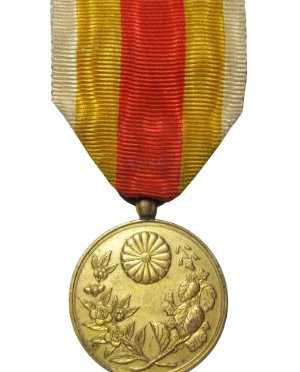
The obverse of the medal shows crossed branches of paulownia (Japan) and plum (Korea). The Imperial mum crest is
above. The reverse has the inscription ‘Korea Annexation Commemorative Medal, Meiji 43 [1910] August 29.’

The medal was awarded in a wooden box with gold lettering.

The Crown Prince’s Visit to Korea Commemorative Medal

The Crown Prince’s Voyage to Korea Medal was established in 1909 to commemorate Prince Yoshihito’s trip to the Korean Empire in 1907.

The Crown Prince’s Visit to Korea Commemorative Medal was established in 1909 to commemorate Prince Yoshihito’s trip to the Korean Empire in 1907. Emperor Taishō (大正天皇Taishō-tennō, 31 August 1879 – 25 December 1926) was the 123rd Emperor of Japan, according to the traditional order of succession, and the second ruler of the Empire of Japan from 30 July 1912 until his death in 1926.

The medal was awarded in gold to Imperial families and in silver to royalty.

The Crown Prince's Visit to Korea Medal Design

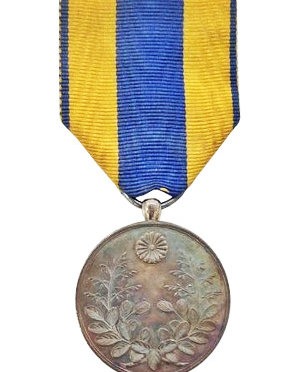
The obverse of the medal shows branches of sandalwood with the Imperial mum crest above. The reverse has the inscription ‘Imperial Japan Crown Prince, Voyage to Korea Commemorative Medal, Meiji 40 [1907] October.’

Notes

This entry was updated on 21 March 2023. The name “The Crown Prince’s Voyage to Korea Commemorative Medal” was replaced by “The Crown Prince’s Visit to Korea Commemorative Medal”. The word “voyage” is not in the inscription on the medal but uses a word 渡 which translates as “crossing”, “trip” or “visit”. This mistake was originally published in “Orders and Medals of Japan and Associated States” by James W. Peterson (OMSA Monograph #1). It was corrected in later editions of the Peterson book. Thank you Don Pfeifer for this information.

The Dunkirk Medal

The Dunkirk Medal is an unofficial commemorative medal established om 1 May 1960 and created by the town of Dunkirk for the area’s defense.

The Dunkirk Medal is an unofficial commemorative medal established on 1 May 1960 and created by the town of Dunkirk to commemorate the defense of the area during May and June 1940.

The allocation of the award was managed by the French National Association of Veterans of the Fortified Sector of Flanders and Dunkirk (and later administrated by the now-disbanded Dunkirk Veterans Association).

The award was initially awarded to only French service personnel (with approximately 30,000 medals issued). In 1970 it was also awarded to any Allied member involved in Operation Dynamo, the evacuation of Allied forces from the Dunkirk area between 29 May and 3 June and those soldiers evacuated from the beaches.

All British servicemen from the Royal Navy, Royal Air Force, Merchant Navy, and the civilian little ship volunteers were eligible to receive the award. For citizens of the United Kingdom, the medal may be worn on the right breast, but as it is not designated an official medal it is not to be mounted with other British official medals and awards.

The History of the Dunkirk Medal

The Dunkirk evacuation, also known as Operation Dynamo, took place between May 26 and June 4, 1940. During this operation, a vast number of British, French, and other Allied troops were evacuated from the French coast as they faced encirclement by German forces. The operation involved a large-scale mobilization of various naval vessels, merchant ships, and civilian boats that braved enemy fire to rescue the stranded troops.

The unofficial Dunkirk Medal was created by private organizations or individuals to recognize the courage and sacrifice of those involved in the evacuation. These commemorative medals are often privately produced and are not officially sanctioned or recognized by the UK government. They may be available for purchase or awarded by certain veterans’ organizations as a way to honor the memory of the Dunkirk evacuation and the servicemen and civilians involved.

A Note About Unofficial Medals

It’s important to note that unofficial commemorative medals do not hold the same status as official military awards and decorations. They do not carry the same level of recognition or entitlements as official honors, such as the campaign medals and service medals awarded by the UK government.

The Dunkirk Medal Design

The Dunkirk Medal is struck in bronze and is 44mm high and 36mm wide.

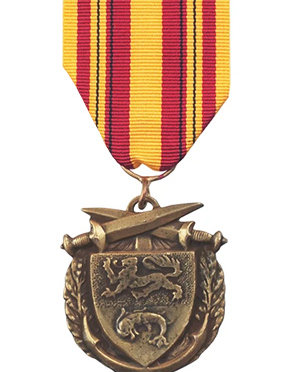
The medal’s obverse depicts a shield bearing the arms of Dunkirk (a fish and in chief, a lion passant) superimposed on an anchor and laurel wreath, crossed swords above. The reverse features a burning oil lamp over a tablet with the inscription: DUNKERQUE 1940.

Beneath the ribbon suspension of the medal are crossed swords. A named certificate was issued with each medal though the medal itself was not inscribed. The medal ribbon measures 36mm wide and has a wide central chrome yellow stripe with one wide and one thin red stripe each side with two further chrome yellow bars and two very thin black stripes.

Right Now on eBay 
Clicking a link to eBay may result in a referral commission being paid if a purchase is made.
Loading...
]

The Belisario Domínguez Medal of Honor

The Belisario Domínguez Medal (Medalla Belisario Domínguez del Senado de la República in Spanish) is the highest decoration that the Mexican Senate gives to eminent citizens.

The name honors Belisario Domínguez, a Chiapas Senator who opposed the Dictatorship of  Victoriano Huerta – a position that cost him his life. He was murdered on October 7th, 1913.

Every year, on Octobre 7th, the Senate and the President of Mexico awards the Belisario Domínguez Medal. Since its inception, the decoration has been given 69 times – eight of them posthumously.

The award includes the medal and a diploma.

The Belisario Domínguez Medal Design

The medal is struck in bronze. The obverse bears the inscriptions “Belisario Domínguez” on the top and “Ennobleció la Patria” (“Made the country more noble“) at the bottom. On the sides of the Belisario Domínguez portrait are the words “Octubre 7” (October 7) and “de 1953” (of 1953).

The Miguel Hidalgo Order

The Miguel Hidalgo Order (Condecoración “Miguel Hidalgo” or Miguel Hidalgo Decoration) is the highest award that the Mexican State gives to its citizens. The Order forms part of the Mexican Honor System.

The Miguel Hidalgo Order is awarded for eminent or distinguished merits, relevant services rendered unto the Nation or to Mankind, exemplar conduct or life’s work, or heroic acts.

The Order is named after Miguel Hidalgo y Costilla (1753-1811), a Mexican Catholic priest and main leader of the Mexican War of Independence. The award was officially issued in 1975 by  President Luis Echeverría and the Executive Branch of the Government of Mexico.

The Miguel Hidalgo Order Design

The Order consists of four classes, which are represented by a collar, a cross, a band, and a plaque. The Collar is awarded for heroic acts and exemplary conduct, and for services rendered unto the Nation or to Humanity that are of a transcendent and extremely beneficial nature. The cross is awarded for eminent merits,  outstandingly exemplar conduct, and heroic acts which would not merit a collar. The Band is given for distinguished merits and exemplary that warrants making it public knowledge. The plaque is awarded for merits not contemplated by the previous grades.

The badge of the Order is a cross in silver and gold with an eagle on the obverse.

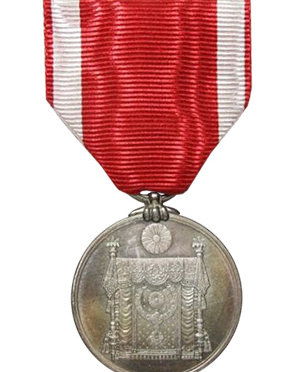
The Meiji Emperor 25th Wedding Anniversary Medal

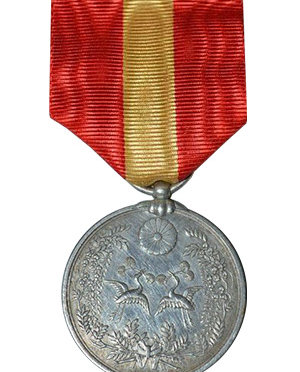
The Meiji Emperor 25th Wedding Anniversary Medal was created to commemorate the wedding anniversary of the Meiji Emperor.

The Meiji Emperor 25th Wedding Anniversary Medal was created to commemorate the wedding anniversary of the Meiji Emperor.

The Meiji Emperor or Meiji the Great (明治大帝Meiji-taitei) was the 122nd emperor of Japan according to the traditional order of succession.  He reigned from 3 February 1867 until his death on 30 July 1912. He was the first monarch of the Empire of Japan and presided over the Meiji era, instigating the Meiji Restoration – a series of rapid changes that witnessed Japan’s transformation from an isolationist, feudal state to industrialized world power.

The gold medal was awarded to Imperial princes and the princesses, and the silver to people of noble rank who attended the ceremonies.

The Commemorative Medal for the Imperial Constitution Promulgation

The Commemorative Medal for the Imperial Constitution Promulgation was established in 1889 to celebrate the first constitution of Japan.

The Commemorative Medal for the Imperial Constitution Promulgation was established in 1889 to celebrate the first constitution of Japan (known informally as the Meiji Constitution, 明治憲法Meiji Kenpō, which was proclaimed on February 11, 1889). Enacted after the Meiji Restoration in 1868, it provided for a form of mixed constitutional and absolute monarchy, based jointly on the German and British models.

The gold medal was awarded to Imperial princes and the silver to people of chokunin or sonin rank. There was also a women’s version with a bow ribbon.

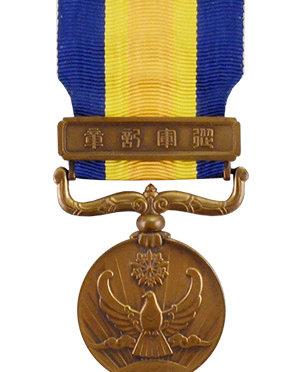
The Manchukuo Border Incident War Medal

The Manchukuo Border Incident War Medal was instituted in 1940 and commemorates the Nomonhan Incident, a clash with Russia in Manchuria.

The Manchukuo Border Incident War Medal was instituted in 1940 and commemorates the Nomonhan Incident, a clash with Russia that happened in Manchuria.

The Battles of Khalkhyn Gol were fought among the Soviet Union, Mongolia, Japan and Manchukuo in 1939. The conflict was named after the river Khalkhyn Gol, which passes through the battlefield. In Japan, this battle is known as the Nomonhan Incident – named after a nearby village on the border between Mongolia and Manchuria.

The battles resulted in the defeat of the Japanese Sixth Army, which incurred 18,000 casualties.

The Manchukuo Border Incident War Medal Design

The medal is struck in bronze and measures 30 mm wide. The bar reads ‘War Medal.’

The obverse shows Pu-Yi’s orchid crest above, with a dove with outstretched wings in the center. Below is part of
the globe showing Asia and behind are clouds and rays. The reverse bears the inscription ‘Border Incident.’

The medal was awarded in a red vase with golden lettering.

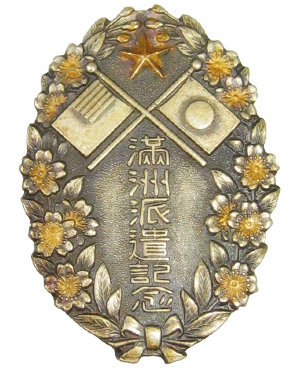
The Manchukuo Army Dispatch Badge

The Manchukuo Army Dispatch Badge was awarded to commemorate a unit’s service in Manchuria. During the 1930s, these badges were common.

The Manchukuo Army Dispatch Badge was awarded to commemorate a unit’s service in Manchuria. During the 1930s, different regiments and companies made their own badges to motivate and inspire soldiers.

The Manchukuo Army Dispatch Badge Design

The obverse of this badge is decorated with cherry blossom branches (a symbol of Japan) and a gold Army star. The flags are the Japanese national flag and the Manchukuo national flag. The central kanji reads ‘Manchuria Dispatch Commemorative.’

Most likely, these badges were awarded in a simple paulownia wood case.

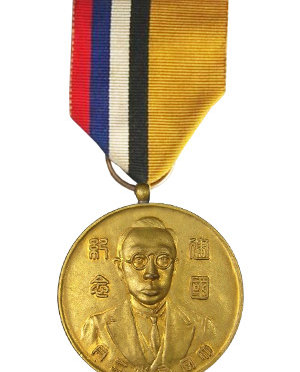
The Manchukuo National Foundation Imperial Medal

The Manchukuo National Foundation Imperial Medal is one of the rarest Manchukuo medals, believed to be a personal award from Emperor Pu-Yi.

The Manchukuo National Foundation Imperial Medal is one of the rarest Manchukuo medals. It’s believed that this medal may have been a personal award from Emperor Pu-Yi.

Very little is known about this medal. This rarer version must have been limited to a select few awardees.

The Manchukuo National Foundation Imperial Medal Design

The medal is round and struck in gold-plated bronze. The kanji on the obverse reads the inscription ‘National Foundation Commemorative, Daidou Year 1 [1932], March.’ There is also an image depicting Pu-Yi. The era name Daidou refers to 3 years: 1932-1934 (specifically March 1st, 1932 to February 28, 1934). The reverse shows the Manchukuo national flag in the center, and on either side are birds commonly called feng, or fenghuang.

It was awarded in a plush case with velvet exterior and inscription on the inside lid reading ‘National Foundation, Imperial Event Commemorative‘.