The Manchukuo Emperor State Visit to Japan Medal

The Manchukuo Emperor State Visit to Japan medal was established in 1935 to commemorate the Manchukuo Emperor Pu-Yi’s visit to Japan in 1934.

The Manchukuo Emperor State Visit to Japan medal was established in 1935 to commemorate the Manchukuo Emperor Pu-Yi’s visit to Japan in 1934. The Emperor Pu-Yi (often called the Last Emperor) made two state visits to Japan: The first in 1935 and the second in 1940. The first one was the most celebrated because he presented himself as the Manchukuo Emperor to the Showa Emperor.

Four commemorative postage stamps were issued, while many important people assembled to welcome Pu-Yi to Japan. The Japan Mint created this official medal to commemorate the 1935 visit.

The medal was awarded by the government and not put on sale like some other Japan Mint items.

The Manchukuo Emperor State Visit to Japan Medal Design

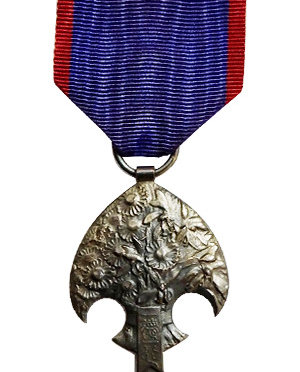
The medal is struck in silver and has the shape of a spearhead.

The obverse is decorated with orchids and chrysanthemums, the Imperial flowers of Manchukuo and Japan. There is an inscription in the banner at the bottom that reads ‘One in virtue and spirit.’ The reverse has the inscription’Kang Te 2 [1934] Manchukuo Empire, Emperor’s Visit to Japan Commemorative Medal, April 6th.’

The medal was awarded in a green case with gold lettering on the front.

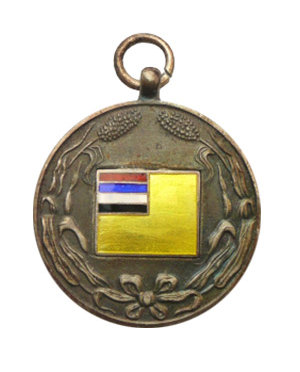
The Commemorative Badge for the Foundation of the Manchukuo Empire

The Commemorative Badge for the Foundation of the Manchukuo Empire is a commemorative item made to celebrate its founding.

  • Time Period: WW2
  • Institution: 1930s?
  • Country: Medals from Japan Japan

The Commemorative Badge for the Foundation of the Manchukuo Empire is one of many commemorative items that were made on the occasion of the founding of the Manchukuo Empire. Similar items were also produced on subsequent anniversaries.

Although these badges had a suspension ring, they were probably never actually worn. Their function was more decorative, with most of them probably bought as a gift for others.

The Commemorative Badge for the Foundation of the Manchukuo Empire Design

The obverse shows two branches around an enameled national flag. These are sorghum branches and buds, a plant used often on Manchukuo items. Although the official imperial crest is the orchid, the sorghum was used as a symbol of the nation, just as the cherry blossom is used as a symbol of Japan.

The reverse shows the inscription ‘Manchukuo Empire, Daidou 2 [1933] March 1st, National Foundation 1-Year Anniversary Commemorative.’

The badge was kept in a paulownia wood box with an inscription reading ‘Manchukuo Empire, National Foundation 1-Year Anniversary Commemorative.’

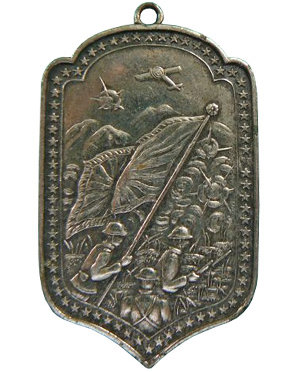
The Imperial Japanese Army Koga Regiment Badge

Time Period: WW2

Institution: 1930s?
Country: Medals from Japan Japan

The Imperial Japanese Army Koga Regiment Badge is an example of a small, portable, and inexpensive regiment badge. These awards were usually given to troops by regiment commanders.

The Imperial Japanese Army Koga Regiment Badge Design

These regimental badges usually had the unit name and number inscribed in the obverse, and could also be personalized. However, they rarely had the name of the individual soldier unless they were hand-carved.

The Koga regiment badge has a border covered with Army stars. The obverse shows, it the center, Japanese soldiers battling at the front. One of them is carrying the regiment standard. In the background are clouds of smoke with stylized explosions and some hills. Above is a fighter plane and another explosion. The inscription in the reverse reads ‘Koga Regiment, Blood-Stained Regiment Standard.’

The Japanese Military Wounded Soldier Badge

Time Period: WW2
Institution: From 1938
Country: Medals from Japan Japan

The Japanese Military Wounded Soldier Badge was issued to both army and navy personnel from about 1938. Also translated as the War Wound Badge, this medal was produced in two varieties.

The gilt senshou badge was awarded for a wound sustained in combat. The silver koushou badge was awarded for a wound sustained in the public service (or in a non-combat situation). It was also often given to a soldier when they contracted a disease like malaria or were poisoned, injured in an equipment accident, etc. 

The Japanese Military Wounded Soldier Badge Design

The badge measures approximately 31 mm high. The outer edges on the reverse side read Gunjin Shoui Kishou (Soldier Wound Badge).

The badge was awarded in a red pressed cardboard or wooden box with gold or silver lettering and with an accompanying registration card.

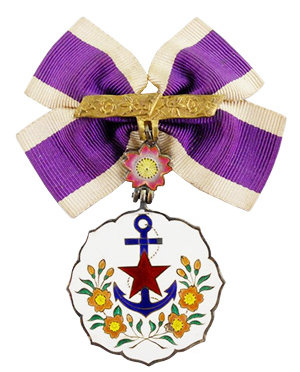
The Patriotic Women’s Association (Aikoku Fujinkai) Distinguished Service Badge

  • Time Period: Pre-WW1
  • Institution: After 1901
  • Country: Medals from Japan Japan

The Patriotic Women’s Association Distinguished Service Badge is a special merit badge awarded by the Patriotic Women’s Association or Aikoku Fujinkai. The Distinguished Service Badge (or Special Merit Badge) was the highest award.

The Patriotic Women’s Association is the oldest of the women’s associations. It was founded on March 2, 1901 by Okumara Ioko and operated under the Ministry of Home Affairs and the Ministry of Health and Welfare.

By 1940, the Association had close to 6,500,000 members in Japan and overseas. Before the outbreak of the Second World War, there were Aikoku Fujinkai branches in Canada, the United States and Brazil, as well as in different territories occupied by the Japanese armed forces. In February 1942, the Asssociation merged with the Greater Japanese Women’s Association for Protection of the Country and the Greater Japan Federation of Women’s Associations into a new association which was called the Greater Japanese Women’s Association.

The Aikoku Fujinkai Distinguished Service Badge Design

The medal is struck in silver and has red, white, blue, orange, green, pink and yellow enamels. It measures 33.5 mm (wide) x 47 mm (high), including its cherry blossom suspension.

The medal is suspended from a silver-gilt bar with pinback and has a bow-tied ribbon with silver-gilt tassels at either end. The badge was awarded in a hard-shelled case made of balsa wood with a black lacquer finish. The box has gilt characters on the lid.

Other badges were as follow:

  • Member Rosette Badge, in yellow, blue and black enamels.
  • Regular Member Badge, in silver with no enamels.
  • Special Member Badge, bronze with yellow enamel.
  • Honor Member Badge, bronze with light blue or white enamel.
  • First Class Exceptional Merit Badge, bronze with colored enamels.
  • Second and Third Class Merit Badges, bronze with a red star.
  • Patron Badge, in reddish bronze with no enamels.

The Royal Household Order for Ladies

The Royal Household Order for Ladies is a Hawaiian order is awarded by Princess Owana Ka’ohelelani in honor of her mother.

The Royal Household Order for Ladies is a Hawaiian order is awarded by Princess Owana Ka’ohelelani in honor of her mother.

As senior heir to the ruling House of Keoua Nui, Princess Owana has placed the royal orders under her patronage. Because these orders were never nationalized, they are recast as House Orders and awarded at the pleasure of its head.

Princess Owana has established the House Order of Ka’ohelelani in honor of her mother.  It exists in seven classes and is given only to members of the Royal Family.[

The Royal Order of the Star of Oceania

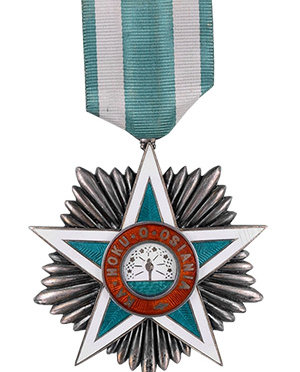
The Royal Order of the Star of Oceania is a Hawaiian order instituted on 16th December 1886 for the recompense of distinguished services.

The Royal Order of the Star of Oceania was founded by King Kalakaua I on 16th December 1886 and awarded for distinguished services rendered in advancing his plan for a confederation of Polynesian nations, islands of the Pacific and Indian Oceans, and on contiguous Continents. In anticipation of Samoa joining the confederation, King Malietoa was awarded the Grand Cross.

The Royal Order of the Star of Oceania is highly awarded to the head of states/dynasties, also as awards of merit to loyal supporters of the royal family and those who provide excellent services in the field of cultural achievement and education throughout the Pacific.

The Order has five classes:

  • Grand Cross – Limited to 15 recipients at any one time
  • Grand Officer – Limited to 30
  • Commander – Limited to 45
  • Officer – Limited to 60
  • Companion (gold and silver medals)

It was re-established and amended by HRH Princess Owana Ka`ohelelani La`anui Salazar,  the “de jure” and “fons honorum” head of the royal house and Grandmaster of the order.

The Royal Order of the Star of Oceania Design

The Grand Cross Star is worn on the breast and the design speaks elements of the sea and sky. It is worn on a cordon or sash of pale green with a white stripe near each edge.

The Commander insignia is suspended from the bow of the cordon. KA HOKU O OSIANIA is inscribed around the shield, translating to ‘The Star of Oceania.’ 

The Royal Order of the Crown of Hawaiʻi

The Royal Order of the Crown of Hawaiʻi is an order instituted in 1848 and awarded to the head of states and supporters of the royal family.

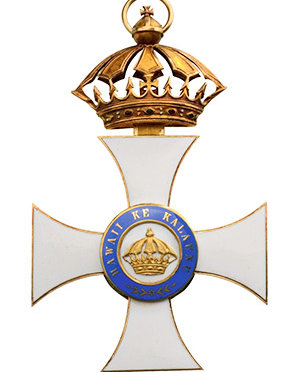
The Royal Order of the Crown of Hawaiʻi is a Hawaiian order instituted in July 1848 and is awarded to the head of states/dynasties, as awards of merit to loyal supporters of the royal family and those who provide excellent services in the field of cultural achievement and education.

The Order was first introduced and created as the Order of the Crown and Cross by H.M. King Kamehameha III in July 1848, on the advice of his Minister of Foreign Affairs, Robert C. Wyllie. In 1883, H.M. King Kalākaua created the Order of the Crown and its statutes written with the motto “Hawaiʻi Ke Kalaunu”, and the ribbon colors of blue and white.

The Royal Order of the Crown of Hawaiʻi Design

The insignia of the Order bears the motto “Hawaiʻi Ke Kalaunu” on the obverse.

The ribbon of the order is blue and white. The revised 2016 order installs the ribbon colors of gold with purple edges; the shield has a purple ring surrounding the Hawaiian crown with the motto “Onipaʻa“.

The Royal Order of Kapiolani

The Royal Order of Kapiolani was instituted in 1880 by King Kalākaua to recognize services in the cause of humanity, science and the arts.

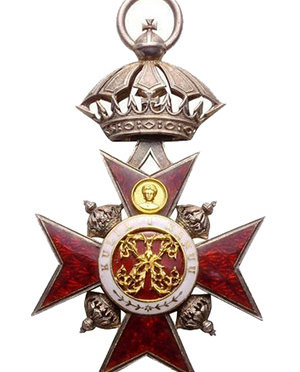
The Royal Order of Kapiolani is a Hawaiian order instituted in 1880 by King Kalākaua to recognize services in the cause of humanity, Science and the Arts, or for special services rendered to the Kingdom of Hawaiʻi.

The Order is named in honor of his ancestor High Chiefess Kapiʻolani the Great, an early exponent of Christianity in the Hawaiian Islands. It also honored his wife Queen Kapiʻolani, the namesake of the first Kapiʻolani.

The Royal Order of Kapiolani was awarded 177 times in all grades during Kalākaua’s reign, and three more times by his successor, Queen Liliʻuokalani. The last award of the Order took place on June 2, 1892.

The Order was awarded in six grades:

  • Grand Cross – 12 recipients
  • High Grand Officer – 15 recipients
  • Grand Officer – 20 recipients
  • Commander – 30 recipients
  • Officer – 50 recipients
  • Companion (Knight) – 60 recipients
  • Medal of Honor – no limit to recipients, 1st (silver) and 2nd-degree (bronze)

In 1893 the Order became obsolete.

The Royal Order of Kapiolani Design

The insignia of the Grand Cross includes a badge, a breast star and grand cordon.

The badge comprises a red enamelled gold Maltese cross, surmounted by a gold Hawaiian crown. Between the arms of the cross are gold Hawaiian crowns in angles. A center disc of red and white enamel displays a gold double-K monogram, surrounded by a white enamel band, on which is inscribed “KULIA I KANUU” or  “Strive to Reach the Summit“. At end of the cross is a small, gold locket with the portrait of Queen Kapiʻolani. On the reverse is a single red disc, with the motto “KULIA”.

The star of the Grand Cross of Order is an octagonal silver star, on which is superimposed the badge without the surmounted crown.

The grand cordon is yellow, bordered by narrow stripes of the colors the Hawaiian flag: white, red and dark-blue. The badge is fastened to the sash’s bow and rests on the hip.

For High Grand Officers, the badge is not worn on a sash but on a neck ribbon of alternating yellow and red strips. Grand Officers wear only the breast star. The Commander wears only the sash the crowns between the arms of the cross on the badge are silver, not gold. The Officer and Companion cross use a smaller badge. The Medals of Honor lack the crowns between the arms of the cross and the badge’s crown surmounting the cross. The medal of the 1st-degree is made of silver, and the 2nd-degree of bronze.

The Royal Order of Kalākaua I

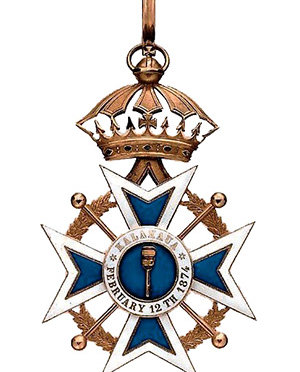
The Royal Order of Kalākaua I is a Hawaiian order instituted in 1874 by King Kalākaua I to commemorate his accession to the throne.

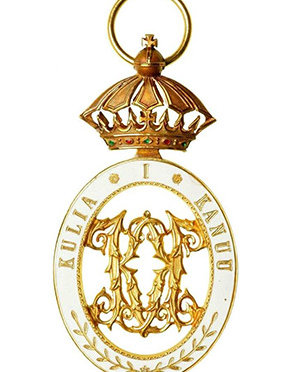
The Royal Order of Kalākaua I is a Hawaiian order instituted on 28 September 1874 by King Kalākaua I to commemorate his accession to the throne of the Kingdom of Hawaiʻi on 12 February 1874.

This order was granted to both native Hawaiians and foreigners for superlative service to the monarch and to the kingdom. It was last conferred by Queen Liliʻuokalani on 1 August 1892.

In the duration of the Order, it was granted 239 times by King Kalākaua I, and 15 times by his sister Queen Liliʻuokalani. In 1893, the Order became abeyant.

The Order was awarded in four grades:

  • The Royal Order of Kalakaua I Grand Cross.gif Knights Grand Cross with Collar (only given for head of states)
  • The Royal Order of Kalakaua I Grand Cross.gif Knights Grand Cross – 12 individuals
  • Order of Kalakaua Companion.gif Grand Officer – 20 individuals
  • Order of Kalakaua Companion.gif Commander – 50 individuals
  • Order of Kalakaua Companion.gif Companion – 60 individuals

The Royal Order of Kalākaua I Design

The badge of the order is a Maltese cross in gold or silver.

The obverse is decorated with Prussian blue and white enamel, surmounted by a Hawaiian crown. The arms of the cross have a border strip of white enamel, with a blue centre separated by a thin band of gold or silver. There is a gold or silver wreath and a pūloʻuloʻu (kapu sticks – ball and stick insignia) between the arms connecting them. On the cross is a blue and white enamel locket. On a white stripe, the inscription KALAKAUA FEBRUARY 12 1874 circles a kāhili (feathered standard of royalty) on a background of blue.

The reverse comprises a locket of blue and white. At the centre of the locket is the date 1874, surrounded by the inscription KEOLA (eternal life) – both in gold.

The insignia for the Knights Grand Cross with Collar is a collar chain composed of alternating monograms “K.I.K.” and kahili of red and yellow enamel and a breast star. The breast star is identical to that of the Knights Grands Cross – an octagonal silver star to which is affixed the badge of Order without the crown and struck in gold. The sash is deep blue. The badge of the Order is fastened to a bow on the sash on a bow, resting on the left hip.

The insignia of Grand Officer Star is only a breast star. The wreath of Grand Officer Star is silver. The insignia of the Commander Cross is identical to that of the Grand Officer Star, except it is worn on a neck ribbon of five alternating white and blue stripes. The Companion Cross comprises a breast badge suspended by a ribbon of white and blue stripes.