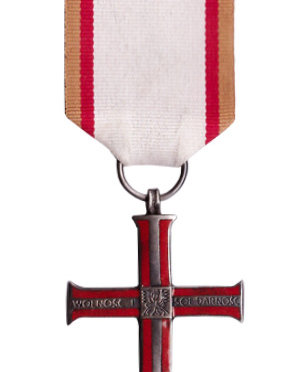
The Cross of Freedom and Solidarity

The Cross of Freedom and Solidarity was established in 2010 to honor killed, wounded or imprisoned members of the democratic opposition.

The Cross of Freedom and Solidarity (or Krzyż Wolności i Solidarności in Polish) was established on 5 August 2010, to honor members of the democratic opposition in Poland who between the years 1956 and 1989 were killed, seriously wounded or injured, arrested, imprisoned or interned for at least 30 days, who lost jobs or were expelled from school or university for at least 6 months as a result of their activities for the benefit of a free and democratic Poland.

Individuals who are found having collaborated with the communist regime may not be awarded.

The Cross of Freedom and Solidarity Design

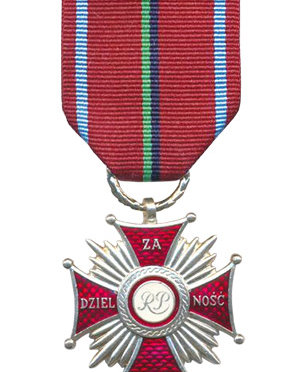
The cross is a red enameled Greek cross struck in silver, similar to that of the Order of the Cross of Independence and the Cross of Independence of 1930. The cross is 42 mm in diameter.

On the obverse, the inscription “WOLNOŚĆ I SOLIDARNOŚĆ” (“Freedom and Solidarity”) is written across the horizontal arms. In the center of the cross carved stylized image of the White Eagle. The reverse side of the cross is smooth.

The Cross of Freedom and Solidarity is suspended from a white ribbon, 38 mm wide. Symmetrically arranged along the edges of the ribbon are gold and crimson stripes each 3 mm wide.
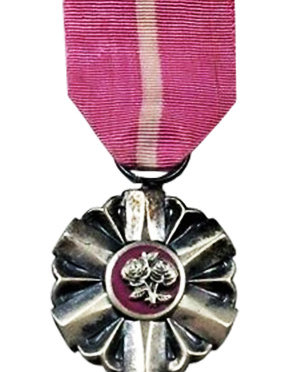
The Medal for Long Marital Life

The Medal for The Medal for Long Marital Life was established in 1960 and awarded to couples who have been married for at least 50 years.

The Medal for Long Marital Life (or Medal Za Długoletnie Pożycie Małżeńskie in Polish) is a medal from Poland established on February 17, 1960 and awarded to couples who have been married for at least 50 years.

The medal is still awarded in cities across the country but ‘PRL’ has become ‘PR’ on the reverse. . In addition to having a 50-year-long marriage, couples should also have at least one child, either their own or adopted, to qualify for the medal.

The Medal for Long Marital Life Design

The medal is round, struck in silver, and has six rays. It measures 35mm in diameter.

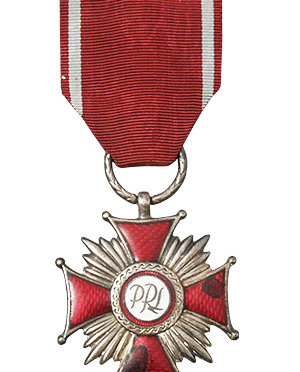
The obverse has a pink enameled center with two roses with intertwined stems superimposed. The reverse has the letters PRL in the center. Surrounding this are the words: “ZA DLUGOLETNIE POZYCIE MALZENSKIE” in a circle.

The ribbon is 37mm wide with a 4mm wide white stripe in the centre of the ribbon.

The Medal for Long Service

The Medal for Long Service is a decoration from Poland awarded in three classes to members of the Armed Forces and other uniformed services.

The Medal for Long Service (or Medal za Długoletnią Służbę in Polish) is a decoration established on January 8, 1938 and awarded in three classes (gold, silver, and bronze) to members of the Polish Armed Forces and other uniformed services, and to civil servants who have honorably completed 30, 20 or 10 years of service to the State.

After the outbreak of the Second World War the conferment was suspended, and after that, the medal was eventually discontinued. In 1951, it was replaced by the Medal of the Armed Forces in the Service of the Fatherland for members of the armed forces. The Medal for Long Service was revived by the Law of 14 June 2007, which amended the Act of 16 October 1992, concerning medals and decorations.

The original medal was awarded by the appointed minister to any member of the armed forces or other uniformed services, or to civilian employees of the government or local government following 30 (gold medal), 20 (silver medal), or 10 years (bronze medal) of continuous or cumulative service. The recipients of the medal were required to make a monetary payment for it.

Since 2007 the medal has been conferred by the President of Poland. Unlike its pre-World War II counterpart, the conferment is not automatic but is decided on an individual basis.

The Medal for Long Service Design

The medal is circular, measures 35 mm in diameter, and is made from gilded, silver-plated or bronze-patined metal.

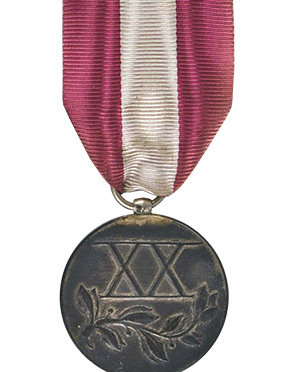
The obverse depicts a Polish crowned eagle surrounded by rye ears and circumscribed “ZA DŁUGOLETNIĄ SŁUŻBĘ” (“FOR LONG SERVICE“). On the reverse are the Roman numerals “XXX” (30), “XX” (20) or “X” (10), with a laurel spray below.

The same numeral in gold, silver or bronze is attached to the ribbon bar. The ribbon has three stripes in red, white, and red.

The Medal for Sacrifice and Courage

The Medal for Sacrifice and Courage was established in 1960 and is awarded to those who, with disregard for their own life, help others.

The Medal for Sacrifice and Courage (or Medal za Ofiarność i Odwagę in Polish) is a medal from Poland established on February 17, 1960. It is awarded to those who, with disregard for their own life, save people from drowning, aid the victims of natural disasters, fires, explosions, or other unfortunate circumstances, or protect the property of others during such events.

The Medal for Sacrifice and Courage Design

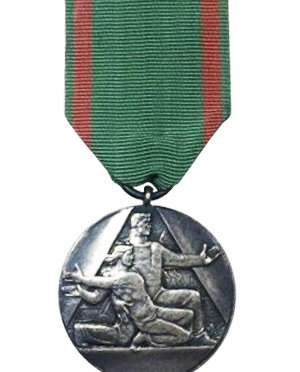
The medal is round and was designed in 1960 by Józef Gosławski. The obverse features an image of a man and woman framed by a triangular background.

The Cross of Merit with Swords (Poland)

The Cross of Merit with Swords is a military award of Poland established October 19, 1942, by the Polish Government in Exile.

The Cross of Merit with Swords (or Krzyż Zasługi z Mieczami in Polish) is a military award of Poland established October 19, 1942, by the Polish Government in Exile.

The Cross of Merit with Swords is awarded for deeds of bravery and valor during time of war not connected with direct combat, and for merit demonstrated in perilous circumstances.

The Order has three grades:

1. Gold Cross of Merit with Swords
2. Silver Cross of Merit with Swords
3. Bronze Cross of Merit with Swords

The cross may be awarded twice in each grade to the same person.

The Cross of Merit with Swords Design

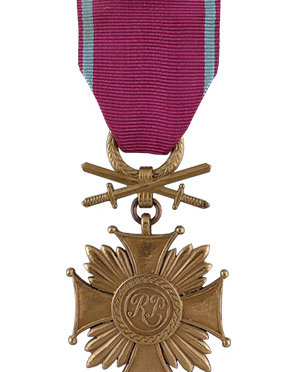
The medal is struck in silver or bronze (the first class with red and white enamels), measures 40.5 mm (w) x 40.5 mm (h) ad weighs approximately 24 grams. The shape is a cross with sunlight rays between the arms.

In the center medallion, in the obverse, are the initials RP (“Rzeczpospolita Polska” or Republic of Poland). The ribbon is red with white edges. The suspension has crossed sowrds.

The medal was awarded with a molded box and a certificate.

The Cross of Merit (Poland)

The Cross of Merit is a civil state decoration of Poland established on June 23, 1923, to recognize services to the state.

The Cross of Merit (or Krzyż Zasługi in Polish) is a civil state decoration of Poland established on June 23, 1923, to recognize services to the state.

At the time of its establishment in 1923, the Cross of Merit was the highest civilian award in Poland. It was given to citizens who went beyond the call of duty in their work for the country and society as a whole.

The Order has three grades:

1. Gold Cross of Merit (Złoty Krzyż Zasługi)
2. Silver Cross of Merit (Srebrny Krzyż Zasługi)
3. Bronze Cross of Merit (Brązowy Krzyż Zasługi)

The Cross of Merit may be awarded twice in each grade to the same person.

The Cross of Merit Design

The medal is struck in silver or bronze (the first class with red and white enamels), measures 40.5 mm (w) x 40.5 mm (h) ad weighs approximately 24 grams. The shape is a cross with sunlight rays between the arms.

In the center medallion, in the obverse, are the initials RP (“Rzeczpospolita Polska” or Republic of Poland). The ribbon is red with white edges.

The medal was awarded with a molded box and a certificate.

The Cross of Merit for Bravery (Poland)

The Cross of Merit for Bravery is awarded for selfless bravery in the defense of the law, national borders, and life and property.

The Cross of Merit for Bravery (or Krzyż Zasługi za Dzielność in Polish) is a medal of Poland awarded for selfless bravery in the defense of the law, national borders, and the life and property of citizens in especially difficult circumstances.

The medal was established on March 7, 1928 as a military-grade of the Cross of Merit. The medal was awarded until World War II and was not recognized by the post-war government. On October 16, 1992 the medal was reintroduced and is currently awarded to police officers, firefighters, and several military and civilian agencies involved in intelligence or security.

The Cross of Merit for Bravery Design

The obverse bears the words “Za Dzielność” (“For Bravery” in Polish) and the letters RP for the Republic of Poland.

The Order of Merit of the Republic of Poland

The Order of Merit of the Republic of Poland was created in 1974 and is awarded to persons who have rendered great service to the country.

  • Time Period: Post-WW2
  • Year of Institution: 10 April 1974
  • Country: Poland

The Order of Merit of the Republic of Poland (or Order Zasługi Rzeczypospolitej Polskiej in Polish) is an order of merit of Poland created in 1974, awarded to persons who have rendered great service to the country. It is granted to foreigners or Poles resident abroad. As such it is sometimes referred to as a traditional “diplomatic order“.

The order was established by an act of 10 April 1974, as the Order of Merit of the Polish People’s Republic. It was awarded in five classes: Grand Cordon of the Order, Commandery with Star, Commandery, Gold Badge of the Order, and Silver Badge of the Order. It was awarded by the Polish Council of State.

Under the 1992 act, the order is awarded to foreigners or Poles resident abroad for distinguished contributions to international cooperation or cooperation between Poland and other countries. It is awarded by the President of Poland.

From 1974 to 1991 the Order was awarded in the following classes:

  •  st class – Grand Cordon of the Order of Merit of the People’s Republic of Poland
  • 2nd class – Commandery with Star of the Order of Merit of the People’s Republic of Poland
  • 3rd class – Commandery of the Order of Merit of the People’s Republic of Poland
  • 4th class – Gold Badge of the Order of Merit of the People’s Republic of Poland
  • 5th class – Silver Badge of the Order of Merit of the People’s Republic of Poland

Since 1992 the Order is awarded in the following classes:

  • 1st class – Grand Cross of the Order of Merit of the Republic of Poland
  • 2nd class – Commander’s Cross with Star of the Order of Merit of the Republic of Poland
  • 3rd class – Commander’s Cross of the Order of Merit of the Republic of Poland
  • 4th class – Officer’s Cross of the Order of Merit of the Republic of Poland
  • 5th class – Knight’s Cross of the Order of Merit of the Republic of Poland

The Order of Merit of the Republic of Poland Design

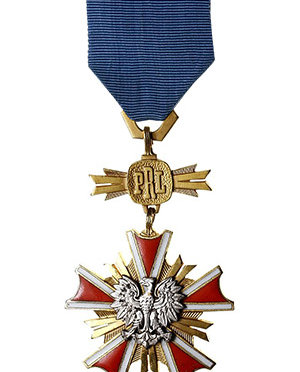
After the fall of communism in Poland in 1989, it was decided to retain the order, with necessary changes. The insignia was changed to the present ones by a presidential decree of 16 April 1991. The abbreviation “PRL” was changed to “RP,” the Eagle was given a crown in accordance with Poland’s new coat of arms, the date “1974” was removed from the reverse, and the color of the ribbon was changed from light cobalt blue to dark cobalt.

The Cross of Valor (Poland)

The Cross of Valor is a military decoration from Poland first introduced in 1920 for deeds of valour and courage on the field of battle.

The Cross of Valour (or Krzyż Walecznych in Polish) is a military decoration from Poland. It was first introduced by the Council of National Defense on 11 August 1920 and it is awarded to an individual who “has demonstrated deeds of valour and courage on the field of battle.” It may be awarded to the same person up to four times.

The medal was introduced in 1920 at the height of the Polish-Soviet War, shortly before the Battle of Warsaw. Through 29 May 1923, when the last medal for the Polish-Soviet War was awarded, the Cross of Valour had been granted to some 60,000 soldiers.

Apart from individuals who had participated in the Polish-Soviet War, the medal had also been awarded retroactively to some soldiers of the Polish Legions, of World War I military units, of the Silesian Uprisings, of the Great Poland Uprising, and to members of the Polish Military Organization. It had been awarded, as well, to veterans of the January 1863 Uprising and to the city of Płock. On 20 September 1940, the President of Poland agreed to award the medal to eligible individuals who had already been awarded it four times during the Polish-Soviet War. In 1943, after the Battle of Lenino, General Zygmunt Berling awarded the Cross of Valour to several soldiers.

The medal itself was approved as a military decoration by order of the Home National Council on 22 December 1944. Until 1947, some 40,000 of the medals had been awarded to Polish soldiers fighting alongside the Red Army.

The medal is given only in wartime or shortly after.[/vc_column_text][vc_column_text css=”.vc_custom_1611843202750{padding-top: 24px !important;}”]

The Cross of Valour Design

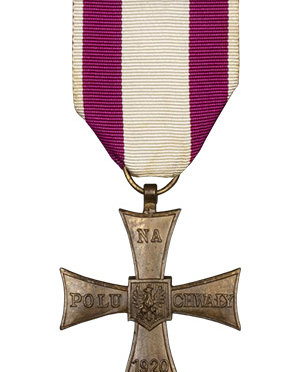
The award has the shape of a bronze cross.

On the obverse, in the center is a Polish crowned eagle with spread wings within a central shield. On the arms an inscription “Na Polu Chwały 1920” meaning “On the fields of Glory 1920”. The reverse bears an upright sword piercing a laurel wreath leaf crown with the inscription “Walecznym” meaning, “Valourious“.#

The cross is suspended from a purple and white ribbon.

The Order of the Cross of Independence

The Order of the Cross of Independence was established in 2010 to honor those who had served voluntarily between the years of 1939 and 1956.

  • Time Period: Post-WW2
  • Year of Institution: 5 August 2010
  • Country: Poland

The Order of the Cross of Independence (or Order Krzyża Niepodległości in Polish) was established on 5 August 2010, to honor those who between the years of 1939-1956 voluntarily served with merit in defending the independence of the Polish State. It is fifth in the order of precedence of Polish awards and decorations.

At its establishment, it was declared to be a continuation of the Cross of Independence which was instituted on 29 October 1930.

The Order is divided into two classes:

  • The Order of the Cross of Independence First Class. Awarded to those who guided the struggle or fought with arms for independence and sovereignty of the motherland with an extraordinary sacrifice.
  • The Order of the Cross of Independence Second Class. Awarded to those who for a significant period of time or in circumstances of extreme danger defended the independence and sovereignty of the homeland, fighting for her recovery, or maintaining the functioning of institutions and traditions of the Polish Republic.

The Order of the Cross of Independence Design

First class

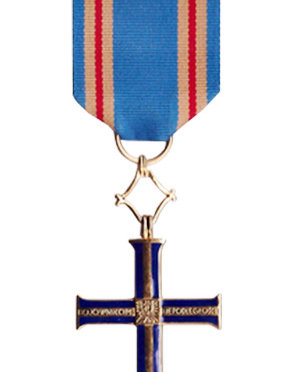
The first class cross of the Order of Independence is suspended by swords attached to a ribbon with a width of 45mm which is worn around the neck. The ribbon is blue with stripes of gold and red at the edges. The ribbon bar of the first class is denoted by a rosette at the center.

Second Class

The second class cross of the Order of the Cross of Independence is worn on the left breast suspended from a ribbon with a width of 40 mm, with colors identical to that of the first class. The ribbon bar of the second class is unadorned by any clasp or attachment.