The Order of the Military Cross (Poland)

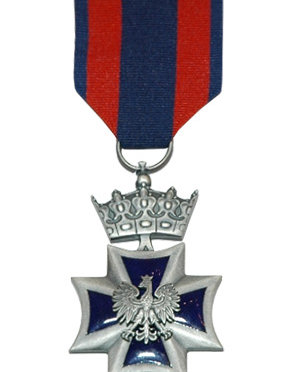
The Order of the Military Cross (or Order Krzyża Wojskowego) is a Polish order established in 2006 and awarded for distinguished service.

  • Time Period: Post-WW2
  • Year of Institution: 18 October 2006
  • Country: Poland

The Order of the Military Cross (or Order Krzyża Wojskowego in Polish) is a Polish order established on 18 October 2006 and awarded for “distinguished service, sacrifice, and courage in actions against terrorism in the country or during foreign deployments of the Armed Forces of the Republic of Poland in times of peace.”

The Military Cross was established by the Law of 14 June 2007, which amended the Act of 16 October 1992, concerning medals and decorations. This law saw the creation of the Military Cross along with the Military Cross of Merit, Navy Cross of Merit, Air Force Cross of Merit and the Medal for Long Service. The change was implemented on 9 October 2007.

According to the previously mentioned law, “The Military Cross has the distinction of being the reward for acts of bravery and courage made during operations against acts of terrorism in the country, or during the use of the Polish Armed Forces outside the country in time of peace.” In the order of precedence of Polish medals, it ranks behind the Cross of Valor and the Cross of Merit for Bravery.

The Order has three classes:

  1. Grand Cross (Krzyż Wielki)
  2. Commander’s Cross (Krzyż Komandorski)
  3. Knight’s Cross (Krzyż Kawalerski)

The Order of Polonia Restituta

The Order of Polonia Restituta is a Polish state order conferred on military, civilians, or foreigners for outstanding achievements.

The Order of Polonia Restituta (or Order Odrodzenia Polski in Polish, Order of the Rebirth of Poland in English) is a Polish state order established in 1921 and conferred on both military and civilians as well as on foreigners for outstanding achievements in the fields of education, science, sport, culture, art, economics, national defense, social work, civil service, or for furthering good relations between countries.

The Order of Polonia Restituta was established on 4 February 1921 with Marshal Józef Piłsudski as first Grand Master. The Marshal awarded the first recipients on 13 July 1921. 

After World War II both the Polish government-in-exile and the Communist People’s Republic of Poland, aligned with the Warsaw Pact, awarded the order, though the versions differed slightly. The order was saved from abuse as it was simply passed over in favor of more traditional communist awards. During this time, the Order of Merit of Poland became the favored award for foreigners.

On 22 December 1990 the Polish government-in-exile returned the rights to its version of the order to the new Polish state. Invalid awards have been revoked and today the remaining communist versions of the order hold the same status as any other issues.

The Order of Polonia Restituta has five classes, categorized according to the Constitution of Poland, Article 138, as follows:

  • Grand Cross. Order of Polonia Restituta First Class, Krzyż Wielki, the Grand Cross, referred to as the Grand Cordon.
  • Commander’s Cross with Star. Order of Polonia Restituta Second Class, Krzyż Komandorski z Gwiazdą, the Commander’s Cross with Star. 
  • Commander’s Cross. Order of Polonia Restituta Third Class, Krzyż Komandorski, the Commander’s Cross.
  • Officer’s Cross. Order of Polonia Restituta Fourth Class, Krzyż Oficerski, the Officer’s Cross. 
  • Knight’s Cross. Order of Polonia Restituta Fifth Class, Krzyż Kawalerski, the Knight’s Cross.

The Order of Polonia Restituta Design

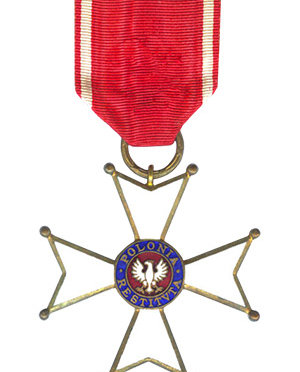
The badge of the Order of Polonia Restituta is a gold Maltese cross enameled in white.

The obverse central disc bears a white eagle on a red background, the Coat of Arms of Poland, surrounded by a blue ring bearing the words “Polonia Restituta“. The reverse central disc bears the year 1918 (for the People’s Republic of Poland version: 1944).

The badge is worn on a ribbon, red with a white stripe near the edges, as a sash on the right shoulder for Grand Cross, around the neck for Commander with Star and Commander, on the left chest with a rosette for Officer, and on the left chest without rosette for Knight.

The star of the order is an eight-pointed silver star with straight rays. The central disc is in white enamel, bearing the monogram “RP” (Republic of Poland) (for the People’s Republic of Poland, “PRL”) and surrounded by a blue ring bearing the Latin words “Polonia Restituta“.

The War Order of Virtuti Militari

The War Order of Virtuti Militari was created in 1792 by Stanisław II August and is Poland’s highest military decoration for heroism.

  • Time Period: Pre-WW1
  • Year of Institution: 22 June 1792
  • Country: Poland

The War Order of Virtuti Militari (meaning “For Military Virtue” in Latin;  Order Wojenny Virtuti Militari in Polish) was created in 1792 by Polish King Stanisław II August to commemorate the victorious Battle of Zieleńce and is Poland’s highest military decoration for heroism and courage in the face of the enemy at war. It’s the oldest military decoration in the world still in use.

The War Order of Virtuti Militari is awarded in five classes either for personal heroism or, to commanders, for leadership. Some of the heroic actions recognized by an award of the Virtuti Militari are equivalent to those meriting the British Victoria Cross, the German Iron Cross, and the American Medal of Honor.

Since the destruction of the Polish–Lithuanian Commonwealth in 1795, the award has been reintroduced, renamed, and banned several times. Throughout the decoration’s existence, thousands of soldiers and officers, Polish and foreign, several cities (and one ship) have been awarded the Virtuti Militari for valor or outstanding leadership in war.

Poland regained its independence in 1918 as the Second Republic of Poland and the Polish Sejm reintroduced the Virtuti Militari on 1 August the following year under a new official name, the “Military Award Virtuti Militari” (Order Wojskowy Virtuti Militari). The class system as introduced under the Duchy of Warsaw was:

  • Grand Cross with Star, Class I: “for a commander who has achieved victory in a battle of strategic importance, resulting in total defeat of the enemy, or a successful defense that has decided the fate of a campaign.”
  • Commander’s Cross, Class II: “for a commander who has achieved a notable tactical victory or a valorous and successful defense of a difficult position.”
  • Knight’s Cross – Class III: for officers, NCOs, and ordinary soldiers, previously awarded the Golden Cross, for acts of outstanding bravery, risk of life, or outstanding command over his troops.
  • Golden Cross – Class IV: for officers who commanded their troops with outstanding bravery and valor, and for NCOs and ordinary soldiers, previously awarded the Silver Cross, for acts of outstanding bravery and risk of life on the field of battle.
  • Silver Cross – Class V: for officers, NCOs, and ordinary soldiers, for acts of outstanding bravery and risk of life on the field of battle.

There have been no new awards since 1989.

The War Order of Virtuti Militari Design

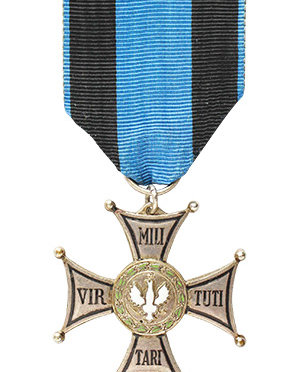
The medal is struck in silver gilt and decorated with enamels. It measures 30.75 by 40.30 mm. The obverse features a white eagle (Orzeł Biały), the national coat of arms of Poland. The reverse has the name of the order inscribed and the year of establishment.

The ribbon has a thin blue outer strip, thicker black ones, and a central blue stripe.

The Order of the White Eagle (Poland)

The Order of the White Eagle (or Order Orła Białego in Polish) is Poland’s highest order, awarded to both civilians and military for merit.

  • Time Period: Pre-WW1
  • Year of Institution: 1 November 1705
  • Country: Poland

The Order of the White Eagle (or Order Orła Białego in Polish) is Poland’s highest order and it’s awarded to both civilians and the military for their merits. The order was officially instituted on 1 November 1705 by Augustus II the Strong and bestowed on eight of his closest diplomatic and political supporters. It is awarded to the most distinguished Poles and the highest-ranking representatives of foreign countries.

Although Augustus the Strong limited the number of knights to seventy-two, he only conferred the Order forty times before his death in 1733 (his son, Augustus, awarded the Order more than three hundred times). The king may have been inspired to found the Order by the example of Peter the Great’s recent founding of the Russian Order of Saint Andrew and by the example of the prestigious French Order of the Holy Spirit.

Initially the creation of the Order was strongly opposed by many of the Polish nobility since membership in the Order conferred a distinction that violated the traditional equality of all Polish nobles. Since the Order had no patron saint, Augustus II made 2 August the feast of the Order. His son, Augustus III, however, changed the Order’s feast day to 3 August.

After the third partitioning of Poland, in 1795, the Order was abolished. It was renewed by 1807 and became the highest award of the Duchy of Warsaw, and after 1815 of the Kingdom of Poland. It was also popular among the Russian tsars, who also conferred the Order upon themselves. The Order of the White Eagle officially became Poland’s highest decoration by an act of Parliament of 4 February 1921. Following the collapse of communism, the Order was once again reinstated on 26 October 1992.

The Order of the White Eagle is one of the oldest orders in the world still in use.

The Order of the White Eagle Design

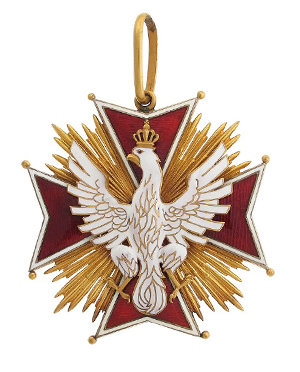
The badge Order of the White Eagle was originally a red enamel oval gold medal with an image of the Polish white eagle on its front side and bearing Augustus II’s royal cypher over crossed swords on its reverse side worn on a light blue ribbon. This was replaced by a Maltese cross in 1709.

The 1713 Insignia

The 1713 badge was a Maltese cross enameled red with white borders with diamonds set in each of the balls at the eight points of the cross and with diamond set rays appearing between each of the points of the cross. In the center of the cross was a white enameled eagle in high relief with spread wings and facing left and with a diamond-set royal crown on its head. At the top of the cross between the two top points was a diamond-studded semi-circular link through which passed a diamond-studded ring through which, in turn, passed the light-blue ribbon from which it was worn. The reverse side was enameled white with red borders and had at its center an oval gold medallion with the founder’s crowned royal cypher above two crossed swords taken from his arms as the Arch-Marshall of the Holy Roman Empire.

The star of the order consisted of an eight-pointed gold star with straight rays which bore a red-bordered white enameled cross pattée with golden rays between the arms and with a golden rosette at its center. The arms of this cross pattée bore the motto “Pro Fide, Lege et Rege” (For Faith, Law and the King) in golden letters. The King of Poland could also wear the cross from a collar of 24 alternating links of white enameled eagles, crowned and holding scepters and orbs, and dark blue enameled ovals surrounded by gold rays.

The Medal of St. George (Russia)

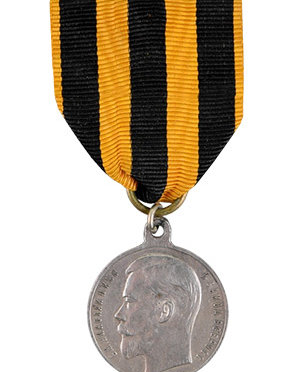
The Medal of St. George for Bravery was established in 1878 and awarded to non-commissioned officers, soldiers, and sailors for acts of valor.

The Medal of St. George for Bravery was established on 3rd August 1878, during the reign of Tsar Alexander II. After the death of Emperor Alexander III in 1894 the Medal was re-issued, wearing the semblance of the new sovereign, Tsar Nicholas II.

The medal was awarded to non-commissioned officers, soldiers, and sailors as well as to civilians for exceptional acts of valor in times of war or peace.

On 10th August 1913, a sweeping amendment was introduced by which the Medal for Bravery was incorporated into the statute of the Order of Saint George and its name was changed to Saint George Medal for Bravery. From 23rd July 1915 the Gold Medals, similarly to the golden Saint George Crosses, were manufactured with a reduced content in gold. From January 1917 they were manufactured with substitute yellow or which metal.

The Cross of St. George Design

The St. George Medal came in four classes. Gold medallions for 1st and 2nd class (shown above). Silver medallions for 3rd and 4th. A bow on the ribbon denoted 1st class and 3rd. The medal was awarded for merit to other Allied soldiers as well as Russians.

The obverse features the bust of the reigning Emperor with his title. The reverse  bears, in the center, in two lines the wording FOR BRAVERY, below the recipient’s impressed award registration number followed by the class of the award.

The ribbon is the same as the Order of Saint George; orange with three black stripes, commonly called “George’s Ribbon”. It symbolizes fire and gunpowder: the Russian “colors of military glory”, and is also thought to be derived from the colors of the original Russian imperial coat of arms (black eagle on a golden background). It was subsequently associated to the colors of the Russian Guard units.

The Medal for Transforming the Non-Black Earth of the RSFSR

The Medal for Transforming the Non-Black Earth of the RSFSR was awarded for 3 years outstanding service in developing Soviet agriculture.

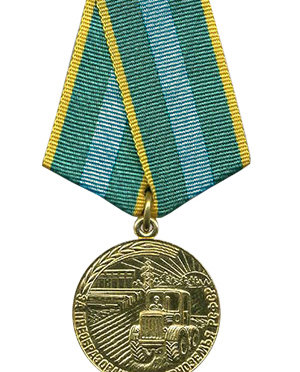
The Medal for Transforming the Non-Black Earth of the RSFSR (or Медаль «За преобразование Нечерноземья РСФСР», Medal «Za preobrazovanie Тechernozem’ja RSFSR» in Russian) was established on 30 September 1977 by decree of the Presidium of the Supreme Soviet of the USSR and awarded for 3 years outstanding service in developing Soviet agriculture.

The Medal “For Transforming the Non-Black Earth of the RSFSR” was awarded to workers, farmers, and employees who made an impact on the work of implementation of the long-term program for the development for agriculture of the non-black earth zone of the Russian Soviet Federative Socialist Republic, and who worked as a rule, for not less than three years in this field and that was located on state or collective farms, or worked in businesses, organizations or institutions whose activities were directly related to the transformation of the non-black earth.

The medal’s statute was amended on July 18, 1980 by decree of the Presidium of the Supreme Soviet of the USSR № 2523-X.

The Medal for Transforming the Non-Black Earth of the RSFSR Design

The medal was 32mm in diameter, circular, and made of tombac, with a raised rim on both sides. It was worn on the left side of the chest.

On the obverse, in the right half, the relief image of a tractor pulling a plow through a field below a rising Sun over a distant tree line; at left the relief images of barns, grain elevators, and power transmission towers; along the medal’s lower circumference, the relief inscription «За преобразование Нечерноземья РСФСР» (“For transforming the Non-Black Earth of the RSFSR”), along the upper left circumference, a panicle of wheat; the obverse had a raised rim.

On the reverse, at the center, the relief image of the hammer and sickle with wheat spikes below a relief five-pointed star emitting rays.

The Medal “For Transforming the Non-Black Earth of the RSFSR” was secured to a standard Soviet pentagonal mount by a ring through the medal suspension loop. The mount was covered by a 24 mm wide overlapping green silk moiré ribbon with 2 mm yellow edge stripes and a 6 mm central blue stripe.

The Medal for Construction of the Baikal-Amur Railway

The Medal for Construction of the Baikal-Amur Railway was awarded to workers on the BAM for 2 years outstanding service.

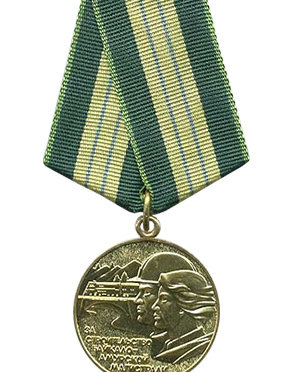
The Medal for Construction of the Baikal-Amur Railway (or Медаль «За строительство Байкало-Амурской магистрали», Medal «Za stroitel’stvo Bajkalo-Amurskoj magistrali in Russian) was established on 8 October 1976 by decree of the Presidium of the Supreme Soviet of the USSR and awarded to workers on the Baikul-Amur Railway (BAM) for 2 years outstanding service between 1974 and 1984.

The medal recognized active participation in the construction of the Baikal-Amur Railway, a huge multi year project under the leadership of then-Soviet premier Leonid Brezhnev. The Medal “For Construction of the Baikal-Amur Railway” was awarded to active participants in the construction of the Baikal-Amur Railway, on the rail section Bam – Tynda – Berkakit, on the second rail section Taishet – Lena, in the production facilities, in the building of housing for the civilian workers, for good work in construction, for high-quality designs and survey work, for honest work at enterprises, institutions and organizations directly supporting the construction efforts and the workers. The medal was usually awarded to workers, engineering-technical workers, and employees who worked on the project in its construction, design, or for its maintenance for at least three years.

The medal’s statute was amended on July 18, 1980 by decree of the Presidium of the Supreme Soviet of the USSR № 2523-X.

The Medal for Construction of the Baikal-Amur Railway Design

The medal was 32 mm in diameter, circular, and made of brass, with a raised rim on both sides. It was worn on the left side of the chest.

On its obverse, in the background in the left half of the medal, the relief image of hills and a train going left across a bridge over a river, under the bridge, the relief inscription on five lines «За строительство Байкало-Амурской магистрали» (“For the construction of the Baikal-Amur Railway”), in the right half of the medal, the left profiles of a man and a woman, the man wearing a construction helmet, the woman being closer and slightly to the right.

On the reverse, the Sun over railroad tracks intersected by a ribbon bearing the inscription «БАМ» (“BAM”) framed by a laurel wreath with the hammer and sickle at the top.

The medal was secured to a standard Soviet pentagonal mount by a ring through the medal suspension loop. The mount was covered by a 24 mm wide overlapping silk moiré ribbon with 1 mm wide light green edge stripes, three 3 mm wide central yellow stripes separated by two 0,5 mm grey stripes, bordered by two 6 mm wide dark green stripes.

The Medal for the Development of Virgin Lands

The Medal for the Development of Virgin Lands was awarded to all Soviet workers who helped cultivate 36,000,000 hectares of land.

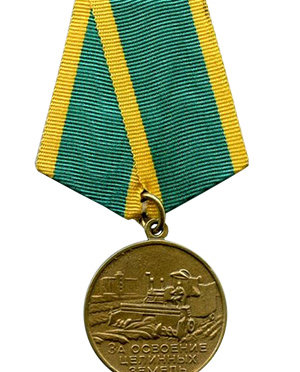
The Medal for the Development of Virgin Lands (or Медаль «За освоение целинных земель», Medal «Za osvoenie tselinnyh zemel» in Russian) was established on 20 October 1956 by decree of the Presidium of the Supreme Soviet of the USSR and awarded to all Soviet workers who helped cultivate 36,000,000 hectares of previously uncultivated lands (started in 1954 by Nikita Khrushchev) in Kazakhstan, Siberia, the Urals, the Volga area and the northern Caucasus for two solid years from 1954–56.

The medal was awarded to farmers, workers of state farms, MTS, construction and other organizations, the Party, government, labor and Komsomol workers for their good work in the development of virgin and fallow lands in Kazakhstan, Siberia, the Ural, the Volga and the North Caucasus for a period of usually at least two years. This Medal was also awarded to Yuri Gagarin right after his space flight (and it became a tradition to award the Medal to many Soviet cosmonauts after that).

The Medal for the Development of Virgin Lands Design

The medal was 32mm in diameter, circular with a raised rim on both sides. It was worn on the left side of the chest.

On its obverse, the image of a C-4 combine harvester in a field with a grain silo in the background on the horizon, at the bottom, the relief inscription on three rows «За освоение целинных земель» (“For the development of virgin lands”).

On the reverse at the bottom, the relief image of the hammer and sickle with sun rays radiating upwards towards a five-pointed star at the top, along the right circumference, ears of corn, along the left circumference, a panicle of wheat.

The medal was secured by a ring through the medal suspension loop to a standard Soviet pentagonal mount covered by an overlapping 24 mm dark green silk moiré ribbon with 3 mm wide yellow edge stripes.

The Medal for the Restoration of the Black Metallurgy Enterprises of the South

The Medal for the Restoration of the Black Metallurgy Enterprises was awarded to Soviet workers of outstanding performance in restorations.

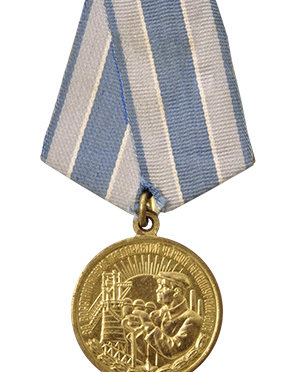
The Medal for the Restoration of the Black Metallurgy Enterprises of the South (or Медаль «За восстановление предприятий чёрной металлургии юга», Medal «Za vosstanovlenie predprijatij chernoj metallurgii yuga» in Russian) was established on 18 May 1948 by decree of the Presidium of the Supreme Soviet of the USSR and awarded to Soviet workers of outstanding performance in restoring the Black Metallurgic Enterprises of the Soviet Union which were destroyed during the Great Patriotic War.

Thirteen blast furnaces, forty-nine open-hearth furnaces, twenty-nine finishing mills, and sixty-eight coke-oven batteries were restored to effective or outstanding production rates.

Lists of potential recipients were reviewed on behalf of the Presidium of the Supreme Soviet of the USSR by the Ministry of Metallurgy of the USSR and the Ministry of Construction of Heavy Industry of the USSR. The medal was to be worn with honor, to serve as an example of high awareness and observance of labor discipline and integrity in the performance of public duties.

The medal’s statute was amended on July 18, 1980 by decree of the Presidium of the Supreme Soviet of the USSR № 2523-X.

The Medal for the Restoration of the Black Metallurgy Enterprises Design

The medal was 32mm in diameter, circular, and made of brass, with a raised rim on both sides. It was worn on the left side of the chest.

On the obverse on the left side, the relief image of a rebuilt blast furnace, at right, a worker with a tool for punching tapholes, in the background at center, the rising Sun with rays going up. Along the medal side and upper circumference, the relief inscription «За восстановление предприятий чёрной металлургии юга» (“For the restoration of the black metallurgy enterprises of the South”), at the bottom, the relief image of a five-pointed star over a laurel wreath.

On the reverse, the relief image of the hammer and sickle over the inscription on two lines in prominent letters «ТРУД В СССР — ДЕЛО ЧЕСТИ» (“LABOUR IN THE USSR – A MATTER OF HONOUR”).

The medal was secured by a ring through the medal suspension loop to a standard Soviet pentagonal mount covered by an overlapping 24 mm silk moiré ribbon. The ribbon had an 8 mm wide central blue stripe bordered by 1 mm wide white stripes themselves bordered by 5 mm wide light blue stripes, 2 mm wide blue edge stripes completed it.

The Medal for the Restoration of the Donbass Coal Mines

The Medal for the Restoration of the Donbass Coal Mines was awarded to workers, clerks, engineering and professionals for outstanding work.

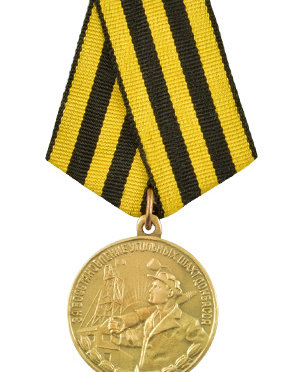
The Medal for the Restoration of the Donbass Coal Mines (or Медаль «За восстановление угольных шахт Донбасса», Medal «Za vosstanovlenie ugl’nyh shaht Donbassa» in Russian) was established on 10 September 1947 by decree of the Presidium of the Supreme Soviet of the USSR and awarded to workers, clerks, engineering and business professionals, for outstanding work, high production performance and achievements in the recovery of the Donbass coal mines.

Lists of potential recipients were reviewed on behalf of the Presidium of the Supreme Soviet of the USSR by the Ministry of the Coal Industry of the USSR, the Ministry of Construction of the USSR or the Ministry of Chemical and Petroleum Industries of the western areas.

The medal’s statute was amended on July 18, 1980 by decree of the Presidium of the Supreme Soviet of the USSR № 2523-X.

The Medal for the Restoration of the Donbass Coal Mines Design

The medal was 32mm in diameter, circular, and made of brass, with a raised rim on both sides. It was worn on the left side of the chest.

On its obverse, in the left half, the relief image of a restored mine, a flag-waving atop the tower; on the right side, the relief image of a helmeted miner facing left carrying a jackhammer on his right shoulder; in the background at center, the Sun with rays going all the way to the top of the medal; along the upper circumference, the relief inscription «За восстановление угольных шахт Донбасса» (“For the Restoration of the Donbass Coal Mines”); along the lower circumference, the relief image of a five-pointed star over a laurel wreath.

On the reverse, the relief image of the hammer and sickle over the inscription on two lines in prominent letters «ТРУД В СССР — ДЕЛО ЧЕСТИ» (“LABOUR IN THE USSR – A MATTER OF HONOUR”).

The medal was secured by a ring through the medal suspension loop to a standard Soviet pentagonal mount covered by an overlapping 24 mm silk moiré ribbon with 0,5 mm black edge stripes and three 5 mm wide gold stripes separated by two 4 mm wide black stripes.