The Australian General Service Medal for Korea

The Australian General Service Medal for Korea (or AGSMK) recognizes former defense force personnel who completed 30 days of service in operations in South Korea during the post-Armistice period, 28 July 1953 to 19 April 1956, including any location 161 km (100 mi) seaward from the coast of South Korea.

The medal was established by letters patent by Queen Elizabeth II on 24 November 2009 and further determination approved by the Governor General on 12 March 2010. The AGSMK was announced on 12 February 2010 by the Parliamentary Secretary for Defence Support, the Hon Dr Mike Kelly AM MP, following the recommendations of the 2005 Post-Armistice Korean Service Review.

The Australian General Service Medal for Korea Design

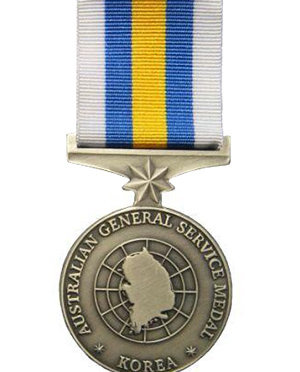
The medal is circular, struck in nickel-silver, and measures 38 mm in diameter. The design is ensigned with the Federation Star and has an antique silver finish with a raised polished outer edge.

The obverse has a central design of a relief map of South Korea superimposed over polar projection lines representing the United Nations and surrounded by the words “Australian General Service Medal Korea”. Centered on the reverse are the words “Post Armistice Service 1953–1956″ surrounded by Australian gum leaves and blossoms with two Federation Stars included in the bottom left and right-hand quadrants.

The ribbon measures 32 millimeters wide and has a central yellow stripe 8mm wide, flanked by 6mm stripes of blue, which in turn are flanked by 6mm stripes white. The ribbon colors are representative of the colors used for the Korea Medal and the United Nations Korea Medal. The ribbon bar consists of a strip of a full-sized ribbon with no emblem.
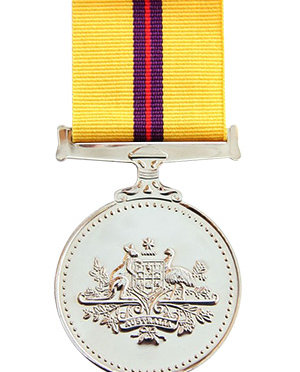
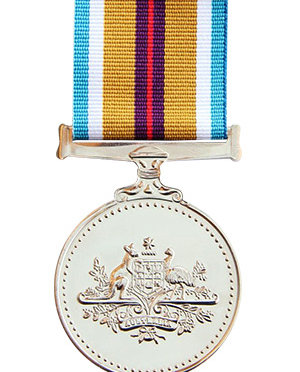
The Iraq Medal (Australia)

The Iraq Medal was instituted by Queen Elizabeth II on the advice of the Australian Prime Minister John Howard in 2004. The Iraq Medal is awarded to Australian Defence Force (ADF) personnel who served in or around Iraq (19 March 2003 – 25 November 2013).

ADF personnel is also recognized by the ‘IRAQ 2003’ clasp to the Australian Active Service Medal.

Members of the ADF who render service with the forces:

  • Operation Falconer – the ADF contribution to the United States-led military operations to remove the threat of Iraqi weapons of mass destruction that commenced on 18 March 2003 and ended on 30 April 2003, with 7 days service in the specified areas comprising the total land areas, territorial waters, inland waterways, and superjacent airspace boundaries of Iraq, Kuwait, Bahrain, Qatar, United Arab Emirates Oman, Saudi Arabia, Jordan Yemen, the Persian Gulf the Strait of Hormuz, the Gulf of Oman, those portions of the Arabian Sea bounded by 68 degrees East and 12 degrees North the Gulf of Aden, the Bab el Mandeb, the Red Sea, the Gulf of Suez and the Gulf of Aqaba; commenced on 1 May 2003 and ended on 22 July 2003, with 30 days service in the specified areas comprising the total land areas, territorial waters, inland waterways, and superjacent airspace boundaries of Iraq, Kuwait, Bahrain, Qatar, United Arab Emirates, Saudi Arabia north of 23 degrees North, the Persian Gulf and the Strait of Hormuz.
  • Operation Catalyst the ADF contribution to the United States-led coalition operations in Iraq to support the Australian effort to assist with the rehabilitation of Iraq and remove the threat of weapons of mass destruction that commenced on 16 July 2003 and ended on 31 July 2009, for 30 days service in the specified areas comprising the total land areas, territorial waters, inland waterways, and superjacent airspace boundaries of Iraq Kuwait, Bahrain, Qatar United Arab Emirates, Saudi Arabia north of 23 degrees North, the Persian Gulf and the Strait of Hormuz.
  • Operation Riverbank from 21 July 2008 personnel attached to the United Nations Assistance Mission for Iraq as part of Operation Riverbank. The operation ended on 25 November 2013.
  • Operation Kruger from 1 January 2009 personnel deployed on Operation KRUGER as part of the Security Detachment Iraq which protects the Australian embassy in Baghdad. The operation ended in late July 2011.

The Iraq Medal Design

The medal is circular and struck in nickel-silver.

The obverse bears the Commonwealth Coat of Arms. The reverse has a processional lion, which is copied from a relief on the Gateway of the Temple of Ishtar in Babylon. In the Assyrian Empire, the lion was a dominant symbol of power. The lion stands on a narrow plinth, symbolizing balance, with the word ‘IRAQ’ inscribed underneath.

The ribbon is sand yellow representing the desert sands of Iraq, with central stripes of purple and red representing the ADF and the conflict in Iraq.

The Afghanistan Medal (Australia)

The Afghanistan Medal is a medal instituted by Queen Elizabeth II on the advice of the Australian Prime Minister John Howard in 2004. The medal is awarded to Australian defense force personnel who served in or around Afghanistan after 11 October 2001.

Members of the Australian Defence Force who render 30 days service (or 30 sorties) with the forces:

  • Operation Slipper — the ADF contribution to the International Coalition Against Terrorism that commenced on 11 October 2001 in the specified areas comprising the total land areas and superjacent airspace boundaries of Afghanistan; commenced on 11 October 2001 and ended on 5 December 2002 in the specified areas comprising the total land areas and superjacent airspace boundaries of Kyrgyzstan; the specified areas comprising the total land areas, territorial waters inland waterways and superjacent airspace boundaries of Kuwait, Bahrain, Qatar, United Arab Emirates, the Persian Gulf, the Strait of Hormuz, the Gulf of Oman, those portions of the Arabian Sea bounded by 68 degrees east and 12 degrees north, and the Gulf of Aden; that; commenced on 11 October 2001 and ended on 5 December 2002, and commenced on 1 January 2009;
  • Operation Palate – the Australian Defence Force contribution to the United Nations Assistance Mission in Afghanistan that commenced on 6 December 2002 in the area comprising the specified total land areas and superjacent airspace boundaries of Afghanistan.

Defense force personnel are also recognized by the ‘ICAT’ clasp to the Australian Active Service Medal and the North Atlantic Treaty Organisation’s Non-Article 5 Medal with ‘ISAF’ clasp. A person is not eligible for the award of the Afghanistan Medal where an entitlement exists to the Iraq Medal for the same deployment.

The Afghanistan Medal Design

The medal is circular and struck in nickel-silver. The design is the same as the Vietnam Medal, but with a plain suspender.

The obverse bears the Commonwealth Coat of Arms. The reverse shows a snow-capped mountain range with a multi-rayed sun rising behind the mountains. The mountains represent the dominant terrain of the country and the rising sun signifies a ‘new dawn’ for the nation. The word ‘AFGHANISTAN‘ is inscribed in English and in the Arabic script of the two dominant languages of Afghanistan, Dari, and Pashto.

The ribbon has a central vertical stripe of red, signifying the conflict in Afghanistan. This is flanked by stripes of purple representing the three arms of the Australian Defence Force. Stripes of khaki, white, and light blue border the inner stripes. They symbolize the Afghanistan terrain, the snow-peaked mountains, and the sky above, respectively.

The International Force East Timor Medal

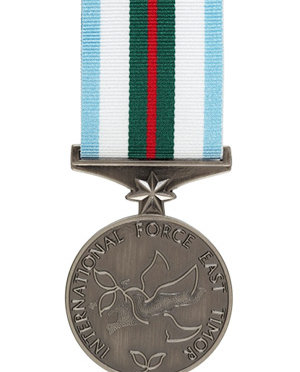
The International Force East Timor Medal (or INTERFET) recognizes members of the Australian Defence Force who served for 30 days (or 30 sorties) in East Timor during the INTERFET campaign – which lasted from 16 September 1999 to 10 April 2000. Australian Defence Force personnel are also recognized by the ‘East Timor’ clasp to the Australian Active Service Medal. Australia has also offered this medal to the other 16 nations that participated in the INTERFET operation.

The qualifying area comprises East Timor and the sea adjacent to East Timor out to a distance of 12 nautical miles (22 km) from the low watermark.

The International Force East Timor Medal Design

The medal is circular and struck in nickel silver. It’s surmounted by a connector piece, which features a raised Federation Star.

The obverse bears the outline of a dove holding an olive branch, as a symbol of peace. This outline is raised in polished white silver and is superimposed on a textured map of East Timor and Territories. ‘INTERNATIONAL FORCE EAST TIMOR‘ is inscribed on the inside of the medal rim.

The reverse features the wording ‘TOGETHER AS ONE FOR PEACE IN EAST TIMOR‘.

The ribbon measures 32 millimeters wide and has a central red stripe, flanked by stripes of green, white, and pale blue. The white, green, and blue stripes represent the Navy, Army, and Air Force, with the dual representation of white for peace, blue for the sea surrounding East Timor and green for the regrowth of a new nation. The central red stripe represents the turbulent past of East Timor.

The Vietnam Logistic and Support Medal

The Vietnam Logistic and Support Medal is a medal issued to recognize the service of Australian support personnel during the Vietnam War. Personnel who have already earned the Vietnam Medal are ineligible for the Vietnam Logistic and Support Medal.

The qualifying criteria for the medal are as follows:

  • Service of one day or more as a member or crew of a ship or aircraft operating in the prescribed area of operations of Vietnam in support of Australian forces.
  • Service of one day or more within the prescribed area of operations of Vietnam while attached to a unit or organization in support of Australian forces.
  • Service of one day or more while attached to or serving with, a unit of the Australian armed forces or allied forces, as an observer.

Groups meeting the criteria for this award also include certain defense personnel in support roles, entertainers, journalists, civilian surgical and medical teams, Qantas aircrew, and embassy couriers.

The Vietnam Logistic and Support Medal Design

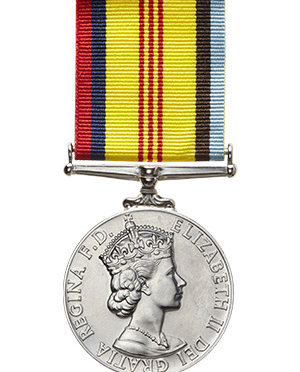
The medal is circular and struck in nickel-silver. The design is the same as the Vietnam Medal, but with a plain suspender.

The obverse bears the crowned effigy of The Queen with the inscription ‘ELIZABETH II DEI GRATIA REGINA F.D.’ The reverse of the medal has the word ‘VIETNAM‘ at the top center above a depiction of a man standing between two symbolic spheres.

The ribbon has three red stripes on a yellow center representing South Vietnam. The ribbon also has a blue stripe to represent the Navy, a red stripe for the Army, and a light blue stripe for the Air Force. The ribbon also has a brown stripe for the color of the earth and waterways of Vietnam.

The King Hussein Medal

The King Hussein Medal is a medal awarded to British and American personnel involved in relief operations codenamed Operation Shoveller during and after the Civil War of September 1970. All personnel was presented with the medal by King Hussein at the end of the deployment.

Permission to wear this medal was never issued for Great Britain.

The King Hussein Medal Design

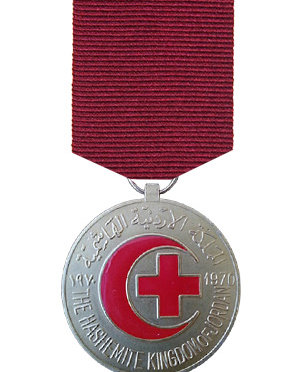
The medal is circular and struck in silver with a red enamel emblem.

The obverse bears the emblem of the Red Cross and Red Crescent and the inscription “THE HASEMITE KINGDOM OF JORDAN” and its Arabic equivalent, with the date 1970 and Arabic equivalent on both sides. The reverse has a seven-line inscription across the center.

The ribbon is plain crimson.

The Pingat Jasa Malaysia Medal

The Pingat Jasa Malaysia Medal (or Malaysian Service Medal) is a medal given by the King and Government of Malaysia and established 3 March 2004. The award is in recognition of “distinguished chivalry, gallantry, sacrifice, or loyalty” in contributing to the freedom of independence of Malaysia.

The medal recognizes service by members of the Malaysian Armed Forces during the Malayan EmergencySecond Malayan Emergency, and the Indonesia–Malaysia confrontation. The medal was also offered for award to members of the Commonwealth forces from Australia, Fiji, India, Nepal, New Zealand, and the United Kingdom who served in Malaysia during the Malayan Emergency and the Indonesia–Malaysia confrontation.

The medal can be conferred and accepted posthumously by next of kin.

The Pingat Jasa Malaysia Medal Design

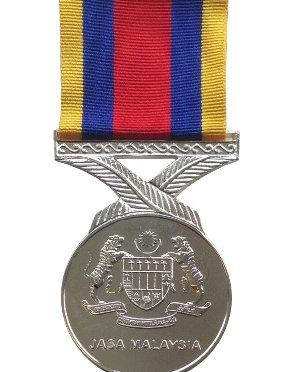
The medal is circular, made of base metal (brass)-coated nickel silver, and measures 38 mm in diameter.

The obverse bears the Coat of arms of Malaysia with the inscription “JASA MALAYSIA” beneath it. The reverse shows a map of Malaysia and the initials P.J.M underneath.

The ribbon is a 35 mm corded ribbon and has five colored vertical stripes. The colors are those of the Malaysian flag. The individual colors and widths of the five vertical stripes are as follows: 4.5 mm yellow, 7 mm blue, 12 mm red, 7 mm blue, and 4.5 mm yellow. The medal is suspended by two crossed palas palm fronds which are attached to a straight suspension bar covered in a decorative pattern.

No clasps or bars were issued for this medal.

The Soviet 40th Anniversary Medal

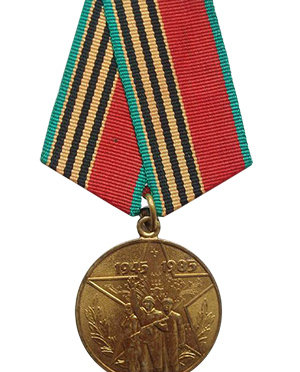
The Soviet 40th Anniversary Medal was established on 12th April 1985 and awarded to British and Canadian forces who served mainly in RN or MN ships on Arctic Convoys. The medal was approved in 1994 by Her Majesty the Queen and first awarded by the Soviet Government to selected ex-Servicemen – in particular surviving veterans of the Arctic Convoys of World War II.

Similar medals were issues for the 50th and subsequent five year anniversaries as well. However, those for the 55th anniversary and above have not been authorized for wear.

The Soviet 40th Anniversary Medal Design

The medal is circular, struck in bronze, and measures 32 mm in diameter.

The obverse features a group of servicemen and women in front of a five-pointed star and flanked by oak leaves and the dates 1945-1985 above. The reverse has the inscription “40th Anniversary of the Victory in the Great Patriotic War 1941-1945” in Russian.

The ribbon is one-half red and the other orange with three black stripes, edged with pale blue. Later issues of the medal have no blue edges.

The medal is worn in the Russian style.

The Rhodesia Medal

The Rhodesia Medal was initiated by the British Government in consultation with Australia, New Zealand, Fiji, and Kenya, whose forces took part in Operation AGILA, (Operation MIDFORD for the New Zealand forces). The medal was awarded for service of at least 14 days between 1 December 1979 and 20 March 1980, to members of the military and police forces, as well as eligible civilians, who participated in monitoring the ceasefire and supervising the elections in the lead-up to Zimbabwean independence.

The role of the multi-national force was to keep the peace between 22,000 guerrilla fighters and the Rhodesian forces during the ceasefire and run-up to the 1980 elections. There was no minimum qualifying period for those killed, wounded or disabled due to service, or where a recipient was decorated for gallantry.

Each country treats the medal as part of its own honors system. Recipients of the Rhodesia Medal also received the Zimbabwean Independence Medal in either silver or bronze, although British personnel did not have permission to wear it in uniform, while New Zealand granted approval for restricted wear only.

The Rhodesia Medal Design

The medal is circular, made of rhodium-plated cupro-nickel, and measures 36 mm in diameter. It was issued by the Royal Mint.

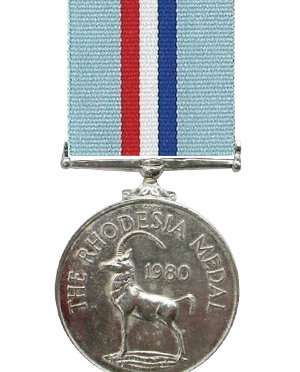
The obverse features the crowned effigy of Queen Elizabeth II with the inscription ELIZABETH II DEL GRATIA REGINA FID.DEF. The reverse depicts a sable antelope surrounded by the inscription THE RHODESIA MEDAL’ and ‘1980‘. The medal was issued named to British armed forces personnel, but unnamed to police officers.

The medal is suspended from a 32 mm sky-blue ribbon with three central stripes of red, white, and blue. No clasps were awarded.

The South Vietnam Campaign Medal

The Republic of Vietnam Campaign Medal (or Chiến Dịch Bội Tinh), is a South Vietnamese military campaign medal created in 1949.

The Republic of Vietnam Campaign Medal (or Chiến Dịch Bội Tinh in Vietnamese), is a South Vietnamese military campaign medal created in 1949 and awarded for two different periods of service in Vietnam.

The medal was first awarded to French military personnel during the First Indochina War (from 8 March 1949 to 20 July 1954). During the Vietnam War (Second Indochina War), the South Vietnamese government awarded the Republic of Vietnam Campaign Medal with Device (1960– ) to members of the South Vietnamese military for wartime service and on March 24, 1966, to members of the U.S. military for support of operations in Vietnam. In May 1966, other allied foreign military personnel became eligible for the award.

On 30 April 1975, Saigon was captured by the North Vietnamese army and South Vietnam surrendered and disbanded. The medal was not awarded after 28 March 1973, when the last U.S. troops left South Vietnam in accordance with the Paris Peace Accords.

In the United States, Public Law 88–257 permits military personnel to accept the medal for service performed in Vietnam from 1 March 1961 to 28 March 1973, inclusive. Since March 1966, the medal may also be awarded to any service member who, while serving outside the geographical limits of the Republic of Vietnam, contributed direct combat support to the Republic of Vietnam Armed Forces for six months.

The Republic of Vietnam Campaign Medal was awarded to Australian military personnel for service in South Vietnam during the period 31 July 1962 to 28 March 1973. The medal was awarded to New Zealand Forces for service in Vietnam for six months between 1964 (arrived Vietnam June 1964) and 1973 (left Vietnam 22 December 1972).

The South Vietnam Campaign Medal Design

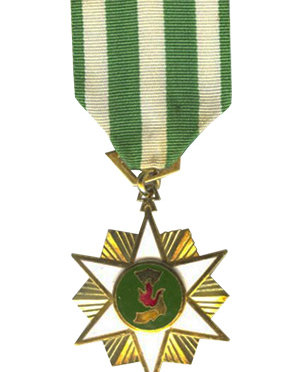
The medal is made of a gold-colored metal in the shape of a 36 mm wide six-pointed white enameled star with six-pointed gold rays between the arms of the star. During the Vietnam War, the Republic of Vietnam Campaign Medal with Device (1960–) was manufactured in the United States.

In the obverse, in the center of the star is an 18 mm green colored disc bearing a gold-colored map of Vietnam with three painted flames in red between North and South Vietnam, signifying the three regions of Vietnam. On the reverse of the medal is a circle bearing the inscription Chiến Dịch (Campaign) above and Bội Tinh (Medal) below the word VIET-NAM in the center.

The suspension ribbon and service ribbon of the medal is stripes in green (to represent freedom) with three vertical white (to represent purity).

Find This Medal Online

Right Now on eBay 
Clicking a link to eBay may result in a referral commission being paid if a purchase is made.
Loading...