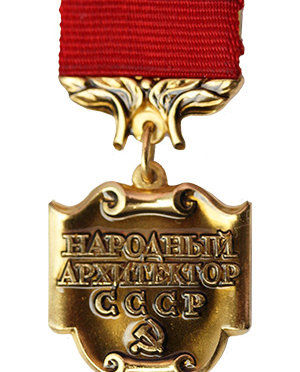
The People’s Architect of the USSR Medal

The People’s Architect of the USSR Medal was established in 1967 and awarded for stunning results in urban planning or building design.

The People’s Architect of the USSR Medal (or Медаль Народный архитектор СССР, Narodnyj architektor SSSR in Russian) was established on 12 August 1967 by Leonid Brezhnev and awarded for stunning results either in urban planning or in the design of important buildings.

The honorary title was granted to architects of the Soviet Union and bestowed by the Presidium of the Supreme Soviet of the USSR owing proposals addressed by the State Construction Committee or by the Soviet Architects’ Union. The Supreme Soviet had the ability to refuse these designations.

A diploma was given to those who were appointed jointly with the medal and its concerning certificate. The title was bestowed to architects who had achieved stunning results in Soviet architecture’s development either applying their expertise and creativity to urban planning or to the design of important building compounds for civil, industrial, or rural use.

Following the Dissolution of the Soviet Union in 1990, the title of Meritorious Architect of the Russian Federation was created by a decree of the Russian presidency.

The People’s Architect of the USSR Medal Design

The medal was made of tombac and its shape was quadrangular with twisted corners. It measures 22.5 by 23.5 mm.

The central part is occupied by the inscription “Народный архитектор СССР” and, below, the hammer and sickle symbol. Both the symbol and inscription are embossed, with convex letters.

The medal is suspended to a single red silk fringe measuring 18 mm by 21 mm with an attached metallic buckle decorated with bay laurel leaves.

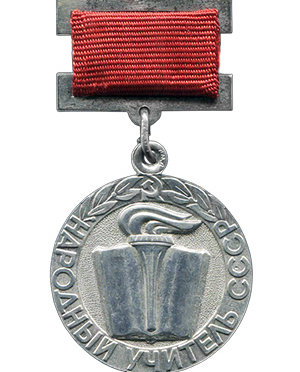
The People’s Teacher of the USSR Medal

The People’s Teacher of the USSR Medal was awarded for worthwhile contributions to the national education system and in teaching communism.

The People’s Teacher of the USSR Medal (or Народный учитель СССР, Narodnyj učitel’ SSSR in Russian) was established on 30 December 1977 and awarded for worthwhile contributions to the national education system and, mainly, in teaching communism to children and young people.

The title was conferred to teachers of Soviet secondary or vocational schools and also to civil servants employed by educational institutions, for worthwhile contributions to the national education system and mainly in teaching communism to children and young people. It was bestowed owing proposals addressed by the USSR Education Department or by the National Education Committee; together with the medal, a diploma of the Supreme Soviet’s presidency was given to the awarded people.

Following the Dissolution of the Soviet Union (1990) the title was modified in National Teacher of the Russian Federation.

The People’s Teacher of the USSR Medal Design

The medal is circular in shape and measures 30 mm in diameter.

The central part of the front side is occupied by an open book and a torch encircled by the inscription “Народный учитель СССР” (People’s Teacher of the USSR) and, above, two bay laurel branches and the hammer and sickle symbol. On the obverse is the inscription Народный учитель СССР — гордость советского общества (National Teacher of the USSR – Pride of sovietic society). Symbols and inscriptions are embossed, with convex letters.

The medal was suspended to a single red silk fringe measuring 18 mm by  21 mm and attached to the suit by a needle.

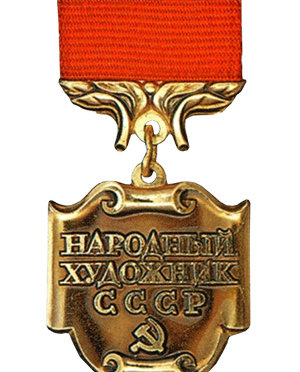
The People’s Painter of the USSR Medal

The People’s Painter of the USSR Medal was established on 16 July 1943 and awarded for exceptional achievements in visual arts.

The People’s Painter of the USSR Medal (or Медаль Народный художникin CCCP, Narodnyj chudožnik SSSR in Russian) was established on 16 July 1943 and awarded for exceptional achievements in visual arts as painting, sculpture, drawing, and photography.

The People’s Painter of the USSR Medal Design

The medal is made of tombac and its shape was quadrangular with twisted corners. It measures 22.5 by 23.5 mm.

The central part is occupied by the inscription “Медаль Народный художник СССР” and, below, the hammer and sickle symbol. Both the symbol and inscription are embossed, with convex letters.

The medal is suspended to a single red silk fringe measuring 18 mm by 21 mm with an attached metallic buckle decorated with bay laurel leaves.

The People’s Artist of the USSR Medal

The People’s Artist of the USSR Medal was an honorary title granted to artists of the Soviet Union for exceptional achievements in arts.

The People’s Artist of the USSR Medal (or Наро́дный арти́ст СССРNarodný artist SSSR in Russian) was an honorary title granted to artists of the Soviet Union. The title was introduced in 1936, replacing the earlier title of “People’s Artist of the Republic“.

The title was bestowed for exceptional achievements in the performing arts. Its recipients included many of the most acclaimed composers, dancers, singers, film and theatre directors, and actors of every Soviet republic.

Each Soviet Republic and the Autonomous Republics had a similar award held previously by virtually every receiver of the higher title of People’s Artist of the USSR.

Honorees were afforded certain privileges and would often receive commissions from the Minister of Culture of the Soviet Union. Accordingly, artists and authors who expressed criticism of the Communist Party were seldom granted such recognition, if not outright censored.

The first recipients of the title (6 September 1936) were Konstantin StanislavskiVladimir Nemirovich-DanchenkoIvan MoskvinAntonina NezhdanovaBoris ShchukinKulyash Baiseitova, and some other actors. In all, there were 1006 recipients of the award.

The People’s Artist of the USSR Medal Design

The medal was made of tombac and its shape was quadrangular with twisted corners. It measures 22.5 by 23.5 mm.

The central part is occupied by the inscription “Наро́дный арти́ст СССР” and, below, the hammer and sickle symbol. Both the symbol and inscription are embossed, with convex letters.

The medal is suspended to a single red silk fringe measuring 18 mm by 21 mm with an attached metallic buckle decorated with bay laurel leaves.
The People’s Doctor of the USSR Medal

The People’s Doctor of the USSR Medal was established in 1977 and awarded for worthwhile contributions to public health improvement. 

The People’s Doctor of the USSR Medal (or Медаль Народный врач СССР, Narodnyj vrač SSSR in Russian) was established on 25 October 1977 by Leonid Brezhnev and awarded for worthwhile contributions to public health improvement. The title was officialized on the n°44/1977 issue of Supreme Soviet’s official journal. Its regulation was later modified and completed by the Supreme Soviet’s decree of 22 August 1988.

The honorary title was conferred by the Supreme Soviet’s presidency on behalf of the Ministry of Health. A diploma of the Supreme Soviet’s presidency was given to those who were appointed People’s Doctor jointly with the medal and its concerning certificate. The title could be bestowed to individual medical doctors and nurses but also to health care structures as general hospitals, sanatoriums, maternity wards, or preventive medicine centers. The awarded people or structures were selected for their worthwhile contributions to public health improvement, for their peculiar skills and expertise, and for having proved abnegation and high moral qualities in their duties fulfillment.

Following the Dissolution of the Soviet Union in 1991, the title was replaced by that of Meritorious Doctor of the Russian Federation.

The People’s Doctor of the USSR Medal Design

The medal was made of tombac and its shape was quadrangular. It measures 22.5 by 23.5 mm.

The central part is occupied by the inscription “Медаль Народный врач СССР” on three lines and below, on the left, the Bowl of Hygieia medical symbol and, on the right, a bay laurel branch. Symbols and inscriptions were embossed, with convex letters.

The medal is suspended to a single red silk fringe measuring 18 mm by 21 mm with an attached metallic buckle decorated with the hammer and sickle symbol.

The USSR Marshal’s Star

The Marshal’s Star (or маршальская звезда in Russian) is a badge of rank worn by marshals of the armed forces of the Soviet Union.

The Marshal’s Star (or маршальская звезда in Russian) is a badge of rank worn by marshals of the armed forces of the Soviet Union (and then the Russian Federation). Officially their names have changed, depending on what ranks received the right to wear them, and are known as the large marshal’s star and the small marshal’s star.

Marshal’s stars were first awarded to the marshals and admirals of the fleet of the Soviet Union. In time, smaller stars were awarded to “marshals of an arm of service” and “chief marshals of an arm of service”, admirals of the fleet, and later generals of the army of the Soviet armed forces.

On the death of the recipient, the award is returned to the diamond fund for re-use. Approximately 200 of this type of marshal’s star were produced.

The USSR Marshal’s Star Design

The medal is a gold five-pointed star with smooth diagonal rays on the front side. In the center is a platinum, five-pointed star with diamonds. The diameter of the gold star is 44.5 millimeters (1.75 in) and the platinum stars are 23 millimeters (0.91 in) in diameter. The star has a depth of 8 millimeters (0.31 in).

The marshal’s star has a triangular eyelet in the upper beam which is connected to an oval eyelet measuring 14 millimeters (0.55 in). The diamonds in the center have a total weight of 2.62 carats and in the rays, there are 25 diamonds weighing a total of 1.25 carats. Between the edges of rays are 5 diamonds weighing a total of 3.06 carats. 

A Marshal of the Soviet Union’s star used a red satin ribbon suspension; ribbons for marshals of a branch varied accordingly: gold for artillery, light blue for aviation, burgundy for armored troops, crimson for engineers, blue for signals, and turquoise for the navy.

The armed forces of the former Soviet Union and the Russian Federation wear two insignia around neck when in parade uniform. There are two different sizes of stars. In 2013, new shoulder insignias were instituted for generals of the army, fleet admirals, and generals of the army. These insignias have one large marshal’s star on the board similar to the style worn by Soviet generals from the early 1970s through 1997.

The Queen’s Gallantry Medal

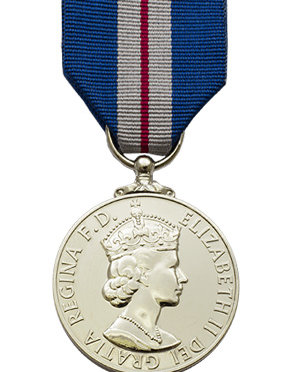
The Queen’s Gallantry Medal (QGM) is a UK decoration awarded for exemplary acts of bravery by civilians, and by members of the Armed Forces.

The Queen’s Gallantry Medal (or QGM) is a United Kingdom decoration awarded for exemplary acts of bravery by civilians, and by members of the Armed Forces “not in the face of the enemy”, where the services were not so outstanding as to merit the George Cross or the George Medal.

The medal was instituted on 20 June 1974 to replace the Order of the British Empire for Gallantry and the British Empire Medal for Gallantry. The QGM ended the anomaly where the Order of the British Empire for Gallantry was awarded for lesser acts of bravery than the George Medal but took precedence over it in the Order of Wear.

The QGM has been awarded posthumously since 30 November 1977.

The Queen’s Gallantry Medal Design

The medal is circular, struck in silver, and measures 36 millimeters in diameter.

The obverse shows the crowned effigy of the Queen, with the inscription “ELIZABETH II DEI GRATIA REGINA F.D.”. The reverse bears the image of a St Edward’s Crown above the words ‘The Queen’s Gallantry Medal’ in four lines, flanked by laurel sprigs.

The ribbon measures 32 mm wide and consists of three equal stripes of dark blue, pearl grey, and dark blue with a narrow rose pink stripe in the center. While awards to women generally have the ribbon fashioned into a bow, female recipients in the armed forces or civilian uniformed services have the medal presented with the ribbon in the same style as for male recipients.

The name of the recipient is impressed on the rim of the medal. If awarded to members of the Armed Forces, service number, rank, and unit are also included.

The Military Medal (MM)

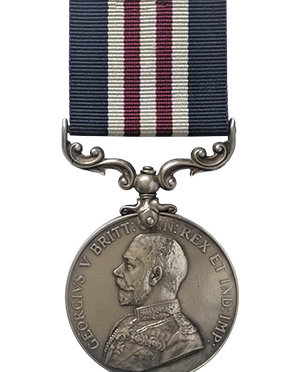
The Military Medal (or MM) was a military decoration established in 1916 and awarded for bravery in battle to personnel of the British Army.

The Military Medal (or MM) was a military decoration established in 1916 and awarded for bravery in battle on land. The award is given to personnel of the British Army and other arms of the armed forces, and to personnel of other Commonwealth countries, below commissioned rank.

The award had retrospective application to 1914, and was awarded to other ranks for “acts of gallantry and devotion to duty under fire“. It was discontinued in 1993 when it was replaced by the Military Cross, which was extended to all ranks, while other Commonwealth nations instituted their own award systems in the post-war period.

When the medal was first introduced, it was unpopular among regular soldiers wrote MM and DCM recipient Frank Richards who stated “the Military Medal, which without a shadow of a doubt had been introduced to save awarding too many DCMs. The old regular soldiers thought very little of the new decoration“.

Since 1918 recipients of the Military Medal have been entitled to the post-nominal letters “MM”.

The Military Medal Design Design

The medal is circular, struck in silver and measures 1.4 inches (36 mm) in diameter.

The obverse bears the effigy of the reigning monarch and an appropriate inscription. The reverse shows the inscription “FOR BRAVERY IN THE FIELD” in four lines, surrounded by a laurel wreath, and surmounted by the Royal Cypher and Imperial Crown.

The ribbon is dark blue, 1.25 inches wide with five equal center stripes of white, red, white, red, and white, each 0.125 inches wide. The suspender is of an ornate scroll type and the name and service details of the recipient were impressed on the rim of the medal, although honorary awards to foreign recipients were issued unnamed. Silver, laurelled bars were authorized for subsequent awards, with a silver rosette worn on the ribbon bar to indicate the award of each bar.

The Distinguished Service Cross (UK)

The Distinguished Service Cross (DSC) is a military decoration awarded to officers for acts of gallantry during active operations at sea.

  • Time Period: Pre-WW1
  • Year of Institution: 15 June 1901 (as Conspicuous Service Cross, renamed 1914)
  • Country: Great Britain

The Distinguished Service Cross (or DSC) is a third level military decoration awarded to officers in recognition of an act or acts of exemplary gallantry during active operations against the enemy at sea. Ranks included officers of the British Armed Forces, Royal Fleet Auxiliary and British Merchant Navy, and formerly also of other Commonwealth countries.

The award was created in 1901 as the Conspicuous Service Cross and awarded to warrant and subordinate officers, including midshipmen, ineligible for the Distinguished Service Order. In October 1914, the award was renamed the Distinguished Service Cross and eligibility was extended to all naval officers (commissioned and warrant) below the rank of lieutenant commander. In August 1916, bars were introduced to reward further acts of gallantry meriting the Cross.

In December 1939 eligibility was extended to Naval Officers of the rank of Commander and Lieutenant-Commander, in April 1940 to equivalent ranks in the Royal Air Force serving with the Fleet, and in November 1942 to those in the Army aboard defensively equipped merchant ships.

Recipients are entitled to the post-nominal “DSC”. Since 1979, the Distinguished Service Cross can be awarded posthumously.

The Distinguished Service Cross Design

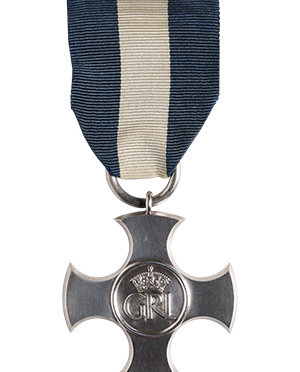
The medal is a plain silver cross with rounded ends with a width of 43 millimeters (1.7 in).

The obverse has a circular center containing the Royal Cypher of the reigning monarch at the time of award surmounted by a crown. The reverse is plain apart from the hallmark, and the ribbon is attached via a hall-marked silver ring. From 1940, the year of issue was engraved on the lower limb of the cross, and since 1984 it has been awarded named to the recipient.

The ribbon has three equal stripes of dark blue, white, and dark blue. The ribbon bar denoties a further award is plain silver, with convex ends and a central crown.

The Australian Operational Service Medal

The Australian Operational Service Medal is a campaign medal established on 22 May 2012 to recognize service by Australian Defence Force (ADF) personnel on designated hazardous operations.

The Australian Operational Service Medal is a campaign medal established on 22 May 2012 to recognize service by Australian Defence Force (ADF) personnel on designated hazardous operations. It replaces the Australian Active Service Medal and Australian Service Medal for future ADF operations.

The medal is issued to military personnel with a different ribbon for each designated operation. When issued to civilians, a standard ribbon is issued with clasps issued for each designated operation. It may also be awarded to civilians who serve alongside the ADF on designated operations under specific conditions.

The military version of the medal has a standard medal design, but ribbons vary depending on operation. An accumulated service device will be awarded for subsequent qualifying service by ADF members where they undertake further service on an operation for which they have already been awarded the Australian Operational Service Medal. The civilian version uses the same medal design as the military version but is awarded with a unique civilian ribbon and a clasp denoting the declared operation.

To date, three ribbons for ADF service have been announced: order Protection, Greater Middle East Operation, and Special Operations.

> Learn more at the Australian Government Site

The Australian Operational Service Medal Design

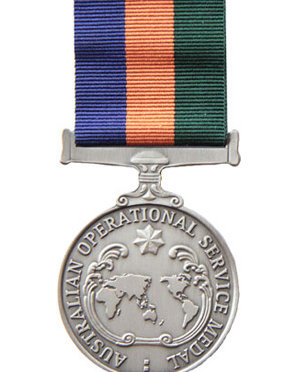
The medal is circular, struck in cupro-nickel, and finished in antique silver.

The obverse bears an old-world stylized world globe signifying global operations, interlinked with a Federation Star. The globe is surrounded by the words ‘AUSTRALIAN OPERATIONAL SERVICE MEDAL’.

The reverse bears a central horizontal stylized scroll with the words ‘Defending Australia and its national interests’, overlaying a wreath of mimosa, above which sits an hourglass motif signifying the ongoing vigilance and timely response of Defence.

The Border Protection ribbon has three equal stripes of dark blue, ochre, and dark green which denote the seas and sky, the deserts, and the forests and grasslands. The Greater Middle East Operation ribbon has three equal stripes of mid-green, black, and light blue, edged by two slim stripes of light sand. Sand represents the desert sands, green represents Australia and hope, black represents anti-piracy, and blue represents the maritime and air aspects. The Special Operations ribbon is 32 mm wide in black with a central stripe of red. Additional accumulated service is denoted by an 8 mm high Arabic numeral with an antique silver finish. The Civilian ribbon is green with central stripes of gold and purple. The purple represents Defence, and green and gold are Australia’s national colors.