The Austrian First World War Commemorative Medal

  • Time Period: WW1
  • Institution: 21 December 1932
  • Country: Austria

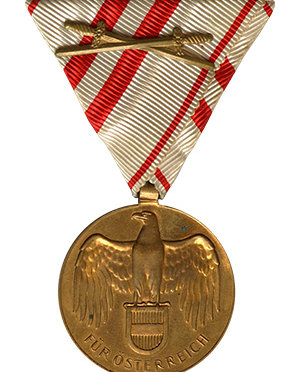
The Austrian First World War Commemorative Medal (or Kreigserinnerungsmedaille in German) was awarded to those Austrians who served in the armed forces of the Austro-Hungarian Empire during the First World War 1914-1918.

The medal was officially gazetted by the Austrian government on 21 December 1932.

In November 1933 the government effectively created two classes for the award by announcing that all front line troops, and any other service personnel who had been wounded in action or taken prisoner, would be entitled to have a crossed swords device added to their medals to distinguish them from other recipients. The crossed swords device (in gilt) was attached to the ribbon.

The Austrian First World War Commemorative Medal Design

The medal was designed by Edwin Grienauer (1893-1964), a prominent Austrian sculptor and medalist that would later teach at the Vienna Arts Academy, who was himself a veteran of the First World War.

The obverse depicts an eagle standing on a shield displaying the medieval arms of the Duchy of Austria (which formed part of the new coat of arms of the post-war Republic of Austria) and below this is the inscription ‘FÜR ÖSTERREICH‘ (“For Austria“).

The reverse displays the dates ‘1914-1918’ and beneath them, the name of the artist, ‘GRIENAUER‘, surrounded by an oak wreath border.

The ribbon is red and white, with the stripes diagonally palced.
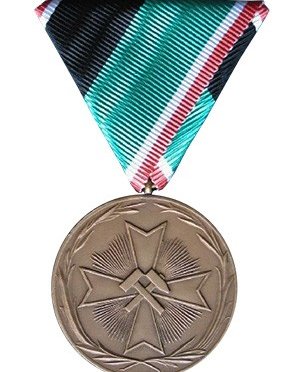
The Mine Rescue Decoration (Austria)

The Mine Rescue Decoration (or Grubenwehrehrenzeichen in German) is a state award of the Republic of Austria, established on February 24, 1954 by the National Council and presented by the Federal Ministry of Trade and Reconstruction (currently known as the Ministry of Digital and Economic Affairs) to both members and non-members of the mine rescue services.

The decoration can be awarded for the following reasons:

  • to members of a mine rescue service who made a special contribution to a rescue operation resulting in loss of their life.
  • to members of a mine rescue service who have provided satisfactory service for a period of at least 15 years.
  • to former members of a mine rescue service who were unable to complete 15 years of satisfactory service due to work-related illness or injury.
  • to any individual who, while under supervision of the mountain authorities, rescues or assists in rescuing an individual at the cost or, or at great risk to, their own life.
  • to any individual who has made a special contribution to the mine rescue services.

The Mine Rescue Decoration Design

The medal is struck in bronze, circular and measures 40 mm. The obverse shows a Maltese cross with outgoing rays, framed by a laurel wreath, and superimposed by a crossed hammer and pick (the traditional symbol of miners). The reverse bears the Austrian Coat of Arms, with the inscription “Für Verdienste im Grubenrettungsdienst” (“For merits in mine rescue service“).

The ribbon is made up of two thick stripes of black and green, bordered by thin stripes of white and red. On the full-sized medal, the ribbon is arranged as an Austrian trifold, while on the miniature medals, it is arranged as a drape.

In addition to the full-sized medal, awardees also receive a certificate, a miniature medal, a ribbon bar, a lapel pin, and a rosette.

The Military Merit Decoration (Austria)

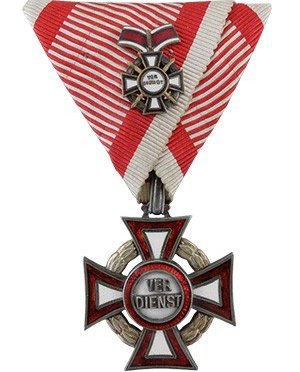
The Austrian Military Merit Decoration (or Militärverdienstzeichen in German) is an Austrian military decoration established on 13 November 1989 to honor the Military of Austria.

The decorations are awarded by the Federal President at the request of the Federal Minister of Defense and after a decision by the Ministerial Council. Ordinance of the Federal Ministry of Defense of November 13, 1989, Federal Law Gazette 551.

Holders of the Military Merit Decoration wear the badge on the left side of the chest.

The Decoration for Services to the Liberation of Austria Design

The badge is a silver-gilt breast star that is worn on the left chest, measuring 30.88 mm (w) x 31.40 mm (h) and weighing 14.3 grams. The cross is 60 mm wide and high and in white enamel, with a red border. Between the arms of the cross are gold crossed swords.

The obverse shows a central white enameled medallion with the Austrian eagle and the inscription “Verdienst” (“Merit” in German). The reverse is decorated with white enamels and has no inscription.

The suspension is a loop from which the ribbon (and sometimes a miniature decoration) is attached. The ribbon is white and red with diagonal lines.

The Decoration for Services to the Liberation of Austria

The Decoration for Services to the Liberation of Austria (or Ehrenzeichen für Verdienste um die Befreiung Österreichs in german) is an Austrian decoration created by federal law on 27 January 1976.

The award is a special distinction for men and women who actively resisted the Nazi regime contributing to Austria’s liberation from Nazi rule.

The President of Austria confers this honour when sent a proposal by the Federal Chancellor based on a report from the Committee on the Austrian Liberation Decoration of Honour.

The Decoration for Services to the Liberation of Austria Design

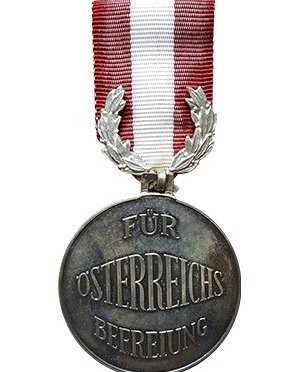
The medal is circular, silver-plated, and has a diameter of 42 mm.

The obverse reads the inscription “FOR AUSTRIA’S LIBERATION“. The text raised and doesn’t have a constant height, but is presented in a convex form. The reverse bears the federal eagle, also centrally positioned.

The suspension is a couple of silver crossed laurel branches. The ribbon is 27 mm wide and split red-white-red. The rosette has a diameter of 10 mm, is colored red-white-red and decorated with two silver-colored, crossed laurel branches. Instead of the rosette, a bar (stitch-like stitching) is provided for women.

The Austrian Decoration for Science and Art

The Austrian Decoration for Science and Art (or Österreichisches Ehrenzeichen für Wissenschaft und Kunst in German) is a state decoration of the Republic of Austria established in 1955 and part of its national honors system.

The award was established by the National Council as an honour for scientific or artistic achievements by Federal Law of May 1955. At the same time, the National Council also established the “Austrian Cross of Honour for Science and Art”, which is awarded as “Cross of Honour, First Class” (German: Ehrenkreuz 1. Klasse) and “Cross of Honour” (German: Ehrenkreuz). While not technically counted as lower classes of the Decoration for Science and Art, these crosses are nevertheless affiliated with it.

Divisions:

  • Decoration for Science and Art. Limited to a maximum of 72 at any one time (36 recipients for science and 36 for arts). In each of these two groups, there are 18 Austrian citizens and 18 foreign nationals.
  • Cross of Honour for Science and Art, First Class. There are no limits on the number of recipients.
  • Cross of Honour for Science and Art. There are no limits on the number of recipients.

Forfeiture of this honor became possible with Federal Law Gazette I No 128/2001. It allows the government to strip recipients of their honors if deemed unworthy. The best-known example of such a forfeiture is of the Nazi physician Heinrich Gross.

The Austrian Decoration for Science and Art Design

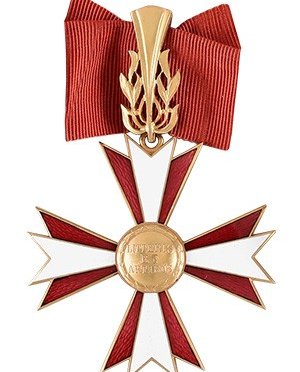
The award consists of a neck badge constructed of gilded bronze with multi-colored enamels, suspended on a loop. It measures 58.09 mm (w) x 59.33 mm (h) and weighs 31.1 grams.

The breast badge is constructed of gilded bronze with multi-colored enamels, consisting of a Maltese Cross.

Its obverse has red enameled arms, in turn, overlaid by a narrow Maltese Cross with white enameled arms, with a central gilt medallion bearing a raised inscription of “LITTERIS ET ARTIBUS” (“LETTERS AND ARTS”), inside f a laurel wreath. The reverse has a central raised medallion bearing the maker’s mark.

The ribbon is red.

The Decoration of Honor for Services to the Republic of Austria

The Decoration of Honour for Services to the Republic of Austria (or Ehrenzeichen für Verdienste um die Republik Österreich in German) is a national honor established by the National Council in 1952 and awarded by the Republic of Austria.

The decoration is conferred by the Republic of Austria to honor people (from Austria and abroad) who have rendered meritorious services to the country.

Recipients are selected by the government and made by the President, who automatically receives the Grand Star of the Decoration for Services to the Republic of Austria by being elected to the office and holds this honor for life.

The decoration is awarded in 15 grades and is Austria’s highest national honor. The grades are:

  1. AUT Honour for Services to the Republic of Austria - 1st Class BAR.png Grand Star 
  2. AUT Honour for Services to the Republic of Austria - 2nd Class BAR.png Grand Decoration of Honour in Gold with Sash 
  3. AUT Honour for Services to the Republic of Austria - 3rd Class BAR.png Grand Decoration of Honour in Silver with Sash 
  4. AUT Honour for Services to the Republic of Austria - 4th Class BAR.png Grand Decoration of Honour in Gold with Star
  5. AUT Honour for Services to the Republic of Austria - 5th Class BAR.png Grand Decoration of Honour in Silver with Star
  6. AUT Honour for Services to the Republic of Austria - 6th Class BAR.png Grand Decoration of Honour in Gold 
  7. AUT Honour for Services to the Republic of Austria - 7th Class BAR.png Grand Decoration of Honour in Silver 
  8. AUT Honour for Services to the Republic of Austria - 8th Class BAR.png Grand Decoration of Honour 
  9. AUT Honour for Services to the Republic of Austria - 9th Class BAR.png Decoration of Honour in Gold 
  10. AUT Honour for Services to the Republic of Austria - 10th Class BAR.png Decoration of Honour in Silver 
  11. AUT Honour for Services to the Republic of Austria - 11th Class BAR.png Decoration of Merit in Gold 
  12. AUT Honour for Services to the Republic of Austria - 12th Class BAR.png Decoration of Merit in Silver
  13. AUT Honour for Services to the Republic of Austria - Gold Medal BAR.png AUT Honour for Services to the Republic of Austria - Life Saving Medal BAR.png Gold Medal 
  14. AUT Honour for Services to the Republic of Austria - Silver Medal BAR.png Silver Medal
  15. AUT Honour for Services to the Republic of Austria - Bronze Medal BAR.png Bronze Medal (no longer awarded)

The Decoration of Honor for Services to the Republic of Austria Design

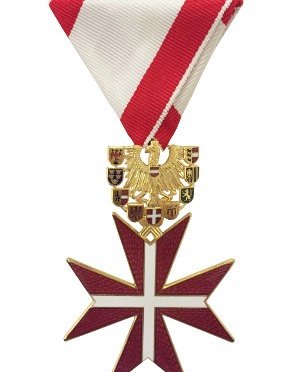
The badge of the Decoration is a Maltese Cross constructed of silvered bronze with multi-colored enamels. It measures 50.02 mm (w) x 50.25 (h).

The obverse has red and white enameled arms, and the reverse is plain. The six o’clock arm has an integral loop connecting to a suspension apparatus in the form of a silvered Republic-style Austrian national eagle surrounded by an enameled shield of the Austrian states, in turn with a suspension ring connecting to a period original neck ribbon.

The ribbon is red and white.

The Imperial Order of Elizabeth (Austria)

The Imperial Austrian Order of Elizabeth was an order created for women in 1898 by Francis Joseph, Emperor of Austria and King of Hungary.

The Imperial Austrian Order of Elizabeth (or Kaiserlich österreichischer Elizabeth-Orden in German) was an order created for women in 1898 by Francis Joseph, Emperor of Austria and King of Hungary.

The order was the namesake of Saint Elisabeth of Hungary, but it was created to honor and memorialize Franz Joseph’s late wife, Empress-Queen Elisabeth. She spent her life giving alms to the poor and sick. After her husband’s death, she gave away the vast majority of his estate to build hospitals and to aid in the relief of her starving subjects and was canonized by Pope Gregory IX in 1235. She is considered the patron saint of bakers, beggars, and charities.

The insignia of the order was to be returned to the state upon the death of the member, or upon the advancement from a lower degree to a higher degree.

The order was divided into three classes:

  • Grand Cross.
  • First Class.
  • Second class.

There were 81 awards of the Grand Cross, 332 awards of the I Degree, 500 awards of the II Degree, and 208 awards of the Elizabeth Medal for merit, between 1898 and 1918 when the Order was disbanded with the collapse of the monarchy.

An Elizabeth Medal for civil merit also existed.

The Order only existed until the end of the monarchy in 1918.

The Order of Elizabeth Design

The order’s badge is a silver Latin cross consisting of red and white enamels, with roses between the arms of the cross. The obverse bears a central white enameled medallion with a rightward facing bust of Elisabeth in gold. The reverse has a central white enameled medallion with a golden royal cipher of Elisabeth and fine hand-engraved detailing.

The ribbon is white and pink and measures 48.57 mm side by 52.40 mm high.

The Imperial Order of Elizabeth and Theresa

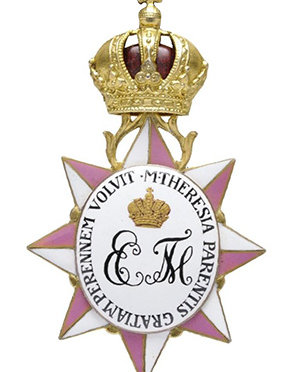
The Imperial and Royal Decoration of Elizabeth and Theresa was a decoration of the Austro-Hungarian Empire, created in Vienna in 1750.

The Imperial and Royal Decoration of Elizabeth and Theresa (or Elisabeth-Theresien-Orden in German) was a decoration of the Austro-Hungarian Empire, created in Vienna in 1750 by Elisabeth Christine of Brunswick-Wolfenbüttel, widow of Charles VI, Holy Roman Emperor, in her testament, to reward the deserving officers who distinguished in battles.

The number of awarded officers reached hardly 20 originally. Those had to serve faithfully in the army of the House of Austria for 30 years and have reached at least the rank of colonel, and had to be inscribed in the Court Council of War, but without distinction of fatherland, birth, or religion. The Order only has one rank: Knight.

The Order was granted with 16,000 florins of annuity to be divided among the recipients. There were originally three grades of annuity: 1000, 800, and 500 florins.

The Imperial and Royal Decoration of Elizabeth and Theresa was revised in 1771 by her daughter Empress Maria Theresa I, as the Elizabetho-Theresian Military Foundation (Elisabeth-Theresianische Militärstiftung). The yearly pension amount was reviewed and the number of maximum members was settled in 21.

The Order was canceled by the Austrian Republic in 1918.

The Order of Elizabeth and Theresa Design

The decoration consists of a star of gold with eight triangles enameled in half-red, half-silver and supported by the imperial crown. It’s charged with an oval shield in the heart with the initials of the two empresses (“ECMT” for Elizabeth Christine Maria Theresa), all topped by a crown, surrounded by the legend: “MARIA THERESIA PARENTIS GRATIAM perennem VOLUIT”.

The ribbon of the Order is black. The decoration was hanging from a triangular knot of that black ribbon on the left chest.

The Order of the Starry Cross

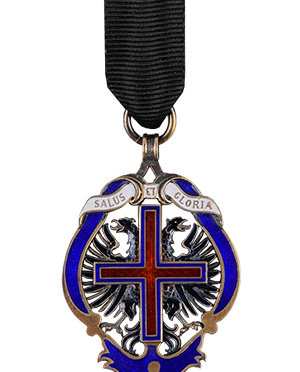
The Order of the Starry Cross (Sternkreuz-Orden) is an imperial Austrian dynastic order founded in 1668 and awarded to Catholic noble ladies.

The Order of the Starry Cross (or Sternkreuz-Orden in German) is an imperial Austrian dynastic order founded in 1668 and awarded to Catholic noble ladies. Only high-born ladies could be invested with the Order, including princesses, countesses, and other high nobility. Once invested, members were to “devote themselves to the service and worship of the Holy Cross, and to lead a virtuous life in the exercise of religion and works of charity.”

The Order was founded in 1668 by Eleonora Gonzaga of Mantua, dowager empress of the Holy Roman Empire and confirmed by Pope Clement IX on 28 June 1668, who placed it under the spiritual management of the Prince-Bishop of Vienna.

According to legend, the Habsburg dynasty owned a piece of the True Cross on which Jesus was crucified. In the aftermath of a fire at the Hofburg on 2 February 1668 the relic was discovered in near-perfect condition. The dowager empress founded the Order in celebration that the relic had survived the fire, believing it to be a true miracle.

The order still exists under the House of Habsburg, though the Austrian Empire no longer exists. It was conceived with only one class.

The Order of the Starry Cross Design

Members of the Order wore en insignia consisting of an oval medallion, with a broad blue enameled border, inclosing a black enameled Eagle with two heads and claws. On it lies a Gold Cross, enameled green, and bordered with brown wood. Over this, on an entwined wreath in black letters, on a white ground, is the motto of the Order, “Salue et Gloria” (“Hail and Glory“).

The insignia was worn, pendent to a strip of black band, on the left breast.

The Order of Franz Joseph

The Imperial Austrian Order of Franz Joseph was founded by Emperor Franz Joseph I on the 1st anniversary of his accession to the throne.

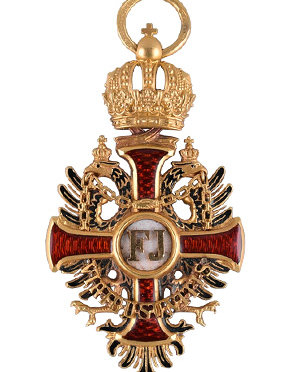
The Imperial Austrian Order of Franz Joseph (or Kaiserlich-Österreichischer Franz-Joseph-Orden in German) was an Order founded by Emperor Franz Joseph I of Austria on December 2, 1849, on the first anniversary of his accession to the imperial throne.

The order was originally awarded in three classes: Grand Cross, Commander’s Cross, and Knight’s Cross. In 1869, the class of Commander with Star was added, which ranked immediately below the Grand Cross. On February 1, 1901, the Officer’s Cross, which ranked between Commander and Knight, was introduced.

The order ceased to exist as a governmental award with the dissolution of the Austro-Hungarian Empire in 1918 and was not re-established with the foundation of the Republic of Austria. However, it remains active as a dynastic order of the House of Habsburg.

The Order of Franz Joseph Design

Knights wore the decoration suspended from a triangular ribbon on the left breast. Officers wore it on the left breast without a ribbon. Commanders wore the decoration at the neck, as did Commander with Star, who also wore a breast star. The Grand Cross was worn suspended from the shoulder and also came with a breast star. The ribbon of all classes of the order was plain red.

In common with the other Austro-Hungarian awards of the period, the Franz Joseph Order was further distinguished with the addition of the War decoration and Swords which could be awarded for military merit. However, if soldiers were honored, it was usually for distinguished service as opposed to gallantry in the face of the enemy.