The 1914-1917 African Campaigns Commemorative Medal

The Commemorative Medal of the African Campaigns 1914–1917 (Médaille Commémorative des Campagnes d’Afrique 1914–1917 / Herinneringsmedaille van de Afrikaanse Veldtochten 1914–1917) is a Belgian military war service medal established on 21 February 1917 by Royal Decree to recognize combat service on the African continent between 1914 and 1918.

The medal was awarded in silver to Belgian military personnel and in bronze to indigenous personnel who participated in the campaigns in Cameroun, Rhodesia, German East Africa, and on the Eastern borders of the Belgian Congo (and in Tanganyika) between 1914 and 1918.

The medal was produced in two different variants:

  • Type 1 (bearing the years 1914–1916 on the reverse), and
  • Type 2 (bearing the years 1914–1917).

The 1914-1917 African Campaigns Commemorative Medal Design

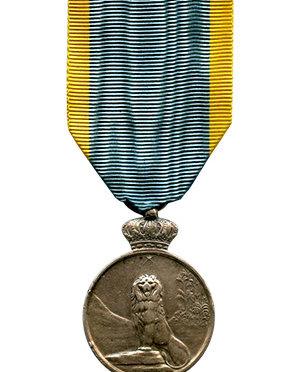
The medal measures 31mm in diameter and is circular and struck in silver for Belgians or bronze for Africans. The award is surmounted by a 14mm wide by 12mm high royal crown and has raised edges on both the obverse and reverse.

The obverse bears the relief image of a lion, its front legs on a rocky outcropping, on the left side of the lion, the base of a mountain, on the right, tropical flora. Above it, there’s a small relief five-pointed star. On the reverse there’s the relief of a five-pointed star bisecting the years “1914*1916” (for the type 1 medal), or “1914*1917” (for the type 2). Three relief laurel branches, two horizontal and one vertical are partially hidden by the names of the localities where engagements were fought inscribed on nine lines, in all capital letters: Kamerun, Ouesso Assobam, Mulundu Jaunde, Afrique Orientale Allemande, Kigali, Nyansa Udjiji, Usumbura Biaramulo, Kitega St Michael and Tabora.

The ribbon is light blue 38mm wide silk moiré with 5mm wide yellow edge stripes, suspended by a ring through a suspension loop.

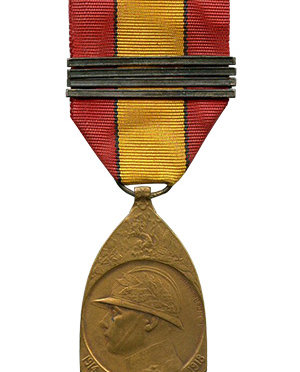
The 1914-1918 Commemorative War Medal

The Commemorative Medal of the 1914–1918 War (Médaille Commémorative de la Guerre 1914-1918 / Oorlogsherinnerinsmedaille 1914-1918) is a Belgian commemorative war medal established on 21 July 1919 by royal decree and awarded to all members of the Belgian Armed Forces who served during the First World War who were eligible for the Inter-Allied Victory Medal.

The 1914-1918 Commemorative War Medal Design

The medal was struck from bronze, and measures 47 mm high by 31 mm wide. It’s triangular shaped and has rounded sides.

Its obverse bears a relief of a helmeted soldier in profile, within a 29 mm in diameter circular recess, and with the helmet adorned with laurels. There are also relief dates “1914” and “1918”. In the upper point of the triangle, above the circular recess, there’s an image of a lion rampant with an oak branch to its left and a laurel branch to its right.

The reverse bears the relief image of a crown surrounded by the same branches as the lion on the obverse, and below the crown, a semi-circular inscription in French on two rows over the large relief dates “1914 – 1918”, “MEDAILLE COMMEMORATIVE / DE LA CAMPAGNE“, the inscription repeated in Dutch below the dates “HERDENKINGSMEDAILLE / VAN DEN VELDTOCHT” (translated to COMMEMORATIVE MEDAL OF THE 1914 – 1918 CAMPAIGN).

The medal is suspended by a ring through the suspension loop to a 39 mm wide red silk moiré ribbon with an 11 mm wide central yellow stripe bordered by 1 mm wide black stripes.

The Maritime Decoration 1914-1918

The Maritime Decoration 1914-1918 was established on 19 November 1918. This medal was awarded in five classes to recognize distinguished services at sea, including merchant seamen and fishermen:

  • Cross First Class,
  • Cross Second Class,
  • Gold Medal,
  • Silver Medal,
  • Bronze Medal.

The Maritime Decoration 1914-1918 Design

The medal’s ribbon is pale green with two red-edged yellow stripes each with a black central stripe, bearing crossed anchors in a metal appropriate to the class.

The Volunteer Combatant’s Medal 1914-1918

The Volunteer Combatant’s Medal 1914–1918 (Médaille du Combattant Volontaire 1914–18 / Medaille van de Vrijwillige Strijder 1914–1918) is a Belgian wartime service medal established on 17 June 1930 by royal decree and awarded to Belgian citizens and foreign nationals who voluntarily enlisted for service in the Belgian Armed Forces during World War I.

The award was given for voluntary enlistment and service in a combat unit in a danger zone for not less than 6 months during the First World War. Later, the eligibility criteria was extended to include volunteers, older than 40 years of age who had served for 3 months in a combat unit in a danger zone, who were older than 50 years of age who had served for 1 month in a combat unit in a danger zone, and medical personnel who had served for 2 years in non-occupied Belgium.

Additional provisions were made regarding awards to youngsters who had fled occupied Belgium and persons who were wounded in action, and posthumous awards.

The Volunteer Combatant’s Medal 1914-1918 Design

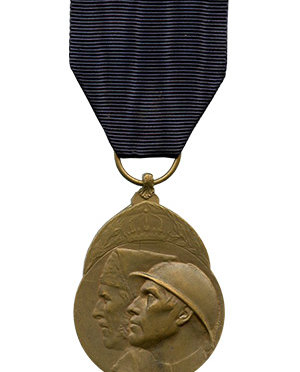
The medal measures 36 mm in diameter and is made of bronze and circular. It’s topped with a crescent-shaped section giving it a nearly oval shape of a height of 50 mm.

On its obverse is the relief image of the head of a helmeted First World War Belgian soldier facing left, to his left and partially hidden behind him, the relief image of the head of an 1830 volunteer also facing left and wearing a bonnet typically worn by the revolutionaries. The crescent section bears the relief image of the Belgian crown over laurel branches.

On the reverse, along the outer circumference, the Latin inscription “VOLUNTARIIS PATRIA MEMOR“, in the center, the years “1914–1918“.

The medal was suspended by a ring through the suspension loop to a silk moiré royal blue ribbon.

The Fire Cross 1914-1918

The Fire Cross 1914-1918 (Croix du Feu 1914–1918 / Vuurkruis 1914–1918) was a Belgian military decoration established by royal decree on 6 February 1934 and awarded to all holders of the so-called “Fire Card” which was given to all who came under fire at the front during the First World War.

The Fire Cross could not be awarded posthumously.

The Fire Cross 1914-1918 Design

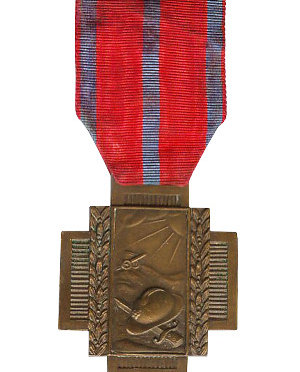
The medal is a 44 mm wide by 54 mm high bronze cross quadrate. Except for a 3 mm wide plain border, the cross arms were striated, horizontally for the lateral arms and vertically for the vertical arms on both the obverse and reverse.

The central rectangle bore on its obverse, 5mm wide vertical laurel branches on either side, at the center, the relief image of a deserted battlefield with at the forefront, the relief image of a World War 1 Belgian helmet over a bayonet, farther and on a slight elevation at left, a 75 mm howitzer, at upper right, the Sun breaking through clouds.

On its reverse, a large laurel branch extending diagonally from bottom left to top right and bisected by the relief inscription on two lines in Latin “SALUS PATRIAE SUPREMA LEX“, translated to “THE NATION’S SALVATION IS OUR HIGHEST DUTY“. In the top left corner, a royal crown from which seven relief rays extend downwards, at bottom right, the relief years on two rows “1914” and “1918”, at the bottom left just below the laurel branch’s stem, the name of the designer of the award, “A. Rombaut”.

The ribbon measures 36mm wide and is red silk moiré, with three 4 mm wide longitudinal blue stripes, one at the centre, the other two on either side 1 mm from the ribbon’s edges.

The Yser Cross

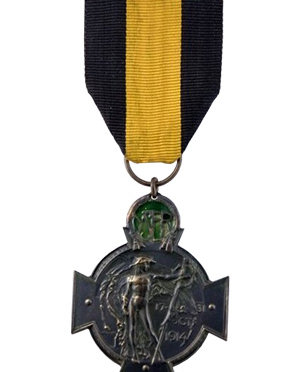
The Yser Cross (Croix de l’Yser / Kruis van de IJzer) replaced the Yser Medal in 1934. The Yser Medal and the Yser Cross could not be worn together, it was one or the other.

The Yser Cross was issued as a replacement to the earlier Yser Medal upon application and payment of a fee, consequently, relatively few were issued as few veterans wanted to trade in their medal, and even fewer wanted to pay the fee.

The Yser Cross Design

The cross was of similar design to the Yser Medal, displaying the same obverse and reverse except that it was in the form of a cross pattée.

Although issued with the same black and red ribbon as the Yser medal, many Flemish recipients opted for an unofficial black and yellow ribbon identifying them as Dutch-speaking Belgians.

The Yser Medal

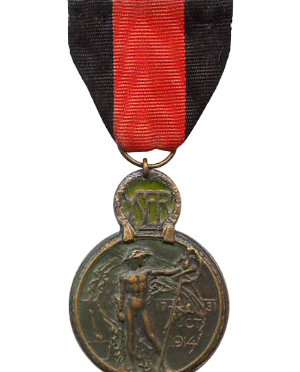
The Yser Medal is a Belgian campaign medal established in 1918 to denote distinguished service during the 1914 Battle of the Yser.

The Yser Medal (Médaille de l’Yser / Medaille van de IJzer) is a Belgian campaign medal established on 18 October 1918 to denote distinguished service during the 1914 Battle of the Yser (between 17 and 31 October 1914) in which the Belgian Army stopped the German advance of the German invasion of Belgium.

The medal could also be awarded to foreign nationals and members of allied military forces who took part in the battle, and could be given posthumously.

It was worn on the left side of the chest and when in the presence of other awards of Belgium, directly after the Belgian War Cross.

The Yser Medal Design

The medal measures 35 mm in diameter and is circular and struck from bronze. It’s surmounted by a smaller diameter green enameled medallion.

The obverse bears a nude, helmeted man holding a lance, which references the halting of the advance of the German forces. To his right, a relief inscription on three lines reads “17-31 OCT 1914” and “YSER“. The reverse bears the image of a roaring wounded lion lying on the bank of the Yser river, with an arrow in its left shoulder. Below the lion, a relief inscription reads “YSER“, and shows the Belgian royal crown over the relief letter “A”, the monogram of King Albert.

The ribbon is red silk moiré with wide black edge stripes. The red denoting the spilled blood, the black denoting the mourning.

The War Cross (Belgium)

[vc_row][vc_column width=”1/4″][vc_single_image image=”6490″ img_size=”full”][/vc_column][vc_column width=”3/4″][vc_column_text]

The War Cross (Belgium)

[/vc_column_text][vc_column_text]

Institution: 25 October 1915
Country: Belgium

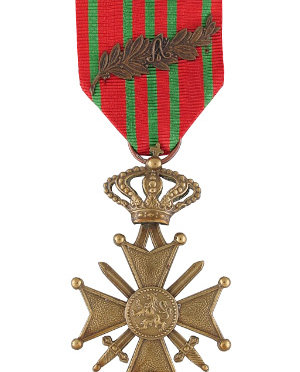
[/vc_column_text][vc_separator css=”.vc_custom_1526473075957{padding-top: 16px !important;padding-bottom: 16px !important;}”][vc_column_text]The War Cross (Croix de guerre / Oorlogskruis) is a military decoration of the Kingdom of Belgium established on 25 October 1915 by royal decree and primarily awarded for bravery or other military virtue on the battlefield, or for three years or more of service on the front line, or good conduct on the battlefield. It was only awarded to individuals.

The award was reestablished on 20 July 1940 by the Belgian government in exile for recognition of bravery and military virtue during World War II. The decoration was again reestablished by royal decree on 3 April 1954 for award during future conflicts.

The War Cross was also awarded to volunteers after a minimum of 18 months of service, to escaped prisoners of war rejoining the armed forces, and to military personnel who were placed on inactive duty because of injury.[/vc_column_text][vc_column_text css=”.vc_custom_1590656067244{padding-top: 24px !important;}”]

The War Cross (1915) Design

WW1

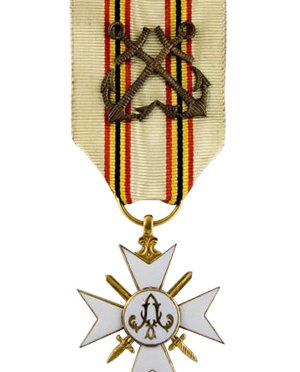
The War Cross from WW1 is a 40mm wide and 65mm high bronze Maltese cross with 3mm balls at its eight points.

On its obverse, it has a 14mm central medallion bearing the relief image of a lion rampant. On its reverse is the royal cypher of King Albert I. Two 37mm long crossed swords point upwards between its arms. A 14mm high “inverted V” between the two points of the top cross arm is secured to the inside of a high royal crown, and the ribbon’s suspension ring passes through the top orb of the crown.

The ribbon of the WW1 War Cross is red and measures 38 mm (1.5 in) wide, with five 2 mm (0.079 in) wide light green longitudinal stripes, three at the center separated by 3 mm (0.12 in) and one on each side 3 mm from the edges.

When the person being awarded was mentioned in despatches, the distinction was denoted by a device worn on the ribbon, either a small lion or a palm adorned with the monogram “A”.

WW2

The WW2 War Cross shows slight changes to the reverse of the central medallion (the royal cypher was that of King Leopold III) and the ribbon. Because the award was now also authorized as a unit award, those presented to a unit were denoted by a ribbon of the war cross being affixed to the unit colors.

The new ribbon was still red with light green stripes but there were now six, 1mm wide, and positioned three on each side 2mm apart beginning 2mm from the edge of the ribbon.[/vc_column_text][vc_raw_html css=”.vc_custom_1590656126997{padding-top: 40px !important;}”]JTNDaW5zJTIwY2xhc3MlM0QlMjJlcG4tcGxhY2VtZW50JTIyJTIwZGF0YS1jb25maWctaWQlM0QlMjI1ZWNmN2M3OGM2NWQ2MDQ3MmIxYTYzY2MlMjIlM0UlM0MlMkZpbnMlM0U=[/vc_raw_html][/vc_column][/vc_row][vc_row][vc_column][vc_column_text css=”.vc_custom_1590504426327{padding-bottom: 24px !important;}”]

Explore More Belgian Medals – See All >

[/vc_column_text][vc_basic_grid post_type=”post” max_items=”18″ style=”pagination” items_per_page=”6″ element_width=”2″ gap=”20″ arrows_design=”vc_arrow-icon-arrow_06_left” arrows_position=”outside” paging_design=”none” item=”masonryGrid_Default” grid_id=”vc_gid:1590655230493-00ce8aa7-b6aa-3″ taxonomies=”127″ el_class=”relatedMedals”][/vc_column][/vc_row][vc_row][vc_column][vc_column_text css=”.vc_custom_1590656143680{padding-bottom: 24px !important;}”]

Explore More Medals from WW1 – See All >

[/vc_column_text][vc_basic_grid post_type=”post” max_items=”18″ style=”pagination” items_per_page=”6″ element_width=”2″ gap=”20″ orderby=”rand” arrows_design=”vc_arrow-icon-arrow_06_left” arrows_position=”outside” paging_design=”none” item=”masonryGrid_Default” grid_id=”vc_gid:1590655230496-c0ab4813-3062-9″ taxonomies=”4″ el_class=”relatedMedals”][/vc_column][/vc_row][vc_row][vc_column][vc_column_text css=”.vc_custom_1590656240664{padding-bottom: 24px !important;}”]

Explore More Medals from WW2 – See All >

[/vc_column_text][vc_basic_grid post_type=”post” max_items=”18″ style=”pagination” items_per_page=”6″ element_width=”2″ gap=”20″ orderby=”rand” arrows_design=”vc_arrow-icon-arrow_06_left” arrows_position=”outside” paging_design=”none” item=”masonryGrid_Default” grid_id=”vc_gid:1590656226877-e32a1611-d274-6″ taxonomies=”8″ el_class=”relatedMedals”][/vc_column][/vc_row]

The 1870-71 Commemorative Medal

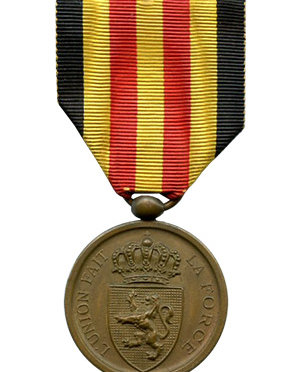
The 1870–71 Commemorative Medal (Médaille Commémorative 1870–71 / Herinneringsmedaille 1870–71) is a Belgian campaign medal established on 20 September 1911 by royal decree and awarded to all members of the Belgian Army who were mobilized during the Franco-Prussian War (15 July 1870 to 5 March 1871).

The Franco-Prussian War was a conflict between the Second French Empire and the German states of the North German Confederation led by the Kingdom of Prussia. The conflict lasted from 19 July 1870 to 28 January 1871, and was caused by Prussian ambitions to expand German unification and French fears of the shift in the European balance of power that would result if the Prussians succeeded. 

The 1870-71 Commemorative Medal Design

The award is a 32mm in diameter circular bronze medal with raised edges on both sides.

The obverse bears the escutcheon of the Coat of arms of Belgium under a royal crown. To the left and right, along the circumference of the medal, the relief inscription “L’UNION FAIT LA FORCE” (“Strength through unity”). The reverse bears a stylized relief capital letter A, the monogram of King Albert I of Belgium and the years 1870–71 also in relief.

The medal is suspended by a ring through the suspension loop from a 35mm wide silk moiré ribbon divided into seven equal 5mm wide longitudinal stripes, black, light green, red, light green, red, light green and black.

The 1830 Volunteers’ Commemorative Cross

The 1830 Volunteers’ Commemorative Cross (Croix Commémorative des Volontaires de 1830 / Herinneringskruis voor de Vrijwilligers van 1830) is a Belgian campaign medal established in 1878 by royal decree  and awarded to all members of the Belgian Army and popular militias who served during the 1830-1831 Belgian Revolution (and who had not been awarded the Iron Cross).

In 1833 and following the end of the Belgian Revolution, the Iron Cross was created to recognize wounds received and bravery in battle. Other combatants of 1830-1831 received no pension, and no commemorative medal was struck, which caused growing discontent in veterans’ circles, who eventually formed the “Federation of Volunteer Combatants of 1830“. It would take over forty years until, in 1878, King Leopold II signed the decree creating the 1830 Volunteers’ Commemorative Cross.

The 1830 Volunteers’ Commemorative Cross Design

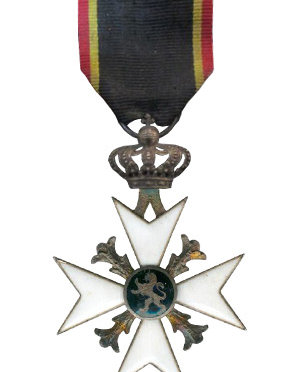
The award is a white enameled Maltese Cross with a gilt Burgundy Cross between its arms and a black enameled central medallion. The two arms converge upwards to a pivot-mounted royal crown. The black enameled central medallion bears, on the obverse, the Belgian lion, a heraldic lion rampant. The reverse bears the year “1830“.

The cross is suspended by a ring through a lateral hole in the royal crown’s orb from a silk moiré ribbon in the national colors of Belgium (a black 2mm width central stripe, and red edge stripes bordered by 2mm yellow stripes on the inside).